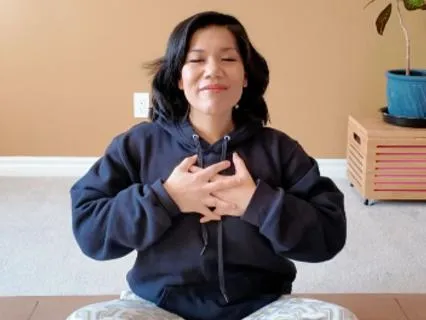
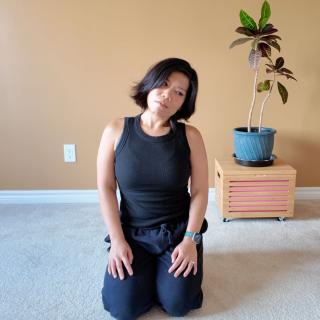
So place your left hand on the back of your skull where it meets your neck.
That's exactly where the vagus nerve begins.
It's the 10th cranial nerve and the only cranial nerve that literally wanders out of the skull.
Vagus actually means wanderer in Latin.
And now using your hands we're going to gently trace that ventral vagal pathway.
So here you're placing one hand on the back of your skull and with the other hand tracing down the back of your throat.
From the brainstem here it travels down through your neck alongside your blood vessels and touching structures that keep you alive.
And imagine the vocal cords inside there.
And then place that hand over your heart and you can take a breath while you're there.
And now spread your fingers visualizing how the vagus nerve branches into the lungs helping to regulate your breathing and your heart rate.
Now take your hand off your neck and place it on your face toward your ears and the muscles of your face and around your eyes.
The ventral vagal pathway includes your social engagement system.
This is the face heart connection.
So our facial expressions,
How we are listening,
The tone of our voice are involved in how we search for and send cues of safety.
If I have a relaxed face,
If I'm speaking with a calm up and down tone,
If my mouth and eyes are smiling,
I convey to your nervous system that you're safe with me.
And if I see that safety cue in you,
I can feel safe and connected too.
And now for the dorsal vagal pathway.
The vagus nerve also has a protective side.
And so instead of a superhero cape,
Imagine a portable turtle shell that pops up on your back whenever the world feels too overwhelming.
So go ahead,
Crawl into a ball shape and pretend you're going inside a turtle shell.
And if you place your hands on your abdomen,
Imagine its connection to the stomach,
Small and large intestines,
Pancreas,
Liver,
Gallbladder,
And spleen.
The dorsal vagal pathway lives below the diaphragm and it cares mostly about digestion.
And yes,
In an emergency,
It energy by collapsing and shutting us down.
It can even numb us from pain.
So think of the vagus nervous having two personalities,
The ventral vagus,
Which is calm and connected,
Safe and social.
And then the dorsal vagus,
Mostly focused on rest and digestion.
And in a state of protection,
It helps us to shut down and collapse.
It helps us survive when life feels like it's too much.
The ventral vagal pathway brings us into engagement and connection.
And the dorsal vagal pathway pulls us out of that when withdrawing is the safest option.
Both are protective.
One helps us reach toward life.
The other helps us withdraw.