Hello from Swansea Bay in Wales and welcome wherever you're joining me from.
It's always a pleasure to be teaching you this wonderful practice we call Yin Yoga.
Today's class is called Yin Yoga and Mindfulness of the Body and what we're going to be doing is really pay attention to the physical sensations of our practice.
There are two parts to this theme.
First,
By listening to our bodies we can make an informed decision in a physical sense about whether we need to adapt the pose or not.
So for example,
If we move into the basic shape of a pose,
Then find we aren't really feeling much,
Or it's too intense,
Or something is actually feeling more like pain than stimulation in the target area,
Then we can take an informed decision and adapt the pose.
Move the arm to a different position,
Bend the knee,
Sit up on something etc.
So this is the first part.
Secondly,
By noticing what's happening in our bodies we can train ourselves to notice what's happening in the mind.
The body is always the first indicator of what's going on in the mind,
So cultivating this skill can help us understand the connection between the two better.
So for example,
If you have a strong emotion come up,
Let's say sadness or excitement,
Then if you pay attention,
You can feel it in a particular part of the body as well.
Butterflies in the tummy,
Or perhaps your heart beating fast,
Something physical that's an indicator that there's something happening in your head.
This can then help us make an informed decision about what to do next,
Both in your yoga practice,
But also in your mind.
So we're going to go straight into the first pose.
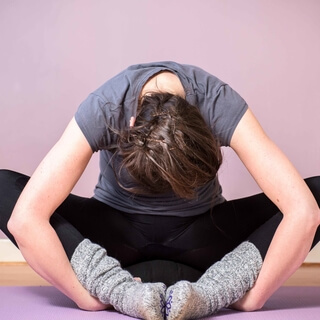
We're going to start with butterfly,
Always a nice pose to start with.
So find your suci position,
Maybe cross legged,
And then bring the soles of the feet together.
Now fold forward.
This is the basic pose,
The basic shape.
So if you're feeling a mild to moderate stretch on the inside thighs,
And a bit of a stretch on the back,
And you're not feeling any pain anywhere,
Then this is fine.
Where you are is fine.
If you want less stretch,
Or you're feeling something's hurting you,
The knees being the biggest one,
Then you might want to try moving the feet away.
Or if you want more stretch,
Perhaps bringing the feet closer to you.
Do remember this is yin,
And we want it to be passive.
So make sure to soften,
To relax the muscles.
You might perhaps also want to sit up on something,
Especially if your hips have a tendency,
Like mine,
To fall backwards.
Now drop the head if that's comfortable.
Allow the body to relax.
And we're going to stay here for around three minutes.
Bring your attention to those target areas,
The inside thighs,
And the back.
And hopefully you're feeling a stretch in at least one of those places.
Allow the muscles to relax.
Notice if you're tensing,
Or clenching.
And just see how you're coming to this practice.
How you're feeling,
How you're arriving.
And if you find it useful to focus on the breath,
Bring your intention to the inhale,
And the exhale.
And what I'd encourage you to do today,
Is to notice where you're feeling the breath in the body.
This is a really good way of bringing your attention to the body,
And the connection between the body and the breath.
So noticing where you feel the rise and the fall of the breath.
Maybe the belly,
Maybe the chest,
Perhaps the shoulders,
The back.
It could be anywhere.
Notice where it is for the belly,
For the chest licking.
Just another 10 seconds or so now.
And then,
I want you to slowly,
Slowly,
Slowly come back up to the centre,
Bring the knees in gently,
And then just sit on the floor with the knees bent.
And the feet can be quite wide,
Hands on the floor or on the knees,
Wherever is comfortable.
And we'll just have a rebound for about a minute,
Closing your eyes,
And noticing how the legs feel after that stretch.
Just how the back feels.
Flash back to the ground.
Now put the hands on the floor behind you.
Push into the hands and lift the hips up gently.
You might want to just come up a little bit or you might want to bring the hips further up.
You choose.
You might want to drop the head back.
Perhaps move the hips from side to side a bit.
Just as a bit of yang activity is a counter pose.
So using a little more muscular effort.
Not too much.
And then let go,
Bring the hips back down.
Let's do it again.
Push into the hands,
Opening up the chest.
Moving the hips up just a little or as far up as you want.
Dropping the head back if you like.
Then moving the hips from side to side.
Then slowly coming back down.
Let's do it one more time.
Press into the hands.
Lift the hips up.
Move the head back.
Move the hips.
Feeling organic.
And then gently coming back down onto the floor again.
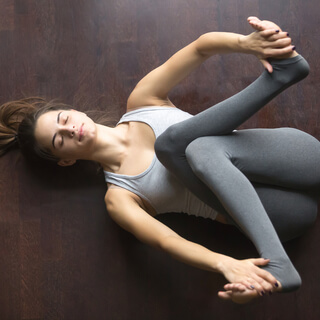
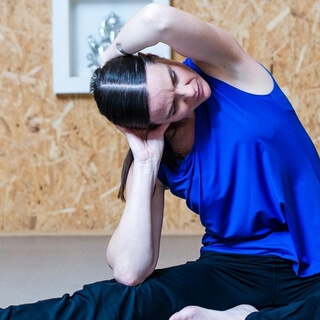
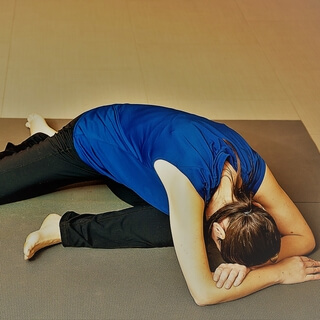
And then we're going to move directly into the next pose which is sometimes called diya and sometimes called collapsed swan.
So what we're going to do is cross our legs.
Leave the right leg where it is.
Approximately at right angle.
And then swing the left foot to the outside of the left hip.
So what we're going to do now is fold forward so our target area is the glutes of the right leg.
So by the glutes I mean the side leg.
Right at the top.
The side of the bum.
Hopefully your knees are okay here.
And if they aren't I'd suggest moving the feet around.
This front leg doesn't have to be at a right angle for example.
So by all means bring the foot closer towards the groin or further away for instance.
And then also this back leg.
You can move it around.
You can move the foot around.
And if you aren't really feeling the glute stretch here,
What I would suggest is to move the position of the torso.
So try moving a bit to the right.
A bit to the left.
And remember we want a sensation on a scale of 0 to 10 between around 3 and 5.
That we can stay in for just under 2 and a half minutes now.
And we can be relaxed.
But the body is stimulated.
So this is another element of listening to the body.
Trying to find the stretch here.
Finding what works for you.
And deciding if this is too much.
If this is not enough.
Finding that balance between making and effort.
And not.
What we are doing in yin yoga is trying to help the efficiency of the body.
Help the body to work better and to stay healthy.
And we've got around a minute left here.
So just soften.
Relax.
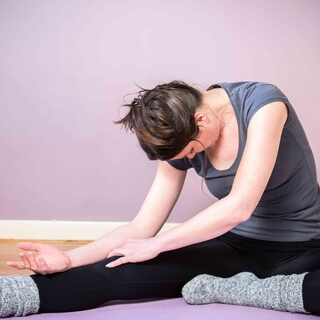
You you Let's roll back up now Push yourself back up to the center And we're going to go directly into the next pose So you can leave that back leg where it is shift it slightly if you need to of course And we'll put the right leg out straight and then fold over it Now you may feel like me that you actually don't fold so far perhaps because of the shape of your hips It doesn't matter if you don't fold forward much if you're feeling that stretch But if you're not Or actually if you'd like a stretch on the inside thigh Then put the leg out to the side Try them both And see which one feels right to you today A stretch on the back A stretch on the side And again Move the back leg if you need to It wants to be comfortable here Remember You can again Move the torso To increase Or decrease the stretch To the right To the left And see how that affects the sensations in the front leg And as always If you find it difficult to fold forward and that's affecting the pose Then you can always sit up on something You often have this option in many in yoga practice You often have this option in many in yoga practice Ask your body Is anything too much here?
Have I got enough stimulation in the place that I want it?
Is anything hurting me?
Is everything okay?
And then resolve to stay still For the next minute and a half And if you want to experiment and do something You can do it And then you can do it And then you can do it And then you can do it And then you can do it And if you want to experiment a bit Really noticing what you are doing The physical sensations Then you might want to move the torso Very,
Very slightly Very,
Very small movements To one side And notice how the stretch in the leg changes Even by moving a couple of centimetres And then go the opposite way Very,
Very small movements Very,
Very small movements And notice how the stretch in the leg changes Even by moving a couple of centimetres And then go the opposite way Really tiny movements How does that change?
How does that feel?
How does that feel?
How does that feel?
It's always good to experiment with the poses It's always good to experiment with the poses We resolve to stay still of course in yin We resolve to stay still of course in yin But it's relative And you're really paying attention Bear that in mind for everything we're doing today Bear that in mind for everything we're doing today Bear that in mind for everything we're doing today Okay Okay So now come up to the centre So now come up to the centre Straighten out the legs Straighten out the legs And then let's go down onto our backs Before we go to the other side Before we go to the other side Lie down Notice how the legs feel Notice how the legs feel How the back feels How the back feels Everybody looks too You get your exercises Now we go to our back We just have to do the back We only have the back That's what core means So now we're going right We're going right We're going down Should we SirSH Not above learned Veryais Okay you now Bend your knees Bring them into the torso And you can rock from side to side Or make circles with the knees Whatever works for you Remembering if you're making circles to go one way Then the other Then make your way back up to sitting again And whatever way you want to And we're going to go to the other side So this time Cross the legs Keep the left leg where it is And then swing the right foot to the outside of the right hip somewhere around there Grab something to sit on if you feel that you want to do that And keep the front leg approximately a right angle to start with if that's okay on the knee And then fold forward See how that feels Can you feel it in the glutes of the front leg?
Is it enough?
Is it too much?
And if you answer yes to any of those questions Then play again with the torso Moving it to different positions to the left to the right And play with the legs as well Moving them forwards More towards you More or less bend in the knee And then when you find your position Resolve to stay still And we'll stay here for three minutes Closing your eyes Focusing on the sensations in the leg And paying attention to your breath Either doing what I suggested at the start which is noticing the breath Which is noticing where in the body you feel the breath But also noticing the quality of your breath If it's fast If it's laboured If it's very slow Your breath can show you whether you've gone too deep into a pose Or whether you're pushing too much in general It can also show whether you're sleepy The state of your mind If you're stressed for example The quality of the breath can tell a lot Not only in yoga but your everyday life So notice it See how it is You You You All right So let's come back up again Pushing gently back up to the centre And then moving directly into that second pose,
Half rock With the back leg staying where it is And having that front leg out straight in front of you Or out to the side Depending on where you want to feel the stretch And fold over the leg itself Or fold down the middle And if you want you can do it differently on this side Make this yoga yours Remember The back leg doesn't have to be in exactly the same position as before The back leg isn't actually that important here We just want it to be comfortable Take a deep breath in And then as you breathe out Notice the body soften Allow the outbreaths to help you deepen into the pose To soften To relax You You And for this last minute half Again If you want to experiment a little bit by making micro movements with the torso in one direction And the other Noticing how the stretch changes in the leg And the other Being mindful of the body Perhaps even twisting very slightly Small Slow movements Keeping that leg passive Keeping the target area passive And then just stay still again Now I want you to come slowly back up again And make your way into shavasana To resting pose Which you can do in whatever neutral position is comfortable for you You can lie on your back You can lie on your front You can lie on your side Or you can end in a seated position As long as you're staying neutral So make your way into whatever is comfortable And take your time moving the body,
Adjusting the body So that you're relaxed or as relaxed as you can Softening Releasing Closing your eyes Perhaps taking a deep breath in through the nose And out through the mouth And then just release And I'll be leaving you here now Our beautiful birds will be going for around 10 minutes or so to take your time Stay for as long as you like If you like this session then do follow me on Insight Timer Check out some of my sessions And you can also check my website You can join me at my live breathwork to meditation sessions which I hold every two weeks And if you enjoyed this class and you'd like to donate You are more than welcome But no pressure at all So stay Release Enjoy your Shavasana And until next time From my practice to yours Namaste You You You You You You You You You You You You You You You You You You You You You