Hello,
Great souls.
Welcome to our yoga sadhana for step one.
The spiritual principle of surrender as a pathway to grace.
Paired with satya,
Truthfulness.
So as I was reflecting on the principle and the spiritual yoga philosophy,
And just,
You know,
Kind of listening for what to share today and what might be meaningful,
What kept coming to me.
Is an experience I've had.
Around the practice of surrender and truthfulness together.
And the theme of sweet surrender.
So I remember at a certain point.
It just came to me that surrender has begun to feel more sweet to me.
And part of that sweetness is relief.
No longer fighting reality,
No longer resisting reality.
No longer struggling with reality,
But as reality presents itself this deep practice of acceptance of it is.
So I think I've said before,
But was very helpful for me in learning the practice of acceptance and surrender,
I don't have to like what it is.
But it's very helpful to really make space within myself for the reality that's happening.
And as I do that,
Even if it's not my preference,
Which is.
Soft way of saying if I don't like what it is,
But I really practice with yoga.
To try to move away from an attitude of I like this,
I don't like this.
It took me quite a while to understand the benefit of that.
It seemed like you know,
Things that I like.
Are pleasant and pleasurable.
So what's the problem with that?
Well,
What I'll say is attachment.
Attachment can create a sense of agitation when what's happening isn't what I like.
So instead of,
Oh,
I really like this or I don't like this,
Just simply a practice,
An honest practice,
A truthful practice of this is what is.
I'm just reflecting right in this moment.
What's coming to mind is traffic.
That's kind of an easy one for me to practice this with.
What I mean by easy is it's a good opportunity to test my level of acceptance on any given day.
Like,
Oh,
Suddenly there's traffic I didn't expect.
Can I take a deep breath?
And accept that reality.
And for me to.
.
.
Practice the teaching of yoga that there's some value and meaning and purpose in it.
I have no idea what it is.
At first glance,
It can seem really inconvenient.
It can seem like,
Wow,
This is now creating a hardship for my day.
Um,
But instead of that,
To say,
Well,
I don't know that it is.
That's an assumption that it's a hardship.
Even if my mind can say,
Well,
Here's all the reasons I know why it's a hardship.
But it's not necessarily a hardship.
That's what I've learned.
What I know is it's happening.
So if I can meet what's happening.
With this attitude of,
Okay.
Well,
I wasn't expecting it.
It might create some challenges.
It might not.
So there's some purpose and meaning to it beyond my understanding in this moment.
Can I meet it with an open receptivity to the truth of it?
Simply allow it,
And then with a prayerful attitude,
So surrender,
Opening to grace.
Can I call upon grace to help me navigate it?
OK,
Help me.
Come to a place of as much as possible easefulness with this.
So all of that to say.
Noticing the physical body and the posture of the body and how it relates to consciousness.
It influences our body position.
And body position influences consciousness.
This is something we learn in yoga.
The same is true with the flow of breath.
And the same is true with the flow of energy.
All of these work together.
So you can kind of enter any doorway.
You can start with physical posture.
You can start with flow of breath.
You can start with thoughts,
What thoughts am I holding?
And with those thoughts quality of consciousness.
So as we practice today,
Just want to invite you to notice Well,
Like right now,
Notice,
If something's happening.
That.
Seems really inconvenient and You don't like it.
So it's not a crisis necessarily at all,
But really like,
Wow,
You wish it was different than what it is.
How do you imagine,
Just take a moment,
Kind of bring yourself to that.
Is something simple like traffic or some other situation that could be irritating and upsetting.
What happens in your body?
Do you notice?
Is there,
I know for me,
A heaviness.
Surrender can be like All right,
If I have to do that.
So you might even do that.
What's that feel like?
A trudging,
Right?
All right,
If I have to deal with this,
I'll deal with it.
And it is surrender.
It's not a practice of as a pathway to grace.
It's getting there.
All right,
I'm dealing with it.
But when I'm practicing surrender with an attitude of opening to grace,
I stand differently.
The heart center is open Not so much like,
Oh,
I love traffic.
I wouldn't say that I do that.
I wouldn't say I do that.
But instead,
What I would say is I lift my spine.
I lift my spine,
Which opens the heart a little bit.
I bring my awareness here.
I begin to take some deep breaths in and out.
That is such a habit in a good way for me,
That often it happens very,
Very quickly.
Because I notice without doing that,
I could create for myself something additional to traffic.
Which is an attitude I have to overcome to get through it.
It just makes the whole thing harder.
So as we're practicing today,
I'm just going to be talking about how it relates,
How our body position relates to open receptivity.
And let's see how that is for you as you practice.
So let's come into Tadasana.
You can be standing or seated.
The feet ideally are touching the floor.
Your belly is relaxed as you breathe.
The crown of the head is lifted toward the sky.
And the shoulders are released down from the ears.
And the arms are relaxed at the side of the body.
And the chin is level to the floor.
The gaze of the eyes.
Whether the eyes are open or closed.
Relaxed and uplifted.
In a gentle way.
Sif looking out to a distant mountain peak.
Begin to take some deep,
Full breaths.
In and out.
And as you practice,
Tadasana.
Imagine yourself.
Open and receptive.
To divine guidance.
However it may come to you.
Even a whisper.
But maybe a circumstance,
Maybe an event.
Is a message.
From the Divine.
Mentally affirming,
I stand ready.
To obey.
Thy least command.
I stand ready.
To welcome.
Whatever is.
As an opportunity.
For further growth.
Walking with divine grace.
I have the inner strength.
To say yes.
To what is in this moment.
Deep,
Full breath.
In and out.
Okay.
So from here,
Let's move into full yogic breath flow.
Just moving the energy,
Flowing with the breath,
Movement of the body.
The hands sweep in front of the body.
We bring the arms out to the side,
Lift the heart as you look up toward the sky.
A sense of welcoming divine energy.
Divine guidance and grace.
Guiding this into the body,
The hands sweep in front of the body.
You come forward as far as is comfortable.
Releasing head and neck,
Rounding the spine if that's okay for your body.
Arms come out to the side.
Inhale,
Sweep the arms up.
Moving the prana through the body.
As you inhale up and arms come out to the side.
I'll turn to the side view here.
Exhaling,
Hands sweep in front of the body.
You flow down.
Releasing and letting go.
Surrender.
Inhale,
The energy is rising.
As a pathway to grace.
Open and welcome.
Divine support.
Gather it in.
Guided through the body.
As you exhale and surrender to what is.
Find your own rhythm.
Practicing opening,
Welcoming,
Receiving grace.
Releasing and letting go.
Any sense of inner obstacle.
To what is happening.
One more time,
Coming down,
Releasing and surrendering.
Inhale,
Lifting the energy.
The consciousness rises as you open and welcome grace.
And then the arms circle around the body.
And pause for a moment.
In Tadasana.
Standing mountain pose.
Just notice how you feel.
Can be a very subtle shift.
And energy.
Or quality of consciousness.
And if maybe you don't feel anything and that's fine too.
So from here we'll move into circle of light,
Circle of joy,
Which opens the heart center.
And Swami Kriyananda said that this practice expands our own energy field.
It strengthens our aura and magnetism.
So the hands are here at the heart center in prayer position.
We inhale,
We're breathing in and out through the nose if possible.
Elbows lift up.
Exhale,
Hands move out in front,
Opening the back of the heart center.
Inhale,
Lift and lengthen,
Stretch tall.
Exhale,
Visualize light and joy.
Surrounding you.
The hands and arms come behind the back.
If possible,
Fingers interlace and we draw the arms behind us.
Exhale,
Arms sweep.
They come around together to the front.
Hands come back to the heart.
So we'll do this a few more times.
You can follow me or go at your own pace.
Inhaling,
Elbows lift up.
Exhale,
Hands move out in front.
Inhale,
Lift and lengthen,
Stretch tall,
Opening the whole body.
Exhale,
Light and joy.
Surround you.
Hands and arms behind,
Draw the arms back,
Fingers interlaced if you can do that.
Exhale,
Arms float.
Palms together,
Hands at the heart.
One more time,
Inhaling.
And exhale.
Inhale,
Lift and lengthen,
Stretch,
Lengthen the spine.
Exhale,
Wide and joy.
Surround you.
Fingers interlace,
Draw the arms and hands back behind you.
And exhale,
Release.
Arms float.
Palms together,
Hands at the heart.
Very nice.
From here,
Side to side stretching.
So this opens up the body.
And it creates space within the body for the breath to come in.
More fully,
More freely.
Within the breath is prana,
Life force.
So we're creating space for grace.
As we practice beginning with the left arm coming up inhale lengthen exhale reach to the fingertips to the side just notice how it feels to do that we'll do this as a flow inhaling up Exhaling down.
Very nice,
Right arm comes up,
Lengthen.
Exhale,
Reach through fingertips.
Just notice how it feels.
Take care of your body,
Only go as far as is comfortable.
Inhale up,
Exhale down.
You can follow me or find your own rhythm.
Left arm comes up,
Lengthen,
Exhale as you reach.
Inhale up.
Exhale down,
Right side.
Lifting,
Lengthening.
Exhale as you reach,
Very nice.
Inhale up.
Exhale down.
This time we'll hold the stretch or you can continue as a flow if it's better for you.
So lengthen.
Exhale,
Reach the fingertips.
Stretching.
You can be looking straight ahead.
You could look down to the floor or you could rotate your head to look up to the sky.
Keep the breath flowing as you stretch.
Gently opening the body,
Creating space.
For grace.
Inhale up.
Exhale down,
We'll go to the other side.
Inhale,
Lift and lengthen.
Exhale,
Reach.
Through the fingertips.
Find the direction for.
Your eyes,
You want to be looking down straight ahead.
Are up toward the sky.
Really listening to your body.
And just noticing how it feels to stretch in this way.
Inhale up,
Nice.
Exhale down.
Very nice.
We'll come into a standing forward bend.
So stretching the back of the legs,
Extending the stretch through the spine.
And I'm gonna show you.
Using the back of the chair.
There are a few ways to do this,
But one is to have the back of the chair for support.
The other is to stand away from the chair and come down.
So let me show you very quickly what it looks like,
And then we'll practice together.
So away from the chair.
I lengthen,
Exhale first,
Neutral spine,
Hands on the thighs.
Then exhale,
Release the head and neck.
And the head and neck are relaxed.
Coming up,
Bend the knees,
Chin to chest.
And sometimes it's nice to bring the arms up and around.
If I'm using the chair,
I have my hands on the chair,
I step away.
And I bring the spine into a nice lengthened position with the hands here for support,
And then I stay there.
With relaxation,
Or you could bring your hands to your legs.
And come down.
So find what's going to work best for you.
I'll practice without the chair.
Hands on the thighs,
Lifting the crown of the head towards the sky.
Inhale,
Press on the thighs.
Exhale,
Come forward.
Nice length in the spine.
Stretching the back of the legs gently,
Looking down toward the floor.
Breathing deeply.
This is the active phase of padahastasana,
The jackknife pose.
The affirmation is nothing on earth.
Can hold me.
Just imagining any sense of obstacle,
Burden,
Difficulty.
None of that can hold you.
We are free.
My soul like a weightless balloon.
Soars through skies of inner freedom.
You can stay here.
Or exhale,
Surrender,
Release,
Drop,
And release the head and neck.
If your hands come to the floor easily,
You can take the index finger and wrap it around the large toe.
To come out of the pose,
Bend the knees,
Tuck chin to chest.
Slowly roll up.
Raise the arms above you,
Exhale around to the side.
And pause once again in Tadasana,
Standing or seated.
And just notice how you feel.
Just listen within the body,
The flow of breath,
The flow of energy.
The affirmation,
Nothing on earth can hold me.
Nothing on earth can hold me.
Very nice.
From here,
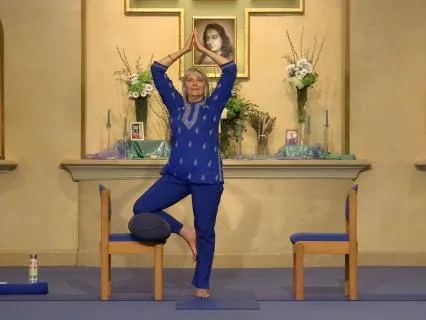
Let's practice for a kasana,
The tree pose.
So tree pose,
There's a few ways to practice.
And I'm gonna show you.
Using the seat of the chair.
And also without the chair.
So without the chair,
I'm going to be standing.
On my left leg.
And the right foot is to the side.
I can have what they call like a kickstand,
The ball of the foot is on the floor and the heel is at the base or I can raise that up to my calf or bring it up to my thigh.
Another option.
And for me,
If I'm using the chair,
Because of the length of my leg.
I need it to be quite high.
Most people don't need big.
Just the seat of the chair would be fine.
The right leg.
Let me bring that closer a little bit.
I bring,
Oh,
It's kind of fiddly today.
There we go.
So it takes me a moment.
And what I'm emphasizing here.
Is the real opening of the hips.
So this is nice,
Like it helps me bring the leg up and I've got the stability to feel balanced.
So hands are here,
So find the position for your legs.
Your feet,
You're standing on the left leg.
And the right leg is to the side.
Hands can be at the heart.
Or inhale them above you.
And the gaze of the eyes is relaxed and uplifted.
Tree pose.
Vrkasana.
Cultivates a quality.
Of inner calm.
And composure.
I am calm.
I am poised.
I am calm.
I am poised.
Breathing into these qualities.
Of calmness.
Rooted.
And a deeper reality.
Of your own divine self.
I am calm.
I am poised.
To come out of the pose if the arms are above you.
Lengthen the arms and exhale down.
Bring the legs side by side.
Move my chair a little bit now.
And notice how you feel.
So I can recognize an imbalance in my physical body.
If I were to walk off the mat,
It would feel odd.
One side of the body has been energized.
I feel more.
Prana.
On the right side of my body.
I just noticed for you.
Can you feel a sense of slight imbalance?
Increase in energy.
We'll go to the other side.
So one of the things that Swami Kriyananda talks about and Yogananda talked about.
Is that the more energy,
The more prana and life force we have active.
Available to us,
The easier it is to practice spiritual principles.
It's very difficult to practice them if my energy is low.
I don't know if you've ever noticed that.
So that's part of what we're doing in our yoga asana practice.
Not only are we creating space for energy,
But we're stimulating the flow of energy so that after practice,
I have more energy than before I started.
So that's just something to notice as you practice.
So now I'll bring.
I want to do the same here.
Thing that I did on this side that I did on the other side,
And that's part of creating balance and harmony in the body.
So now I'm going to stand on my right leg.
And my left leg will come to the side.
So take a moment to notice for yourself,
Getting stable in the base of the pose first.
Hands come to the heart.
You can keep them here.
You can go straight up or sweep them out to the side with an inhale.
Palms together.
Generally,
We keep the eyes open in this pose,
Maybe just slightly open.
Because it's a balancing asana.
When I'm utilizing a chair for support.
It's easier to close my eyes.
Now some people can close their eyes even without a chair.
You just notice what helps you stay centered in the pose.
And dive deeply into the experience.
Of tree for Kasana.
I am calm.
I am poised.
Energy rising through the body.
The fingertips pointing upward.
Guide the prana,
The life force,
To rise.
I am calm.
I am poised.
To come out of the pose.
Inhale,
Lengthen the arms.
Exhale,
Sweep them down around you.
Bring the legs side by side.
Find your Tadassana.
And just take a moment.
To go within if it's comfortable closing the eyes,
Keeping the gaze uplifted.
Is gently nudging the energy to continue to rise.
As you mentally repeat.
I am calm.
I am poised.
I am calm.
I am poised.
Very nice.
From here,
We'll practice.
The triangle pose.
Trikonasana.
And I'll show you how to practice with the chair.
Or without.
The Trikonasana is known to be one of the most vitalizing and energizing asanas.
So we take the practice of deep inwardness of Vrikasana.
This calmness,
This expansive quality of centered,
Calm awareness.
Energy is awakened in that pose.
And then we add a lot more energy and see if we can bring it into a calm container.
So we have both of this,
Both happening simultaneously.
Is dynamic calmness.
So we're going to step,
Let me bring this chair a little closer.
The feet are wide apart.
And we'll turn the left foot out.
And if you're using the chair,
You can use the back of the chair or the seat.
So I'm just checking to see,
Is it close enough?
It's a slight difference.
It's almost slightly too far for the seat.
So let me just pull it in a tiny bit.
Yeah,
Made all the difference.
So I look at my heel.
And I line it up with the instep of my right foot.
I step as wide as is comfortable.
For Trikonasana.
.
.
It's easier to go to the side if my legs are wider.
If they're too close in,
It's harder to do.
If they're close in because you just notice that it's stretching too much to be in a wide stance,
Use the top of your chair because I won't go as far,
Which is fine.
But I wouldn't want to use the seat because that's hard to do when your legs are not in a wide stance.
Bend your knee just slightly.
Bring the torso back to the front with the knees still bent.
This helps open the hips and protect the knees.
Then straighten the leg.
Inhale,
Arms up.
Palms together,
Lengthen.
Hands towards the front,
Exhale down to shoulder height.
Now tilt the hip and with your left arm,
Reach slightly above the head and bring it down to the top of the chair,
The seat of the chair.
Or the leg.
The arm is above you.
You can look straight ahead.
Down to the floor.
Or look up to the sky.
Breathing in and out through the nose,
Imagine.
You are being flooded.
With divine energy.
Swami Kriyananda said that's what's happening in this post.
The affirmation is energy and joy flood my body cells.
Joy descends to me.
Energy and joy.
Flood my body cells.
Joy descends to me.
So just imagine joyful energy.
Showering you.
Filling,
Revitalizing.
Every cell of the body.
Energy and joy.
Flood my body cells.
Joy descends to me.
Very nice,
Then we'll inhale up.
Whoops,
Bring arms out to the center.
Turn both feet forward and exhale arms down.
And then come back to Tadasana.
And take a moment,
Just notice how you feel.
Listening sensitively for any subtle shift of experience.
Very nice.
We'll go to the other side.
So stepping the feet,
The legs wide again.
This time turn the right foot out.
Looking down,
Line the heel of the right foot with the instep of the left foot.
Bend the knee.
I'm going to make sure the chair I can reach it,
So I'm going to use it.
With the knees still bent,
I bring my torso back to the front.
And straighten the leg.
Inhale,
Arms up,
Palms together,
Lengthen.
Turn the hands towards the front,
Exhale down to shoulder height.
Tilt the head and reach now with the right arm until the body just naturally pauses.
Hands go to the top of the chair,
The seat of the chair,
Or the leg.
Listen to where your body feels just right in the pose.
As you practice,
What may happen for you is the body continues to relax in the asana.
So you can start in one position and then just notice,
Oh,
The muscles are just ever so slightly relaxing.
So without forcing,
Without reaching.
Without striving.
Opening.
To the asana.
Looking straight ahead down to the floor or up to the sky.
Energy and joy flood my body cells.
Joy descends to me.
Energy and joy.
Flood my body cells.
Joy descends to me.
Visualizing a flood of joyful energy.
Welcoming this joy.
To come out of the pose,
We'll inhale up.
Arms back to shoulder height,
Turn so both feet are facing forward,
Exhale down.
Let's step back to Tadasana.
Relax the body.
Continue to lift through the crown of the head.
Shoulders relaxed down from the ears,
Belly relaxed as you breathe.
Arms relaxed at your side.
Flooded with divine energy.
Flooded with divine joy.
Mentally affirming.
Energy and joy.
Flood my body's cells.
Joy descends.
To me.
Very nice.
From here,
We'll practice.
Royal pigeon pose.
I'm going to practice using the chair.
If you're familiar with this pose,
And you prefer to practice on the floor.
You're welcome to do that.
But today,
I'm going to guide us using the chair.
I just want to bring.
This closer.
Okay.
So let's see.
Bring a prop.
To show you.
So the first thing I want to do is take my right ankle and cross it over the left thigh.
And this will help to,
Let me think about that for a second,
Because I know I'm mirroring you.
I know that didn't sound right.
Left ankle over the right thigh.
Now,
If that feels like too much to lift your leg that high,
You could put it on a pillow or a stack of pillows.
The more firm this is,
The easier it will be for you.
Sometimes if the pillows are too soft,
You'll need more.
It's fine,
And they won't be quite as stable.
But do be careful.
To find for yourself what really allows you to practice the pose without it being.
.
.
Hurtful.
Because it really opens up the hip area.
It's quite a dramatic hip opener.
So.
First,
I relax my body,
My torso.
I relax the shoulders down.
Chin is level to the floor.
And I take a moment to notice,
How does this feel?
The other thing I want to be aware of is how close to the front of my chair am I if I were to come forward?
In the pose.
Will I feel like I'm falling out of my seat?
If you think you might come forward in the pose,
I mean,
Just take a moment just to kind of check that.
Or if you're not sure,
Move back just to be absolutely safe and sure.
Okay,
So we take a moment with the spine lifted and lengthened.
Shoulders relax down from the ears.
And I'm consciously lifting the energy to the point between the eyebrows.
Yogananda called this the spiritual eye.
The seed of superconscious awareness.
It's a doorway to infinity.
And this asana helps to draw the energy.
To that super conscious.
Aware state.
As you practice the asana,
What you'll listen for is your body naturally,
The torso,
Wanting to come forward.
To increase the stretch.
If it doesn't want to,
There's no need to do that.
So you just very carefully listen.
Some people,
Whether they're on the floor or in the chair,
Will come all the way forward because the hips are just very open.
So they need to do that in order to feel any sense of being in the asana.
So you listen to what is true for you,
Truthfulness,
Satya.
The affirmation for this asana is I rise.
Above all thought.
Of past and future.
Into the eternal now.
I rise.
Above all thought.
Of past.
And future.
Into the eternal now.
The breath is flowing.
Stepping into the quality of being fully present.
To this moment.
Not where the moment will lead.
Not where I have been.
But where I am right now.
Where you are right now.
I rise above all thought of past and future.
Into the eternal now.
We'll come into a sense of deep,
Full surrender.
To this present moment.
With the consciousness lifted.
And if the spine,
The torso wants to come forward,
Allow yourself to come forward.
Adjust your seat as needed.
Release the head and neck.
To come out of the pose,
Slowly inhale and bring yourself up.
Uncross the legs.
Come into a neutral seat,
Whether you're in the chair or on the floor.
Allow the body.
To receive.
To integrate.
What we've just practiced.
Before moving to the other side.
Creating space.
For grace.
Very nice.
We'll go to the other side.
I'm going to turn my chair to the side so you can see the side view of this practice.
Sometimes that can be helpful.
So now I'm going to take my right leg.
Now I'll take the right leg Cross it over the left.
You can see that I'm seated away from the back of my chair.
I noticed when I came forward last time,
I did need to adjust my seat a little.
So I'm going to do that this time.
But still,
I stay away from the back of my seat because it allows the energy to rise more freely if I'm not making contact.
If you need to make contact,
It's fine.
But if you're able to sit a little bit of a distance away.
It will help to strengthen the muscles in your back.
So that's the other reason that I sit away from the back of the seat.
So shoulders relax down from the ears.
Chin level to the floor.
Or take a moment to notice the hip area.
So if you're on the floor or in the chair,
Take a moment to really lengthen your spine.
Very nice.
Or by lengthening the spine.
I'm nudging the energy upward.
That lifting and lengthening signals the energy to rise to this point.
And then I bring awareness here.
I'm just visualizing energy rising,
This inner doorway opening.
Helping me to rest in eternity.
I rise above all thought of past and future.
And to the eternal now.
Belly relaxed as you breathe.
And allow the body now to guide you.
You can stay exactly in this position.
Or as you practice.
Just notice if the body wants to come forward.
And if it does,
Allow that.
I rise above all thought of past and future.
And to the eternal now.
To come out of the pose,
Slowly inhale up.
Bring yourself back to neutral.
Come into a comfortable,
Stable seat.
Whether on the floor or in the chair.
Body is relaxed.
Allowing you,
Allowing the body,
The heart and the mind to integrate the asana.
Rajika Pottanasana,
Royal Pigeon Pose.
I rise above all thought of past and future.
And to the eternal now.
Very nice.
From here,
We'll practice Ustrasana,
The camel pose,
And I'll show you seated in the chair as well as kneeling on the floor.
So I just want to bring my chair back a little bit.
To create space for that.
So if I'm seated in the chair,
I like to be close to the front of the chair.
It just gives me a little bit more room.
My hands can be halfway back or all the way back to the chair,
And I'm holding the back of the chair.
Looking forward,
The chin is level to start.
And I reach my heart as if I could touch the wall in front of me.
Reaching that,
I create a nice arch in the spine.
Once I'm in position,
I just slightly lift the chin,
So the gaze of my eyes is uplifted.
If you're kneeling,
You can use the chair as well.
First I begin with my buttocks close to the seat.
I hold the legs and then walk away.
And I just take my time.
And because I've done it enough,
I kind of know where to be.
But once I kind of have a certain distance,
I will lift my heart to the sky.
And I have the chair to support me.
My hands are still up pretty close to the seat versus low.
And then I lift here.
I haven't dropped my head.
My neck is neutral.
It's the arch in my spine that allows me to look to the sky.
So finding the position of your body.
Where the arch feels just right for you.
The backward bends.
Stimulate a strong flow of energy.
Oostrasana.
Is a dynamic asana for the heart center.
Opening heart.
And welcoming divine light.
With calm faith.
I open to thy light.
Imagining yourself bathed in light.
Filled with light.
Divine Grace.
Pouring into you.
Every cell of the body.
Receiving this light.
With calm faith,
I open to thy light.
When you're ready to come out,
If you like,
You can raise one arm up to bring the torso back to neutral.
And then.
.
.
Bring your,
You can sit in the chair or if you're on the floor and you like,
You can bring your buttocks to your heels.
You could also.
Sit on a pillow.
Find a seat that feels comfortable.
And supportive for your body,
Palms turned upward on the thighs.
Closing the eyes if that's comfortable.
Guiding the awareness deep within.
See if you can sense.
A rise of energy within you.
Utilizing.
Visualization Imagining your body.
Filled with divine light.
Surrounded in divine light.
Overflowing with grace.
Pausing here in Vajrasana,
The firm pose.
Grounded and stable.
Uplifted in consciousness.
Connecting to stillness.
Inner stillness,
Inner strength.
In stillness I touch my inner strength.
In stillness,
I touch my inner strength.
Vajrasana,
The firm pose.
Very nice.
From here we'll practice Balasana.
That's a nice gentle inversion.
You can practice it in the chair or on the floor.
I'm just going to take a sip of water.
Before I demonstrate that.
The idea here is we're lengthening the spine and we're bringing the head as much as is comfortable lower than the heart.
So if you're in the chair,
You could have a chair in front of you with arms folded,
Same thing on the floor or the bolster in front.
Is a way to practice coming forward,
Arms here,
Resting forehead here.
The idea is to relax the spine and come forward so all that awakened energy will flow freely through the spine toward the spiritual eye.
In the chair,
Your hands could be on the thighs.
You could have your forearms.
So just fingers interlaced,
Head like this.
You don't have to come further than that.
So I'm going to demonstrate on the floor.
If you've already come into the pose,
That's fine.
Just stay there.
But if you're not familiar with the asana,
You can follow along with me.
I lift and lengthen my spine on the inhale.
The hands are behind me.
I exhale forward.
And I slowly lower.
My torso forward.
Until I release the forehead toward the floor.
You the affirmation.
As I relax from outer involvement.
Into my inner haven of peace.
I relax from outer involvement.
Into my inner haven of peace.
To come out of the pose,
Slowly inhale.
As you bring the torso up back to neutral.
Rest the hands turned upward on the thighs.
If it's comfortable,
Close the eyes with the gaze just slightly lifted.
Bringing awareness to the point between the eyebrows.
I relax from outer involvement.
And to my inner haven.
Of peace.
Nothing on earth.
Can hold me.
My soul like a weightless balloon.
Soars through skies of inner freedom.
I am calm.
I am poised.
I am calm.
I am poised.
Energy and joy flood my body's cells.
Joy.
Descends to me.
I rise above all thought of past and future.
Into the eternal now.
With calm face.
I open to thy light.
I relax from outer involvement.
Into my inner haven.
Of peace.
I welcome.
Divine Guidance.
And grace.
Deep,
Full breath in and out.
Very nice.
We'll come into Shavasana now.
So you can come into traditional Shavasana lying on your back.
If you want to have a blanket underneath your head for support,
You can do that.
You can also.
.
.
Bring the legs over the chair for support,
If you like that.
When I use the chair,
I like to have a blanket for support.
So I just take a folded blanket.
I have blankets at home,
But sometimes a pillow,
A fairly flat pillow can also work.
So first.
I want to show you without a chair.
And again,
If you know how to come into your Shavasana,
You can just begin to do that.
But if you're not sure,
I want to show you.
So I can have the blanket for support.
Or not.
My legs are just slightly wider than hip width.
My feet are relaxed and splayed out.
My hands relaxed and splayed out.
If I lift my heart and chest,
It just kind of helps adjust the shoulders.
My upper body to be more relaxed,
Tensing buttocks.
And release.
You could also tense the whole body with a double breath.
Throw the breath out.
And relax.
I'll show those who want to practice with legs over the chair how to do that.
I sit close to the legs.
Then I swing my legs around.
Lower myself down.
Bring the blanket in.
Arms at the side.
Relax and let go.
Finding the Position for Shavasana.
That's most relaxing for you.
Which can include remaining in the chair.
So for some.
.
.
That's the most relaxing.
Is to stay seated.
You can go right into meditation if you like.
Or place a pillow behind you and lean back.
And simply practice deep relaxation and then join.
Into meditation.
When deep relaxation is finished.
Listen to the words for this asana.
And just allow them,
Just mentally repeat them.
Allow them to wash through you.
Bones muscle movement.
I surrender now.
Anxiety,
Elation,
And depression.
Churning thoughts.
All these I give.
And to the hands of peace.
I surrender now.
Into the hands.
Of peace.
Bringing awareness now back to your breath.
Begin to visualize the breath.
Washing through the body.
Washing through the heart.
Washing through the mind.
Gently allow the breath.
To guide you back into this moment.
And stretching the body.
Moving the body in any way that feels comfortable for you.
Rolling to the right side,
Pausing for a moment.
And bring yourself into a comfortable seat.
For meditation practice now.
We'll meditate together for five minutes.
I'll chant OM when we finish.
You Let's end our sadhana together by sending out healing energy.
Divine light.
And blessing to all.
Just visualize.
That from you as a divine channel of grace.
We've been creating space for this divine grace,
And now let's consciously offer it as a blessing.
To everyone.
Rubbing the hands together,
Visualize light.
Energy and joy,
Divine grace flowing out,
Flowing through you.
Three aums.
Oh.
You Om Shanti Shanti Okay,
Great soul.
So good to be with you.
Many blessings to you.