So our topic today is attunement.
When we're looking at yoga and the 12 steps,
The third step is,
The wording of the third step is that we made a decision to turn our will and our life over to the care of God as we understood Him.
And in yoga practice and teaching,
Attunement lines up with the third step very profoundly.
And it's really something in Ananda we talk about quite a bit because Yogananda talked about it.
He was always teaching through attunement.
Swamiji said that quite often Master would not give words as much as he would tell people to go within,
To lift their consciousness and tune into his vibration,
Which is the vibration of the Divine.
So he would tell people,
Find God within yourself.
And quoted Jesus saying,
The kingdom of heaven is within you.
So this practice of the third step,
Just as a reminder,
Step one is surrender,
Right?
I'm giving up my way of doing something.
I'm willing to surrender.
I'm running the show and deciding for my life what's supposed to be happening moment to moment.
Ultimately,
That's the practice of spiritual surrender.
Is I'm getting my way out of the way so I can hear a higher,
I can hear higher guidance.
And that can be guidance of my own highest self,
Which is the reflection of God within me.
And step two is that we believe that the divine exists and it will guide us back to wholeness.
So when we move towards the principle of step three,
Attunement,
What we're practicing here is a practice of inviting grace in,
And listening to that grace in every decision that we make.
So I'm smiling because there's a term I've heard Asha use from the Catholic tradition of over scrupulosity.
I don't know if I'm getting that right.
And what it is,
Is when we become too fixated,
Right?
So we can take this practice of attunement and actually,
Rather than be super conscious in our guidance,
Have the conscious mind or subconscious mind trying to analyze what is we're supposed to be doing.
And that's not the practice of attunement.
It's much more spacious.
It's much more open.
Yogananda described the will,
Like engaging the will,
As a quality of willingness rather than willfulness.
So when we're willful,
You might think of it as the hands being fists,
Right?
I will do it.
And in the yoga practice,
We bring all that same strength,
But an open receptivity,
Because we're working in partnership with the divine.
So we're really always walking with a sense that I want to receive divine guidance,
And I want to follow that divine guidance.
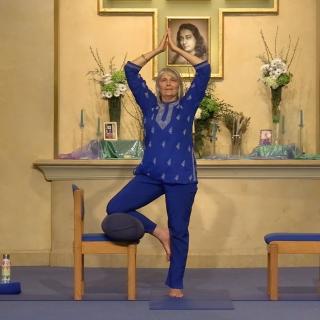
In the yoga postures,
One of the asanas is standing mountain pose.
And there's an affirmation that really speaks to this practice.
The affirmation is,
I stand ready to obey thy least command.
I stand ready to obey thy least command.
This practice and this affirmation,
You know,
The wording of it sometimes can catch you off guard.
And I was teaching the other day with Yudhisthira.
He and I lead our Ananda Bay Area School of Yoga and Meditation here.
So I have the joy of teaching with him.
And he said,
In that affirmation,
There are three words that can be difficult,
Right?
Thy,
Because that's something greater than.
Obey.
And command.
The practice of attunement is one in which those words become sweet.
So it's interesting,
You know,
Initially it can be scary to be offering up our life and our and,
You know,
Saying,
OK,
You tell me,
Divine,
You tell me,
Lord,
Whatever the wording of the divine is for you.
And then to practice so much receptivity to that,
That even if it isn't something I would want to do,
I would be willing to do it,
Right?
So that is a very deep practice.
And depending on wherever we're standing,
So if it's a new practice,
Let's just say what comes to mind at the moment for me is the alphabet.
So we're at letter A,
And we don't jump to Z.
We don't say,
Well,
If I'm just getting used to doing this,
I don't surrender in a way.
That I.
.
.
That's more than I can really honestly do.
So to be truthful with yourself and begin saying it,
Right?
So we make a decision to turn our will in our life over and we practice that decision.
We talk to others who live with that decision.
How do you do it?
I was,
As I was preparing for our talk today,
Was reminded of a beautiful student of mine.
She was asking me,
We were talking on this principle.
She'd been practicing it in her life.
And she came in so sincerely and said,
How do you do it?
Like,
Really wanted to know,
Well,
How do I do it?
So what I said to her is that,
You know,
And Swamiji talks about this with intuition.
In fact,
I'll mention a book I highly recommend of his,
Intuition for Starters.
And this is a book,
I would say,
I continue to find strength and wisdom and grace.
And I've been practicing,
Following my intuition and listening to it for many,
Many years.
So I could say I'm still a starter because it all applies to me.
But she was asking me,
You know,
Practically,
And in this book he talks about the importance of common sense with our intuition.
So common sense for me is that I make a schedule.
I'm very scheduled.
My calendar is quite full,
Even in these extraordinary times.
And I'm grateful for that.
I'm grateful for the opportunity to serve and work with others.
So I have a full schedule,
And at this time,
This was before sheltering in place,
And my life was quite busy,
And she knew that.
So that was,
I think,
Part of why she was asking me,
How do you do it?
And I said,
You know,
I have the schedule.
That's common sense.
I have a plan.
But what I do is live within that plan with a,
My practice is to live in a way that God's in charge of the plan.
So I'm very reliable.
I am,
Generally speaking,
If I say that,
If I put something in my book and I commit to doing something,
It almost always happens.
You know,
Pretty regularly in my life.
That being said,
I don't expect that it will.
And the reason I say that is because Well,
It's part of the practice.
When I live in a place of expectation,
While I've written it down so therefore it will happen,
I can be attached energetically to the plan.
That makes it very difficult when the plan starts to change.
If instead I'm committed to it energetically.
And this is something I've heard Swamiji talk about in terms of intuition and following,
To the best of our ability,
The guidance that we receive to do something.
So something else he talks about is don't be discouraged by obstacles.
Because there are times when we really will encounter obstacles.
And sometimes,
Initially,
If we're receiving guidance to go in a new direction,
And there's energetically within ourself or around us,
Things are set up in such a way that they don't easily yield to this new direction.
It could be easy for us to become discouraged and think,
Well,
Maybe I got it wrong.
Maybe this isn't trying to happen.
One of the stories I heard him talk about was a program he was leading.
And others were supporting him in that.
And it was their role to market the program and get things set up and get things ready.
And I've heard other teachers who had been in that,
Who were in the position in the story he was talking about.
So I heard him talk about it.
And later I heard some who were actually the members of that part of the story.
His point,
And theirs as well,
Was to say,
So basically what happened is it wasn't well marketed.
And so there wasn't a very good turnout.
And someone who had been responsible for the marketing said to him,
Maybe Divine Mother doesn't want this to happen.
And he very strongly said,
If Divine Mother does not want it to happen,
She will make it impossible to happen.
We need to,
If we feel we're meant to do something,
We need to move forward toward that with everything that we have.
And if it doesn't happen,
Well,
Then we can accept then it wasn't meant to happen.
But he was challenging them of don't let yourself off the hook energetically by saying,
Oh,
Maybe it wasn't supposed to happen.
He was correcting them.
And that's what I later heard someone who had been in that group talking about themselves.
They said,
You know,
We really didn't put out the adequate energy,
And we were trying to get let off the hook and say,
Oh,
Maybe it wasn't supposed to happen,
And it wasn't true.
So when we're moving towards something,
We move toward it,
And I'll come back to myself again,
As dynamically as I can with a sense of ease within myself.
Yogananda,
One of his famous quotes is to be calmly active and actively calm.
So that calmness,
And that's a quality of the divine,
Is a quality that's very even.
It's very steady.
It's very soothing,
Actually.
There's no agitation in calmness.
So to be very,
Very active and calm is the practice.
It is the practice,
And I really appreciate that word practice.
Because I don't expect of myself to be perfect at it every day,
Right,
Or every moment.
But I know where I'm headed.
I know what I'm aiming toward.
So when I notice myself getting agitated,
I'll take a breath.
I'll take a moment.
I'll say a prayer,
You know,
What is it that's trying to happen right now?
Generally speaking,
It's keep the energy high.
So if I'm going in a new direction,
The energy,
It's not meant to drop,
It's not meant to,
And that's what can happen with discouragement as we give up,
Like,
Oh,
Forget it,
Right?
Because the outcome is different than what I planned.
It's not easy to have plans and have none of them turn out,
Right?
That isn't easy.
Me.
What I've found to do and part of the practice again for myself is what I would call divine humor and say,
Okay,
So am I being in a loving way,
I would say tested here,
Right?
Am I just being tested to,
Can I keep rising?
Another one of our yoga posture affirmations is I rise joyfully.
To meet each new opportunity.
And this is for the pose Bhujangasana,
It's the cobra pose.
And it can be a challenging pose.
So I was teaching it one day in class and a new student,
Brand new to the class,
Was there.
And we came up into the pose and at a certain point,
Which is the practice of Ananda Yoga,
I offered the affirmation of cobra.
I rise joyfully to meet each new opportunity.
And just as I said that,
The voice in the classroom,
Students said,
Joyfully,
And we all laughed.
It was just perfect.
And I laughed and said,
Yes,
Joyfully,
This is the practice.
And sometimes that feels extraordinarily.
Challenging to do.
Can I rise with joy when I encounter traffic?
Can I rise with joy when the sinks clogged up and I had a plan for the day that happened today.
So the practice,
And this is what I was telling my student,
Is that if I'm consciously putting it in God's hands and consciously doing that throughout the day,
And that's what I find helpful,
Is not to just do it at the start of the day,
But throughout the day,
Have a practice of giving it back to God.
And one way that I can do that is in between things.
So there's generally in my schedule I have I'm something I'm doing and then it finishes and then there's a moment in time however long before the next thing and that's a really nice time to offer what has been back to God and try to bring myself back if I've gone away from it at all.
To a place of being in alignment.
Yogananda talked about it as tuning a radio station.
This was something,
One of the metaphors that he used,
If you tune into a radio station.
So a very simple way to do that in yoga practice is bring awareness to the point between the eyebrows.
Chant the,
Chant Aum and the vibration of Aum.
So hearing Aum,
Playing it,
Chanting it,
Lifting the gaze to this point,
Taking a few moments to center yourself,
To offer a prayer.
All of these things help bring us into the vibration of our own highest self.
And in that vibration,
We can hear more readily guidance for our life.
So I thought I would also say,
Just from Swami's book,
I've touched on it already,
But a few things that he says,
A few things that he offers in terms of recognizing intuition,
Because that really can be difficult.
There are three primary qualities to intuition that Swamiji talks about.
Joy,
Clarity and calmness.
So he said that You don't have to feel all three,
You can feel all three,
But you definitely want to be feeling at least one of those qualities,
To know that it's truly intuition.
So a sense of joy within the inner guidance to move in a particular direction,
A sense of calmness,
No agitation,
A sense of clarity.
It feels very,
Very clear to you.
So if you think,
I mean,
This is a way that I practice it,
The opposite of that,
Right?
Now,
I don't necessarily think of it as the opposite of joy,
But what I would say is different than joy is happy,
Which can be excited.
And Swamiji says that excitement is not joy.
And when we're listening for intuition,
Excitement is something to be careful about,
Because we're not in a centered place when we feel excited.
We're more in an emotional,
Agitated place.
It might feel good,
Excitement can feel very good.
There's nothing wrong with excitement,
But it's not a sign of intuition,
And that's something to be careful about.
Joy has a calm quality to it,
So it's expansive,
It's profound,
It's deep,
But nothing about joy is agitating.
So if you feel excited,
If I feel excited,
I'm careful about guidance that I feel I'm receiving.
Maybe I like the guidance and so I feel excited about it.
So I will really try to wait.
I will question whether it's true guidance if I feel excited.
But mostly I'm just waiting for calmness.
I'm waiting for clarity.
I'm waiting for joy.
Those were some very clear guidelines that Swamiji gave.
He said,
Be willing to act,
So have the courage to follow the guidance when you receive it.
Act with a sense of continued listening.
So,
You know,
If you receive guidance,
Move in this direction.
Don't run in that direction without observing what you experience or asking again.
You want to ask as you go,
But you want to go.
You want to move.
One of my favorite quotes that speaks to this is,
God can't guide our steps if we're not taking any.
And that's been very helpful for me because I can have the experience of trepidation,
Right?
And I've worked with others who have shared that with me,
That they're trying to practice their intuition and then they're worried,
But what if I make a mistake?
And Something else that Swamiji says in this book is if you are sincere in seeking guidance,
You will be guided even if you're a little off course.
So maybe you received guidance,
True guidance.
You move in a direction.
Maybe you stopped listening and you're starting to get off course again because you weren't paying attention.
You'll be corrected if you keep praying,
If you keep asking,
And if you cultivate a practice.
And this is why I find it very helpful to have it as a daily practice,
That attunement is something we practice every day.
And to bring on board those things that help with attunement,
So this is reciting or repeating the name of God.
And this can be a name that's intimate for you,
You know,
Your name of God.
When you repeat it,
It can be a sacred sound like Om.
I have a friend who for his Japa is Om Guru,
Om Guru.
And that is a way that he just feels he can tune into the vibration of the divine and be repeating that in the background of his life.
His consciousness and feel the quality of protection,
Protection of divine grace being with him.
I know for me,
Prayers have always been very meaningful and helpful.
And so if I find myself just not feeling centered,
Right,
I'm not feeling as grounded as I want to be,
If my consciousness isn't feeling as uplifted,
And usually how I would sense that is agitation.
Then repeating a prayer.
I went for a bike ride the other day,
And I just found that when I started my ride,
I started repeating a prayer.
And I almost,
I did that for half of the ride,
Maybe I stopped for a little bit,
And then I started again.
And then I just switched the prayer.
I went to a different one,
And I found that I could feel its effect in a very positive way.
And what I was really doing is strengthening attunement,
Feeling like the channel was clear.
I've really noticed during this time of sheltering in place,
It has required many more tools for me to stay in a place where I feel like I can hear grace and I can sense the calmness of that grace and the clarity of that grace and the joy within that grace.
So,
I guess as I'm saying that,
I've come to a point where I really do listen for all three of those qualities.
They are part of intuition and I find that when I'm experiencing them,
There's an ease in my life.
And if I'm not feeling it,
Then I will ask the question.
What could help me?
And because I talked about this in our first class,
Our first talk about,
I think it was the fundamentals of yoga,
That part of what we're given in this path and this practice are many tools.
And the same is true with the 12 steps.
We receive many tools for nurturing our spiritual life.
So I will go into the toolbox.
And the other day it was a bike ride in prayer.
That was one of several tools I'm sure I used that day.
I find that I'm using tools all throughout the day.
But part of what happens over time is that the resting point becomes a guideline.
So I can notice that in 12-step language,
It's called spiritual fitness.
So we work on our spiritual life just like you might go to the gym,
Right?
You practice things to come to a place of emotional balance,
To come to a place of mental clarity,
To come to a place where these principles are a way of life.
So they're no longer something outside myself that I'm evaluating and trying on,
But they've become part of a way of life that is natural and comfortable,
And as I said,
Sweet.
So there's a sweetness.
In the program Yoga and the 12 Steps that we teach,
We line up yamas and niyamas.
Which you may be familiar with in yogic philosophy.
And what we line up with this practice of attunement is devotion.
Devotion to the Supreme Lord.
So this devotion,
The heart,
Helps us.
So cultivating the heart energy,
Cultivating a sense,
Yogananda called it a divine romance.
Part of what we're looking for when we start the prayer that Yogananda gave us,
It's father,
Mother,
Friend,
Beloved.
I think it's beloved friend God.
So any one of those aspects you can cultivate in your life.
You can practice.
How do you resonate with that?
For me,
The friend,
The divine friend,
Sometimes is the greatest comfort to think of God as my friend.
There's something about that that feels more accessible and welcoming.
When we're turning our life over,
When we're saying,
Okay,
I want to be giving that to a divine friend,
To someone who comes to the table with a capacity of perfect love and deeply caring only for my highest good.
That is the teaching of yoga,
That that is what the divine is,
And that's what the masters are.
When we're building a spiritual life,
Part of what we're building is belief in that possibility.
There was a talk that Swamiji gave,
And in the middle of it,
Someone raised their hand and said,
You know,
I really appreciate everything that you're saying,
But I have a really hard time with the concept of God.
I have a really hard time trying to align my life and attune my life with this thing called God.
What would you suggest I do?
" Because he was very drawn to yoga,
Very drawn to everything Swamiji was saying.
And Swamiji said,
I would think of it,
You know,
Consider thinking of it as your own highest self.
And for this individual,
He could lean back and say,
I could do that.
He said,
I could do that.
And really,
That is so much of the practice.
It's our own highest wisdom that the masters awaken in us,
That the teachings awaken.
So it's interesting that we're turning our will and our life over.
It's an act of,
It's a decision.
It takes will to do it.
It's not passive.
And in doing that,
Dividing in.
An energy,
A power.
An awakening of the God within us.
And over time,
Swamiji said,
Towards the end of his life,
He could no longer tell the difference between Master's thoughts and his thoughts.
That's extraordinary.
And that is this practice of attunement where you feel so completely in line,
So completely attuned,
That it's a continual flowing of grace.
And being with others who are living this,
It leads the way for us.
So,
Yogananda said that satsang is one of the most important tools to connect with others who are practicing these principles.
Who are living them,
And just being in their company,
We begin to align like an instrument.
So we call it attunement because we are literally tuning ourselves to a very high vibration.
So as you practice this week,
I invite you to be listening for the divine and listening within your own life,
What's the next step for you?
So how do you come to this principle?
If it's very active in your life,
If attunement is something you already resonate with,
And you're on board,
You want to do this,
Then I would say,
I mean,
Maybe revisit this book.
Right?
Maybe revisit this and spend some time in the question.
How can I grow?
How can I receive more?
How can I expand this container to receive more grace in my life,
To follow it with more freedom?
Okay,
Great souls,
Wonderful to be with you today.
Many,
Many blessings to you.