In this Zen meditation instruction you will learn how to practice Zen meditation at home.
Zen meditation is easy in theory but in practice can sometimes be challenging.
It helps you to relax and to focus.
Relaxation is important in the sense that we are open enough to let things come as they are without resisting.
Relaxation however is not the only important aspect.
We are also supposed to be truly there,
Awake,
Mindful,
Present,
Alert.
This means we truly observe what is going on,
Especially inwardly,
And do not close off from ourselves.
Relaxation and alertness are being especially helpful when dealing with thoughts.
As you might know,
All thoughts are in the end temporary,
Although they can stay in our heads for quite a long time.
In Zen meditation we practice to allow thoughts to go their natural way again,
Which is that they arise and dissolve by themselves.
To allow thoughts to do that it is necessary to not suppress them.
We have to be relaxed enough to let them arise as they are.
Besides it is important that we notice our thoughts and that we see them as thoughts.
If we are not mindful about our thoughts they usually overwhelm us and take a walk with us.
Seeing,
Observing,
Being aware of them is enough.
We do not need to add anything extra to our thinking.
The elements of relaxation and alertness are also being represented in the physical posture of Zen meditation,
With which we will start right now.
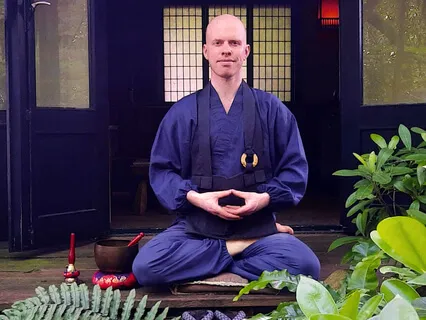
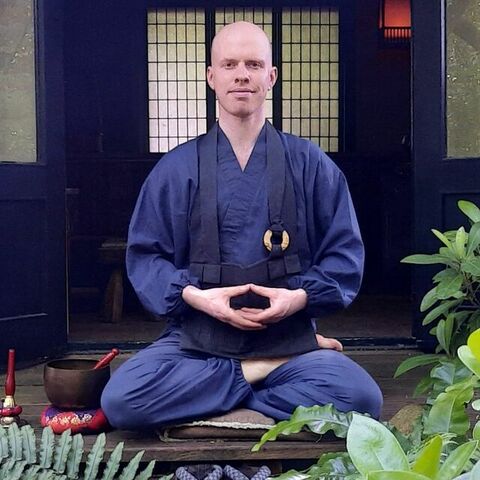
To sit in meditation you can use a meditation cushion or other elevated cushion and preferably a soft mat under the cushion where you put your legs.
When you sit cross legged it is especially important that your legs lay flat on the mat or the ground.
Floating knees give a less stable posture,
Which will affect your mental stability during meditation.
So when you sit cross legged try to lay your legs flat on the mat or on the ground.
One leg in front of the other.
This is called the Burmese position.
You can tilt your pelvis forward somewhat to make it easier for your legs to go down and touch the mat.
If you are flexible you can try to sit in the half lotus position.
Keeping your right leg on your left thigh or your left leg on your right thigh.
But be careful and do this only when it feels right.
You can go even further and sit in the full lotus position in which both feet lay on the opposite thigh.
This however is a position that only a limited number of Westerners can handle and also a limited number of Easterners by the way.
Another way to sit on the cushion is with your legs along the cushion as if you sit on a horse.
You might want to sit a little higher up when doing this position and use two cushions if the pressure on your knees or legs gets too intense.
This is called the Seiza position.
Do you meditate on a chair?
Take care that you keep your back free and place your feet straight and flat on the ground at hip width.
Whatever your posture is,
It is important that you are able to sit relaxed and experience a light challenge in your posture.
The posture should not be too demanding but at the same time ask something from you.
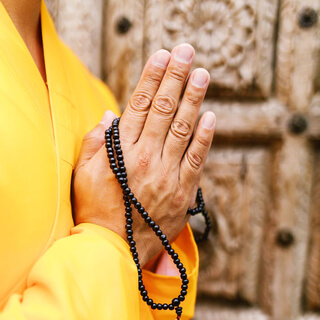
The hands are placed in an oval shape in front of the navel where they are placed on top of each other.
The thumbs press lightly against one another.
You can view this oval shape as sort of a mirror for yourself.
Do your hands lower down during meditation and end up in your lap?
This probably means you are getting too relaxed or sleepy.
Lift the hands up again until they are in front of your navel.
Are your thumbs pressing heavily against one another?
This means you are getting too tense.
Relax your thumbs until they touch lightly.
Try to sit straight up.
You do not have to force this.
It is like allowing some air between your vertebrae.
Sitting naturally straight up gives more energy to your meditation practice.
During meditation keep your eyes open and look to the ground using a view angle of about 45 degrees.
Try to keep your head straight up.
Only your eyes should be looking down and your head should be straight in line with your spine.
The practice we are going to do is called susokan or counting the exhalations.
The counting brings alignment to your meditation practice.
It is a neutral focus point,
Making it easier for you to deal with distracting thoughts during your meditation.
Every exhalation we give one count.
We count for ourselves and not out loud,
But for now I will do a few counts out loud to give you an image.
It goes like this.
Tu killed to also.
3 This way we count until 10 and from 10 we start again at 1.
You might lose the count during your meditation period.
If that happens,
Just start again at 1.
You happen to count further than 10,
Just start as soon as you find out at 1 again.
Zen practice is very forgiving.
You can always start over and over again.
Remember it is not a matter of achievement in that you have succeeded if you are able to count to 10 perfectly.
Distractions and thoughts that come during the meditation are part of it.
We do not switch them off but make space for thoughts to arise and dissolve.
The space you create by counting the exhalations.
One more time pay close attention to your physical posture.
Are your legs in a stable position on the mat and when you sit on a chair are your feet stably on the ground?
Wiggle a little bit from left to right,
From back to front to find your center of gravity.
Do you have your hands in an oval shape in front of your navel?
Are the tips of your thumb slightly touching?
Are you sitting straight up?
Do you have your head straight and are your eyes looking down about 45 degrees?
Try to keep the meditation simple and straightforward for yourself and regard the counting of the exhalations as a basis.
Thoughts and distractions might come in between and might be on the background but we can let them be and continue counting the exhalations.
We will now meditate a period of seven minutes in silence.
You you you you you you you you you you you you you you you