So welcome everyone.
It's nice to be back with you again.
And for this special sort of talk and meditation today,
This is a tribute to a very remarkable person,
A Thich Nhat Hanh,
Thai as he was known,
Which means teacher in Vietnamese,
Who is often credited with helping to bring mindfulness to the West.
He established monasteries.
He wrote more than 100 books,
But so,
So much more,
Which I'll talk a little bit about today.
He died a week ago today at the age of 95.
I'll be providing a guided meditation and a brief talk.
And what I've tried to do is actually let him speak for himself.
So you'll hear a lot of words from him and a lot of his teachings directly from him.
Why don't we start with a meditation?
And as always,
I encourage you to start by just checking for how you're sitting right now.
See if you can find a way to be comfortable in your body.
Still be alert.
But relaxed.
You can close your eyes if you feel comfortable doing so.
I will be using a meditation bell for this meditation,
As Thai often did.
And he would sometimes instruct meditators to invite in the sound of the bell,
Which was really kind of an opening to that sound of the bell,
Attentive to the way the bell begins,
Fades,
Disappears as a way of trying to help us listen a little more deeply.
Relaxing now into your breath.
Just bring a gentle attention to the knowledge that I'm breathing in,
I'm breathing out.
I know that I am breathing in.
I know that I'm breathing out.
In,
Out.
Breathing in,
I notice my breath is deep.
Breathing out,
I notice my breath is slow.
Deep,
Slow,
Enjoy.
The bell is ringing.
Breathing in,
I calm my body and my mind.
Breathing out,
I ease everything.
Calm.
Ease.
The bell is ringing.
Breathing in,
I smile.
Nothing is as important as my joy,
My peace.
I smile to everything,
Even to my suffering.
Breathing out,
I release.
I let go.
This is my practice of freedom.
Smile,
Release.
The bell is ringing.
Breathing in,
I establish myself in the present moment.
Breathing out,
I realize it is a wonderful moment.
Present moment.
Wonderful moment.
Enjoy.
The bell is ringing.
You can come gently back.
In 1982,
I first saw Thich Nhat Hanh.
A friend had invited me to go hear him speak at a local church.
This was a time before he became so famous as he later was.
There was a small circle of chairs in the church basement.
Just a handful of us there.
I didn't know anything about Buddhism.
I didn't know anything about Buddhist monks.
He had a very quiet voice,
Almost like a whisper.
And at the same time,
I just felt like there was something so real about him.
He didn't just talk about peace.
There was something about his presence that he just was peace.
The embodiment of all of these words.
This message was very simple.
Sorry,
This is my dog who has come to meditate with us.
The message was very simple.
Don't go looking for peace.
Because peace is right here.
It's in every step,
In every breath we take.
Here are the instructions that he would use to give.
Focus on the in-breath.
Release everything else.
Regret about the past.
Concern for the future.
Let go.
And you have freedom.
Breathing in makes you free.
And breathing out is pleasant.
Breathe in.
I'm aware of my body.
Bring your mind home to your body.
Fully present.
Fully alive.
The oneness of body and mind.
Fully in the here and now.
Touching the wonders of life.
You don't have to run into the future in order to find happiness,
To find joy.
Life is available only in the present moment.
Living happily in the present moment.
Breathing in,
I know there's a painful feeling within me.
Hello,
My little pain.
I know you are there.
I will take good care of you.
Energy generated by mindfulness is the mother who holds the pain of the crying child.
Recognize the pain and embrace the pain tenderly.
He was born in Vietnam in 1926 and he entered a Zen monastery there at the age of 16.
And reading many accounts of his life,
One thing that struck me was that he was just an original.
There was something about him from an early age.
He was one of the first group of monks that were permitted in Vietnam to ride a bicycle.
He was a monk who,
Unusual for that time,
Wanted to continue his education in the humanities and went on to study as a monk at the University of Saigon.
Where he studied science.
And his teachings emphasized what you're hearing already,
Which is this notion that there is no moment except the present moment.
That,
You know,
In our lives,
The past is already gone.
The future has not arrived.
And so the only opportunity that we have to live is in this present moment.
There's an old saying that life is what happens while you're making other plans.
And when you closely examine the present moment,
Too,
You start to see that it's not a problem like the past or the present,
Present,
Past or the future are for us.
So this perspective,
This realization can really change everything.
And it's not like we don't continue to make plans or to work or to love or care for children,
But we do all of it from this kind of balance or steadiness or peace that's available in the present moment.
One of his most popular books is a book called Peace in Every Step.
And here is the way that it begins.
Title of the first chapter,
24 Brand New Hours.
Every morning when we wake up,
We have 24 brand new hours to live.
What a precious gift.
We have the capacity to live in a way in these 24 hours that will bring peace,
Joy,
Happiness to ourselves and others.
Peace is present right here and now in ourselves and in everything we do and see.
The question is whether or not we are in touch with it.
We don't have to travel far away to enjoy the blue sky.
We don't have to leave our city or even our neighborhood to enjoy the beautiful eyes of a child.
Even the air we breathe can be a source of joy.
So if we can start to live in this present moment,
Then that means also that every activity provides an opportunity for awakening.
Again,
Here are more words from Ty about activities during the day.
Brushing teeth,
Brushing my teeth and rinsing my mouth.
I vow to speak purely and lovingly with my mouth is fragrant with right speech,
A flower blooms in the garden of my heart.
Washing your feet.
Peace and joy in every toe.
My own peace and joy.
Walking meditation.
The mind can go in a thousand directions,
But on this beautiful path,
I walk in peace with every step a gentle wind blows with every step a flower blooms.
Washing the dishes.
Washing the dishes is like bathing a baby Buddha.
The profane is sacred.
Every day mind is Buddha mind.
When I was in Vietnam.
So many of our villages were being bombed.
Along with my monastic brothers and sisters I had to decide what to do.
Should we continue to practice in our monasteries,
Or should we leave the meditation halls in order to help the people who were suffering under the bombs.
After careful reflection,
We decided to do both.
To go out and help people,
And to do it in mindfulness.
We call it engaged Buddhism.
Mindfulness must be engaged.
Once there is seeing,
There must also be acting.
We must be aware of the real problems of the world.
And then with mindfulness,
We will know what to do,
And what not to do to be of help.
In 1966 he traveled to the United States and Europe to call for an end to the hostilities in Vietnam,
And he made this very simple proposal to the United States government.
First,
To help the Vietnamese people form a government truly responsive to Vietnamese aspirations.
Second,
Cease the bombings of Vietnam.
Third,
Any Vietnamese military operations must be purely defensive.
Fourth,
US military forces must be withdrawn in the next few months.
And last,
The US should offer to pay for reconstruction.
In response,
The South Vietnamese government accused him of being a communist,
And of treason,
And barred him from returning.
And then after that government fell,
The new communist government also barred him from returning to Vietnam.
And thus he began a 39 year exile from Vietnam.
While he was in the United States,
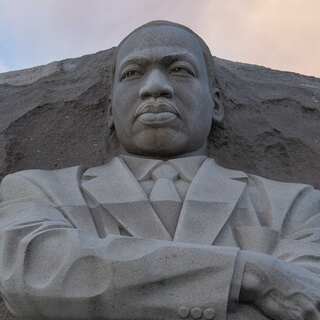
He convinced Martin Luther King Jr.
To speak out for the first time against the war.
And in the same year,
Dr.
King publicly nominated him for the Nobel Peace Prize,
Calling him a possible of peace and non-violence,
Whose ideas for peace,
If applied,
Would build a monument to humanity.
And I quote,
I do not personally know of anyone more worthy of the Nobel Prize than this gentle Buddhist monk from Vietnam.
There is a Zen teacher in the United States named Joan Halifax,
And she recalls during the 1960s when the war was raging and lots of young people were engaged in the civil rights movement and the anti-war movement and really trying to find a new consciousness that would be centered on freedom and justice,
The environment,
Non-violence.
But that she noticed that this often translated into a sense of moral outrage towards our own government that,
In her words,
Was nothing but non-violence.
Excuse me,
Was anything but non-violent.
So in the swirling world,
In stepped Thich Nhat Hanh and Joan recalls going to a peace march in New York along Fifth Avenue,
And she described it this way.
While crowds pressed toward anxiously and forward anxiously and quickly down the street,
This humble,
Brown-clad monk did something very curious.
He walked extremely slowly and mindfully,
Causing great consternation to the police and to many who did not understand what he was doing.
It was during this strange moment that I realized that being a social activist was not necessarily separate from being a contemplative.
My mind and heart were changed that day.
And this from Thich Nhat Hanh,
In the peace movement,
There is a lot of anger,
Frustration and misunderstanding.
The peace movement can write very good protest letters,
But we are not yet able to write a love letter.
We need to write a letter to the Congress or to the President of the United States that they will want to read.
Why don't we conclude with a final meditation and for the meditation,
I'll be using the words of Thay himself and just allow those words to speak to us today.
Again,
Just finding a posture that is comfortable for you and closing your eyes.
Just returning again to your breath.
Notice as you breathe in how your abdomen rises.
And as you breathe out,
How your abdomen releases.
Breathing in,
The breath makes your body calm.
Breathing out,
You release everything.
Release means I let go of everything.
My projects,
My worries,
My tensions.
So I'm able to enjoy my presence in the here and now.
We become free.
Free from our own sorrow.
Our own suffering.
Our own tensions.
Breathing in,
I smile.
Nothing is as important as my peace,
My joy.
I smile to everything,
Even my sufferings,
My difficulties.
Breathing out,
I release.
I let go.
This is the practice of freedom.
Breathing in,
I go back to the present moment.
Breathing out,
I know this is a wonderful moment.
The moment when I realize I'm still alive.
I can touch life.
Because to be alive is a miracle.
To be alive.
And to know you are alive is the greatest of miracles.
If you don't go back to the present moment,
You cannot perform this miracle.
Breathing in,
I establish myself in the present moment.
Breathing out,
I realize it's a wonderful moment.
In fact,
It is the only moment available to me to live.
Breathing in,
Present moment.
Breathing out,
Wonderful moment.
Present moment,
Wonderful moment.
Chime Now gently in your own time you can come back,
Open your eyes,
Welcome all the sights and the sounds surrounding you.
Take a little bit of this spirit of Thay with you,
With us through the rest of this day,
This evening.
Thank you for your kind attention.