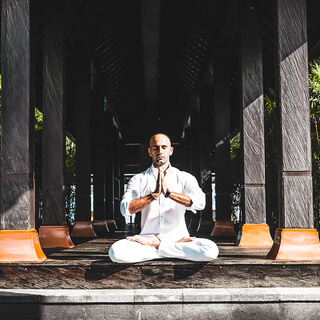
GONG Now we're really getting into it.
We've seen the core of the technique and we start to understand exactly how it works and what it can do for us.
And there's going to be more to come,
But everything else is really an extrapolation from this.
And we'll understand that as we start to apply bit by bit more things.
And now it's really important to start to understand two different things.
The difference between phenomenon and interpretation.
That becomes very important as we start to open up to the stories that we have in our body.
Phenomenon and interpretation.
Because now as we were talking about earlier,
We're going to start to repeatedly play our stories.
Repeatedly bring our stories up.
And if we don't understand this difference between phenomenon and interpretation,
We can get very easily distracted.
I'm a story lover,
So I'm very easily distracted by story.
And it's understandable if you're distracted by your own stories because they're very personal to each of you.
And they're a beautiful thing to watch unfold actually.
But it's only by sticking to phenomenon,
Sticking to sensation,
That we go deeper into the practice.
So we do want the stories to come up.
We just don't want to be affected by them too much.
Recently one of my friends started reading The Count of Monte Cristo and I was excited for him and jealous at the same time because it's such a wonderful book and he was getting to re-experience it,
Experience it for the first time,
Which I'll never be able to do because I already read it 18 years ago.
And now you're each going to get to dig into and unpack your own stories.
And eventually that gets past the personal into the universal.
We start to unpack the structure of the body,
The structure of the psyche,
The structure of the energetic system,
And we start to go deeply into the fundamental nature of reality as we're a part of that.
But first we've got to get through that layer of story that we might be reactive to,
The layer of triggers that we've stored.
Going back to my Tai Chi teacher and the sensitive points and this game that he used to teach us,
That's literally what we're doing with ourselves.
We're moving through our bodies and seeing if there are any sensitive trigger points that can throw us off balance.
It's exactly the same exercise except for one is using another person to push you physically and this is using our minds to push us on a sensory level to go through and feel everything.
So that's what we're doing.
We're going through our bodies and finding out where our trigger points are,
Sharpening our awareness so we can actually feel them.
How do we create these trigger points?
When my brother was seven years old,
We're both children,
My big brother,
He defended me from getting bitten by a dog when we were in a park together.
He stuck his arm up and stepped in front of the dog,
Stepped in front of me to protect me from the dog and he got bitten instead on his arm.
And it wasn't that serious a bite but for a seven-year-old getting bitten by a dog about the same size as him,
It was a traumatic experience.
And from that day forward,
He was scared of dogs.
That's the normal way that we tell the story.
Then after that point,
Whenever he sees a dog,
He's scared because he sees a dog.
But now that we start to understand this technique,
We know that's not really how it works.
When that dog jumped up and bit him,
He experienced a sensation somewhere deep in the pit of his stomach that made him seize up.
He was involuntarily forced to feel a sensation that made him feel uncomfortable that he felt the need to seize up and cover up.
And then that becomes associated with the story of the dog biting him.
So the dog becomes a trigger for that sensation to come up again.
So as an adult,
When he sees a dog,
He feels that sensation and it's something that he's unable to feel without reacting to it.
So that produces fear.
That produces reactivity.
He realized this.
He realized,
Why am I looking at this tiny dog that my mother owns and still feeling the same fear that I would feel over a pit bull coming to jump at me and bite me?
It doesn't make any sense.
And so he started to realize this himself.
And if we can find this sensation,
We can find the sensation that we're afraid of,
We realize we're not afraid of the stimulus.
We're simply afraid of the reactivity that we programmed into ourselves.
The dog's not there anymore.
And the dog was never the issue in the first place anyway.
The issue is that our internal register of sensations has somehow become unbalanced.
And that's what we get to discover.
Good landing.
That's what we get to discover as we go through the body and we start to be able to feel all these little points.
We feel where we've thrown our system out of balance.
What is it that we've stored that we're reacting to?
And what's the story we're telling ourselves that makes it justifiable for us to react to phenomenon?
Interpretation and phenomenon.
Phenomenon,
Interpretation.
The phenomenon here is the sensory awareness,
The sensations,
Everything we feel.
That's the reality that we're feeling.
The interpretation is the story,
The reactivity,
The emotional psychological complex that we've wrapped around it that makes it a trigger point for us.
Sensation on its own is not a trigger point.
It's the reactive cycle we programmed into it that is.
And as we go through the body,
We can find out all the points that we store that in.
It's just that it works in layers.
That's why it's so important to do what we've been doing for the first three days.
To sharpen our minds and go deeper.
Because right now,
We're going over ourselves and we're playing one layer that we have within us.
We're like a record with multiple layers of grooves.
We can play one song or we can play another or another or another.
We store them all inside of us.
And so right now at this layer of awareness,
We can start to play this one song that we might be very familiar with.
We might have heard it a lot of times already.
But as we sharpen our awareness,
There are more layers underneath there.
More stories,
More songs waiting to be played.
That's why it's important for us not to get wrapped up in any one layer of story.
At first the stories that we see about our lives might trigger us.
They might fascinate us.
They might make us attached in some way,
Which makes us focus on them.
But the quicker we can perceive them without reacting to them and let go of this,
The quicker we can move through and get to a deeper layer of story.
A deeper layer of sensation.
The problem is that as we start to play this record,
As we start to move our awareness through our body,
You might notice that it becomes easy to blunt our awareness.
To stop feeling sensation acutely.
So that we're just moving through and we're feeling sensation very faintly,
But it stops being so deep.
We stop bringing too many things up.
If that's the case,
Then we want to go back to sharpening our awareness.
Go back to working on it.
Developing that single pointed awareness now that we know what to do.
And when we start to feel sensation very easily,
Then we can go back to the practice of moving through the body so that we're not just wasting our time moving,
Moving,
Moving,
Doing nothing.
Day one,
What we learned from day one is really the most important thing.
It wasn't just me saying that on day one to motivate you to get going with the practice.
If we don't learn to master our mind,
Then every single thing we go through after that is something that puts us at effect,
Has the potential to put us at effect.
As soon as we do find a strong experience,
As soon as we do receive some strong sensory input and we cannot maintain our position without being thrown off balance by it,
Then we lose the practice.
So what we're doing on day one is something that we can carry through the whole practice.
It makes us the hero of our story.
And we all know what the hero does.
The hero faces the dragon,
Slays it,
And saves the village.
If we come up against one of our personal stories,
One of our personal dragons that we're not ready to face,
It means that we're not the hero of the story yet.
But we're fully capable of getting there.
We're fully capable of being entirely immovable.
Again,
The Buddha gives us the perfect example.
It's that same image of him choosing to sit on the last night before his enlightenment.
Even if my skin peels away,
My flesh rots,
And my bones turn to dust,
I will not move.
That's exactly the image of how we need to meditate when we're facing off against something.
And remember that all we're facing off against is ourselves,
Is the ideas we've stored within ourselves.
As we're sitting here,
All we're doing is we're unpacking our internal landscape and seeing what it contains.
I think shadow work is a wonderful form of psychoanalysis.
And I think it's entirely compatible with vipassana.
And you could say that what we're doing,
As we're digging deeper into ourselves,
Is we're starting to unpack our shadow,
Starting to take the contents of our shadow out so we can perceive them.
We can feel them directly.
And we no longer have to imagine what they are.
There was a psychoanalyst who was a student of Freud's called Wilhelm Reich,
Who came up with a form of therapy that was basically like a form of Western vipassana that he discovered himself.
He realized,
Through taking people through a process of catharsis,
That they would exhibit physical symptoms,
That exhibit somatic symptoms as they went through a catharsis.
And then he realized that you could trigger the complex by taking them through the physical symptoms instead of through the psychological.
So if you've got them to re-experience the physical symptoms that the complex was associated with,
They would go through the same catharsis.
It's just that he did it from the outside in.
He would stimulate it from the outside in to be able to bring it up.
What he called this layer of story that we wrap ourselves in is character armor.
He said that we've built up a whole character to defend ourselves against our sensitive points.
And what we're doing as we go through all these mini catharsis,
As we take ourselves through this process,
Is we're slowly taking bits of that armor off to be able to see the sensitive points that we've hidden underneath the armor that we've built,
The character that we've built.
So the real story that we're addicted to,
The real interpretation that we're addicted to that we need to be aware of,
Is the one of our character,
Of our identity.
That's why the Buddha's three big points again about the nature of reality,
Of this reality.
Anicca,
Anatta,
Dukkha.
Anatta being non-self.
If we're attached to a specific form of our identity,
Of our character,
Of our story,
Of our record,
Then we never get down to the reality.
And that's the question we're consistently being asked as we practice this.
Once we get past the point of sharpening our awareness,
Where we can reliably feel what we've got inside,
The question we're being asked is,
Are we ready to perceive reality?
Are we ready to simply perceive what is without being thrown off by interpretation?
Without being wrapped up in any old stories that might be caught there that are telling us a version of ourselves that isn't really accurate?
Because what's accurate is what we're perceiving now.
It's what's really contained within us.
And when we perceive these old stories,
It's an opportunity for us to prove that we can re-experience them without reliving them.
If every time we play one of these old stories,
We simply go through living,
Reliving the same emotions again and again,
Then we know that we're still reacting to that story.
We are not a quantumist to it.
We are no longer a quantumist in our practice.
And so now we have a clear marker of when we are.
We can feel something and we cannot react to it.
We can let it play without it affecting us.
My brother can watch dogs walk past without reacting to that sensation,
Without tensing up in fear,
Which now he can,
By the way.
He's no longer scared of dogs,
So it is possible we can get through it.
And that's what we're doing here.
This whole process becomes like a marathon,
Not a sprint.
It's a long path.
It's a long journey for us to be able to go through the record that we've formed here and unwrap it and become sensitive enough to feel it down to the bones,
Beneath the bones.
And to be able to slowly watch it all burn itself away,
Watch it all fade away.
And that's what we're doing.
We want to develop as much of an immovable mind as possible so that whatever we face against it does not have the power to throw us off center.
And we want to develop as sharp a mind as possible so we can actually perceive everything that's contained within us.
And we might be surprised by some of the things that come up in a good way,
In a bad way.
It doesn't really matter.
The novelty will come up and we have a chance to be able to experience it,
Feel it,
And then eventually not react.
And then sit and rest in phenomenon and not in interpretation.
There's nothing to fear but fear itself.
FDR.
And that's so true when we start to practice this.
Because all fear is,
Is a form of reactivity.
Because what are we really afraid of?
Everything we can potentially experience while sitting here right now is already in us right now.
We're carrying it around with us every single day.
And it's the choice between it being dormant and it being active.
When it becomes active is a time when people can potentially become worried about it because they don't want to re-experience that thing again.
But when it's dormant is actually when it's most dangerous to us.
Because when it's dormant it is a fixed aspect of our reality that we have no control over.
So we can't do anything about it.
When it's active,
When we're drawing up the poison,
When we started to liquidate it,
Which we'll talk a lot more about tomorrow,
We start to liquidate it,
Then we can actually do something about it.
We're being given the opportunity to dissolve and reframe an aspect of our reality.
What a wonderful opportunity that is.
We can change something about the nature of what we experience.
And all we have to be willing to do that is sit through a horror movie.
Sit there through a few difficult sensations and watch something play and learn to not react to them and then we can get through.
I'm sure we've all got our own horror movies that we've got to sit through here and it might take a few times to watch them before we become non-reactive to them.
But we can do it.
And we don't need anything to do it but us.
That's it.
It's good to do it as a collective.
It's nice to do it in a group where we can intensify the process.
But all we need is us sitting alone in a room with a mind that we can use,
With an active mind.
And that's exactly what the technique has given us.
It's given us the ability to be able to face anything that could come up and to choose to not be moved by it.
Even if we start to find a complex that's bigger than us at the moment and it does move us,
We know how to work against it.
We know how to switch between being at cause and being at effect and slowly getting strong enough to stop it.
And that's what we're doing.
But first we need to become sharp enough to be able to do that.
So one of the dangers when we start to practice for Pashna,
Like I said,
Is that we start to become a little bit blunt,
A little bit dull.
Because we go through the body and we get blunted by coming up against the sensation constantly.
Losing this keen edge that we're developing with our mind.
So let's make sure that as we practice for Pashna and go deeper into it,
We continue to sharpen the mind.
We continue to come back.
At the beginning of every sit,
Unless you already have a very keen and sharp mind,
Let's do a little bit of Anupana.
Let's just hold our mind here for a little bit.
Holding our mind on the whetstone so it gets sharp enough to be able to cut into the body.
And then we can start to unpack everything we've got inside of it.
Now these long sessions that we've got in the evening become very useful.
Because we've got a few long solid hours where we don't need to go away and do anything.
We don't need to eat.
We don't need to go and lay in a flotation tank or have spa time.
We can just sit here and we can focus and we can slowly let our minds get sharper,
Sharp enough to be able to dig in.
So that by the time that we go to bed tonight,
We are in a more lucid state than we are now.
And then when we go to face the unconscious,
We can go to it with a sharp mind.
It's very important because it's extremely difficult to carry an active lucid mind into our dreams,
Into our sleep.
It's extremely difficult to carry our consciousness into sleep because naturally we're going into an unconscious state.
So one of the big moments when we can start to lose this balance that we're gaining is when we go to sleep.
That's why when we wake up again,
We can be more at effect and we need to collect our mind quickly and get sharper.
But what can happen and what does happen to a lot of monks as well.
A lot of people who aren't monks too,
Practicing regularly in the world,
Is that when you get a certain volume of practice,
As you approach the sleep state,
You realize that this barrier between the unconscious and the conscious mind is very thin.
And as you go to sleep,
You can carry a thread of awareness into sleep.
You might not be 100% lucid dreaming,
Which is something slightly different,
But you can just carry this thread of awareness,
Of sensation into the sleep state.
And then when you wake up,
You wake up deeper in meditation than when you went to bed.
And then we really do have this unbroken thread of awareness running through our whole day,
Running through our whole lives.
And that's what we want to do.
We want to make this as unbroken as possible.
Now you know the four postures.
Now you know whatever we're doing,
We can walk around and we can maintain this unbroken awareness throughout the whole day.
Whether we're talking,
Whether we're eating,
Whether we're showering,
Whatever we're doing,
It doesn't have to be on a meditation retreat.
We can carry it through everything and carry our mindfulness to it and eventually to our sleep so that when we face the unconscious,
When it's just waiting there for its chance to take control again,
We meet it.
We meet it with our awareness and we go into our sleep state and we stop being out of effect.
It's another reason for the late night practice.
So let's approach this late night practice with that attitude today.
We got a couple of hours to sit before the next break.
So let's start with some standing meditation so we can just open the body up a little bit,
Start to activate the body,
Ease out any pain that might be in there so that we can sit for a long time afterwards.
Is everybody ready?
Okay.
Pick a position on your mats.