Welcome,
And thanks for being here.
Learning to control anxiety and stress starts with learning to control the breath.
It is possible to engage our own relaxation system.
This is also known as the parasympathetic response.
The first step is activating diaphragmatic or belly breathing.
Breaths can be fast in as little as 45 seconds.
The research on this breathing technique is shown to reduce stress and anxiety,
Increase quality of life,
Reduce blood pressure,
And even reduce inflammation.
Before we begin,
Take a moment to grab a book that is wide enough and heavy enough to rest on your stomach.
Once you have your book,
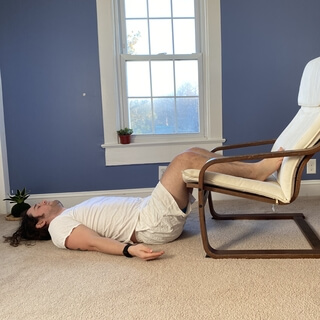
Lay down on your back,
Placing the book on your stomach.
Now bend your knees so that your feet are flat on the floor and your knees are pointing toward the ceiling.
Just take a few minutes to get comfortable.
Just feel the book centered on your stomach and feel your back firmly pressed against the floor.
You will use the rising and falling of the book to determine if you are doing diaphragmatic breathing properly.
Now start to breathe through your nose or your mouth if this feels more comfortable for you.
Use the in-breath to fill up your stomach with air,
And you should notice the book rise on the in-breath and fall on the out-breath.
If you're noticing the book move up and then back down,
Congratulations,
You're doing it correctly.
Just take a few minutes to get comfortable with it.
If you're having difficulty making the book rise,
Just keep trying your best.
It might feel a little awkward at first if you're not used to breathing through the diaphragm.
Just keep on practicing.
If you continue to have difficulty,
Be sure to press your lower back into the ground.
This should make it easier to breathe into the diaphragm,
Inflating the stomach like a balloon.
Keep on trying.
Once you start to feel comfortable with this,
Begin to make your inhalation and exhalation longer.
Let's see if we can do it to the count of three.
Breathe in,
Two,
Three,
Hold,
Breathe out,
Two,
Three,
Breathe in,
Two,
Three,
Hold,
Breathe out,
Two,
Three,
Breathe in,
Two,
Three,
Hold,
Breathe out,
Two,
Three,
Hold.
You get the idea.
You can do a few on your own.
Feel the relaxation at the space between the exhale and before the next inhale.
Build awareness of this feeling of calm that accompanies this practice.
Continue to engage in this practice for another two minutes.
In order to alter patterns of anxiety and stress,
Consistent practice will be necessary.
Ideally work up to five to 10 minutes,
But even practicing for just a few minutes on a regular basis will result in benefits.
Enjoy your day and I'll see you next time.