Come closer,
The night has already noticed you.
Lie down as if you are listening with your whole body.
Let the day with all its noise and neat conclusions lose interest in you and let your thoughts unbutton themselves.
I will tell you a story that arrived in my dreams.
These tales arrive when the thinking mind goes wandering and something older slips in barefoot.
Keep what warms you,
The rest will leave politely,
The way dreams do when they have said enough.
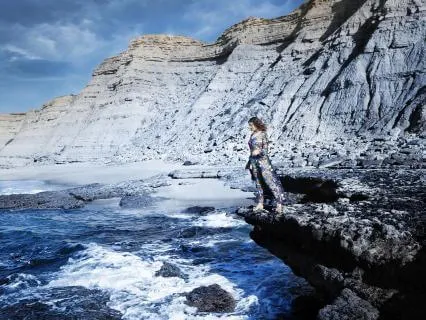
She stands at the hem of the world,
Where land loosens its grip and the sea begins its long persuasive sentences.
Her name is Nerea,
A name meaning she who is born of the waters and guarded by the trees.
It is an old name carried on the breath of women who believed that a child shaped by two elements would never be wholly lost.
Nerea was born between forest and sea.
Her mother came from the green hush of the woods,
Where roots speak in patience and branches hold stories like lanterns.
Her father belonged to the tide,
Restless,
Tidal-blooded,
Listening always for horizons.
From the forest she inherited stillness,
From the sea,
Longing.
And so she grew up fluent in thresholds.
The waves arrive dressed in lace,
Theatrical and insistent,
Curtsying at her ankles as if she is royalty they intend to unseat.
The shells beneath her feet murmur this small applause.
She tells herself she belongs here,
On this side of things,
Where air still obeys lungs and the earth remembers her weight.
She repeats this belief the way one repeats a childhood prayer,
Hoping rhythm will substitute for certainty.
Her friends,
Bright,
Reckless creatures,
Have already entered the water.
They wade and glide and surrender,
Their laughter rising like incense.
In their salt-slicked limbs she glimpses another possible self,
Braver,
Perhaps,
Or simply less acquainted with consequence.
They beckon.
Come,
Their bodies say.
Come and enjoy.
But fear knows Nerea well.
It roots her in place like an ancient medicinal herb,
Bitter,
Stubborn,
Protective.
The forest in her tightens its grip.
Trees do not rush headlong into tides.
The sea presses higher,
Cool hands sliding up her calves,
Reminding her that she is mostly water already.
But still,
She remains.
She prefers the modest miracles,
Puddles that remember rain,
Streams that gossip softly,
Tidal pools,
Those small republics of survival where life arranges itself on a scale her heart can manage and her feet can still feel the contact with earth.
The next day,
The sky wears iron.
Winter has tightened its jaw,
And yet Nerea returns,
Obedient to a summons she does not remember agreeing to.
Frost threads the air.
The lilies along the shore wear dew like borrowed jewels.
Today,
She thinks,
I will listen.
The sea does not whisper.
She never has.
She's a goddess of declarations,
And she fingers Nerea's feet with icy familiarity.
Beautiful and treacherous,
Her depths a library of drowned intentions.
And that is when the man appears.
He comes from distance and weather,
Assembled from grief and years.
His back bends as though the sky has rested its elbows there far too long.
One leg falters,
The other forgives.
His walking stick is less an aid than a companion worn smooth by shared silences.
Nerea feels him before she understands him.
He walks towards the water.
At first,
She assumes that others will intervene.
And indeed,
There are others.
A fisherman drops his net.
Two women shout from the dunes.
A boy runs,
Slipping in the sand.
Voices break open the air.
Stop!
Sir!
Wait!
They rush forward,
But the tide is quicker than their good intentions.
Nerea's body knows what must be done before her mind arranges its arguments.
Her chest tightens.
Her breath sharpens.
The forest in her whispers,
Hold.
The sea in her roars,
Go!
She does neither.
She stands at the border of herself.
The man sheds his walking stick with intent.
It falls into the sand with a sound too small for such a large decision.
He steps into the water,
The way one steps into a sentence already written.
Water climbs his shins,
His knees,
His waist.
The fishermen run toward him.
They wade in,
But the current resists them.
The boy cries out.
The women cover their mouths.
Nerea stands still.
She could still caw,
But fear has turned her limbs to bark.
Roots thread her ankles deep into the shore.
The ancient instinct for survival,
Older than courage,
Mistakes stillness for safety.
This is happening,
She whispers,
Not to warning,
But to steady herself.
The sea rises.
The others struggle to stop him.
One man is pulled back by the force of the undertow.
Another falls.
The waves swallow the disabled man with terrible efficiency.
And then suddenly,
The surface smooths itself,
As if nothing has been decided at all.
Guilt arrives first,
Hot and immediate.
It claws at Nerea's ribs,
Demanding action that is already expired.
Shame follows,
Heavier,
Settling into bone.
You should have moved.
You should have been more,
Braver,
Made of different material.
The forest behind her feels suddenly judgmental.
The sea before her,
Accusing.
The others stand stunned.
Some weep,
Some curse the tide.
Eventually they drift away,
Carrying their helplessness like damp clothing.
Nerea remains.
The sky fractures.
Clouds knot themselves into darker thoughts.
Hail begins to fall.
Small militant pearls flung from heaven.
One lands in Nerea's palm,
Startling her with its cold insistence.
As it melts,
It leaves behind not water,
But meaning.
A mark.
A promise that even guilt can be fertile ground.
From the sea,
Strange births occur from the hail.
Iceborne creatures,
Fragile and fierce,
Unfold themselves into being.
A world begins again.
For a breath,
It seems the man's outline is not erased,
But translated.
Dissolving into light,
Into movement,
Into something the human eye cannot keep.
Perhaps some endings are openings wherein disguises,
Too severe for the heart to recognize,
She thinks.
But this does not settle her.
The unfinished moment follows her as she turns toward the forest.
The trees receive her without spectacle.
Here,
The air smells of rosemary and damp earth.
Ghosts hang like pale laundry between branches.
Regrets,
Memories,
All the things people carry and cannot fold away.
She sinks at the base of an old cedar and finally allows the shaking.
For a long time,
She listens only to the voice of shame.
But then something softer begins to speak.
It does not excuse her.
It does not rewrite the moment.
It asks her to look carefully.
At the freezing fear that sealed her voice.
At the paralysis that gripped her limbs.
At the ancient survival instinct that once kept her ancestors alive in darker forests than this one.
She sees herself there on the shore.
Not monstrous.
Not indifferent.
Human.
Frightened by immensity.
The forest in her understands this.
Trees do not condemn themselves for bending in wind.
They bend and they grow rings around the storm.
The sea in her understands something too.
Tides retreat.
They return.
They are not defined by a single wave.
Perhaps.
Perhaps forgiveness,
She realizes,
Is not forgetting.
It is allowing the two places within you,
Forest and water,
To speak kindly to one another.
The forest says,
You survived.
And the sea says,
This too shall pass.
Between them a third voice forms,
Steady and clear.
Compassion.
Not the graceful compassion offered to others,
But the harder mercy extended inward.
Nerea is not the young woman who leapt to rescue.
She is the one who learned.
And learning,
Too,
Is a form of courage.
The image of the man no longer stands as accusation,
But as teacher,
A quiet,
Unfinished sentence that will guide her steps when the next threshold appears.
The forest exhales.
The ghosts lighten.
Behind her,
The sea remains vast and unsolved,
As it should be.
Within her,
Forest and water rest,
Not in perfect agreement,
But in gentle conversation.
And that is enough for tonight.
Sleep will come soon.
Let it find you between your own two shores.
Forgiving what you must.
Accepting where you can.
The night has already noticed you.
Rest.