Hello,
So welcome to day three of the series and in this session I'm going to read a story called the meditation master and the vase and this is one of my own favorites.
I'm going to say a few words then to unpack it with some depth I'm going to read another story and then we'll have a quiet time quiet meditation just a short one Recently I noticed how irritated I was becoming with our new printer which seemed incapable of doing the most basic of things like printing.
This got me thinking about my relationship to my possessions.
I lived for five years with very few possessions whilst living in a buddhist retreat center and I must say I was very happy indeed.
I rarely missed the things of this world.
One of my reflections has been that it is not really about possessions but about my relationship to those possessions that really matters.
I am reminded of Hakuin the meditation master who was 90 years old and who decides to visit his old friend Basho in the next valley.
Basho was also 90 years old.
They have been friends since they were eight years of age.
They entered monastic life together as children and trained together for decades.
He gathers all his monks and nuns together and tells them that he intends to go see his old friend Basho.
He tells them that neither of them have long to live and it is time to see Basho maybe for one last time.
He asks them to look after each other in his absence and to practice well.
The two men have a wonderful time together reminiscing and joking and laughing but all things must end and it is time for Hakuin to head back to his own monastery.
Hakuin has a very devoted cleaning lady.
Hakuin,
Though he can be very stern when he needs to be,
Has always been very kind to her and her family and she loves him very much.
She realizes that Hakuin is due back and thinks to herself that she wants to prepare his room for his arrival.
She sweeps the floor,
Cleans his worktops,
Polishes the ornaments.
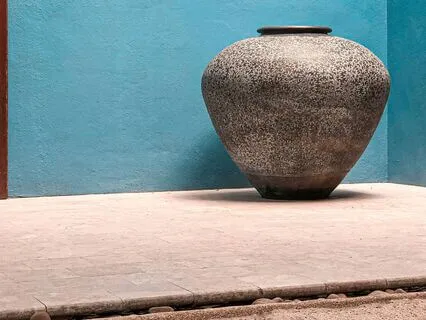
Then she sees his favorite vase.
This vase has been handed down by his master and the masters before him.
It is very precious indeed.
Each morning after his meditation he caresses the vase and remembers his beloved masters.
She picks up the vase,
Begins cleaning it and then drops it.
It smashes into a hundred pieces.
At that moment the handle of the door begins to creak open.
Hakuin walks in and she looks at him in horror ready to apologize.
However,
He looks her in the eyes and says,
Don't you worry my dear,
I got that vase for pleasure,
Not for pain.
Maybe we could ponder on our own relationship to possessions.
Maybe it's worth asking,
Do my possessions bring me pleasure or do they bring me pain?
Perhaps we can learn to be happy with possessions and happy without them.
That's the end of the story.
I think it's a really sweet story and it's interesting how did he or how was he able to have that response?
It may be worth just considering.
Yes,
There was compassion for her.
She was more important than the vase.
How she was feeling was more important because it was an accident,
She didn't do it on purpose.
Yes,
He had deep compassion which is obvious.
But there's another reason and now I'm going to read another story.
The Buddhist master sat and surveyed his students.
One of them stood up,
Bowed,
Then asked him a question.
Please master,
Can you tell us how we should view our life?
He sat quietly for a few moments,
Then reached for a beautiful vase on the table next to him.
See this vase?
He said,
It has a crack in it.
Nobody could see the crack but he insisted it was there.
Everybody was confused.
He said,
Listen,
Someday this vase will break,
It will fall apart.
That is the crack in it.
So we have to be mindful when holding it,
We have to treat it with care.
Now,
If it were a plastic vase,
You wouldn't care for it in the same way because it wouldn't break so easily.
Likewise,
We have a crack in us.
It is called our future death.
Our relationships also have a crack in them.
At some point,
Our loved ones will leave us or we will leave them.
That is why our relationships are precious.
We need to cherish ourselves and each other because just like the vase,
We are precious and easily broken.
There are many cracks in our lives.
The wonderful poet,
Singer,
Songwriter Leonard Cohen once said,
Everything has a crack in it.
It is where the light gets in.
So we should look for these cracks as they are a portal to the land of happiness.
When we feel vulnerable,
This is a crack.
Our usual sense of our solid self is being shaken.
This vulnerable,
Anxious quiver should be welcomed and felt in the body.
However,
Most of us,
Most of the time,
Do what we can to avoid it.
What a shame.
These anxious quivers,
As I'm calling them,
Can happen when we are being criticised.
Being criticised means our sense of who we are is being challenged.
If we can turn toward these moments of vulnerability or the ending of things,
Then we begin to sense something new.
Our sense of our self begins to become more fluid,
More flexible.
This turning towards the feeling of vulnerability begins to bring us into an intimate relationship with ourselves and the whole of life.
We begin to intuitively see that each moment of our life is precious.
Because it's all we have.
There is nothing outside of this moment except our thoughts that there is something better in some other time and place.
Our meditation practice helps us to see this for ourselves,
Not just as an idea but as a living reality.
We begin to see what the Master was saying,
That every event,
Every relationship,
Every moment has a crack in it.
And because of this crack,
It is absolutely precious.
Practice this.
Take your seat in meditation.
Perhaps we can do that now.
That is the end of the story.
So take your seat for a quiet meditation.
Feel the contact with the chair or the cushions.
Sense your hands resting in your lap.
Turn your attention to your breath.
Really feel it.
Now pay particular attention to the end of the out-breath.
Allow yourself to feel emotionally what it means to breathe.
In this breath it reflected the whole of life.
That everything has a beginning and an end.
I'm going to go quiet for a few moments to allow you to do this.
Notice what it feels like to let go of the breath.
As the breath ends,
It's gone.
Is there a holding on?
If there is,
It's okay.
Each breath arises,
There's a beginning,
And the end.
Feel the ending.
Then what happens?
There's a pause,
And the beginning.
The cycle begins again.
Now release your awareness of the breath and just bring to mind the fact that just as the breath has a beginning and an end,
So do all our relationships.
This is why we need to cherish ourself and each other.
Welcome any feelings of sadness or joy.
Beyond or behind these vulnerabilities lies the land of joy and wonder.
Of intimacy with life.
Just turn towards any feelings and just allow them to be.
This is one way of just learning how to view each moment as precious.
The beginning and the ending.
Meetings and partings.
Thank you very much.
Bye-bye.