Mindfulness,
Relaxation and Tai Chi of the mind.
Mindfulness is,
In essence,
Nothing more complicated than relaxing the mind.
But first,
Take a moment now to relax a part of the body.
Maybe an arm or a leg.
What was the process you went through to do that?
Initially,
I imagine,
You turned your attention towards your arm or leg.
You then perhaps became more aware of the sensations in that part of the body.
And then the critical action to relax would have been some kind of release and letting go.
Maybe proceeded by a tensing of the muscles to exaggerate that feeling of release.
Mindfulness is more or less the same process of relaxation but focused on the mind rather than the body.
The similarities are so strong that by just relaxing the body,
For example,
With a body scan,
We can find that we have also ended up with a much more relaxed mind.
Relaxing the body isn't always an easy,
Instant and straightforward thing to do.
If there is agitation,
Pain or restlessness in the body,
Then it will take more time to initiate a state of relaxation.
Relaxation of the mind can seem to be more difficult to achieve than relaxing the body because our minds are often in such a state of habitual,
Restless agitation.
Relaxation of the mind therefore takes time and requires patience.
And because we don't always get results as quickly as we would expect or hope for,
We can be tempted to think the relaxation process that seems to work well for the body isn't going to work for the mind.
We can then give up and abandon the simple approach of relaxation and search instead for a more sophisticated,
Complicated or esoteric system of meditation or spiritual practice or decide that true,
Lasting mental relaxation is only for a special few monks and gurus and just not a realistic goal for someone leading a busy life.
The challenge of relaxing the mind is to be patient and allow time for the effects to slowly percolate into our inner experience.
Relaxation process starts the instant we have the intent to be more aware in the present moment,
But the effects of relaxation that this brings can take much longer.
At the beginning of a mindfulness session it can be quite frustrating as we see how much our mind wanders,
But by the end,
More often than not,
We are experiencing the mental relaxation that mindfulness brings.
So at the start of a session,
Be particularly patient and don't expect immediate results.
Surrender to the fact that a good portion of time at the beginning may well be just noticing how much our mind is wandering.
This is not wasting time or doing it wrong,
It is a necessary part of the process of gradually and gently allowing the relaxation response to manifest in the mind.
And remember having no thoughts is never the aim of mindfulness.
Relaxation and stillness are not synonymous.
We can be tense or relaxed when we are still,
And we can be tense or relaxed in motion.
To be relaxed mentally does not require us to be still or silent in the mind,
Just as physical relaxation doesn't require us to be perfectly immobile.
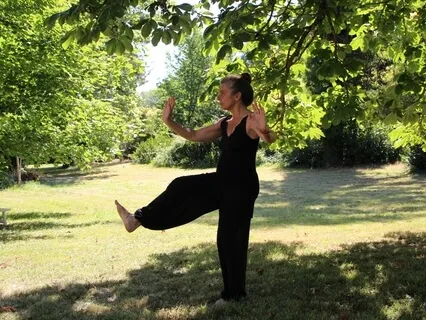
Tai Chi is mindful,
Aware and attentive movement.
Muscles are engaged that are needed to produce the movement,
But the rest of the body is relaxed and the movement is graceful and flowing.
A sense of poise and effortlessness accompanies the movement.
So too with our thoughts within a mindful state.
The movement of thoughts is still welcome,
And with awareness and attention of these thoughts they too can become graceful and flowing and take place within a mind that is relaxed and at ease.
So be patient with the mind,
Relaxation will come,
And it will come through the simple practice of mindfulness.
Don't expect quick results,
And don't try to empty,
Quiet nor still the mind.
Be attentive to your thoughts,
Welcome them,
Allow them to flow,
And in time notice how the quality of your thoughts gradually changes and becomes more graceful,
More effortless,
More creative,
And enjoy the flowing movement of your thoughts through a relaxed and contented mind.