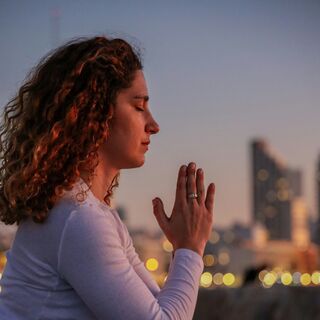
Welcome everybody.
I hope you're enjoying the meditations that I've been offering for the past month or so.
I love just playing with a different variety of meditations.
I think we have this idea that,
Two things,
I think we have this idea that meditation has to be completely silent and there is a place for that.
We also hear a lot of times how hard it is to meditate.
Here's what I believe about meditation.
I think there is a definite place to be still and to be quiet and even allow your mind to transport into some other space,
Like with the forest meditation that I guided a few weeks ago.
But I believe that our entire life is a meditation and taking time to practice being still and to practice observing the mind and observing the thoughts and observing the breath is a great way to integrate to life,
Paying attention to what we think,
How we speak to others,
How we act.
I read somewhere by Jon Kabat-Zinn,
Who is the master of mindfulness,
That a mindfulness practice is really how you are in your day-to-day life,
Moment to moment.
That it's not sitting for five minutes and then going back to a crazy way of being.
It's moment by moment,
Thought by thought.
It's part of how you show up in the world.
Mindfulness is defined as being aware of what you're doing while you're doing it.
That's my belief as well.
I think it's great if you come to a cushion or a seat and you learn these things and learn how to pay attention and how to be in the moment,
But it's what you do with it where it really begins to matter.
I love exploring and sharing with you just different techniques of meditation that I've learned over the years and some of my favorites.
Today's meditation is just going to be a complete breath meditation.
In yoga,
We call it Durga Breathing and Durga Pranayama.
Pranayama is the practice of breathing,
But Durga Pranayama is the complete breath.
It's taking air into the lowest parts of our lungs,
Letting it rise into the middle section of our lungs,
And then all the way up to the very top lobes of our lungs,
Which we very rarely,
Especially as Americans,
Breathe into.
We tend to breathe the lower parts,
The fight or flight,
And the quick panting breath,
But we hardly ever allow the breath to come fully up to here where we feel like we can't take another sip and then letting it wash back down.
I also am going to play with my Tibetan bowl today.
This is a beautiful sound,
So I will be offering the sound bowl throughout the meditation,
So you'll hear it,
And it's designed to just call you back into attention of the complete breath because what happens is when we do slow down and we do become still,
That's when the flood of thoughts come.
That's when we start to think about the grocery list or the kids or what we have to do next or what happened last week or any of this crazy thing that's out there that's not really where we want to be right now.
So I'll be ringing my Tibetan bowl just to call your attention back to breathing.
So a Durga breath,
Like I said,
It's known as the complete breath,
And it's a fullness,
And it's a three-part breathing is what it's most commonly referred to as.
So I want you to picture that your lungs are divided into three sections,
And I will guide you through breathing into those three sections,
And then on the exhale,
Exhale out of those same three sections,
And I want you to pay attention to the sensation.
This style of breathing has shown by research to lower our nervous system,
To lower that reason that we feel like we need to respond quickly or react quickly,
And it reduces our tendency to be in fight-or-flight,
And it can help us access a more calm way of being.
So it calms everything down.
If you feel inclined to take the yoga practice that I'm offering in this series,
You'll learn a little bit about how important it is to stop and to let things settle and then to re-engage.
So meditation is a great way to do that.
It's just stop,
Re-engage,
And then go about your day.
So go ahead and find a comfortable seat and close your eyes.
It can be any particular chair.
It doesn't have to be a cushion.
It doesn't have to be anything special.
Just find a seat.
Close your eyes.
Just take a normal breath.
Don't change it at all.
Just breathe.
Just allow the flood of thoughts to come because they do.
I'm human.
I have a thinking brain.
Trying to resist those thoughts only creates more thoughts.
Just allow them like a cloud passing through a sky.
No big deal.
And now start to bring your awareness to what it feels like to be breathing.
How the belly gets a little full and empties,
The chest rises and falls.
You feel that little sweet whisper of life as it passes over your upper lip.
There's coolness to the inhale and warmth in the exhale.
Beautiful.
Now pay attention to breathing into the lowest part of your belly and let it expand just into the belly.
And then let it fall out of the belly.
Just soften as the belly draws in.
Then try that again.
Just let the belly expand and the belly come in.
Take a few more like that.
In this next breath,
Let it come into the belly but then let it rise up into the chest.
A little fuller breath.
Let it come out of the body just as it came in.
Chest and the belly.
And then do that again.
Let it come into the belly,
Into the chest,
And then it escapes from the chest and the belly draws in.
Take a few more like that.
Now we will take the breath all the way up.
So let it come into the belly,
Into the chest,
And then now let it rise beyond the chest,
Into the upper lobes of the lungs,
Almost as if you feel it tickling your throat.
And then it leaves the body in the same way.
The throat,
Chest,
And the belly draws in.
Let the air come in again from the belly,
To the chest,
To the throat.
Allow it to empty in the same way and notice now how long you can breathe,
How different it is from the day-to-day breathing.
Let's continue in that fashion.
Allowing the breath to move from the low,
To the mid,
To the upper areas of the lungs.
And then returning the exhale.
Now notice how your body feels in just a really short amount of time,
Taking complete,
Full breaths.
Not staying attached to any thoughts,
Just returning your focus,
Paying attention to what you're doing while you're doing it.
By definition,
Mindfulness.
So we practice it here to apply it there,
So that when we're in a conversation,
You're paying attention to what we're doing while we're doing it.
We're listening,
Not to respond,
To understand.
When we're eating a meal,
We're taking in the senses,
The textures,
The aromas,
The bounty of goodness.
We're with another person.
Their mind is not distracted by the past or the future.
We're enjoying the company,
Paying attention to what we're doing while we're doing it.
Coupling that with a complete breath,
It's like taking that pitcher of water that I spoke about in the yoga practice this week.
We allow the dirt to settle at the bottom,
And there is amazing clarity.
So if there's something in your life that's causing you to feel unclear,
Not grounded,
Uncertain,
Take five minutes,
Find the durga breath,
The complete breath,
And then notice how you feel after.
If there is space between your thoughts,
If there's clarity,
There's a sense wholeness,
Groundedness,
And grace.
As always,
It's so wonderful to share my studio with you,
To share my heart with you,
To offer you tools.
I am so grateful.
Thank you so much.
Return to this complete breath anytime you need it.
It's always available.
I'll see you real soon.