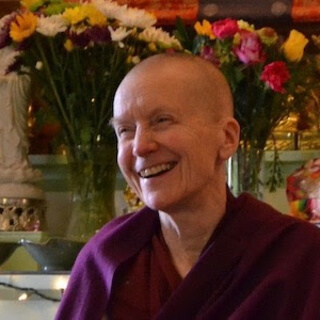
So what we're going to be doing is meditation.
And first we'll do some prayers to help get into a good state of mind for meditation.
And then we'll do some silent meditation for about 10 minutes.
And I'll give a little bit of instructions on how to meditate on the breath if you would like to do that.
Otherwise,
If you have your own meditation practice that you're familiar with,
You can do that.
And then we'll do a guided meditation.
I'll be talking a little bit and asking you to contemplate certain things,
Give you time to do that.
And this guided meditation will be related to the book that Venerable Chodron has been teaching in these monthly events.
It's called Working With Anger.
So I think we can all use that,
How to Work With Our Anger.
So I'll do a guided meditation on what she.
.
.
Talked about last month.
So in last month's talk,
She was reading from chapter six.
And in that chapter,
It talks about different techniques we can use to work with our anger.
And there's lots of these in Buddhism.
And it's best if we learn these techniques and then try them out,
Practice them,
Get familiar with them.
And in that way,
Our mind gets familiar with these methods.
And then when we find ourselves in situations where somebody's pushing our anger button or rather we should just better to say our anger buttons are getting pushed because I don't think anyone deliberately does that,
But it just happens that,
Yeah,
We get angry.
And so if we're very familiar with these methods,
We can use them even in those kinds of situations.
Whereas it's better to do that than wait until you're in a situation where you're exploding with anger and then try to figure out what to do.
If you're already familiar with the methods ahead of time,
You can use them in those situations.
And so in that chapter,
She talks about how it's useful to practice meditation,
A regular practice of meditation really helps with this.
And it doesn't have to be a very formal way of practicing meditation,
Sitting,
You know,
A certain position and a certain place,
But just sitting in a comfortable chair.
Or even going for a walk or sitting in a park and just contemplating these ideas.
And that way our mind gets familiar with these methods.
And then it will be easier to use them when we need to.
And to repeat something I mentioned in last month's meditation,
It's helpful to recognize that we have choices.
Sometimes people feel as though they have no choice but to get angry.
There's a situation,
They're angry,
And that is the only possible way to respond.
No other way.
It's probably not true.
There are probably other ways we could respond.
We could deal with that situation other than with anger.
And I like to think of it like traffic circles in a road when you're driving and you get to a traffic circle and there's different roads going off in different directions and you've got a choice which one you take.
So it's similar in our life when we find ourselves in situations even if we're getting triggered and angry coming up,
There are choices we can make.
We don't have to just explode and go with the anger and act it out.
But yeah,
There are other things we can do that might be more satisfying and not as harmful to ourselves and others.
So yeah,
We'll explore that in this meditation.
Okay,
So we'll start with the prayers and then do some silent meditation for a little while.
So the last prayer we just recited is called the Four Immeasurables.
And these are four thoughts,
Very positive,
Beneficial thoughts or states of mind that we try to cultivate.
And I think they're kind of universal.
They're found in all religious traditions,
And also a lot of people who are not religious can relate to them.
So the verse is loving kindness,
Which is really wishing that everyone everyone could be happy,
Feeling how wonderful it would be if everyone,
Every living being could have happiness,
Could have all the good experiences they wish for.
Just that you can feel that way.
And the second is compassion,
Which is wishing everyone to not suffer.
So see if you could feel that way,
How wonderful it would be if all people and all beings could be free of all the painful and pleasant unwanted experiences that they have.
All of those could vanish and everyone could be free from them.
And the third is joy or rejoicing.
And that is when we share in the happiness of others.
When someone is experiencing something good,
Instead of being jealous,
Resentful,
We are happy for them.
So it's a much better state of mind than jealousy.
See if you can have that wish to share in the happiness,
The joy of others.
And the fourth is equanimity.
One meaning of this is that when we do cultivate these states of mind of love and compassion and so on,
We do so in an unbiased way without excluding anyone.
It's not easy to do,
But we can at least aspire to do this,
To be able to feel love and compassion and positive feelings.
For everyone without exception.
So see if you can recognize that if we try to cultivate these four positive states of mind in ourselves,
There's a greater chance that we can influence others in the same way,
Help them generate these states of mind.
And if we can do that,
Our society,
The world,
Everyone will be much better off.
And see if you can make that your reason,
Your motivation for being here and doing this meditation to bring about a more positive state of mind in yourself so that you can help others to also be more positive and make this a better world.
Okay,
So let's spend some time sitting quietly.
If you already have a meditation practice you're familiar with and you would like to do,
Then you can do that.
If you're not so familiar with meditation practices,
Then one thing you could do would be to pay attention to the breathing.
Observe your breath flowing in and out.
And make that like the focal object for your mind,
For your awareness.
Let's try to be aware of each breath coming in and going out.
And whenever your mind wanders away,
Which it probably will,
Don't be surprised.
It's very hard to keep our mind focused on one thing for more than a few seconds.
So naturally it will wander away.
You will get distracted by other thoughts.
Thoughts,
Memories,
Sounds,
And so forth.
But when that happens,
Just notice it,
Be aware of it,
Don't beat yourself up,
Feel bad,
Just disengage your attention from that other object and bring it back to the breath.
Being aware of the breath coming in and going out.
If you find yourself bothered by thoughts or other distractions.
See if you can recognize how they are transitory.
They come and they go.
They're not always there in your mind,
In your experience.
Not rose and static things,
But rather fluid and flowing,
Coming and going.
And that can help you to just let go of them more easily and go back to the breath.
Okay,
So now we'll move over to the reflective part of the meditation,
But still do your best to keep your mind focused on what we're doing in the meditation.
Try not to let your mind wander away to other places or other times,
The past,
The future and so on,
But just be right here.
So bring to mind a situation in which you felt some form of anger,
Or it could have been mild irritation,
Annoyance,
Frustration.
It's best to pick a minor incident rather than one that was really strong or you felt very strong anger.
Otherwise,
That can be difficult to work with in meditation.
You might be able to remember many such incidents,
But just choose one for now.
And when you have thought of that incident,
Just spend some time sitting quietly with that incident,
With your memories of what happened.
And try not to get caught up in the storyline,
Who did this,
Who did that,
Who said that,
Who said what,
And so on.
But instead of that,
Just notice within yourself the various physical sensations and also mental experiences that arise and pass with regard to those the memory of that incident.
And try to observe these experiences within yourself,
Physical and mental feelings,
In the same way you would observe things when looking out a window and seeing people and cars passing by and other things happening.
So you're just observing those things without getting caught up with them,
Attached to them,
Just watching things come and go.
Thank you for watching.
So try to do the same with your own mind,
With your own experience.
Just watching what happens in yourself without reacting,
Getting caught up in them,
And try to avoid identifying with them.
So try to see how they are transitory.
They come and they go.
They're not permanent,
Frozen,
Fixed things,
But changing things.
Try to observe that.
And also see if you can recognize that you have a choice with regard to the thoughts and feelings going on inside of you.
You don't have to buy into them and follow them and act on them.
You do have other choices.
So one thing that is helpful is to reframe this incident,
This story.
And one way we can do that is by.
.
.
Trying to have a better understanding of the other person or persons involved in that.
Incident.
So focus on them,
Focus on that person or those persons.
And reflect it.
Just like you,
They are trying to be happy,
Trying to fulfill their needs and wishes.
And trying to avoid problems and difficulties.
That's probably the basic place where they're coming from.
And also reflect that these other persons,
Just like you,
Sometimes get angry,
Frustrated,
Confused.
They don't have complete control over their mind,
Their thoughts,
Their feelings.
So they sometimes find themselves having disturbing thoughts and emotions that influence how they speak,
How they act.
Maybe you can feel empathy for them.
So after doing these reflections,
These contemplations See if there's been any change in your mind,
The way you feel physically and mentally with regard to that incident,
Those persons involved.
Are the feelings you have now different than previously when you were feeling angry or critical?
And finally,
See if you can come to a conclusion based on what you understood,
What you experienced during this meditation.
For example,
You might feel the wish to work more on your anger and criticalness and try to have more understanding and compassion.
Or you might feel the need to think about these things more before making such a decision.
So whatever conclusion feels right to you,
Bring that into your mind.
And finally,
Let's make a mental dedication of the positive energy or merit we've created by doing this meditation,
Just as we contemplated in the beginning,
Wishing everyone to be happy and free of suffering.
So dedicate this energy that it will bring everyone closer to that goal of greater peace and happiness,
Well-being and freedom from suffering.