So let's get comfortable.
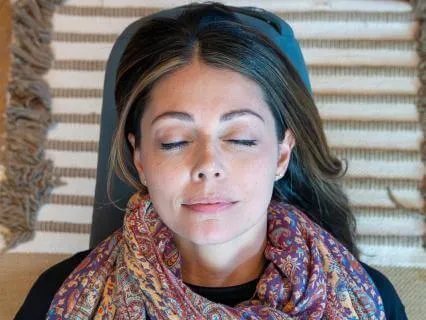
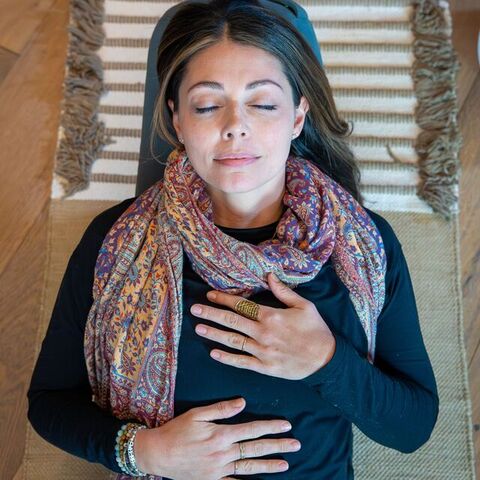
Allow your body to rest wherever it decides to land.
Relax into your shoulders,
Letting your arms rest beside you.
Soften into your hands.
You may close your eyes or gently lower your gaze and go within.
There is a structured breathing technique where each part of the breath is equal in length.
It follows four simple steps and we will do this together.
We will inhale for four,
Hold for four,
Exhale out for four,
And then hold for four.
It is called box breathing because if you imagine drawing a square,
Each side represents one part of the breath.
The even rhythm creates balance in the body.
So let's begin.
Fully expel air out of your lungs.
Take a deep breath in,
Two,
Three,
Four.
Hold,
Two,
Three,
Four.
Exhale out,
Two,
Three,
Four.
Hold,
Two,
Three,
Four.
Inhale,
Two,
Three,
Four.
Hold,
Two,
Three,
Four.
Empty out,
Two,
Three,
Four.
Pause,
Two,
Three,
Four.
Full,
Slow,
Deep breath in,
Three,
Four.
Hold,
Three,
Four.
Exhale all the way out,
Three,
Four.
Hold,
Two,
Three,
Four.
Deep,
Full breath in.
Hold at the top.
Empty out,
Two,
Three,
Four.
Pausing at the bottom.
Keep going at your own pace.
Tracing your breath.
Release the count.
As you breathe this way,
You're doing something powerful for your brain and body.
This sends signals through the vagus nerve to your nervous system that you are safe.
When your body senses safety,
It shifts out of fight or flight and into rest and repair.
Continue breathing,
Pausing between the inhalations and exhalations.
Now bring your awareness to bodily sensations.
Simply notice what's happening within.
Following your breath,
Witnessing the inflow and the outflow and the brief pauses between the breaths.
Stress often begins in the brain's alarm center,
The amygdala.
Its job is to scan for danger,
But the challenge is that it cannot always tell the difference between a real threat and an email notification or a long to-do list.
When it senses stress,
Which most likely we experience on a day-to-day basis,
It signals your body to release cortisol and adrenaline.
Your heart rate increases,
Muscles tighten,
Breathing becomes shallow.
Our bodies,
Our brains can feel like they are on overload,
But here is the empowering part.
Your brain is one of the fastest ways to calm that deep-rooted alarm system.
Every slow,
Intentional inhale and exhale sends a signal to your brain that you are safe.
When your body feels safe,
It begins to settle.
Heart rate slows,
Muscles soften,
Thoughts become clearer.
And the more we practice this,
The easier it becomes to detect when stress is rising.
At first,
We often only notice stress when we are already overwhelmed,
But with consistent breath work and awareness,
We begin to catch it earlier.
We notice the tightening in the shoulders,
The shallow breathing,
The racing thoughts.
That awareness is key.
When we can notice stress without judgment,
We create space,
And in that space,
We gain a choice.
Instead of reacting automatically,
We can pause.
Instead of escalating in the moment,
We can regulate.
Breathe.
Instead of being controlled by stress,
We can shift it.
Awareness turns reaction into response.
Breath turns tension into balance.
Take another slow,
Deep inhale through your nose,
Pause,
And exhale out.
As you do this,
Imagine your nervous system settling like a snow globe after it has been shaken.
Thoughts may still be there,
But they begin to fall into place and settle.
Notice the rhythm of your breath.
Notice the steadiness in your body.
Training your brain to find that calm within.
Take one final,
Slow,
Deep breath.
Before you open your eyes,
Ask yourself gently,
What do I need right now?
And see if a simple answer arises.
And when you are ready,
Slowly come back.
May you carry the steadiness with you as you move back into your day.
And remember,
Your breath is always with you whenever you need.
Your breath is always available.
And each time you return to it,
You strengthen your brain's ability to move from stress to balance.
Have a blessed day.