If you've ever been in a room when someone struck a singing bowl.
You know there's something that happens in your body before your mind can catch up.
The sound isn't just heard,
It's felt.
In this video,
I want to introduce you to the three instruments you may encounter the most in sound healing.
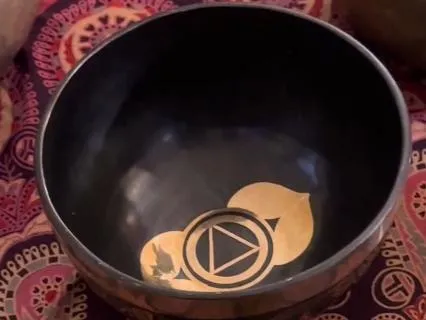
Singing bowls,
Gongs,
And tuning forks.
And share a little bit about what makes each of them so effective.
Singing balls.
Are part of a family of instruments known as standing bells.
They've been used across Asia for thousands of years.
In Buddhist temples and in Himalayan traditions.
And in practices that predate Buddhism entirely.
They're typically made from bell metal,
An alloy of copper and tin.
The same material used in church bells and gongs.
You might see them called Tibetan bowls,
But many practitioners now prefer the term Himalayan bowls.
Or simply singing balls.
This better reflects their broader origin.
And what makes them remarkable from a sound healing perspective is this.
They don't produce just a single note.
They produce a whole world of sound.
And so when you strike a bowl,
The most prominent note you hear is called the fundamental.
Sometimes the masculine term.
But above that,
There's a secondary tone,
Often a fifth away.
And then layers of overtones that ripple outward beyond what we can consciously hear.
Notice that gentle wah-wah-wah sound.
That pulsing quality in the sound.
This is called a monaural beat,
And it's an oscillation.
Caused by the interaction of those multiple tones,
This gentle pulse that has the capacity to entrain our brainwaves towards a calmer,
More meditative state.
A smaller bowl will give you a higher,
Brighter tone that cuts through easily.
A medium bowl tends to resonate with the range of the human voice,
Beautiful for meditation or chanting.
A larger bowl offers something deep and grounding,
With overtones that seem to float above it.
My own entry into sound healing came through recovery from anxiety.
I noticed that humming certain notes and tones seemed to settle something in my nervous system.
When I first heard the singing bowl.
I recognized that same feeling immediately.
And eventually,
I let my intuition,
Not my analytical mind,
Lead me to my first bull.
And that's my suggestion for anyone.
Just let the bull choose you.
Choose what feels the best.
Gongs are made from the same bell metal family as singing bowls.
And share that same capacity for producing rich,
Complex overtones.
What gongs offer that bowls generally don't.
Is sheer scale.
A full-sized gong played with a mallet can produce a wave of sound that washes across an entire room.
In a sound bath setting,
Gongs are often used as a kind of reset.
Massive immersive frequency field that invites the nervous system to let go of habitual tension patterns.
The unpredictable,
Complex tones of the gong can help shift the brain out of our default left brain analytical mode and into something more open and receptive.
Gong has deep roots in ceremonial and sacred traditions across Asia and Europe.
And you'll find it central to many modern day professional sound bath practitioners' work.
Tuning forks offer a completely different quality.
Where singing bowls and gongs are rich and complex,
A tuning fork gives you a single,
Pure,
Precise tone.
Because of that precision,
Tuning forks are often used therapeutically to work with specific frequencies.
Sometimes applied directly to the body on acupressure points or near joints.
And so,
Despite their differences in size,
Tone,
And tradition,
Singing bowls,
Gongs,
And tuning forks,
All operate on the same underlying principle.
They produce sustained resonant frequencies that your body recognizes and responds to.
Each one is capable of producing the oscillations and overtones that support brainwave entrainment.
Each one can help activate the parasympathetic nervous system.
Each one is a doorway.
If you're new to all of this,
I'd suggest starting simply.
Find a ball that speaks to you.
Not because of its note or its hertz.
But because of how it makes you feel.
Spend a few minutes with it each day.
Let your nervous system begin to remember what rest feels like.
From there,
The practice tends to unfold naturally.