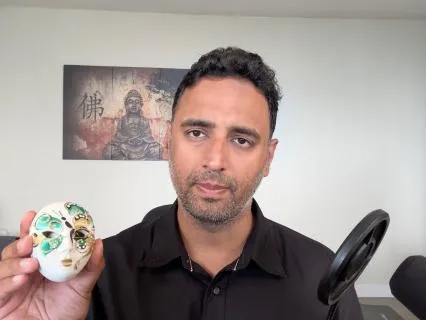
Today we explore Shadow Persona.
So what is Shadow Persona?
Let me explain this through an example and through a demonstration.
Think of this as outer persona.
The persona or the personality that we carry in front of the society.
For example,
We go to a social gathering.
And this is the persona and it's literally a mask that we wear.
And we show usually maybe because our parents told us to behave or to behave in a certain way.
We have this tendency to put up a persona.
And which is normal for human beings,
We need that because We want to have a nice social interaction.
But for some people,
This goes to an extreme,
Where there is extreme people-pleasing behavior and there is a lot of smiling,
A lot of laughter,
A lot of positivity,
Praise.
All that is wonderful.
There are different levels on which people express this.
But the stronger this outer persona.
The stronger.
The shadow persona.
Now,
Where is the shadow persona?
It's within.
Inside is this shadow persona.
And this shadow persona is that part of us which has all those emotions that we avoid to express to show to others.
Anger,
Sadness,
Depression,
Stress,
Anxiety,
Rage.
These are some examples.
But usually these emotions we express either in front of ourselves and when we are alone.
Or we do that in front of people whom we are close to,
Our family members,
Our close friends.
Are close relatives.
People who live in our home.
Have you seen someone,
Have you seen a person who is very pleasing on the outside?
But when,
As soon as this person gets home?
This person is totally different.
This person is displaying a different behavior.
And sometimes if this behavior is extreme and the outer persona and the shadow persona are extreme People outside who meet this person outside won't believe you when you tell them that this person can show so much anger or sadness or all these emotions at home.
So this is the Shardu persona.
So the point being that the stronger.
.
.
The.
Persona on the outside,
The outer persona,
Which is usually positive,
The stronger,
The shadow persona.
And this causes problems because then people come back home and then they are angry with their family.
They are sad,
They are experiencing rage,
They are experiencing confusion.
All those emotions become a problem.
So now how to work with this?
Shadow Persona.
There are three major steps that we take here.
The first one is Authenticity.
The second one is vulnerability.
And the third one is catharsis.
So let me explain these steps.
The first one is Authenticity.
We allow ourselves to be authentic.
We have a Neutral,
Mostly neutral expression.
Yes,
We want to smile to people.
But we are authentic.
We are not forcing that smile on the outside.
We are not forcing a certain behavior.
We are being authentic as much as we can.
The second.
Tool or step.
Is vulnerability.
We allow ourselves to share.
We allow ourselves to express our emotions,
What we are feeling.
You know,
For example.
.
.
Someone going on a stage can mention,
Can be vulnerable and tell the audience that,
I want to be honest,
I'm feeling a bit nervous right now.
This makes a connection.
This makes people feel that you are authentic also.
And it makes a connection between people.
And the third is catharsis.
C-A-T-H-A-R-S-I-S catharsis.
Now what is catharsis?
Catharsis is when you release the shadow persona through expressing with intensity.
An example of this is that if you are feeling angry.
If there is anger.
Then instead of taking out that anger on family or on friends,
I go into my solitude,
I find space maybe in my car or somewhere.
Where other people cannot hear me.
And I shout.
And I release,
I release,
I can shout.
Or if I feel like kind of punching a pillow or something like that,
I release that.
Through healthy Catharsis,
By not harming anyone.
And so basically,
You are releasing these emotions without harming anyone.
So that this shadow persona is healed.
I hope that this gives you an idea of what the shadow persona is and how we can work with the shadow persona.
And take care.