Hello dear ones.
And welcome to today's bedtime story.
The Dreamers Library.
A story of dreams shared across distance.
And the courage to wait.
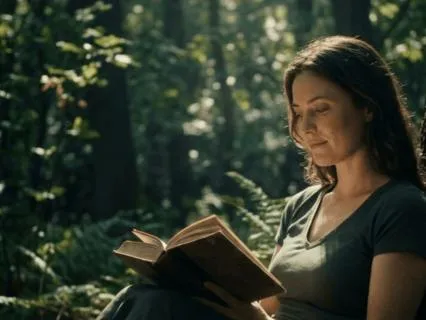
There was a library in Samuel's dreams.
It had been there since childhood.
A large calm room with high windows and warm light.
Shelves that went up farther than the ceiling should logically allow.
And a smell of old paper and something else.
Something like rain on stone.
Samuel associated with contentment.
As a boy he had gone there most nights.
Had curled up in the green armchair by the east window and rent.
Or simply sat.
Feeling the particular piece of the place settle over him like a blanket.
The books were unusual.
They were not books he had read in waking life.
The titles were different.
The cover's unfamiliar.
And yet the stories inside them felt true in a way that waking life stories sometimes didn't.
They felt like memory rather than fiction.
When he read them,
He understood things he had not understood before.
At 17,
He realised he was not alone in the library.
He became aware of it gradually.
A sense of other presence,
Other warmth.
The occasional soft sound of another page turning.
He had assumed until he was 17.
That these were simply elements of the dream.
Like furniture or weather.
The night he was 17 and a half.
He looked up from his book and there was a girl in the blue chair across the room.
Weeding with a cup of something steaming on the table beside her.
Utterly at ease.
She looked up.
Their eyes met.
Her expression was the precise mirror of his own.
The look of someone who has just realised that what they thought was furniture was actually another person.
Oh,
She said.
Oh.
Isan.
Have you always been here?
She asked.
Since I was small,
" he said.
Me too,
She said.
And then with the directness of someone who has decided that dreamlike circumstances call for practical responses.
I'm Yuki.
I think I'm asleep in Tokyo.
Samuel was 38 now,
A secondary school history teacher in Accra,
And the library had changed,
Grown,
Deepened,
Become populated.
There were,
By his last careful count,
Nine regular visitors.
Yuki,
Who was still in Tokyo,
Now an architect,
Who came to the library three or four times a week and used it,
She said,
To think through problems that resisted waking life logic.
A retired school teacher named Ernesto,
Who had been visiting for 12 years,
And brought dream books about botany,
Which he could not explain but found deeply satisfying.
A teenager from Lagos named Amara,
Who had only recently appeared,
Still startled by the library,
Still finding her footing The others came and went with varying regularity.
A nurse from Perth.
A farmer from rural Finland.
A woman from Spain,
Whose name he had never learned because she only ever stayed for a few minutes,
Sitting by the west window,
Looking out at a view that was different for her than it was for him.
They had developed over years a quiet etiquette.
The library was not for long conversations.
It was for reading.
For thinking.
Or the particular quality of peace it offers.
But they did speak.
They exchanged fragments of their waking lives.
Recommendations for dream books that had helped them work something out.
A kind of careful,
Considered confidence that people share when they have been witnesses to each other's interior lives for years.
Samuel had not tried to understand the mechanics of it.
He had a friend in Accra,
A physicist named Felix,
Who had once attempted to engage him in a serious theoretical discussion about shared dreaming,
Consciousness,
Quantum entanglement,
And the non-local nature of the mind.
Samuel had listened patiently.
And then said that he thought the library was the library and that it worked the way it worked.
And that he was not sure he needed a theory more than he needed the thing itself.
Felix had been slightly offended by this.
And Samuel had brought him a bottle of good scotch as an apology.
Amara was 15 and she was frightened.
Samuel could see it clearly.
Not in the library where she seemed calmer.
But in the quality of her presence there.
The way she chose a chair in a corner and sat with her back to the wall.
The way she held her dream book,
Not quite reading it,
But using it as something to hold.
He had seen this before.
The library arrived for people when they needed it,
He had come to believe.
Or at least the people who came to the library arrived when something in their waking life had become difficult enough to require the kind of quiet that only a place like this could offer.
He did not cry.
He sat near her sometimes,
At a respectful distance,
And read and occasionally he said something small and undemanding.
A comment about the weather the library was having.
A question about her book.
Slowly over several weeks of dreams.
She began to speak more freely.
Situation was not a simple one.
There were details she offered in fragments.
A family under strain.
A school that felt unsafe.
The specific,
Particular loneliness of a teenager who is capable and perceptive.
And therefore acutely aware of all the ways in which her circumstances were unjust.
Samuel Lesson.
He did not offer solutions.
He did not have solutions.
He was a history teacher in Accra and she was a teenager in Lagos and their connection was a shared library in a dream.
What he had to offer was presence and attention.
And the library itself.
This warm,
Calm,
Unhurried space.
That asked nothing of her.
Except that she stay for a while.
How long have you been coming here?
She asked him one evening.
Since I was eight or nine.
More than 30 years now.
She was quiet for a moment.
Does it help?
In your real life,
I mean.
He considered the question carefully.
The way he considered questions in his classroom.
With real attention and presence.
Not just reaching for the easy answer.
It taught me that there is always a room,
He said,
Finally.
Even when the waking world is very loud.
There is always somewhere you can go that is quiet and lit and full of things worth knowing.
I don't think I learned that anywhere else.
Amara looked at the shells.
At the high windows and their warm sourceless light.
I'd like that,
She said.
To believe there's always a room.
There is,
" said Samuel simply.
You are sitting in it.
On Samuel's 41st birthday,
He arrived in the library to find a book on the green armchair.
The one he had always used since childhood.
It had not been there before.
The cover was plain,
The colour of old gold.
With no title.
Inside,
The pages were full of the library itself.
Drawings of the room from angles he had never considered.
From perspectives that showed parts of it he had never seen.
A staircase behind the north shell that he had somehow never noticed,
Leading up to a second level,
With different windows and different light.
A door in the east wall,
Behind the curtain.
That he had taken for decoration.
Between the drawings,
In a handwriting he didn't recognise,
Were notes.
The library appeared,
The notes said,
When it was needed.
It was,
The notes suggested,
A very old thing.
Older than any of its current visitors.
And it would be here long after they were gone.
It had been given many names in many languages.
The simplest translation across all of them was approximately.
The place where minds meet to remember they are not alone.
Samuel read the whole book that night,
Sitting in his chair.
While around him,
The library breathed its old,
Familiar breath.
In the morning,
He woke in Accra with the golden light of early morning coming through his window.
And the sound of the city beginning its day.
And he lay still for a while.
Holding the feeling of the library.
The warmth of it.
The solidity.
The sense of other people reading in other chairs.
And he thought.
This is one of the greatest gifts I have ever been given.
Not the library itself.
But the understanding it had shown him over the 30 years.
That even in the loneliest moments of a life.
You are never,
Ever alone.
He got up and made coffee.
He went to school and taught his students about the things that history shows us.
Which is mostly this.
That human beings.
Across every age and culture and circumstance.
Have always found ways to reach toward each other.
Across the distances that seem to keep them apart.
Some of them,
He knew.
Found ways more unusual than most.
And he did not consider this a problem at all.