Welcome to the mindfulness meditation podcast.
I'm your host,
Dawn Eshleman.
Every Wednesday at the Rubin Museum of Art in Chelsea,
We present a meditation session led by a prominent meditation teacher from the New York area.
This podcast is a recording of our weekly booths.
If you would like to join us in person,
Please visit our website at rubinmuseum.
Org slash meditation.
We are proud to be partnering with Sharon Salzberg and the teachers from the New York Insight Meditation Center.
In the description for each episode,
You will find information about the theme for that week's session,
Including an image of a related artwork chosen from the Rubin Museum's permanent collection.
And now,
Please enjoy your practice.
Good afternoon.
Welcome to the Rubin Museum and to your weekly mindfulness meditation practice.
I am happy to say that while we are partnering with our family of mindfulness organizations,
Including Sharon Salzberg,
The Interdependence Project,
And the New York Insight Meditation Center,
We have a new ad,
And that is the Hemera Foundation,
Who is supporting this program.
So many thanks to the Hemera Foundation.
Welcome,
Hemera.
Good to have you.
How many of you have made it up to the sixth floor now to donate your OM to the OM Lab?
Great.
So as you likely know,
The OM Lab is this experiment of sorts that we have on the sixth floor.
We are dedicating that space to really an exploration of OM and of understanding what that small and potent seed syllable is all about.
It is a mantra in and of itself and the sort of precursor to many mantras,
Specifically in Tibetan Buddhism and other religions as well.
And our goal is to collect as many OMs as we possibly can.
They are going to be featured in our upcoming exhibition called The World is Sound,
All about sound,
And sound is sacred matter amongst other things,
So your voice will be featured in that collection of OMs if you do donate.
And so it is really within that context,
This conversation about OM,
About mantra,
And about sound that we are bringing you this month's theme,
Which comes to a close today.
So throughout the month we have been exploring this idea of mantra,
Of what it means through different lenses and Tibetan Buddhist lenses,
But also through a secular lens.
And we have been thinking about mantra as a powerful sound and sonic experience that is sometimes the experience of which,
Hearing and listening to a mantra is really more potent and powerful than the actual literal translation,
The kind of content meaning of the mantra itself.
And then we have also been thinking about mantras that we have in our own lives,
In our own spiritual traditions or in our own secular lives.
Maybe they are mantras we didn't know we had,
Or they are mantras that develop through a relationship or over the course of time.
And however they come to us,
Whatever their source or context,
They are phrases that are repeatable,
That ground us,
And that give us a sense of connection.
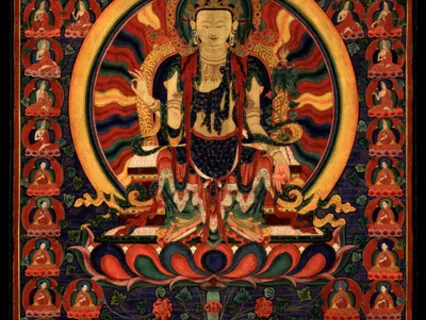
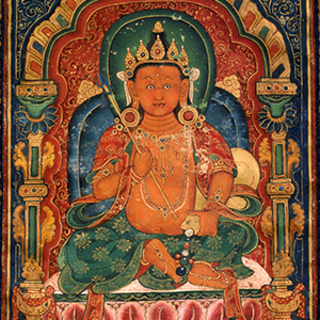
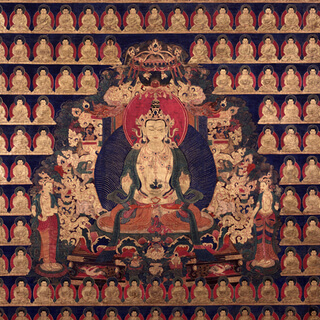
So today we are looking at this beautiful tanka painting of Maitreya,
Sitting on this very colorful lotus blossom throne.
And Maitreya's right hand is held in the gesture of blessing,
And his left is held in the gesture of generosity.
And we see lotus is a major theme here with this very dominant colorful lotus throne that he is sitting on.
And it is a little challenging to see here,
But under his feet are also two lotus blossoms that kind of support his feet there.
And this pose that he is sitting in is actually an interesting one.
We don't see as often as some of the other poses like royal ease,
But this one is a western style,
A seated pose.
And let's see,
I don't have the year that this tanka was made,
But Jeremy I'm sure can contextualize it a little bit more art historically for you if you'd like to take the tour afterwards that's free and take a look at this in person.
But really Maitreya,
And the reason that we're focusing on Maitreya today,
Is that Maitreya is a really important figure who has several mantras associated with him.
He is considered the Buddha of the future,
And is considered to be kind of living up in a heaven realm,
Waiting for Buddhism to die away and be forgotten about,
And then he will help it be reborn and remembered.
So that is his purpose.
And the mantra that is associated with him is this one here,
Which is Om Maitri Maha Maitri Maitriye Svaha.
Okay,
You don't have to memorize it or anything,
Don't worry.
But I just wanted to give you a sense of it,
And of course it begins with Om.
So great to have Tracy Cochran back here with us today,
She's leading our meditation,
And she kicked us off at the beginning of the month and she's back here to kind of wrap this up with us,
So that's really nice to have her,
As always.
And she is the editorial director of Parabola,
And that is a gorgeous quarterly magazine that is sold in the shop,
All about the world's wisdom traditions.
She is a teacher of meditation and also leads mindful writing workshops,
Which we will learn a little bit more about at the end of the program today.
Please give her a warm welcome back,
Tracy Cochran.
I'm happy to be back with my group.
Thich Nhat Hanh and other great teachers have said that Maitri,
The Buddha of the future,
Will be the group.
Isn't that interesting?
So it's the last day of mantra,
And if you're anything like me,
Sometimes when you come to a room like this,
You can feel like it's all you can do to get yourself here physically,
Like you're a package that's been damaged in transit,
You know,
You just deliver yourself,
And you don't know what will come.
So I want to invite you to just,
Along with me,
Listen to the sound of this bell.
We're not sitting yet,
Just listen.
So there's something in us that vibrates with that sound.
And Thich Nhat Hanh once said,
Just like there are every cell in our body,
Every cell is saturated with dukkha,
With suffering,
But also every single cell in the body has seeds of understanding and awakening.
I don't know about you,
But when I hear these beautiful bells,
These Asian bells,
I feel called somehow.
Like there is a part of me that I forget all about that wakes up.
And Thich Nhat Hanh used to talk about waking the bell,
Or listening.
And it occurred to me when I was getting ready to sit with you that I haven't talked about listening,
And listening is not hearing.
Listening is that part of us that responds.
The poet Rilke said that listening is obedience to what is.
Isn't that beautiful?
And I know that ancient monastic Christian tradition would talk about the ears of the heart,
Able to hear something,
Calling us to our true home,
As Thich Nhat Hanh would put it.
That we're more than we've decided we are.
So rather than talking about it,
I thought we would spend a couple of minutes together doing what we did the very first week,
Which is called a rolling om.
And I need Dawn's wonderful voice,
And all of your wonderful voices,
Because my voice doesn't om,
So,
In a traditional way,
Shall we say.
So,
Rather than listening to me talk,
We're going to enjoy,
We can shut our eyes,
It's nice to shut our eyes,
And let ourselves say om,
Which remember is a syllable that vibrates with life itself,
With the beginning of the universe,
With the whole life.
And let yourself om as quietly or as loudly as you feel to,
And at your own rhythm and pace until I ring the bell,
And we'll start now.
Om.
Om.
Om.
Om.
We allow ourselves to feel that stillness,
Silence is also vibrating,
Resonating in us.
So when the Buddha discovered this path,
According to several different ancient traditions,
He said,
He didn't say he invented it,
He didn't say he was marketing a brand new program for liberation,
He said he rediscovered an ancient way,
An ancient road rose up to meet him.
And when we hear how that sound lands on us and the bell,
And also the vibration,
The mantra of stillness itself,
We remember that we were made to wake up.
We were made to be part of this cosmos.
On any given day we can feel like we're just not up to it.
You know,
Like the universe is,
It's old and it's vast,
And it requires a PhD in astrophysics to understand our place in it,
And to understand that all of the cosmos,
All that is seen and unseen is made of vibrations,
That seems to take math skills beyond my own.
And yet it's right here.
We are made to feel it.
Dogen,
The great medieval Zen master,
Said when we sit down together,
We sit in a circle,
We join the ancient ones.
And the Buddha,
When he said he rediscovered this ancient path,
Said he discovered the path that was walked upon by the ancient ones.
And it's so cool to remember that when you come into this room to sit down,
We're sitting down just like the ancient ones,
Just like people in all times,
Who had a longing for something they couldn't even necessarily name.
But they knew they were more than the separation of the thinking brain,
The brain on the stick,
As I usually experience myself,
That there's something deeper in us,
That calls us.
And remember,
The root of the word holy means to make whole,
To be part of a wholeness.
It doesn't mean to be perfect.
And we're made for that.
It's good to know that we're literally sitting in bodies that we inherited from our earliest ancestors,
And from,
Before that,
From the cosmos,
Molecules that came to us from stars,
Spinal columns that came to us from the first animals that stood upright,
Parts of our brain from reptiles.
And a part of us that some cultures call soul.
And we don't talk about it in Buddhism except in a definition that comes to us that I like,
From Mary Oliver,
Where she said,
The first wildest and wisest thing I know is that the soul exists,
And it consists entirely of attentiveness.
Isn't that good?
Of listening,
Of responsiveness.
When you are chanting Aum,
You're also listening.
When you're listening to the bell,
You're listening.
So something unfolds in us naturally when we sit down together.
And in this Sangha,
In this room in particular,
Don and I were talking before that.
We've been through a lot together,
Haven't we?
Since it started.
Some of us have been through a lot,
And we've been through a very challenging year.
And one time in the winter,
The winter of our discontent,
We came together and there was a lot of pain in the room.
And I did a Buddhist retelling of Horton,
Here's a Who,
Which I won't recap if you weren't here,
Except to say that he's a Ganesh,
He's a figure who embodies loyalty,
Who embodies continuing in the face of difficulty.
And he was protecting a little village that felt powerless and unseen.
And at a certain point they had to rise up and help him.
And they did it by saying a mantra that we have repeated.
And I'm going to invite us to repeat it one more time,
Because it feels like the mantra of this room,
That we come together,
We come here from all different places,
And all different states,
And all different ages,
And all different situations,
And we sit down together,
Searching for something that doesn't have a name,
To remember,
To remember,
Which is the heart of this practice,
That we're more than we think we are,
That we're part of the great flow of life.
So the mantra,
And you can close your eyes to say it again,
And you can say it as quietly as you want,
And we'll say it three times,
I'll ring the bell,
And we'll go into sitting,
Is,
We are here.
We need to all say it,
Everybody.
We are here.
We are here.
We are here.
Now we take our seat,
Remembering that our effort doesn't have to be perfect.
It's a practice of showing up.
We're sitting down.
We're letting our spines be straight,
Our spines that came to us from distant ancestors,
And our feet are square on the floor,
Experiencing our whole body as a gift,
And the life force that animates it as a gift.
And we just notice it for a minute.
And as we feel ourselves relax a little bit,
We bring the attention to the rhythm of our breathing,
Without changing it in any way.
Noticing that this rhythm also is a gift from the beginning of life.
And as the body relaxes and softens,
We notice the vibrancy inside of it,
So much life,
So much responsiveness to the sensation of air on the skin,
Thinking that bubbles up,
Impressions of all kinds.
And when we notice we're being taken away,
We gently bring the attention home again to the breathing,
And this experience of being in this body.
We begin to remember that there is an awareness in us that isn't thinking,
That we share,
That comes to us like breath.
When we get carried away,
We notice this,
And gently come back again to the breathing and the body,
Without judgment,
Without comment.
Noticing how it feels to be completely welcome here.
Now might as well focus on the vibration.
.
.
Noticing that there's a stillness that isn't perfect silence but openness,
Non-resistance.
We allow ourselves to vibrate with things and let go.
We allow ourselves to make decisions that we can't make.
We make decisions that we can't make.
We make decisions that we can't make.
.
.
.
.
Noticing how alive it is,
This stillness.
That there is a light of awareness like sunlight that can see without judging.
And that as we let go and get quiet we open to forces of all kinds.
Breath,
Light,
Compassion.
.
.
.
.
.
.
.
.
.
.
.
.
.
.
.
.
.
.
.
.
.
.
.
.
.
.
.
.
.
.
.
.
.
.
.
.
.
.
.
.
.
.
.
.
.
.
.
.
.
.
.
.
.
.
.
.
.
.
.
.
.
.
.
.
.
.
.
.
.
.
.
.
.
.
.
.
.
.
.
.
.
.
.
.
.
.
.
.
.
.
.
.
.
.
.
.
.
.
.
.
.
.
.
.
.
.
.
.
.
.
.
.
.
.
.
.
.
.
.
.
.
.
.
.
.
.
.
.
.
.
.
.
.
.
.
.
.
.
.
.
.
.
.
.
.
.
.
.
.
.
.
.
.
.
.
.
.
.
.
.
.
.
.
.
.
.
.
.
.
.
.
.
.
.
.
.
.
.
.
.
.
.
.
.
.
.
.
.
.
.
.
.
.
.
.
.
.
.
.
.
.
.
.
.
.
.
.
.
.
.
.
.
.
.
.
.
.
.
.
.
.
.
.
.
.
.
.
.
.
.
.
.
.
.
.
.
.
.
.
.
.
.
.
.
.
.
.
.