Welcome to the mindfulness meditation podcast presented by the Rubin Museum of Art.
We are a museum in Chelsea,
New York City that connects visitors to the art and ideas of the Himalayas and serves as a space for reflection and personal transformation.
I'm your host,
Dawn Eshelman.
Every Monday we present a meditation session inspired by a different artwork from the Rubin Museum's collection and led by a prominent meditation teacher from the New York area.
This podcast is a recording of our weekly practice currently held virtually.
In the description for each episode,
You will find information about the theme for that week's session,
Including an image of the related artwork.
Our mindfulness meditation podcast is presented in partnership with Sharon Salzberg and teachers from the New York Insight Meditation Center,
The Interdependence Project,
And Parabola Magazine.
And now,
Please enjoy your practice.
Welcome to mindfulness meditation online with the Rubin Museum of Art.
My name is Tashi Chodron,
And I'm happy to be your host today.
We are a museum of Himalayan art and ideas in New York City,
And we are so glad to have all of you join us for our weekly program where we combine art and meditation online.
Inspired from our collection,
We will take a look at a work of art.
We will hear a brief talk from our teacher,
And then we will have a short sit,
15 to 20 minutes for the meditation guided by our teacher.
Let's take a look at today's theme and artwork.
The theme for this month is Renewal,
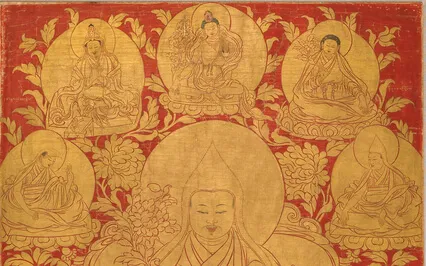
And the art connection for today is the fifth Dalai Lama,
Ngawang Lobsang Yatso,
1617 to 1682.
With previous incarnations,
This is a central Tibet dated 18th century,
Mineral pigments on cloth called thangka,
A scroll painting.
The dimension of this thangka painting is 27 by half into 17 by half inch.
The renewal of spirit from previous lives,
The great fifth Dalai Lama Ngawang Lobsang Yatso depicted here holding a lotus and a vase of longevity was the first theocratic ruler of a unified Tibet.
The fifth Dalai Lama is often referred to as the great fifth as he was spiritual and political leader.
His status is expressed through a language of divine inheritance,
The succession of past glorious empires through reincarnation.
In fact,
We just celebrated His Holiness the Dalai Lama,
The present Dalai Lama's 87th birthday on July 6th,
And it was celebrated by fans and followers and Buddhists from all over the world and all religion in fact.
The present Dalai Lama is the 14th reincarnation.
In this particular thangka painting,
We're looking at the central figure is the great fifth,
The fifth Dalai Lama.
The fifth Dalai Lama identified himself as an incarnation of the Bodhisattva of compassion,
Avalokiteshvara in Tibetan,
It's Chenrik-Zik depicted in this painting at top center.
Avalokiteshvara was not only the patron deity of Tibet,
But also the founder of the Tibetan empire,
Tsongtsen Gampo ruled 617-650 depicting at top left on this thangka painting was considered his emanation.
By asserting himself as an emanation of Avalokiteshvara,
The Dalai Lama was symbolically declaring that his was a divine kingship and more specifically that he was in the lineage of the Tibetan emperor who first unified Tibet and thus positioned himself as the rightful inheritor of the old Tibetan empire.
This beautiful thangka painting with the red background paintings such as this are associated with Buddha Amitabha,
The Buddha of Pure Land,
Also sometimes referred as Amitayus and his lotus family,
Which includes the incarnations of the Dalai Lamas.
In this sophisticated painting,
The figures are outlined in red and their surfaces are painted with an undercoat of yellow and an overcoat of gold.
Fine patterns are polished into this gold ground to create a subtle ornamentation in the painting surface.
Now let's bring on our teacher for today.
Tracy,
I'm so honored to introduce you.
Thank you so much for being here.
Tracy Cochrane has been a student and teacher of meditation and spiritual practices for decades.
She is the founder of the Hudson River Sangha,
Which is now virtual and is open to all.
The link for her weekly meditations can be found on our website,
Tacycockrane.
Org.
In addition,
Tracy has taught mindfulness meditation and mindful writing at the Rubin Museum of Art and the New York Insight Meditation Center,
As well as in schools,
Corporations and other venues worldwide.
She's also a writer and the editorial director of Parabola Magazine,
An acclaimed quarterly magazine that seeks to bring timeless spiritual wisdom to the burning questions of the day.
Her writings,
Podcasts and other details can be found on her website and on parabolamagazine.
Org.
In fact,
The Parabola Magazine has a new edition coming soon.
Tracy,
Thanks so much for being here.
Thank you,
Tashi.
It's an honor to be here with you and with all of you at the virtual Rubin Museum.
And I picked this beautiful illustration of the great fifth Dalai Lama because last week was the birthday of our current great Dalai Lama,
14th Dalai Lama.
And both of these great Dalai Lamas were characterized by having this extraordinary ability to be very effective in the world and do hard things,
And at the same time embody this great bodhisattva of compassion.
And it bedevils so many of us,
How can we do our jobs and do the hard things that life requires us to do and still maintain this inner connection to mindfulness,
To compassionate awareness.
And both of these great Tibetan leaders seem to have mastered this.
So at any rate,
What I wish to share with you is that I met His Holiness,
14th Dalai Lama,
Several times,
And the experience turned out to be very unexpected.
It taught me a great deal,
It opened my heart and my mind about what compassion can look like.
Because He actually snapped at me one time.
But let me back up.
The first time I met Him as a journalist in the company of other journalists from around the world,
He was proceeding down a line,
There were a line of us assembled,
And there was me and standing next to me was my husband Jeff,
Also a journalist.
And in a very regal yet warm way,
He was shaking hands with us.
Except when he got to my husband,
His handlers,
His bodyguards,
Whoever they were,
Took him by the elbows to lead him away.
And somehow it's as if he could feel Jeff's disappointment because he very gently kind of shook them off and turned back and walked over to my husband and held his hand in his two hands,
The Dalai Lama's two hands,
And made eye contact.
And it so touched me,
This freedom and sensitivity,
This obvious compassion that I never forgot it.
So another opportunity came up some years later to meet the Dalai Lama again in a small company of people.
And this time at an event honoring the former president of Costa Rica,
Oscar Arias,
Winner of the Nobel Peace Prize.
Did I want to go?
Yes,
I very much wanted to go.
And I was full of a desire to ask a question of the Dalai Lama and to have his response.
So off I went again with Jeff.
And again,
We had the great privilege of being in a small group with two great men.
But my heart was set on asking a question of His Holiness,
The Dalai Lama.
So there was a talk introducing Oscar Arias and then we were allowed to ask questions and right out of the gate I spoke,
The first one to speak,
Asking some heartfelt,
At the time it felt like a heartfelt question of the Dalai Lama.
And he looked at me and said,
This is Oscar Arias's night.
This is a special event for him.
I think we should be addressing our questions to him.
And there was a silence.
And he did,
After this pause,
Go on and answer my question.
But by then my psyche was completely full of this impression.
The Bodhisattva of compassion just snapped at me.
The Bodhisattva of compassion,
The great 14th Dalai Lama just put me in my place.
And I said,
This is what I was full of.
How embarrassing.
How shaming.
How extraordinary.
So it burned.
And I don't remember his answer.
I don't remember my question.
But that impression remained.
And for a while it was like a secret shame that occasionally I would divulge to.
I talked to another Dharma teacher who had met him a number of times who basically said,
You're overthinking it,
Tracy,
Because he does often speak very strongly to people,
Snap people.
And still it was a shame.
And over the years,
Over the years,
It softened.
It softened.
And the lens of my heart-mind began to open.
And not only was I able to see that he was correct in doing what he did,
That I was being very blind in a way,
At the time very rude,
Or at least a little bit rude,
In not recognizing the whole of the evening and seemingly intent on having a special experience for myself that I could treasure.
Not only that,
But I also came to see that compassion and compassionate awareness doesn't mean niceness.
And a lot of people in the West would have this fleeting impression of his Holiness as a kind of teddy bear,
Someone very jolly who laughs all the time and is warm and fuzzy.
This is not what compassion is,
And this is not what his compassion is.
His was an awareness and a quality of heart and mind that enabled him to lead the Tibetan people out of Tibet when he was 16 years old,
Braving all kinds of hardships and dangers.
His was a quality of compassion that guided him and enabled him to help a people who had scattered all over the world to remember what was most essential about their tradition.
It is a compassion that has helped the rest of us in the world to appreciate the underlying truths of this tradition,
Regardless of our blind spots,
As in my case.
And after all those years,
I remember it now with a smile even more so because before I joined you Tashi,
I told her a little bit about the story and said that in Tibet there's word for such a snap,
A shock,
And that it's auspicious.
And in my case it certainly was because it also showed me the theme for this month is renewal,
That an aspect of renewal is resilience,
Is a feeling that whatever we think we are,
We are more than this.
We too can open to a compassionate awareness that sees our own edges,
Our own,
The parts of us that we might feel some shame about or some embarrassment or some sorrow.
And this too is something that can be held in the light of awareness and that can bring us,
When held that way,
A new understanding,
A new depth,
A new flavor to what it means to be here,
To be human.
So let's sit together for 15 or 20 minutes and noticing how it feels to bring the attention back to yourself,
Back to your own body and heart and mind,
Allowing the eyes to close or gazing away from the screen.
But close eyes are really wonderful for looking inward.
And just allowing yourself to notice how it feels to be here today.
Noting that even though you are in your own home,
Your own office,
You're also joining hearts and minds with others right now.
And notice that there is already an awareness that's here that can open to receive an impression of how you are today.
Not thinking about it,
Not analyzing it,
But just opening to receive.
Letting this awareness,
This attention go anywhere it's naturally inclined to go in the body.
If there's a place of tension,
It might wish to go there or to just settle at the feet or the hands or open to take in an impression of the whole weight of the body.
Just let everything happen to you.
Noticing that this awareness can meet everything that arises with compassion and interest.
And when you notice that you've been here,
You've been here,
You've been here,
You've been here,
You've been here,
You've been here,
You've been here,
Know that this is natural.
Know that this is just thinking.
Gently bring the attention home again to the body,
To the experience of this present moment.
Notice how it feels to be under the gaze of an attention that's open like the sky.
That's kind of hint.
Curious.
Caring.
Notice how it feels to have everything that comes up,
Every fleeting thought or fear or tension be accepted,
Seen,
Not judged or rejected.
Notice how it feels to be under the gaze of an attention that's open like the sky.
Let yourself rest in stillness,
Which doesn't mean silence but softness,
Not striving.
Being with what is here.
Let yourself rest in stillness,
Which doesn't mean silence but softness,
Not striving.
Notice as you settle down,
As you make this movement of coming home to the body in the present moment,
Notice that you also open to presence,
To an awareness inside and outside.
Let yourself rest in stillness,
Which doesn't mean silence but softness,
Not striving.
Notice that there's an energy inside you,
An aliveness that doesn't stop with your skin.
An aliveness that doesn't stop with your skin,
That fills you and radiates outward around you towards life.
Notice how alive you are,
How connected to life.
How connected to presence,
To this presence that sees with compassion.
Thank you.
Notice how it feels to have everything,
The times of distraction,
And the times of coming home to the present,
Everything acceptable,
Human.
Not to be rejected,
But received with kindness and curiosity.
Thank you.
Just rest in stillness,
In presence.
Not grasping at any solution,
Any story,
Any one impression.
Just softening and opening and being with what is.
Thank you.
Noticing how it feels to have everything that appears today,
Worthy of compassion,
Of acceptance,
Of interest.
Letting everything arise and pass like waves in the ocean.
Nothing to cling to,
Nothing to reject.
Thank you.
Just rest.
Just allow yourself to be seen by an attention that's compassionate,
Fast like the sky.
Notice how it feels to accept yourself fully as you are.
Notice how it feels to accept yourself fully as human.
Subject causes and conditions.
And also a compassionate awareness that sees.
Letting go of separation,
Of fear.
Of thinking.
Just being here.
Thank you.
Thank you so much for that beautiful question,
Tracy.
Thank you for listening and thank you for practicing with us.