Welcome to the Mindfulness Meditation podcast.
I'm your host,
Dawn Eshelman.
Every Wednesday at the Rubin Museum of Art in Chelsea,
We present a meditation session led by a prominent meditation teacher from the New York area.
This podcast is a recording of our weekly practice.
If you would like to join us in person,
Please visit our website at rubinmuseum.
Org slash meditation.
We are proud to be partnering with Sharon Salzberg and teachers from the New York Insight Meditation Center.
The series is supported in part by the Hemera Foundation.
In the description for each episode,
You will find information about the theme for that week's session,
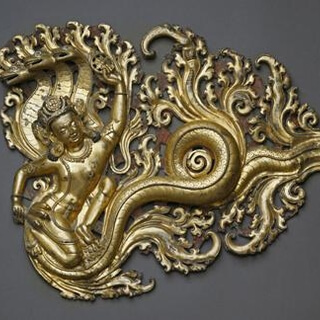
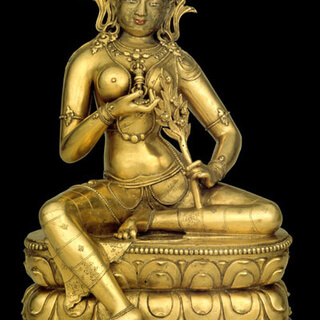
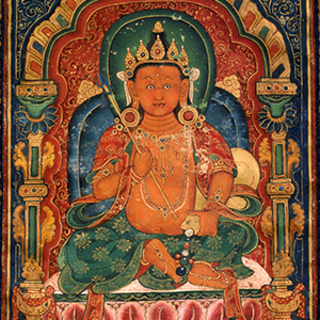
Including an image of a related artwork chosen from the Rubin Museum's permanent collection.
And now,
Please enjoy your practice.
Good afternoon,
Everybody.
There's a nice buzz in the room today.
Is it still sunny and beautiful outside?
Great.
Welcome to the Rubin Museum of Art and to our weekly mindfulness meditation practice.
My name is Dawn Eshelman.
Great to have you all here.
There's a little change in the air today.
We are in fact talking about change this month.
And we're bringing this theme to you in relationship to this topic of the future.
All year long,
We've been examining our relationship to the future.
And last month,
We looked at hope and anxiety and how that affects our relationship to the future.
And of course,
A piece,
A part of that is certainly change.
Change being,
You know,
In most philosophies,
Western and Eastern,
A kind of constant.
And we're looking at here today behind me is a tool for change,
For transformation,
For change of the kind of ultimate sort,
Enlightenment.
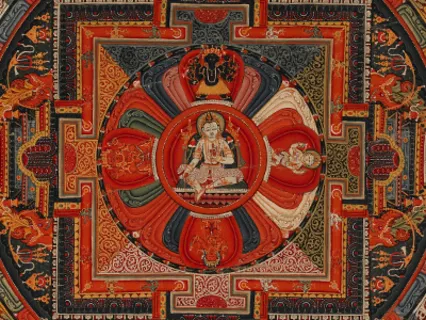
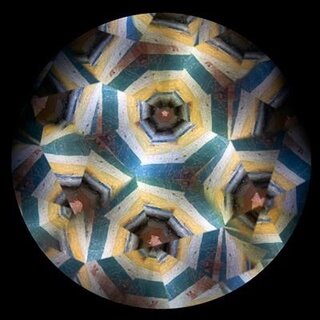
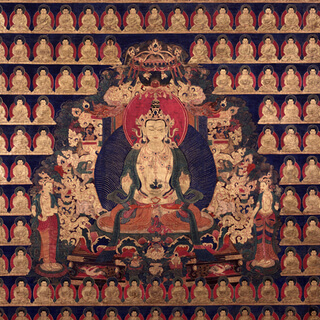
This is a mandala.
And it is the mandala of Amo Gopasha.
This is from 15th century northern Nepal or southern Tibet.
And this is a beautifully detailed tanka.
And I encourage those of you who are able to join Jeremy on the free gallery tour afterwards,
So you can really get a look at a lot of the detail.
We've tried to show you a bit of it here in detail as you've been entering.
But it is really a interesting and kind of packed with coded symbolism piece here.
And at the center is in fact not Amo Gopasha,
But is Avalokitesvara.
So bodhisattva of compassion who really dedicated,
You know,
His entire practice to the enlightenment of others,
Helping others become enlightened,
Postponing his own Buddhahood in order to do so.
And in the most kind of general terms,
A mandala can be utilized by a practitioner who might sit in front of it in meditation,
Who would in fact work their way through each kind of concentric circle of the mandala to the very,
Very center.
And in some cases this represents kind of a life path or a journey.
And in fact you can see there are a multitude of layers and gates that one would enter through in order to reach the center.
And upon reaching the center,
The practitioner would then try to embody the qualities of that being in the center of the deity.
So I'll just pause it to you.
If you were to create a mandala that kind of represented your life,
What would be at the center?
What would you put?
In this case we have unfailing compassion,
Unfailing compassion at the center.
And it is through this process of aligning with those qualities of the deity that the practitioner would really realize their own power and kind of the infinite nature of that power.
So with change we think about all of these qualities and our own responsibility as well.
So delighted to have Tracy Cochran back here with us.
She is a writer and the editorial director of the quarterly magazine Parabola,
Which you can find upstairs in the shop.
Beautiful edition right now on Hope,
Which is nice and timely.
And also parabola.
Org.
And in addition to the Rubin,
She teaches at New York Insight and every Sunday at Hudson River Sangha in Tarrytown.
You can find her writings and teaching schedule online at tracycockran.
Org.
Please welcome her back,
Tracy Cochran.
I'm delighted to be here today.
I could hear such a happy sound in the room.
And I know what it's about.
I think you can guess too that this is the first day of Diwali,
Which is the Hindu festival of lights.
And it celebrates the overcoming of darkness by light,
Of good overcoming evil.
Goodnesses appear to overcome evil and knowledge is overcoming ignorance.
And it's true.
It's an ancient,
Ancient festival.
And it's in the Sanskrit text.
And it's not unrelated to the mandala in impermanence because it celebrates the fact that when things are darkest,
Lights can appear.
And if we were in India,
We would see all kinds of small lights on rooftops and in temples.
And that light doesn't have to be a lamp.
It could be an act of human warmth or engagement.
And I certainly felt it yesterday at my local polling place when it was absolutely mobbed.
And I was particularly touched by not one,
But two new mothers cradling little newborns in one arm and voting with the other arm.
There was something very touching about that.
And I realized that it's interesting to remember that a mandala is the big picture.
It's a cosmos.
It's a circle.
And there's something about stepping back.
And we tend,
When things feel dark to us,
To think it will always be this way.
There's something frozen and immovable about it.
And then we remember,
No,
Things can change.
Light can appear.
A shift can happen.
And this is associated,
This mandala,
With the bodhisattva of compassion,
As Dawn said.
And I was so touched this time reading something that I've read so many times before,
That this bodhisattva stays here.
He does not leave the scene,
Or she in her female form will not leave the scene until every single being on earth is liberated from suffering and there are causes of suffering.
And I read that over and over again,
This bodhisattva will not leave,
Will help every being,
Including black widow spiders,
Including Senate majority leaders,
Including heads of state.
There is nothing this bodhisattva won't face and look at and see into.
And of course last week was Halloween,
Which isn't unrelated to Diwali because in ancient Celtic times they saw this as a thin time,
A time when spirits,
Including spirits that are very fearful and very terrifying and very hate-fueled,
Can pass into this world.
But so can the spirits of our beloved ancestors.
So in ancient Scotland,
People would put on masks and ghostly outfits to scare away,
To stand up to the fearful spirits.
Have you ever found yourself acting fierce to ward off something that scared you?
And they would also invite home the spirits of their beloved ancestors.
And they would do something that I might have mentioned here before,
But it's so worth mentioning.
In some places they would light a great big bonfire and they would put out the lights in their own houses and imagine how that must have looked in a world lit only by fire.
And they would relight their own fires from a common fire.
And they would go home and light it and invite the spirit of their benevolent and beloved ancestors home.
And I was so taken by this because I thought this is exactly,
Exactly what we can be doing now.
And mind you,
When Don invited me to lead today,
I didn't know what the news would be this morning.
And I realized that regardless of the news,
There's something that's the same.
The ancestor,
Which is our earliest ancestors,
Regardless of our ethnicity,
Regardless of our ancestral journey,
Our earliest ancestors lived close to the land.
That's what indigenous means,
To be of the land.
They wanted the same things.
They wanted to be warm when it was cold.
They wanted to be safe and have refuge.
They wanted something good to eat and to be as well as they could be.
They wanted to belong,
To be welcome,
To be happy.
And I realized that our bodies come to us from those ancestors and so do our hearts.
Every baby has an indigenous heart,
An indigenous body,
Wants the same basic goodness.
And I realized that we can light a common fire in a place like this and remember together that common humanity,
That common wish for basic good things.
And we can take refuge there.
We can take refuge there in this present moment when we're about to sit,
Remembering that everything is impermanent.
Everything changes,
Everything changes.
And that in the middle of the darkness there can be light.
And that love can overcome hatred and that basic feeling of goodness and generosity that could take a new mother out on a day when it was pouring rain with her baby to cast her out.
And that absolutely no state is final.
No success is final and no failure is final.
And that we can always take rest and refuge in this basic heart and body that understands how to continue,
How to open to change,
How to welcome it,
Remembering what truly matters,
What we have in common with all beings.
So I'll leave it there and we can sit together,
Taking a comfortable seat.
Really take your time granting this body welcome,
Allowing yourself to remember that this body came to you from your distant,
Distant ancestors.
Ancestors who came through all kinds of turmoil,
Warfare,
Displacements,
Hardships,
And survived.
Allowing yourself to just sit up as straight as you can and plant your feet and sense how it feels to be in this body right now with no judgments or expectations about how you should feel,
Just welcome it.
Noticing that this kind attention begins to soften the body.
We begin to relax.
Knowing that no matter what burdens you carry here,
You can sit and breathe and be acceptable exactly as you are.
Noticing that even though there's thinking,
There's sounds,
There's sensations,
All this is happening,
You can come home,
Come back to the body in this moment and back to the breathing.
And when you get taken by your thinking or your feeling or your feeling,
You can just feel it.
Noticing things,
You can notice this with no judgment and gently come home again.
Noticing that when you come home to the body and the breath,
You don't shut down,
You open to life.
Sati,
The word for mindfulness,
Means to remember.
You begin to remember that you belong to life.
Allowing air to come in and go out,
Impressions to pass through.
Noticing that when you come home to the body and the breath,
You can notice this with no judgment and you can come back to the body and be acceptable.
Noticing that when you come back,
When you come home to the body,
You remember a light inside that is attention without thinking,
Without judging.
Noticing that when you come home to the body and the breath,
You can notice this with no judgment and you can come back to the body and be acceptable.
Noticing how it feels to come back with no judging.
You begin to feel accompanied by attention,
By compassion.
Noticing that when you come home to the body and the breath,
You can come back to the body and be acceptable.
Noticing that when you come home to the body and the breath,
You can come back to the body and be acceptable.
When we get sleepy or thinking,
We gently come back to the body,
Noticing that the body has its own attention,
Its own intelligence.
It responds without thinking.
Noticing that when you come home to the body and the breath,
You can come back to the body and be acceptable.
Noticing that when you come home to the body and the breath,
You can come back to the body and be acceptable.
Meditation is a movement of coming home,
Opening to life,
To the depth of our own mind.
Our own lives.
Noticing that when you come home to the body and the breath,
You can come back to the body and be acceptable.
Noticing that when you come home to the body and the breath,
You can come back to the body and be acceptable.
When we go to sleep or start to daydream or think,
We gently come home.
Come home to the warmth and the vibrancy of this life.
Noticing that stillness can be very rich.
Rich and alive.
Noticing that when you come home to the body and the breath,
You can come back to the body and be acceptable.
Thank you,
Thank you very much.
That concludes this week's practice.
If you'd like to attend in person,
Please check out our website,
Rubinmuseum.
Org slash meditation,
To learn more.
Sessions are free to Rubin Museum members,
Just one of the many benefits of membership.
Thank you for listening.
Have a mindful day.