Welcome to the mindfulness meditation podcast presented by the Rubin Museum of Art.
We are a museum in Chelsea,
New York City that connects visitors to the art and ideas of the Himalayas and serves as a space for reflection and personal transformation.
I'm your host,
Dawn Eshelman.
Every Monday we present a meditation session inspired by a different artwork from the Rubin Museum's collection and led by a prominent meditation teacher from the New York area.
This podcast is a recording of our weekly practice currently held virtually.
In the description for each episode,
You will find information about the theme for that week's session,
Including an image of the related artwork.
Our mindfulness meditation podcast is presented in partnership with Sharon Salzberg and teachers from the New York Insight Meditation Center,
The Interdependence Project,
And Parabola Magazine.
And now,
Please enjoy your practice.
Hi everyone.
Welcome to Mindfulness Meditation Online with the Rubin Museum of Art.
I'm Dawn Eshelman.
Great to have you all here joining us.
It's August.
Unbelievable.
And here we are for our weekly practice where we combine art and meditation online.
For those of you who are new to us,
The Rubin Museum is a museum of Himalayan art and ideas in New York City.
And it's great to have you here.
We are open.
The Rubin Museum is open to all and our staff on the ground is following very thoughtful protocols to keep everyone as safe as possible.
So please book your ticket.
You can utilize a timed ticket.
And come check out our beautiful exhibition Awaken,
A Tibetan Buddhist journey toward enlightenment,
Which explores the steps in the journey of self-knowledge and transformation from chaos to awakening and everything in between.
So inspired from the exhibition,
We take a look at a work of art from our collection.
We hear a brief talk from our teacher.
And then we have a short sit together,
About 15 or 20 minutes,
Which is guided by our teacher.
And today we have the fabulous Tracy Cochran,
Who I'll introduce and bring on in just a moment.
Tomorrow,
We launch the final episode of the Awaken podcast.
This is something that we've created specifically in response to and inspired by the Awaken exhibition.
So tomorrow we get to hear from the amazing Yongei Minjor Rinpoche.
You can hear him on episode 10 of the podcast called Awaken.
And if you've enjoyed the series,
We would love it if you would give it a review on whatever app you're using to listen.
It really helps.
So let's look together at a work of art from our collection.
And our theme this month,
As we begin the month of August together,
Is offerings.
And we are looking at offerings kind of in the spirit of all of the amazing bounty that is often in our lives around this time of year.
If you go to the farmer's market,
You will see many,
Many offerings that we are enjoying right now.
And it's often a time of sharing with one another in a secular sense.
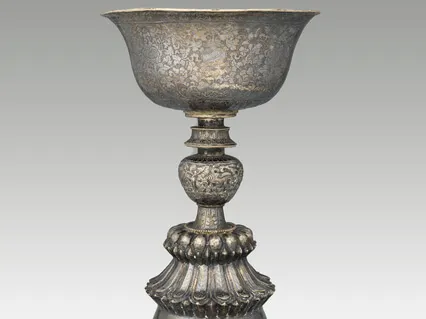
And so here we're looking at an object that is a ritual object in the tradition of Tibetan Buddhism.
And it's a butter lamp.
It is from Tibet.
It is made of silver.
It is about 11 inches high,
So about as tall as a sheet of paper.
And butter lamps,
Actually,
Before I talk about the symbolism,
Let's just look together at this beautiful detail here.
We can see that there is a beautifully intricate pattern on this cup of the butter lamp that depicts this kind of labyrinth of lotus blossoms,
Stems,
Leaves,
Petals,
Buds,
And blossoms.
And then the stem itself has many different kind of textures and expressions of a lotus.
So especially kind of the last three levels there of the stem,
You can see imagery that we often see in Tonka paintings.
We'll see a figure seated on a kind of lotus blossom that looks similar to some of these petals here.
So of course,
The lotus is such an important symbol in Tibetan Buddhism,
Reminding us of this purity,
This Buddha nature in every person from the perspective of Tibetan Buddhist practitioners.
And the butter lamp is a very common feature of Tibetan Buddhist temples and shrines and monasteries all throughout the Himalayan region.
Butter lamps are traditionally placed on the altar as an offering,
And they're offered during a meditation practice or a ceremony with the wish that all beings be free from suffering and reach enlightenment.
The lamps traditionally burn yak butter,
But now they often use vegetable oil or ghee,
Clarified butter.
Butter lamps are used by Buddhist practitioners to focus the mind and aid meditation.
So the senses are a really important kind of way of supporting that action.
And oftentimes monks are in charge of restocking the constant offerings of butter lamps throughout the monastery,
But practitioners who are on pilgrimages are also supplying the lamp oil as a way of gaining merit.
And symbolically,
These lights are seen to banish darkness outside and dispel the darkness of ignorance within.
So butter lamps represent this widely accessible form of offering,
And that's why they're seen really throughout the world in Buddhist monasteries.
And most importantly,
The benefits of offering just one butter lamp is said to be immeasurable.
Butter lamps represent this physical embodiment of countless prayers and wishes.
Okay,
So let's bring on our teacher today,
The fabulous Tracy Cochran,
Who's been a student and teacher of meditation and spiritual practice for decades.
She is the founder of the Hudson River Sangha,
Which meets virtually right now,
Wednesdays and Sundays,
But I hear tell that soon they'll be able to meet in person as well.
And you can find all about Tracy and her Sangha at tracycockran.
Org.
In addition to teaching here at the Rubin and in many other settings,
She is also a writer and the editorial director of Parabola,
Which is an acclaimed and really beautiful quarterly magazine that seeks to bring timeless spiritual wisdom to the burning questions of the day.
Well,
The burning question of the day has to do with fire,
Not only here in mindfulness meditation with this butter lamp,
But the new issue of Parabola is all about fire.
So you can find out more about Tracy's writings,
Podcasts,
And other details on her website and parabola.
Org.
Tracy,
Great to have you here.
I'm glad to be here with my friends who I can't see,
But I sense.
And one of the wonderful features about Zoom is that it really calls us to sense ourselves.
To sense ourselves.
And I'm inviting you to really just entertain the idea that you are a lamp.
You're a lamp,
A light,
And that might be hard to imagine,
Especially in such times,
Challenging times,
Transitional times,
And a great many uncertainties and challenges confront us inside and outside.
And one of the things I love about this tradition is the concept of the bardo,
The transition.
And in the Tibetan Buddhist sense of the transition,
When you enter the bardo,
You are met by a Buddha,
And they're Buddhas,
They have special qualities,
And this one holds up a mirror,
A mirror to you.
Picture that.
And traditionally,
And even instinctively,
We think of that with trepidation,
That a mirror is going to hold up our shortcomings and deficiencies and mistakes,
And we certainly all have them.
But when I was preparing for today,
I remembered that mirrors also magnify light.
They do.
They would have,
I live in a place with many blackouts and I become fascinated with the way in earlier times I put a candle or a lamp in front of a mirror to make it expand.
And so what if this Buddha with a mirror was holding a way up for you to experience the light you have inside you?
And that light isn't,
This isn't a fantasy.
It's a capacity we have to hold ourselves and other people in light of compassion.
We start with ourselves.
We tend to think of good deeds as something outside,
But what if it was something inside,
What if it was right now the ability to let yourself sense and feel exactly what presents itself to be seen and to be felt,
To sink below your thinking into just feeling and feeling with an attitude of welcome.
And there's a wonderful,
Famous contemporary poem that starts with,
The time will come when with elation you will greet yourself arriving in your own norm,
Your own mirror and you will smile with welcome.
What if you could do that right now,
Even if what you're feeling today is stress or not much or sorrow or distraction,
What if you could sense that and feel it with an attitude of acceptance?
Welcome.
The contemporary Buddhist teacher Tara Brach quotes a Sufi teaching often that is so beautiful and it says,
Don't feel bitter about your allotment of the world's pain and in Sufism they picture a world mother like Kuan Yin or Tara,
A world being who holds all pain,
All suffering and we are part of that heart so that what we feel,
What confronts us is not our pain but a portion of the world's pain,
The world's sorrow.
What if we right now considered that what we're feeling isn't something that separates us from life and from others but something that we share with all humans and maybe possibly with all beings and that instead of rejecting it or resenting it we held it in the light of compassion which is acceptance.
We regard it with attention,
A kind attention which is a form of care.
We pay attention to what we care about.
And what if we let ourselves begin to experience that we ourselves are lights of compassion,
Of love,
That we're the ones we look for who welcome us smiling and say,
Darling,
In the words of Thich Nhat Hanh,
I'm here for you,
I see that you suffer and I'm here,
I'm here.
And there's a famous line from Shakespeare,
From Merchant of Venice that reads,
See how far that little candle throws its beams so shines a good deed in a weary world.
And what if today we realize that that good deed is this small movement that we're making together right now of allowing ourselves to feel our suffering and holding it in compassion,
Discovering that as we do so we have a light of presence that shines out to others as well.
So let's take our seats to sit together.
And let yourself be comfortable but also let your back be straight.
And let your eyes close.
If that's not comfortable for some reason,
Just keep them partially parted and gaze down.
But closing your eyes is best.
The better to feel how it feels to be here.
Notice that even though you are physically in a different place from me and others,
That you are actually sitting with others,
With other people who are just like you in their quest for an attention that doesn't judge,
That meets them with welcome.
Let yourself rest in stillness,
Knowing that you have company.
And when you find yourself thinking,
Dreaming,
And listening to your thoughts,
Your thoughts dreaming,
Know that this is completely natural,
Just like breath.
And gently come back again to the sensation of sitting here with others.
And let yourself rest in stillness.
Notice how it feels to rest in the light of an attention that's kind,
Curious,
And accepting.
And let yourself rest in stillness.
And let yourself rest in stillness.
And see that you can begin again.
And every time find welcome.
And let yourself rest in stillness.
When you come back to the body,
To sensation,
To feeling,
You also come back to presence.
Offering yourself to the light of attention.
And let yourself rest in stillness.
And let yourself rest in stillness.
And let yourself rest in stillness.
And let yourself rest in stillness.
And let yourself rest in stillness.
And let yourself rest in stillness.
And let yourself rest in stillness.
And notice that when you return,
When you come back to sensation,
You actually open.
You are more present.
You are more able to receive the life that's being offered.
Notice breath,
Impressions,
Sensations.
Notice breath,
Impressions,
Sensations.
Life offered to you.
Amen.
And notice your own response,
Your breath,
Your responsiveness to touch on your skin,
To sound,
To presence.
And notice your own response,
Your own presence.
And notice your own response,
Your own presence.
And notice your own response,
Your own presence.
And notice your own response,
Your own presence.
Being alive is to be in a state of offering.
And being offered.
And notice your own response,
Your own presence.
And notice your own response,
Your own presence.
And notice how it feels to let everything happen.
With acceptance.
With a light of compassion.
With a light of kindness.
And notice how it feels to let everything happen.
And notice how it feels to let everything happen.
And notice how it feels to let everything happen.
And notice how it feels to let everything happen.
And notice how it feels to let everything happen.
And notice how it feels to let everything happen.
And notice your own acceptance,
Care.
Touching others.
And notice how it feels to let everything happen.
And notice how it feels to let everything happen.
And notice how it feels to let everything happen.
And notice how it feels to let everything happen.
And notice how it feels to let everything happen.
And notice how it feels to let everything happen.