Welcome to the mindfulness meditation podcast presented by the Rubin Museum of Art.
We are a museum in Chelsea,
New York City that connects visitors to the art and ideas of the Himalayas and serves as a space for reflection and personal transformation.
I'm your host,
Dawn Eshelman.
Every Monday we present a meditation session inspired by a different artwork from the Rubin Museum's collection and led by a prominent meditation teacher from the New York area.
This podcast is a recording of our weekly practice currently held virtually.
In the description for each episode,
You will find information about the theme for that week's session,
Including an image of the related artwork.
Our mindfulness meditation podcast is presented in partnership with Sharon Salzberg and teachers from the New York Insight Meditation Center,
The Interdependence Project,
And Parabola Magazine.
And now,
Please enjoy your practice.
Hi,
Everyone.
Welcome to mindfulness meditation online with the Rubin Museum of Art.
I'm Dawn Eshelman,
And we are a museum of Himalayan art and ideas in New York City and so glad to have you all joining us.
This is our weekly program where we combine art and meditation online.
Today,
Actually here in our session,
We take a theme from the Montelab as well.
We're going to be talking about transforming afflictive emotions.
So taking these really challenging emotions,
Envy,
Anger,
Ignorance,
And through being with them,
Really exploring them,
Being able to transform them into wisdom,
Into equanimity,
Joy,
Etc.
So that's what we'll be talking about in just a little bit.
Before I take us back to our art object with that in mind,
Just a reminder,
We will look at art together.
We'll then welcome our teacher,
Who is today the wonderful Sharon Salzberg.
And Sharon will give us a short talk about this idea of transforming afflictive emotions and what that has to do with our practice.
And then we will sit together 15 or 20 minutes guided by Sharon.
Okay,
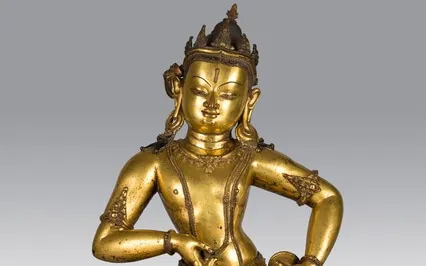
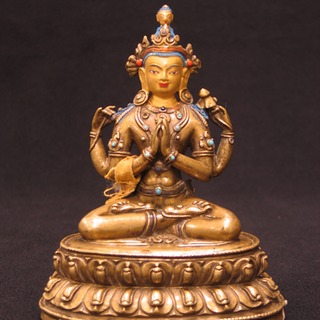
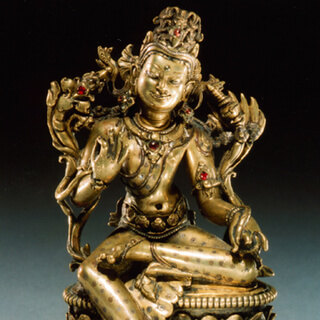
So let's look one more time here at this beautiful sculpture.
This is from Nepal.
This is 14th century gilt copper alloy of multiple parts.
And with a little bit of traces of pigments here,
So a little bit of paint.
And this is Vajrasattva.
Vajrasattva is this embodiment,
The personification of the Vajra.
The Vajra being that ritual implement that often accompanies the bell,
Which stands for this power,
This indestructible power of the enlightened mind.
And in fact,
You can see Vajrasattva holding in his left hand a bell and in his right hand,
He would have been holding here a Vajra,
Which is not here anymore,
But interesting to imagine it there and to know that those two symbols are going together here in the sculpture as well.
So Vajrasattva is this highly accomplished bodhisattva,
But also a primordial Buddha who's often invoked in order to purify errors made,
Right,
During ritual practice and other practices.
So it's a very elegant example of Nepalese sculpture.
And we have this kind of beautifully proportioned body and this strong limbs and it's sort of the sway to his torso is what I'm getting at here.
There's like this beautiful bend as he's kind of dancing while he's sitting here,
Both movement and stability coming together here.
So let's bring on Sharon.
Sharon Salzberg is the co-founder of the Insight Meditation Society in Barre,
Massachusetts,
And has guided meditation retreats all over the world for many years.
And her latest book is Real Change Mindfulness to Heal Ourselves in the World,
Which is coming out in paperback,
I believe at the end of this month,
Just in time for a little gift giving.
Sharon is the author of many other wonderful books.
Real Love,
The Art of Mindful Connection,
Real Happiness,
The Power of Meditation and Faith and Love and Kindness and many others.
She's been a regular participant on many of our stage conversations here at the Rubin.
Sharon,
Welcome back.
So nice to have you.
It's a great delight to be with you all.
I love looking at the chat and see where you're tuning in from.
You know,
And I usually have a commentary like,
Oh,
I grew up in Washington Heights.
Oh,
You know,
You're right around the corner.
I looked at an apartment there once.
And then some of you from much further away,
Which is an incredibly delightful thought as well,
You know,
To,
To have that sense of gathering coming together.
And I find this a really compelling and interesting topic.
First of all,
I,
I really like the term afflictive emotion.
There are a lot of terms that cover that category of things we feel like,
You know,
As Dawn said,
Envy and jealousy and so on.
Including like defilements is one very classical translation.
The term in Pali,
The language of the original Buddhist texts is klesa in Sanskrit.
It's klesha.
And it literally means torment of the mind.
So if you use a word like defilement,
It of course sounds kind of judgmental,
Like I'm defiled,
Like how,
How Richard,
You know,
I'm awful,
But,
Um,
I think we can all get behind the idea of torments of the mind.
And interestingly,
It's not from feeling one of these or a whole bevy of these emotions,
And it's not from feeling them intensely that we get tormented,
But it's from,
In a way,
Taking them to heart,
Getting invested.
A lot of those emotions I find,
You know,
Um,
Greed,
Grasping,
Hatred,
Uh,
Delusion.
They're really almost like misplaced faith or misplaced trust.
You know,
Many of us have been taught our whole lives.
If we only hold on tightly enough,
We'll be okay.
If we only like fight and battle and push away and resent,
We'll get empowered.
And so it takes something.
It takes a whole process really to,
To learn to relate differently,
But that's the whole point,
You know,
Not to judge oneself for what you're feeling,
But to take the opportunity of the appearance of one of these States to practice relating differently.
And often,
Uh,
There is a transformation that happens right there because embedded within any of these States is maybe hope or trust or wanting to come close to life or wanting,
Uh,
To Marshall energy,
To be courageous.
That would be anger,
You know?
And so we have that opportunity when we practice relating differently.
So I just really liked that term afflictive emotion because one of the exercises I do,
And I really urge people to do is when you see the arising of one of these States and you see in your mind,
You're calling it bad and wrong and terrible and awful.
And you're calling yourself bad and wrong and terrible and awful.
See if you can do a mental translation to painful.
This is a painful state.
When we get lost in it,
Where we get defined by it,
When we get engrossed in it,
It's also a painful state when we hate it and we're ashamed of it and we're afraid of it.
And we want to push it away more than anything.
And yet to name it a painful state can open the door to a kind of compassion and presence,
Which is really like,
That's the alchemical agent that will do the transformation.
So there's a lot in what I just said.
We have to understand these things will arise.
This is part of being a human being.
It's never just me.
It feels like just me a lot of the time.
And we may expressly add that sense of isolation,
But it's never ever just me.
So we can acknowledge this is part of the human condition.
Also we can invest in a kind of interested stance because,
You know,
These states are so painful or we're taught they're so wrong to feel that it's not common to actually sit and take a look,
A really heartfelt look.
And almost like saying,
What is this?
What is this state?
You know,
What happens in my body with the appearance of let's say envy or,
Or hatred?
What's happening?
What's the,
Um,
The mood,
The movie that is created.
If you're sitting and looking at something like hatred,
You see it's a very complex state with strands of maybe grief and sorrow and fear and almost always within that state,
We find a sense,
A certain sense of helplessness because in Tibetan culture,
They say anger in this case is what we pick up when we feel weak because we think it's going to make us strong.
And there is a strength from the energy of it,
But there's also a kind of brittleness we can see.
And there's a tunnel vision we can see.
It's like,
If you think about the last time you were just like enraged at yourself,
Bring it up.
You maybe can bring it up right now.
It's not also a time where we think,
Oh,
Said that really stupid thing at that meeting this morning,
But I did five good things this morning too.
It's like those five good things.
They're gone.
They're wiped away when we are lost in that state.
And again,
This is different than feeling that state.
When we're lost in that state,
We lose a lot of information.
We lose a sense of options.
We lose a sense of possibility.
We lose a sense of creativity,
Right?
It really is like being stuck in a vice and we just,
We learn that we come to see that we see what's happening in our bodies.
We see the other emotions that are kind of part of this complex of feelings.
We see the nature of how it manifests,
What the consequences are of really getting submerged in one of these States.
We see its afflictive nature.
We have some compassion for ourselves and we are empowered by that clear seeing because when it comes up in life,
In conversation,
At work,
In commuting,
Wherever we are,
We have a way of being with it that is not getting lost in it,
Not getting overcome by it,
And also not trying to deny it or push it away or judging ourselves for what we're feeling.
And so the afflictiveness comes from being lost or from decreeing of the enemy and somehow desperately trying to make it not what you're actually feeling.
And this is what we practice.
We practice it over and over and over again to be present with what arises,
To acknowledge it,
To neither.
And this is all practice.
It's not something that most of us have been brought up doing.
Some may be,
But not very many of us.
And it's like a skills training,
You know,
So you've got to kind of give yourself a break as you keep practicing and practicing and understand that we're developing the skill.
It gets easier and easier over time.
So practicing being with what's happening,
Neither getting sucked into it and overcome by it,
Nor pushing it away and just being there,
Present,
Balanced,
Aware,
And kind.
So the last thing I'll say before we sit is I chose the Vajrasattva because there are other practices,
Not ones that I particularly teach,
But there are practices around Vajrasattva and repeating the mantra and in different forms.
There's a hundred syllable mantra.
There's a six syllable mantra.
And Vajrasattva practice,
I think,
Resembles any kind of meditation practice and what we do in that to a certain degree,
At least it's a purification practice.
It's like well-known if you're doing a meditation practice of any kind and certainly something like Vajrasattva practice.
A lot of what is quieter within us,
But actually having power within us,
Like any of these afflictive states,
Tend to come to the surface.
So it's not uncommon to feel like I'm getting worse.
You know,
Like there's a lot of stuff coming up because any practice is a purification practice.
But again,
You know,
It's not the point like to quantify things like I had five minutes of hatred yesterday and I have 45 today,
I'm getting worse.
It's not about that.
Everything is about how we relate to what comes up.
And so do not despair if you are committed to exploring a meditation practice and it's not all serene and lofty and exquisite.
You know,
That's okay.
It's actually really good because we get to see and we get to understand for ourselves where greater happiness lies and the choices that we can make toward that.
Okay,
So let's sit together.
Can sit comfortably.
We can start just by listening to sound,
The sound of my voice or other sounds.
Today I'm speaking to you from Barre,
Massachusetts,
So I'm not bringing the sounds of New York City.
But you may be hearing very local sounds.
Of course we like certain sounds and we don't like others,
But we don't have to chase after them to hold on or push away.
Just let them come,
Let them go.
Unless you are responsible for responding to the sound,
You just have it wash through you.
Bring your attention to the feeling of your body sitting,
Whatever sensations you discover.
See if you can feel the earth supporting you.
See if you're going to feel space touching you,
Which means moving into receptive mode because space is already touching us.
It's always touching us.
We just need to feel it.
And bring your attention to the feeling of your breath,
Just the normal natural breath.
You don't have to try to make it deeper or different.
And see where the breath is clearest for you or strongest for you.
That's the nostrils or the chest or the abdomen.
You can find that spot,
Bring your attention there and just rest.
See if you can feel one breath.
If you like,
You can use a quiet mental notation like in,
Out or rising,
Falling to help support the awareness of the breath,
But very quiet.
So it really is just a support for feeling the breath.
If images or sounds or sensations or emotions should arise,
But they're not all that strong.
If you can stay connected to the feeling of the breath,
Just let them fall on by your breathing.
But let's say a strong emotion does arise and it's easily classified as afflictive.
See if you can acknowledge simply this is what's happening right now.
This is the truth of the present moment.
There's anger,
There's envy,
Whatever.
Or maybe it's a very positive,
Uplifting emotion that's quite strong.
There's joy.
There's gratitude.
Just to notice this is what's happening right now.
No judgment.
And then see if you can bring your attention back to the feeling of the breath.
And for all those perhaps many times,
You're just gone.
Lost in thoughts,
Swept up in a fantasy.
When you fall asleep,
Truly don't worry about it.
We say the most important moment is the next moment after you've been gone.
Where we have the chance to practice letting go and beginning again.
So we let go of whatever's taken us away.
Come back to the feeling of surprise.
Come back to the feeling of surprise.
You you you you you you you you you you you you you you you you you you you you yeah,
When you feel ready,
You can open your eyes,
Or lift your gaze,
And we'll end the meditation.
Thank you,
Sharon.
That concludes this week's practice.
If you'd like to support the Rubin in this meditation series,
We invite you to become a member.
If you're looking for more inspiring content,
Please check out our new podcast,
Awaken,
Hosted by Laurie Anderson.
The 10-part series features personal stories that explore the dynamic path to enlightenment and what it means to wake up.
Now available wherever you listen to podcasts.
Thank you for listening,
And thank you for practicing with us.