Welcome to the mindfulness meditation podcast presented by the Rubin Museum of Art.
We are a museum in Chelsea,
New York City that connects visitors to the art and ideas of the Himalayas and serves as a space for reflection and personal transformation.
I'm your host,
Dawn Eshelman.
Every Monday we present a meditation session inspired by a different artwork from the Rubin Museum's collection and led by a prominent meditation teacher from the New York area.
This podcast is a recording of our weekly practice currently held virtually.
In the description for each episode,
You will find information about the theme for that week's session,
Including an image of the related artwork.
Our mindfulness meditation podcast is presented in partnership with Sharon Salzberg and teachers from the New York Insight Meditation Center,
The Interdependence Project,
And Parabola Magazine.
And now,
Please enjoy your practice.
Hi,
Everyone.
Welcome to mindfulness meditation online with the Rubin Museum of Art.
I'm Dawn Eshelman.
Great to have you all here.
We're a museum of Himalayan art and ideas in New York City,
And we practice together once a week here,
Combining art and meditation online.
It's great to see some of you here in the chat saying hello.
And as always,
I invite you to come to the museum.
We are open,
And our staff is just the most thoughtful,
Caring group,
Keeping this space available for you in a safe environment as possible.
And come check out Awaken,
A Tibetan Buddhist journey toward enlightenment,
Which explores the steps in the journey of self-knowledge and transformation from chaos to awakening and everything in between.
It's a beautiful exhibition.
Today,
Inspired by the exhibition and an artwork from it,
We'll take a look together.
We'll hear a brief talk from our teacher,
The wonderful Sharon Salzberg.
And then we'll sit together,
Guided by Sharon for 15 or 20 minutes.
So let's take a look at the art today.
And this month,
All month long,
We are talking about wisdom.
And this concept in partnership with compassion,
Wisdom and compassion,
Are often paired and spoken about as these two complementary skills that are really transformative for a practitioner on their path to enlightenment.
And so this month we're thinking about wisdom and also what that means to meditation practitioners and how it informs our practice.
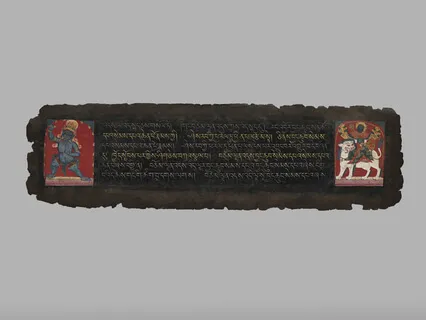
So here we're looking at a page from a perfection of wisdom sutra.
This is a manuscript and a page from a manuscript.
This is the Prajnaparamita Sutra,
Perfection of wisdom sutra.
This is from Tibet,
13th,
14th century.
We're looking at pigments on paper,
Including gold and silver ink.
And of course this illuminated,
Illustrated version here.
So the Buddhist teachings were oral recitations and they were written down in texts known as the sutras and also envisioned in images that accompanied them.
And this is one of the earliest and most important,
The wisdom,
Perfection of wisdom sutra.
And this is meant to convey and portray these teachings that the self is a construct.
And this is a concept that becomes developed and really supports the Mahayana movement.
And the blue figure on the left is Vajrapani.
Vajrapani is one of the earliest appearing bodhisattvas in Mahayana Buddhism and is a protector.
On the right is also a protector.
Let's take a closer look at that so you can see this beautiful white lion that Bhasharana,
The protector of the Dharma rides.
And on the left here,
Vajrapani.
All of these were created between 50 and 600 BCE in India and 600 CE.
And there are 38 sutras in all.
And essentially perfection of wisdom creates an understanding in the reader's mind that allows for the recognition of all truths which have always existed but were unable to be seen because of ignorance or attachment or fear.
And the hope for result is that this engages the reader fully in the discussion and encourages a significant change and awareness in one's spiritual perception.
So let's bring on our teacher today,
Sharon Salzberg,
Who will talk to us a little bit more about this idea of wisdom.
She is the co-founder of the Insight Meditation Society in Barre,
Massachusetts.
She's guided meditation retreats all over the world for many years.
And she's the author of very practical,
Fun,
And funny,
And helpful books,
Including her latest real change,
Mindfulness to Heal Ourselves and the World.
It's great to have you here,
Sharon.
You can find out all about what you're doing,
Which I know you're doing so much all the time and have so many beneficial things to offer.
And you can find out about those things on Sharon's website,
Sharonsalzberg.
Com.
Thanks,
Sharon.
Thank you so much.
It's wonderful to be with all of you.
And I so enjoy reading where everyone's tuning in from,
Which is such a widespread place.
And somebody from Puerto Rico and Baltimore,
It's so great.
And welcome to everybody.
And it's such an interesting topic as well to be thinking about wisdom,
Because I think the kind of common use of the word in English doesn't necessarily distinguish it from knowledge.
And yet,
I think in the in the teachings,
If not so much a distinction,
You see an evolution,
An evolutionary process where knowledge can become wisdom.
So what is called knowledge actually begins with often looking at a text or having a conversation or listening to somebody give a talk or some way in which we absorb a concept.
And this is considered a very positive thing.
It's not a negative thing.
The concept,
Of course,
Might become an assumption.
It can get hardened.
It can it can be a kind of separating point of view.
And that that's not good.
But just taking in the worldview of others and and kind of getting a bigger picture of life,
According to the statements of others,
Is considered a very good thing.
I think the Buddha himself talked about study as something broadening.
If you think about the ways people get all of us get so attached to our own sectarian point of view and don't realize maybe the underlying principles of why we maybe practice a certain method or we approach life in a certain way.
And when we get to those underlying principles.
So in kindness or generosity or something like that,
Looking at balance as an important way of development and growth,
When we get to those underlying principles,
Then maybe we see logically we should see that there's more than one approach that can be accomplishing the same thing.
And this is just broadening its opening in different ways.
And maybe we see the world depicted in a way that we're not awfully used to.
You know,
We have families conditioning,
We have cultural conditioning,
We have our personal conditioning.
And this,
Too,
Begins to form a certain point of view.
And as long as we understand it is a point of view and we're willing to take in others,
Then then that's fine.
I think of certain schools of Tibetan Buddhism,
They say they talk about people looking at the sky through a straw.
You know,
And they say,
Wow,
It's really big up there,
Really open,
Really expansive.
But if they cling to only looking through that straw,
Then,
Of course,
It's a very limited point of view.
And every once in a while,
Something happens.
We look at a piece of art,
We read something,
We have a conversation with somebody or we hear a lecture or something like that,
And we find,
Oh,
We're putting down the straw and we're taking a look and you go,
Wow,
That's really big up there.
So that's the first aspect of knowledge.
It's being able to take in other points of view,
Being able to take in information,
Being able to look at data in effect,
We would say these days.
And the second stage is kind of taking a good look at what we've just heard or what we've just read.
It's pondering it,
It's contemplating it,
It's seeing what seems right about it to us,
Maybe what seems wrong about it to us,
That other perspective.
And it's really,
It's thinking more deeply.
It's still like a very much a thinking process.
Like I've been thinking about the word wisdom since sometime yesterday and over and over again,
I think,
What does that bring up for me?
What do I think about when I contemplate the term wisdom?
Where's it landing inside of me?
And this is an important step in beginning to make knowledge kind of more our own because it's going through a process of some investigation,
Maybe some discernment,
Maybe questioning,
Maybe winnowing out different aspects that don't seem so right to us.
And so it's very much a sense of a path or an evolution.
And then we come to the third phase,
Which is really psych the out chemical phase where knowledge becomes wisdom,
Where we put something into practice.
We really much more deeply see for ourselves if it seems right,
If it seems true.
And this is very much in accordance with what the Buddha taught when he so famously said,
Don't believe anything.
Don't believe anything because you've read it in a sacred text because you've heard it from me,
Because you've heard it from a great elder.
Put it into practice and see for yourself what's true.
There's something about stepping off the sidelines where we just hold something as a kind of abstract idea or concept,
And we really kind of work it to see what's true.
What are the implications of living in that way?
How does it feel inside of me?
What are the consequences of undertaking that?
And so something that has been somewhat more separate or abstract really almost like enters us and ultimately can become a kind of bone deep realization.
And when I think of wisdom,
I think about the kinds of statements we might read about or hear about.
Maybe we've heard them our entire lives actually.
And if we think about it more deeply and see if it feels to us that it's worth the experiment and then we make the experiment.
We have a kind of lived experience.
We breathe life into something.
And then we see for ourselves what's true so deeply,
Not just as a concept,
But in the kind of knowing that changes how we make choices and what we prioritize and how we look at life because it is on such a different level.
That's actually wisdom.
If you think about,
I mean,
Obviously everybody knows everything changes all of the time.
We don't have to go through a process to be able to just recite that.
But how much do we cling and how afraid are we of loss and how much do we protest just movement of life and really how are we living?
And that is the crucial thing not to have more sayings to write about or give lectures about but even to ourselves,
But to really live through.
And I think about,
I mean,
There's so many examples of that.
One that comes to my mind is here in Barry,
Mass.
Still,
There's a kind of resident community that people who work at the retreat center,
The Insight Meditation Society,
They're people who once worked at the retreat center and now live in a community.
And every once in a while,
That community will undertake a kind of voluntary discipline.
So one,
For example,
Was,
And these are very time limited.
You don't really undertake these necessarily for the rest of your life,
But it's an experiment to really bring something from that more conceptual level into a more lived,
Deeply known experience of wisdom.
So one time,
This community decided,
Okay,
For a month,
Let's practice in such a way so that if a strong desire to give something arises in your mind,
And it's not going to hurt anybody.
It's not like for the New Yorkers listening,
It's not like giving away your uncontrolled apartment,
Right?
If a strong impulse to give something arises in your mind,
And it's not going to hurt somebody,
It's too excessive,
It's too crazy,
Whatever,
Give it.
And just pay attention to the whole process.
What does it feel like to want to make that offering,
To relinquish,
To share?
What does it feel like if the next 50 thoughts are frightened?
I don't know about that.
I've carried that book through four moves.
It's right at the top of my pile.
I'm surely going to get to it someday.
I don't know if I can give it away because what if it's the one thing I need to read so that I'm completely enlightened by next week and maybe I'll get to it soon.
And that is not an uncommon process.
We have the impulse to give and then we hesitate.
We get frightened.
We withdraw.
We feel,
What if I don't have enough?
What if I need it ultimately?
So we watch that.
We pay attention to that and then give it anyway.
Watch what it feels like in that surrender to the offering and then watch what it feels like afterwards.
Do you ever actually regret it?
Mostly not actually.
So that's a different thing because of the power of one's awareness than just having in one's mind the first enlightened quality,
The first quality of awakening.
The Buddha talked about was generosity.
And the Buddha said we always have something to give.
So that's what we practice to begin with because we have felt into the joy of wanting to make the offering,
How powerful it might be in that hesitation,
What it's like to exercise that agency anyway and give it and the joy that almost always comes from having shared.
And so we've taken a more conceptual framework and worked it to make it real.
And I also just want to make one point that the community in that kind of endeavor can be really helpful because you get to share,
This is what happened for me and this is what it was like and other people will share as well.
And so there is a power in having at least one other person,
If that's possible,
In your life to be working on taking knowledge and making it into wisdom.
Okay,
So let's sit together.
You can sit comfortably.
Close your eyes or not.
And start by listening to sound as we so often do.
The sound of my voice or other sounds.
It's a way of relaxing deep inside,
Allowing our experience to come and go.
Of course we like certain sounds and we don't like others.
But we don't have to chase after it to hold on or push away.
Just let the sounds wash through you.
Unless you are responsible for actually responding to that sound.
If not,
It can just wash through you.
Bring your attention to the feeling of your body sitting,
Whatever sensations you discover.
See if you can feel the earth supporting you.
See if you can feel space touching you.
Not in the sense of like picking up your finger and poking it in the air.
But realizing space is already touching us.
It's always touching us.
We just need to receive it.
Bring your attention to your hands and see if you can make the shift from the more conceptual level like the fingers to the world of direct sensation.
Picking up,
Pulsing,
Throbbing,
Pressure,
Whatever it might be.
You don't have to name these things but feel them.
And bring your attention to the feeling of the breath.
Just the normal natural breath.
Wherever you feel it most distinctly.
The nostrils,
The chest or the abdomen.
You don't have to try to make your breath deeper or different.
See if there's a place where it's clearest for you or strongest for you.
Bring your attention there.
Just rest.
See if you can feel one breath.
Without concern for what's gone by.
Just rest.
That needing to be ready for what comes next.
Just rest.
Just one breath.
If you like,
You can use a quiet mental notation like in,
Out,
Or rising,
Falling to help support the awareness of the breath but very quiet.
So your attention is really going to feeling the breath,
One breath at a time.
Good.
Good.
And if you find yourself pulled away,
Getting lost in thought,
Spun out in a fantasy,
Or you fall asleep,
Truly don't worry about it.
You notice that you've been gone.
See if you can gently let go and bring your attention back to the feeling of the breath.
Doesn't matter where your mind went.
It doesn't matter for how long.
And practice letting go and beginning again without so much blame.
See what happens.
Good.
Good.
You you you you you you you you you you And when you feel ready,
You can open your eyes or lift your gaze and we'll end the meditation.
Thank you Sharon.
That concludes this week's practice.
If you'd like to support the Rubin and this meditation series,
We invite you to become a member.
If you're looking for more inspiring content,
Please check out our new podcast Awaken,
Hosted by Laurie Anderson.
The 10-part series features personal stories that explore the dynamic path to enlightenment and what it means to wake up.
Now available wherever you listen to podcasts.
Thank you for listening and thank you for practicing with us.