Welcome to the Mindfulness Meditation Podcast presented by the Rubin Museum of Art.
We are a museum in Chelsea,
New York City,
That connects visitors to the art and ideas of the Himalayas and serves as a space for reflection and personal transformation.
I'm your host,
Dawn Eshelman.
Every Monday we present a meditation session inspired by a different artwork from the Rubin Museum's collection and led by a prominent meditation teacher from the New York area.
This podcast is a recording of our weekly practice,
Currently held virtually.
In the description for each episode,
You will find information about the theme for that week's session,
Including an image of the related artwork.
Our Mindfulness Meditation Podcast is presented in partnership with Sharon Salzberg and teachers from the New York Insight Meditation Center,
The Interdependence Project,
And Parabola Magazine.
And now,
Please enjoy your practice.
Hi everyone.
Welcome to Mindfulness Meditation Online with the Rubin Museum of Art.
I'm Dawn Eshelman.
So nice to be here with you today as your host.
For those of you who are new to the Rubin,
We are a museum of Himalayan art and ideas in New York City,
And we're so glad to have you all join us.
This is our weekly program where we combine art and meditation online.
We'd love to hear from you.
It's great to feel connected with you and hear where you're coming from,
Where you're joining from,
What you're thinking about in your practice.
So great to see some people pop in on the chat here.
And please continue to do so if you'd like to say hello.
As we do every week,
We take inspiration from our collection and we'll look at a work of art together from our collection.
We'll hear a brief talk from our teacher.
Today is the wonderful Rebecca Lee.
And then we'll have a short sit together,
About 15 to 20 minutes,
Guided by Rebecca.
So we'll look together at the art that we've chosen for today.
This is our final day of February.
Throughout the month,
We've been talking about love in all of its complexity.
Not the Hallmark version,
But the real deal.
And especially with all that's going on in the world around us and conflict,
And it's really helpful,
I think,
To be able to focus on this particular version expression of love,
Which is compassion.
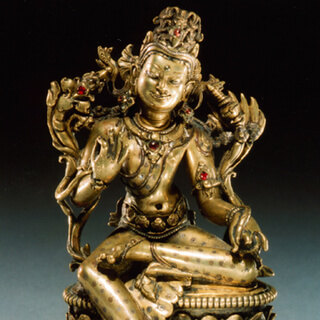
And Rebecca picked this for us today,
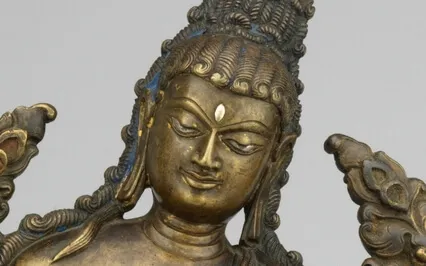
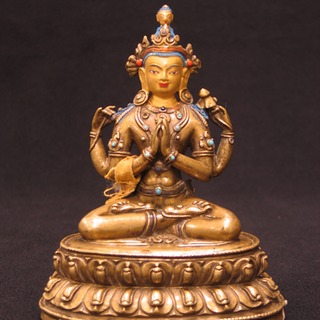
Avalokiteshvara.
Avalokiteshvara,
This version is from Tibet,
12th century,
Copper alloy.
And of course,
We know Avalokiteshvara as the Bodhisattva of compassion.
So this embodiment of loving compassion.
This is probably the most venerated deity in Tibetan Buddhist traditions.
And interestingly,
Avalokiteshvara,
This figure has undergone many transformations over the centuries and throughout cultures.
So present in other cultures and religions as well,
Even if under a different name.
So we know Avalokiteshvara in Tibetan is Chenrezig,
And Guanyin in China.
Also shows up in Japan,
Nepal,
And other cultures.
This ever present,
This pervasive,
This kind of very vital and important figure,
The Bodhisattva of compassion,
Who shows us how to model new ways of acting that enabled us to skillfully help other beings.
This work of this Bodhisattva centers love and care.
And we're looking at this figure seated in that peaceful posture,
Right?
The posture of royal ease with one foot folded in a meditation seat and the other kind of jetting out.
And he holds the stem of the lotus,
Lotus is,
Of course,
Associated there with its symbolism of awakening.
And we've got these inlaid eyes,
I'm going to just kind of zoom in here so we can really see the face here.
And a tuft of hair between those eyes,
Beautifully elegant eyebrows,
And a subtle smile.
So this is really our great cosmic being looking inward and into the mind to witness the lamentations of the world with spaciousness,
Forgiveness,
And compassion.
We are joined by the wonderful Rebecca Lee,
Who is a Dharma heir in the lineage of Chan Master Sheng Yen,
Is the founder and guiding teacher of Chan Dharma Community.
Rebecca's talks and writings can be found at RebeccaLee.
Org,
And she is a sociology professor at the College of New Jersey,
Where she also serves as the faculty director of the Alan Dawley Center for the Study of Social Justice.
She has a new book,
Kind of inspired by her students,
Called Allow Joy Into Our Hearts,
Chan Practice in Uncertain Times.
And she is now conducting in-person residential retreats,
So check out her website and you will see the variety of locations where you can find them,
Where you can find Rebecca and practice in person.
What a privilege.
Rebecca,
Welcome.
It's so great to have you here.
Thank you.
Thank you,
Dawn,
For your wonderful introduction.
And also thank you for pointing out how we are in this time where we broke out last week,
And all the more important for us to engage in the practice of cultivating compassion.
And as Dawn has mentioned,
The artwork today,
Which is a sculpture of Avalokiteshvara,
And in Mandarin Chinese,
We refer to this bodhisattva as Guan Yin.
And Guan Yin,
All the more,
In the beginning of the Chinese version of the Heart Sutra,
Guan Yin refers,
Literally means,
Hearing the sound of the world.
Meaning awareness of the suffering of beings,
Or the sound of the world.
And of course,
Not just suffering,
But all the other things that are happening,
But particularly being a bodhisattva of compassion.
She's attuned to the suffering of the world.
And in this moment,
We can also keep the suffering of everyone affected by the conflict in Europe,
In our heart.
And when we think about compassion,
It can be fairly vague and abstract,
But what it really refers to is the cultivation of unconditional love.
Unconditional love.
And for many people,
It may seem something quite unreachable.
And perhaps some will think that,
Yeah,
You know,
It would be nice to have compassion,
But maybe really think of it as an aspiration.
But it's not just an ideal or an aspiration.
Every single one of us can cultivate compassion through Chan practice,
By engaging in meditative practice.
And my root teacher,
Master Shen Yan,
Who is a Chan Buddhist master,
Would say that his dharma centers,
They are a practice center of Guan Yin,
Referring to the fact that Chan practice is the cultivation of great compassion.
It's quite important to keep in mind,
Because many people may think that Chan Zen practice is about wisdom.
But wisdom and compassion are inseparable.
And Chan meditation,
In Chan meditation,
We settle the mind with the use of a meditation method,
Which then allows us to cultivate clear awareness of our entrenched habits.
The entrenched habits of our mind that keeps us from loving unconditionally.
We are all naturally capable of loving and connecting fully and unconditionally with everyone.
That's our natural capacity.
However,
Somewhere along the way,
We learn some unhelpful habits that keeps us from doing so.
And as we meditate and settle the mind,
We'll notice those little murmurs,
A little agitation in the mind that tells us that there are these conditions that we must fulfill in order for us to deserve love.
Maybe I have to be perfect.
I have to become this or that in order for us to love ourselves fully.
And we may apply these same conditions when it comes to other people in our life,
Setting conditions that we may not be aware of.
So Chan practice allows us to become aware of this habit that keeps us from loving unconditionally.
Now it's quite important to understand what unconditional love does not mean.
It doesn't mean that we don't set boundaries and let people take advantage of us.
It does not mean that we indulge ourselves or others in harmful,
Hurtful behaviors.
That's not what it means.
So when we talk about cultivating unconditional love,
We're talking about why we hold ourselves and others accountable for our actions,
Meaning for ourselves,
We face the consequences of our actions.
We also remember that mistakes we make in engaging in unkind,
Hurtful actions does not mean that we don't deserve love.
So we love ourselves and others anyway,
Regardless of what we have done.
Very often we may have this idea in our mind that unconditionally loving someone would involve a lot of perhaps sacrifice.
We have to give up something that causes anxiety.
We may be wondering,
What do I have to give up?
Do I have to give up my value?
Do I have to give up my principle?
When we remember that we all have a natural tendency and capacity to love unconditionally and to connect with ourselves and others fully,
Then we'll realize that unconditional love arises when we are fully present,
When we are fully here,
Fully connected with this body and mind in this space as it is.
And when we are sharing space in the presence of others,
What that means,
What this full presence means,
Is to really see them as they are.
We might find that we often don't do that.
We see our idea of what this person is supposed to be,
Rather than seeing this person.
It may be our child,
It may be our partner,
It may be our parents,
Our friends,
Maybe a stranger that we have preconceived notion about.
Instead of seeing our idea only of this person,
We are fully present with this person,
Seeing them as they are.
We look them in the eyes,
And instantly we connect with this person.
And to show that we are really seeing this person,
We can,
When appropriate,
And when the opportunity arises,
Share our recognition,
Our acknowledgement of the gift of their presence.
Not what they have done for us,
But just their being here,
It's a gift to us.
Makes up part of our life,
As it is.
And so when we can cultivate this mindset this way,
Then we will be able to give rise to unconditional love.
We can start with ourselves,
Regardless of what we have done.
We may have made some really serious mistakes,
Lots of mistakes.
Perhaps being mean to people,
Being unkind,
Being selfish,
Regardless of what we have done.
Yes,
We have to face the consequences of our actions.
We accept that.
And we love ourselves anyway.
Unconditional love.
We can practice this a lot,
Because we spend a lot of time with ourselves.
When we cultivate this capacity to love ourselves,
Even when we have made a lot of mistakes,
Then we can do the same with others in our lives.
Yes,
We hold them accountable,
We do not condone harmful actions.
Yet,
We love them anyway.
Love them anyway.
And when we engage in this practice,
Then we'll notice all the subtle thoughts that come up as these various conditions we have developed in our mind.
In order for ourselves,
Or for others,
To deserve love.
Essentially,
The way we do it is that I'm going to withhold love until we are perfect.
No mistake.
And fulfill all the expectations I have for myself,
Or for others.
And when we notice these conditions,
We'll see that they are really,
These different conditions that we set in our mind that must be fulfilled for us to love,
Are the bricks and bars of the prison we have built to restrict our heart.
Our heart is naturally capable of loving unconditionally.
Our heart is much bigger than we have been allowing it to be.
To think about it,
We've been restraining our heart.
And that is itself suffering.
We can allow our heart to love and connect fully and freely.
And we can do so by practicing to remember to give rise to compassion for suffering beings.
And learn from Avalokiteshvara.
And very often,
The reason why we don't remember is we forget that people are suffering,
Including ourselves.
When people act in selfish ways,
Maybe they say unkind words,
Engage in very inconsiderate actions,
We're not making excuses for them.
But we forget that we do that because we're suffering.
We can see it in our own experience,
That when we're suffering,
When our mind's agitated,
We're not at peace,
Then we take it out on other people.
And we fall back into our habits of being selfish,
Being unkind,
Being inconsiderate.
And when we engage in charm practice,
Being fully engaged in life,
Then every moment is the opportunity for practice.
So I encourage you to take an opportunity in our daily life.
There's no shortage of that.
So whenever we encounter someone doing something that irritates us,
Because they're being inconsiderate,
For example,
We drive in a parking lot,
And it's hard to find parking space,
And someone parks a car that takes up two spaces,
We find ourselves getting quite annoyed by that.
And notice,
At the same time,
The urge to withhold love,
As our habit of conditional withholding love is being activated.
So this clear awareness that we cultivate from settling the mind from meditative practice,
Allow us to remember that,
Oh,
Yeah,
Yes,
This is inconsiderate.
But the person doing it suffers.
And when we remember this,
Then we can give rise to compassion,
While recognizing that this behavior should not be condoned.
And it takes practice.
In the beginning,
We completely forget about compassion.
We just get upset and get annoyed,
And want to punish this person.
And as we practice more,
We are more likely to remember and reconnect with our natural capacity to love,
And remember that,
Yes,
Behind this action,
Behind this inconsiderate action,
Is suffering.
And so we may notice,
We get upset,
And then we have,
We feel compassion for this person.
And as we practice more,
We can see the harmful action,
The selfish action,
Are caused by suffering readily,
And naturally,
Compassion arises.
This is avalokiteshvara,
Bodhisattva of compassion.
So here,
The key is to remember mindfulness,
The meaning of mindfulness is to remember as our habit,
Our default is to forget.
And we can learn to remember more by engaging in the meditative practice that we are about to share together.
So let's do that.
And I would like to invite you to settle the body in a comfortable position,
Allowing the skeletal structure to support the body by letting the lower back to fall into its natural curvature,
Keeping the,
Setting the head and neck and spine in a aligned way,
Facilitated by tucking in the chin slightly,
Tip of the tongue touching the roof of the mouth behind the upper front teeth lightly,
Eyes relaxed and downcast,
And I take you through a guided meditation,
And feel the relaxation of the top of the head,
Directly experience the subtle sensations,
As we allow,
Allow the tension to melt away,
And feel the relaxation spread to the forehead,
Check to see if we are holding tension in this area,
Perhaps the area between the eyebrows,
Eye habit,
Maybe from worrying,
And allow,
Allow the tension to melt away,
And feel the relaxation spread to the eyeballs and eye muscles,
Directly experience the subtle sensations,
As we allow the muscles around our eyes to relax,
Allowing,
Allowing the tension to melt away.
And feel the relaxation spread to the facial muscles,
Check to see if we are holding tension in these muscles by habit,
Perhaps to hold a certain facial expression for others to see,
Right here,
Right now,
There's no need to do that,
You can give these muscles a vacation,
And allow,
Allow the tension to melt away,
And feel the relaxation spread to the entire head,
And feel the relaxation spread down the neck muscles,
The shoulder muscles,
Directly experience the subtle sensations,
As we allow,
Allow the tension to melt away,
And feel the relaxation spread down the arms,
To the forearms,
And all the way down to the fingertips,
And feel the relaxation spread to the chest area,
Check to see if we are holding tension in this area by habit,
Maybe from anxiety,
Grief,
Fear,
Right here,
Right now,
We can give them a rest,
And allow,
Allow the tension to melt away,
And feel the relaxation spread down the torso,
All the way down to the lower abdomen,
At the skeletal structure,
Can hold up the body,
And these lower abdominal muscles,
Don't need to work so hard,
We can give them a vacation,
And allow,
Allow the tension to melt away,
And feel the relaxation spread to the upper back,
Directly experience the subtle sensations of these upper back muscles,
Softening,
As we allow,
Allow the tension to melt away,
And feel the relaxation spread down the back,
And all the way down to the lower back,
And down to our buttocks,
Where we feel the sensations of the body sitting on a chair,
Or cushion,
Or bench,
And feel the relaxation spread down to the thigh muscles,
And all the way down to the toes,
And feel the relaxation of the entire body,
Sitting,
Right here,
Right now,
Moment after moment,
And you notice the subtle changing sensations,
As the body breathes,
And rest our attention,
Gently,
On the subtle changing sensations,
Of the body breathing,
To anchor us,
To the emerging present moment,
And if we notice,
The mind drifting off,
Disconnected,
From the body breathing,
Not a problem,
It's not a failure,
See that as an opportunity,
To practice remembering,
Remembering to come back,
To reconnect,
With the direct experience,
Of the subtle changing sensations,
Of the body breathing,
It doesn't matter,
How often,
Or how long,
The mind drifts off,
As long as you find your way back,
Remembering to come back to the practice,
You are practicing well,
Maintain this clear awareness,
As we transition from stillness to motion,
As we begin to move our body,
And stay with the changing sensations,
As the body moves,
We can take this clarity,
And stability,
Cultivated in meditation,
Into our life lifting motion,
Thank you Rebecca,
That concludes this week's practice,
If you'd like to support the Ruben,
And this meditation series,
We invite you to become a member,
If you're looking for more inspiring content,
Please check out our new podcast,
Awaken,
Hosted by Laurie Anderson,
The 10 part series features personal stories,
That explore the dynamic path to enlightenment,
And what it means to wake up,
Now available wherever you listen to podcasts,
Thank you for listening,
And thank you for practicing with us.