Welcome to the Mindfulness Meditation Podcast presented by the Rubin Museum of Art.
We are a museum in Chelsea,
New York City that connects visitors to the art and ideas of the Himalayas and serves as a space for reflection and personal transformation.
I'm your host,
Tashi Chodron.
Every Thursday,
We present a meditation session inspired by a different artwork from the Rubin Museum's collection and led by a prominent meditation teacher from the New York area.
This podcast is a recording of our weekly in-person practice.
In the description for each episode,
You will find information about the theme for that week's session,
Including an image of the related artwork.
Our Mindfulness Meditation Podcast is presented in partnership with Sharon Salzberg and teachers from the New York Insight Meditation Center,
The Interdependence Project and Parabola magazine and supported by the Frederick P.
Lenz Foundation for American Buddhism.
And now,
Please enjoy your practice.
Good afternoon,
Everyone,
Tashi Delek,
And welcome.
Welcome to the Return of Mindfulness Meditation with Rubin Museum of Art.
I'm Tashi Chodron,
Programs and Communities Ambassador.
I'm so happy to be your host today.
So we are a museum of Himalayan art and ideas in New York City,
And we are so glad to have all of you join us for this weekly program where we combine art and meditation.
And from our collection,
We will take a look at work of art from our collection.
We will hear a brief talk from our teacher,
And we are so happy to have our teacher,
Lama Arya Dorma,
Back in person.
And then we will have a short sit,
About 15 to 20 minutes for the meditation guided by our teacher.
So let's look at today's art connection,
And we are exploring on the theme of change.
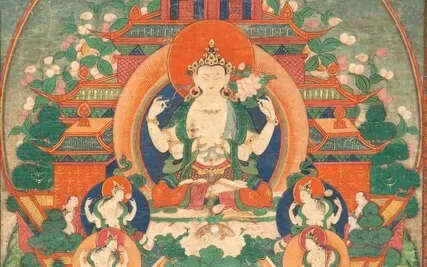
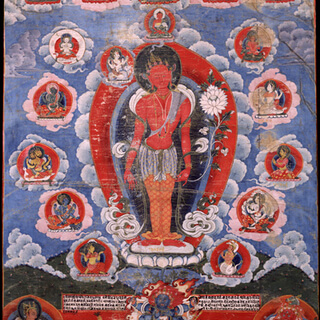
And the art connection for today is this beautiful Thangka painting of Avalokiteshvara in his Potala Palace,
Or in his Pure Realm.
And in Tibetan,
He's known as Chendrik Zig Chak Zhe.
This is origin from Tibet and is about 48 and a half into 26 and a half inches.
And this is a beautiful Thangka painting,
Mineral pigment on cloth.
So Avalokiteshvara,
The Bodhisattva of compassion and patron deity of Tibet,
He comes in many different forms.
Some of you may have seen or known that Avalokiteshvara appears in 1,
000 arms,
1,
000 eyes,
And 11-headed,
Peaceful and fierce,
Wrathful expression.
And then he also appears in six arms as well.
And here,
As you see here,
He appears in four arms.
So this is the Avalokiteshvara that presides over his celestial dwelling of Mount Potalaka,
Believed to be an island off the coast of western India,
Adorned in silk and jewel.
The four-armed Avalokiteshvara holds crystal mala,
Which is a prayer bead,
In his right hand.
In the right hand holds crystal mala prayer beads,
And the lotus flower in the upper left.
Without signifying purity,
Awakening,
Liberation,
And enlightenment,
His other pair of hands falls at the heart in a gesture of reverence.
And now on the lower left corner is the Green Tara,
The mother of all savior,
Protector of eight great fear,
In her pure realms of sandalwood grove.
And then on the right corner is the Avalokiteshvara in the form of Padma Pani.
Unique details punctuate the resplendent scenes and tiny figures climbing the rope of the bridge,
And the devotees praise to be in this pure land.
The four-armed Avalokiteshvara represents the four immeasurable,
The immeasurable of love,
The immeasurable compassion,
Immeasurable joy,
And immeasurable equanimity.
And the mantra for Avalokiteshvara is the six-syllable mantra,
OM MANI PADME HUM.
The short translation is jewel in lotus.
The flip side of the Thangka says a lot about this Thangka.
Sometimes you will see who this Thangka painting is dedicated to and who the painters are.
And in this instance,
You see the mantra in the Lensa script.
Not Sanskrit,
Not Tibetan,
But in Lensa script.
And now let's bring on our teacher for today.
Our teacher is Lama Arya Doma.
Lama Arya Doma is an ordained Buddhist teacher in the Karmakarya tradition of Tibetan Buddhism who has completed over a decade of monastic study and meditation training.
She emphasizes Vajrayana Buddhism and Buddhist principles,
Making them relevant in our everyday lives,
Helping us to cultivate loving kindness and compassion,
And bringing about a transformation of contentment and a genuine sense of well-being.
Please help me in welcoming Lama Arya Doma.
Welcome,
Everyone.
Good afternoon.
I'm so happy to be here with you all.
Thank you for coming in today,
This very special day.
So thank you,
Tashi,
For the introduction.
And thank you for Rubin Museum for organizing this beautiful event week after week.
It's so important to have this mindfulness meditation sessions that you can take back home some peace and quiet in your heart.
So this Thangka is such an amazing Thangka painting of Avalokiteshvara.
And most importantly,
Tashi,
Children just explained the Thangka in detail.
And it's really important to understand this painting.
It is really,
Really very significant.
And what is very important is right at the bottom,
You can hardly see it,
But there's a small bridge,
Two bridges that people are crossing to the Potala.
And that is the Buddhist aspiration to be reborn in Potala,
The pure land of Avalokiteshvara.
And it fits in with the theme of this month,
Which is life after.
So there are three important questions.
What is the Buddhist perspective about life after death?
And the second one is,
And why do Buddhists aspire to be born in Potala in the pure land?
And how does the practice of mindfulness meditation help us in life after?
So the first question,
What is the Buddhist perspective about the life after death?
The understanding in Buddhism is everybody,
All beings will be reborn into another life form.
And so this cycle that we all beings go through,
Which is birth,
Death,
And rebirth,
The cycle keeps going,
And that is called samsara.
And this cycle keeps going on and on and on until you break that cycle and become enlightened.
So this is the aspiration of all Buddhist devotees,
To become enlightened,
To break that cycle of rebirth,
Birth,
Death,
Rebirth.
And this is something we aspire,
We practice,
We pray to.
Now in Buddhism,
Death is something that it is practiced,
You know,
We practice every day in our lives,
Knowing that death is what is going to come to us.
All human beings,
All beings are going to experience death.
In the Western culture,
It's not a common topic,
You know,
To talk about death.
I guess death is probably a negative subject.
But in the Buddhist view and Buddhist perspective,
Death is a very,
Very important topic,
Because we all know that after death,
There is going to be rebirth.
And the whole practice when we live,
In the most Buddhist,
Practice towards life after,
After we die.
So there's this amazing book.
It was first introduced by this great realized master from India,
Padmasambhava.
He took these teachings of stages of death to Tibet.
And after those teachings translated to English,
And the book is called The Book of Dead.
So this is something,
A very,
Very important book for us to study,
For us to understand what happens.
So when you die,
In the Buddhist belief,
When you die,
Your mind continues.
Your body may not be there,
But your mind continues.
So it's a big tradition when somebody dies in the Eastern culture,
Especially in the Tibetan culture,
Or people who are Buddhist devotees.
The belief is,
For 49 days,
Your mental consciousness continues.
Your body may not be there,
But your mental consciousness continues until the next rebirth.
So for 49 days,
Most of the Tibetan devotees will invite a priest,
A lama,
Or a highly realized master to come to the home of people who have died,
To recite the prayers,
And to point out the white light.
You know,
The prayer goes something like that,
Now you are dead,
Let go of all your attachments and desires,
And go to the white light.
And when you die,
There is this moment where you can see the white light.
And that is the nature of your mind,
That Buddha nature.
And if you have practiced meditation in your lifetime,
You can see that light,
And you can go towards that.
You can become enlightened instantly.
And so all our practice,
Like in the monastery,
All our practice is towards recognizing that light.
So it's a very important topic about rebirth.
And I really believe today we have these very special people who have come in to hear about rebirth.
And also there's a magazine here at the Rubin Museum called Spiral,
And there's so many great articles on this topic.
So please pick up one and study more about it,
Because death is nothing to fear about.
If you understand in your lifetime what to do when you die,
There's a manual for death.
You know,
There's no manual for birth,
I think.
There's no manual how to take care of your children,
But there's definitely an amazing manual put together,
Ancient Buddhist teachings about rebirth,
What happens to you after death.
And so why do Buddhists aspire to be born in Potala,
In the Pure Land?
There are many,
Many Pure Lands,
And our locateeshwaras,
Potala,
The Pure Land,
It's so beautiful that all the Buddhists,
We pray,
We aspire to be born there.
We aspire to be born there because the Pure Land is such a beautiful place.
It's a perfect paradise.
There's no anger,
There's no greed,
And there's no suffering.
And my master,
My teacher explained that if you want water,
You can just ask for water and a spring will appear.
And if you want cool air and you just have to say,
Oh,
You know,
I'm feeling warm and cool breeze,
And it's so beautifully scented and mystical music.
And so there's no need for you to be having anxiety or suffering.
And so immediately you can do your practice,
Your spiritual practices,
And it's very easy to be enlightened in the Pure Land.
So how does the practice of mindfulness meditation help us in the life after?
So when you meditate,
You can understand the nature of your mind.
You're more aware.
You can let go of all your anxiety,
Your fear,
And your suffering,
And you can make your mind very peaceful.
And when you die,
Because the mental consciousness continues,
The state of your mind when you die is very,
Very important.
If you're a very angry person,
Then that consciousness will sort of go towards that same energy,
The negative energy.
But in your lifetime,
If you practice meditation and you understand that you can let go of that anger and have a state of mental peace and happiness and compassion,
All these can be cultivated in mindfulness meditation,
A sense of compassion,
Kindness,
Generosity.
So when you have these positive qualities and when you die,
You will automatically be in a state of peacefulness.
So I would love for you all to pick up a spiral magazine and study more about it,
And don't fear it.
So right now,
We will start the mindfulness meditation.
So it'll be nice for all of us to sit upright,
And you could come a little further from the chair so your back is not resting on the chair,
And be relaxed.
And if your back hurts,
You can relax into it.
Don't have to have it very straight,
But relaxed and comfortable.
And with your hands,
You can place it on your knees,
Or you can place it this way.
So I know all of you are wearing masks,
So all you need to do is just inhale and exhale normally and naturally,
And just observe your breath going in and coming out.
Inhale and exhale,
And just observe your breath going in and going out.
And as you breathe out,
Let the breath permeate the entire room,
And just rest in that present moment of awareness.
Breathe in and breathe out naturally,
Normally,
At your own pace,
And just observe you breathing in and out.
And as you breathe out,
Just imagine the breath filling the entire space,
And rest your mind in that moment,
In the present moment.
You may notice a thought coming up,
And that's okay.
Just acknowledge it,
Label it as thought,
Let it go.
And continue the story,
And just bring back your mind's attention to your breath.
Inhale and exhale,
Breathe normally,
And just observe your thoughts.
Just observe your breath.
Your mind is like space itself,
And your thoughts are like birds.
They come and go,
And leave no sign.
Inhale and exhale,
Breathe normally,
And just observe your breath going in and coming out.
And as you breathe out,
Let your breath just fill the air in front of you,
And just be in the present moment of awareness.
Rest in this present moment of awareness.
When you catch yourself thinking,
Just label it as thinking.
Don't follow that thought.
And again,
Bring your mind's attention to your breath,
Observing the breath going in and coming out.
And rest in that present moment of awareness.
When you practice mindfulness meditation diligently,
Even for a short moment every day,
You know,
You can let go of that thoughts.
And some of these thoughts bring up deep emotion of anger,
Anxiety,
And this is why we do the formal practice,
So we can let go of those thoughts,
And we can cultivate compassion,
Loving kindness.
And then day-to-day life,
You can practice generosity,
Peacefulness,
And this meditation practice,
You can get peace and joy and happiness,
Because you can practice letting go of the angry thoughts.
That is why we need to have a daily practice.
Thank you all.
Thank you.
Thank you so much for that beautiful session,
Lama Arya.
That concludes this week's practice.
To support The Rubin and this meditation series,
We invite you to become a member at rubinmuseum.
Org slash membership.
If you are looking for more inspiring content,
Please check out our other podcast,
Awaken,
Which uses art to explore the dynamic paths to enlightenment and what it means to wake up.
Season 2,
Hosted by Raveena Arora,
Is out now and explores the transformative power of emotions using a mandala as a guide.
Available wherever you listen to podcasts.
And to stay up-to-date with The Rubin Museum's virtual and in-person offerings,
Sign up for a monthly newsletter at rubinmuseum.
Org slash enews.
I am Tashi Chodron.
Thank you so much for listening.
Have a mindful day.