Welcome to the Mindfulness Meditation Podcast presented by the Rubin Museum of Art.
We are a museum in Chelsea,
New York City that connects visitors to the art and ideas of the Himalayas and serves as a space for reflection and personal transformation.
I'm your host,
Tashi Chodron.
Every Thursday,
We present a meditation session inspired by a different artwork from the Rubin Museum's collection and led by a prominent meditation teacher from the New York area.
This podcast is a recording of our weekly in-person practice.
In the description for each episode,
You will find information about the theme for that week's session,
Including an image of the related artwork.
Our Mindfulness Meditation Podcast is presented in partnership with Sharon Salzberg and teachers from the New York Insight Meditation Center,
The Interdependence Project and Parabola magazine and supported by the Frederick P.
Lenz Foundation for American Buddhism.
And now,
Please enjoy your practice.
Good afternoon,
Everybody.
Tashi Delek.
Welcome.
Welcome to Mindfulness Meditation at the Rubin Museum of Art.
I am Tashi Chodron,
Himalayan Programs and Communities Ambassador.
I'm so happy to be your host today.
We are a global hub for Himalayan art with a home base in New York City,
And we're so glad to have all of you join us for our weekly program where we combine art and meditation.
But from our collection,
We will first take a look at work of art.
We will then hear a brief talk from our teacher,
Kimberly Brown,
And then we will have a short sit,
15 to 20 minutes,
For the meditation guided by her.
Now let's take a look at today's theme and artwork.
The theme this month is realization.
But realize what?
To realize the true nature that is the basic goodness,
Loving kindness and compassion that is within each of us.
We come together every week here to invoke that basic goodness so we can be a better person or a happier person.
Most of us may know today is September 21st,
And it's Universal Peace Day.
So I'd like to wish Happy International Peace Day.
We want peace,
Not war.
Let's work together to find solutions to realize interdependence in nature,
That no one thing is independent,
That we all need each other.
Now let's bring the art for today's session.
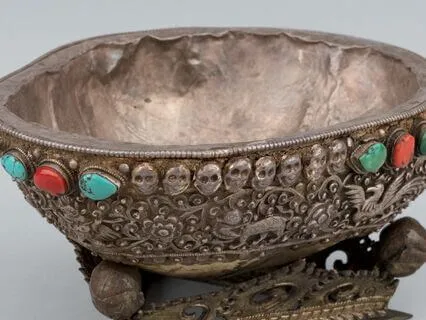
The today's art is the skull cup and base,
Origin from Tibet,
Dated 18th century,
Features silver,
Turquoise,
Coral and brass all the way.
The size is about three into seven and a half into five and a half inches.
And this is a beautiful ritual object.
In India and Tibet,
The skull cup is known as a Kapala in Sanskrit and Thodpa in Tibetan,
And is used in Tibetan and Buddhist Hindu tantric rituals.
Many carved and elaborately mounted Kapalas survive mostly in Tibet.
They are generally made from the top of the human skull and embellished with precious metals and stones.
Skull cups held in the hands of many deities are often associated with offerings made to fierce,
Wrathful deities.
In Tibetan Buddhism,
The skull represents emptiness or impermanence.
It's a simple reminder of impermanence nature.
The human cranium featured in skull cups are often gathered from charnel ground.
Now let's bring on our teacher for today.
Our teacher is Kimberly Brown.
Kimberly Brown is a meditation teacher and author.
She leads classes and retreats that emphasize the power of compassion and kindness meditation to reconnect us to ourselves and others.
Her teachings provide an approachable pathway to personal and collective well-being through effective and modern techniques based on traditional practices.
She studies in both the Tibetan and Insight schools of Buddhism,
And is a certified mindfulness instructor.
Kimberly,
Thank you so much for being here.
Please help me in welcoming Kimberly Brown.
Thank you,
Tashi Chaudhry.
So the skull cup.
One of the first times I came to this museum would have been,
I don't know,
2008,
2009,
Somewhere around there.
Tim Henry,
Who is,
Now he's a director of the museum,
But he used to introduce the programs.
And he,
I don't know what program I came to,
It was here in this room,
And he held in his hand a skull cup.
I don't know if it was this one,
I don't know,
The museum may have many,
But it to me was extraordinary and amazing.
That's a human skull.
That's your skull.
That's my skull.
All of us are changing all the time.
And when we're talking about realization,
You know,
In Tibetan Buddhism,
Teachers and even high lamas and Rinpoches,
They won't say they're enlightened.
They won't even often say it about other living teachers,
But what they'll say is they've had a realization,
Or someone else is very realized.
What's meant by this is a deep and profound knowing beyond thought and reason of the nature of our life,
Right?
So everyone here,
Nobody would disagree with me that everything's impermanent and we're all going to die,
Right?
Nobody,
Everybody knows it here,
But then when someone you know dies,
It's shocking.
Then when you lose your job,
You can't believe it.
Then when you get that call,
Someone you love is sick,
You're sick.
Oh my God,
Right?
I had a Tibetan teacher years ago,
And he was an older man who at a very young age in Tibet was brought up in the monastery,
I don't know if he was six or seven or eight years old.
He went to live there and trained to be a monk.
And he said at a certain age,
Maybe he was 12 or 13,
They had a visitor to the monastery who came from this teacher's village or area and reported that a friend of this teacher who at that time was like 13 had died.
I think it was an accidental drowning.
This teacher said to us,
I was so shocked,
I couldn't believe it.
And my teacher said to me,
What do you mean you can't believe it?
And what he was saying to us is that our surprise is evidence that we have not realized that everything is impermanent and changing.
And that,
You know,
We could call it death,
Or we could just call it change,
You know,
Everything keeps changing.
Now,
That doesn't make loss easy or not painful in any way.
But avoiding this fact that everything's going to keep changing,
Things are going to come together and fall apart,
Including us,
It causes us a lot of confusion.
We make bad decisions because we don't want to feel this or understand it.
Or lacking in appreciation and contentment,
Because we're not realizing this very moment is fleeting.
So everything's very,
Very precious.
Another realization is that all of our actions have outcomes.
Everything I say and you say,
Everything you do,
It has an outcome,
Okay?
And all of the outcomes of our actions will outlive us.
What does that mean?
Well,
Each one of us are the result of other people's actions in the past.
This building used to be used to be Barney's,
Right?
And you know,
That building was built decades ago,
I would guess that architect is not alive anymore.
And yet here we are,
The result of that person's actions.
And so one way to look at the fact of change is to see it as an opportunity to help create conditions that will happen in the future to benefit ourselves and to benefit each other.
So it doesn't have to be,
Oh my God,
This is terrible.
I'm going to die.
What am I going to do?
It's wow,
Everything is going to change.
This is the nature of life,
Including me and my body.
And I have this beautiful opportunity to use my words and my thoughts and my deeds to affect myself and others in a beneficial way.
To perhaps bring about a future where it's more healthy,
Where it's more equitable for all beings.
So in this way,
This realization of our own mortality becomes a very powerful tool to live with wisdom and compassion right now.
In Zen,
There's something called the Evening Gatha,
And it says,
Life and death are of extreme importance.
Death comes without warning.
Take heed,
Do not squander your life.
That's what it means.
It doesn't mean go out shopping more,
Right?
It doesn't mean be in more denial.
It means your life is so valuable and so precious,
And you have so much power to affect yourself and others through loving kindness,
Through compassion,
And through this knowledge,
This realization of impermanence and change.
So unfortunately,
It's really hard to have these realizations just by reading or talking.
It comes out of silence and stillness,
You know?
And it's in all traditions,
You know,
It's in all the Buddhist traditions,
But all of the wisdom traditions have these practices,
You know,
Prayer,
Places to get quiet.
This has become a,
Sadly,
Very rare commodity for all of us to be without phones,
Devices,
Noise.
So it's something we need to really cultivate to take care of ourselves.
And I encourage all of you to take 10 minutes a day,
Just put all the devices away,
Sit at your kitchen table and listen to the birds,
To touch your own human heart.
But today,
One way we can start to realize impermanence and change is simply by bringing our attention to sound.
Sound is always changing.
You sit down for 10 minutes anywhere,
No sound just stays.
They all come and go.
So it's a very easy way to kind of get a little realization of change and impermanence.
So we'll do a little of that,
And we'll also do a little loving kindness meditation to encourage ourselves to remember our basic goodness,
As Tashi Chodron encouraged us to remember.
This is a sense,
This is a knowledge.
We're not born with a bunch of sin.
We're born with the capacity to love,
To be wise,
To make connections with others,
To have joy.
And we can really notice that if you sit and get quiet.
So everybody,
You can go ahead and close your eyes.
Take a minute to,
I don't know,
My yoga teacher says,
Get everything just right.
Take a minute to feel comfortable the way you're sitting.
If your mind is extraordinarily spacey and you're daydreaming,
The moment you close your eyes,
Well then,
Open your eyes and just let them gaze gently toward the floor or whatever's right below you.
Alternately,
If you're feeling very tired,
Do the same.
Let yourself be.
This is a moment you don't have to fix,
You don't have to figure it out or analyze it.
You don't have to make anything different than it is right in this moment.
Notice light entering through your eyelids,
Breath,
Air on your skin,
You might notice these thoughts,
Those are impermanent too,
It all comes and goes.
Choosing to bring all your attention to the sound entering your ears.
Just sensing right where the sound enters,
Resting your attention here.
Because you don't have to do anything,
You don't even have to listen.
Just letting these waves enter,
You don't have to identify them,
Just resting here,
Just checking in with yourself,
Your attention wander,
It's okay,
Bringing it back to your ears,
Allowing yourself to receive the sound.
There might be moments what you're receiving is silence,
Choosing to move your attention from the sound to your heart center,
To the center of your chest.
If you'd like,
You could place your hand on your heart and make a connection with yourself.
You could do this,
Maybe you imagine you're looking in the mirror and say silently,
May I be at peace with the unfolding of life,
May I be at peace with the unfolding of life,
May I be at peace with the unfolding of life.
Just silently repeating this to yourself,
Like you're giving yourself a gift,
Just for a minute or two,
May I be at peace with the unfolding of life,
And like you to imagine some people who are close to you,
People that you love and love you in an easy way,
Not your sister who you love who's really difficult,
Other people that you feel comfortable with and really love you and imagine they're here with you saying to all of you,
May we be at peace with the unfolding of life,
May we be at peace with the unfolding of life,
May we be at peace with the unfolding of life.
Just for one minute,
Silently repeating this,
Including all of us here tonight,
Today,
May we be at peace with the unfolding of life,
May all of the strangers in the world that we'll never meet,
All of the animal realm,
All of the dangerous people and the people we don't like,
May we be at peace with the unfolding of life,
All beings,
You can drop those phrases,
Just feeling your breath,
Body,
Sound entering your ears,
Taking a moment to thank yourself for this practice,
For your willingness,
For your efforts,
Evidence,
Your deep compassion and wisdom,
And whenever you'd like,
You can move,
You could stretch as you open your eyes,
Bring your attention back to the room.
Thank you.
Thank you so much for that,
Kimberly.
That concludes this week's practice.
To support the Rubin and this meditation series,
We invite you to become a member at rubinmuseum.
Org and to stay up to date with the Rubin Museum's virtual and in-person offerings,
Sign up for a monthly newsletter at rubinmuseum.
Org.
I am Tashi Chodron.
Thank you so much for listening.
Have a mindful day.