Welcome to the mindfulness meditation podcast presented by the Rubin Museum of Art.
We are a museum in Chelsea,
New York City that connects visitors to the art and ideas of the Himalayas and serves as a space for reflection and personal transformation.
I'm your host,
Dawn Eshelman.
Every Monday we present a meditation session inspired by a different artwork from the Rubin Museum's collection and led by a prominent meditation teacher from the New York area.
This podcast is a recording of our weekly practice currently held virtually.
In the description for each episode,
You will find information about the theme for that week's session,
Including an image of the related artwork.
Our mindfulness meditation podcast is presented in partnership with Sharon Salzberg and teachers from the New York Insight Meditation Center,
The Interdependence Project,
And Parabola Magazine.
And now,
Please enjoy your practice.
Hi,
Everyone.
Welcome to mindfulness meditation online with the Rubin Museum of Art.
Great to be here with you.
I'm Dawn Eshelman,
And we are a museum of Himalayan art and ideas in New York City.
And so glad to have all of you joining us.
This is our weekly practice where we combine art and meditation online.
So nice to see some familiar names in the chat there.
And welcome,
New folks as well.
For today's session,
We'll look together at a work of art from our collection.
We'll hear a brief talk from our teacher,
And then we'll sit together,
15 to 20 minutes,
Guided by our teacher.
And let's take a look together here at this work of art that we were peeking at a little bit earlier as you were waiting.
This is such a cool work and really different from what we usually get to look at here together,
Right?
Although you'll recognize there are certainly similarities to most of the work in our collection.
And I'll zoom in a little bit here,
But I wanted you to see this is just right at our front window here.
So when you come to the Rubin,
This is one of the very first works of art that you will see.
And we're looking at this today because we've been talking this month about this idea of facing chaos,
That that's the first step in the process to awakening.
And this idea,
This theme really comes from our brand new exhibition that just opened Awaken a Tibetan Buddhist Journey Toward Enlightenment.
So come and check it out if you can,
If you're nearby and check out all our digital resources as well.
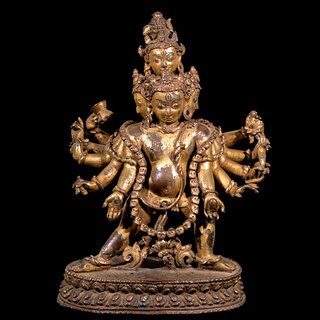
This artwork is called Wrathful Activity,
Fierce Energy,
And it's by the artist Shiza Dawood,
Born in 1974,
London.
This was made in 2018 and it's neon on a painted black board.
And it's just buzzing with energy.
It's an abstracted figure,
But it's a contemporary twist on depictions of Buddhist deities,
Especially the wrathful deities,
Right?
Which we know are a positive force despite the fact that they look scary,
Demonic.
And at the top,
Those figures there are floating above the main head are skulls,
Six small skulls enveloping flames above the central figure's elongated face.
And this represents the wrathfulness and the power to transform ferocious activity into positive energy.
And it really traditionally serves as a wake up call to the practitioner trying to snap us out of the chaos of our distractions and turn to what really matters.
So we know that chaos can not only be annoying,
It can be kind of,
It's really the cause of suffering so it can be dangerous and even violent.
And we know that hate crimes against Asians and Asians American have really been on the rise,
Particularly since the beginning of the pandemic.
And very sadly with these horrible murders in Atlanta last week,
And just would like to say that as an organization centered around Himalayan art with Asian communities at our core,
We want to show our support against hate and against white supremacy and in support of these communities and want to shout out some of the amazing work that organizations are doing right now to support Asians and Asian Americans and education.
And that's part of our goal too is really cross-cultural education and understanding.
And we'll move on now to bring on our wonderful teacher today,
Tracy Cochran,
Who will talk to us a little bit more about facing chaos and what that has to do with our practice.
Tracy has been a student and a teacher of meditation and spiritual practice for many years.
She is the founder of the Hudson River Sangha,
Which is now virtual,
Open to everybody,
Wednesday afternoons,
Sunday evenings.
The link for her weekly meditations can be found on her website,
TracyCochran.
Org.
And in addition to teaching here at the Rubin,
She's taught mindfulness meditation and mindful writing also at the New York Insight Meditation Center and schools,
Corporations.
She is the writer and editorial director of the beautiful,
Beautiful little magazine Parabola,
Just a quarterly,
The wellness issue is out now and it seeks to bring timeless spiritual wisdom to the burning questions of the day.
You can check that out on parabola.
Org.
Tracy,
Thanks so much for being here and I'll bring you on in just a second here.
Hi there.
Hi.
Hi.
I'm delighted to be here today and I love having my talk literally illuminated by that seemingly scary but by now dear to me artwork because that would be the first thing I would see when I walk into the Rubin.
And one thing I love about it is that it's very much like chaos in the way Dawn was describing in our practice.
Something can happen that plunges our world into a feeling of chaos.
And we've experienced this collectively with the pandemic.
We experience it with tragic news like Dawn brought about attacks on the Asian community.
And we experience it on an almost daily basis in life.
So I wanted to speak just very briefly and concretely about that feeling.
You feeling when you can actually feel like that neon figure.
When you have a plan,
When things seem to be in order,
When life seems to make sense to you and suddenly something happens that plunges it into disarray.
And I don't mean just big and tragic events like pandemic and attacks.
But just this morning I had this beautiful,
Beautiful plan for myself.
I was going to meditate,
Which I did,
And write and then walk and collect myself so I could be in a collected state for you.
None of that happened.
Because suddenly and without warning I had to drive someone to a doctor,
To a medical appointment.
And it's interesting,
As mundane as it sounds,
Just take a comfortable seat and let your body remember those times when all of a sudden you had to do something you didn't think you were going to have to do or all of a sudden something broke or your computer crashed.
Notice what happens in the body and you can remember it.
Instantly we tend to become these embattled little fortresses.
Drawbridge comes up.
The gates come down.
Instantly we go into fight,
Flight,
Freeze.
We're plunged into a dark and uncertain world and we're just holding on.
This is the beginning of our practice.
There's a tendency to think that this is bad news.
That there's something wrong with us.
If after all this time we still get triggered and go into fight,
Flight.
I'm here to tell you that there's nothing wrong with you.
This is the organism working the way it was evolved to work.
The gift of the practice is to begin to see that we're not just fight,
Flight.
Not just reptile mind.
Not just our defensiveness and tendency to blame or be aggressive.
Which we typically do when things go wrong.
I saw a cartoon in the New Yorker years ago that showed a couple in a car with kids in the back lost in the woods and the caption said we all agree that we're lost.
The important thing is who's to blame.
We go into blame.
If only this hadn't happened.
If only they hadn't done that.
If only,
If only,
If only outside conditions had remained calm and just like I wanted them.
What can we do when we're in the middle of being gripped by overwhelm or fight,
Flight?
Come back to the body.
Come down out of the thinking.
You can do it now.
And just sense yourself in the simplest,
Barest way.
Come home to sensation.
And notice that you're more than you're thinking.
In fact,
You're thinking in many cases is not actually helpful.
It would be better to be more like the animal of your body.
Meaning observe and sense.
You can do it now.
And just come back to the breath even before we begin to sit.
And notice that this movement of return in itself begins to settle you and also open you.
Sati,
An ancient Pali word for mindfulness means to remember.
To remember the present moment.
When we're facing difficulty or chaos or uncertainty,
We come back to the body and we can begin to soften and open so that we remember that we can respond,
That we know things.
That we can observe things.
That we can take our way moment by moment through uncertainty.
And we begin to see that uncertainty isn't just bad news.
We tend to think of it as oh,
No.
The worst could happen.
It also means that unexpected help can appear,
Not just in the form of another person who might drive you or help you,
But inside yourself.
You begin to remember capacities for patience,
For equanimity.
You can be with this with a measure of openness and even good humor.
That being with the unexpected can bring wonderful surprises inside ourselves.
We're more than we think we are.
So I once heard a wonderful true story that I'm going to share with you.
It's just a one-minute story before we begin to sit.
A friend of mine befriended a man who was a member of the Mi'kmaq tribe in Canada.
An indigenous man.
One of the first nations.
And he was taken away from his parents.
One of the most cruel features of white colonial culture is that they would take indigenous children and put them in schools.
Take them away from their parents,
Their culture,
Their ways.
Before this boy was taken,
His parents drove him 100 miles from home,
According to the story as it was told me,
100 miles.
And he was dropped off in the forest by his parents and told to find his way home.
Now,
Be mindful,
I'm describing what was being done to a boy in the Mi'kmaq tribe who had been taught to find his way.
I'm not suggesting that urban children in New York or Cincinnati should do such a thing.
So anyway,
They dropped him off and he tracked his way home because his parents wanted to give him the gift of knowing who he really was.
Knowing who he really was.
And what he could really do.
His real capacities.
So he would know it deep in his body and never forget who he was.
This is a practice for us to come together,
To come home to sensation in the body as we begin to do.
Take your seat now.
Close your eyes.
So that we too may open up and remember our true belonging to life.
Our true capacities for wisdom and compassion and inner peace.
So let's take our seats together.
Feet on the floor.
Back straight.
And resting easily on the neck.
And notice how it feels to be in this body today.
Not yesterday,
Not tomorrow.
Right now.
Notice what's present.
You might find places of tension.
And see that you can bring attention to this tension.
And allow it to soften just a bit.
Notice how it feels to let yourself be surrounded by an attention that sees without judgment.
And notice how it feels to be surrounded by an attention that sees without judgment.
Let yourself sink into sensation.
Reaching the feet on the floor.
Reaching the shoulders and hips.
Reaching the weight of the whole body.
See that when you get taken by thinking,
You can gently come to the top of your head.
Come back again to the body and sensation.
Noticing that this doesn't shut you down,
It opens you to the life outside and also inside.
Notice how it feels to rest in stillness.
In awareness.
You When you get lost in thinking or picturing,
See that you can notice this with no judgement and gently return again to sensation,
To presence.
Finding that you're not alone.
But accompanied by life.
By breath.
Impressions.
Sensations.
You Notice that this stillness,
This presence is kind.
Non judging.
Accepting you completely as you are.
Today.
You.
Feeling how alive you are inside.
How vibrant and responsive.
Remembering that you're part of life.
You.
You.
Come home to sensation and rest in presence.
You.
Notice how it feels to be completely acceptable.
Every thought,
Every action,
Every thing seen by an attention that doesn't judge.
You.
You.
You.
Notice that no matter how lost I am,
No matter how freaked out or sad.
I can come home to presence.
To sensation.
And to an awareness that doesn't judge.
That receives me.
You.
You.
Come home to awareness.
To presence.
And notice that you're not alone.
You.
Thank you.
Thank you for your practice.
Thank you so much,
Tracy.
That concludes this week's practice.
If you would like to support the Rubin and this meditation series we invite you to become a member.
Thank you for listening.