Welcome to the Mindfulness Meditation Podcast.
I'm your host,
Dawn Eshelman.
Every Wednesday at the Rubin Museum of Art in Chelsea,
We present a meditation session led by a prominent meditation teacher from the New York area.
This podcast is a recording of our weekly practice.
If you would like to join us in person,
Please visit our website at rubinmuseum.
Org slash meditation.
We are proud to be partnering with Sharon Salzberg and teachers from the New York Insight Meditation Center.
The series is supported in part by the Hamera Foundation.
In the description for each episode,
You will find information about the theme for that week's session,
Including an image of a related artwork chosen from the Rubin Museum's permanent collection.
And now,
Please enjoy your practice.
Good afternoon,
Everybody.
Welcome to the Rubin Museum and to our weekly mindfulness meditation practice.
My name is Dawn Eshelman.
I know many of you already,
But just curious if anybody is here for the first time.
Welcome.
Great,
As always,
To have newcomers and great to have all of you back.
We are talking this month about impermanence.
And I think at first can seem like a really challenging topic to understand.
And from a Western point of view can feel sometimes negative in terms of understanding its impact on our lives.
But in fact,
We can also think of this concept as something that is acknowledging core truth of existence and is freeing in a certain way.
The exhibition up on the sixth floor and throughout the museum,
In fact,
Is called The World is Sound.
And one of the key concepts of that exhibition is sound as this metaphor for impermanence.
And you will see up in kind of the heart of the exhibition,
There is a displayed in kind of an arc shape are several ritual instruments,
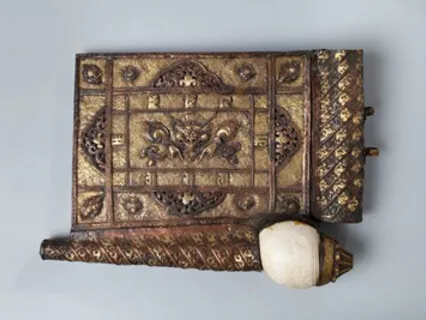
One of which is the object we're looking at today.
This is the conch shell horn or trumpet.
And it is often used at the beginning of a ritual or a gathering as a kind of call,
A call not only for a very practical sense in terms of hey,
Everybody,
This is starting this is happening.
But a call also that wakes us out of any kind of slumber of ignorance and calls us to really be present and see the truth.
And the conch itself is an important symbol in Tibetan Buddhism.
It I think that this this image here has the tip of the conch covered by the mouthpiece there.
But in fact,
The conch has this spiral shape that is,
You know,
The shape itself is known as the golden spiral,
This shape that is present in so many objects in the natural world,
The architecture of which is very symmetrical and is thought to be meaningful and even magical in some traditions.
And the conch is also a rare thing in this kind of landlocked area and is treasured,
Highly treasured,
Especially when it has its spiral going to the right,
Which is is symbolic in Tibetan Buddhism.
And I think above all,
Just remember that it's this this conch which calls out to us in this sort of with this intent to wake us to wake us and so that we can see truthfully.
So Tracy Cochran is here with us today,
And she'll be talking with us a little bit more about this idea of impermanence and what it means in our lives today and in our practice as well.
You know her well,
But she is the editorial director of parabola magazine,
Which is a gorgeous quarterly magazine filled with lots of Tracy's writings and others as well,
Of course.
But if you love her stories,
You should check it out.
And we sell it up in the shop.
And you can also find it online at parabola.
Org.
Tracy's been a student of meditation and other spiritual practices for decades.
And in addition to the Rubin,
She teaches at New York Insight and every Sunday at Terrytown Insight in Terrytown,
New York.
Please welcome her back,
Tracy Cochran.
I'm glad to be back.
It's itself this museum and emblem in the very best sense of change.
Because we're sitting in a place that as many of you know,
Used to be Barney's.
It was Barney's.
And I learned just before it was Barney's women's department and it epitomized consumption,
Luxury consumption.
I used to work nearby and they would have an annual warehouse sale,
Which was a little bit like Mad Max,
Fury Road.
It was intense.
And I remember timidly venturing in there and seeing these dignified New Yorkers ripping off their clothes to try on these clothes.
And I guess they were operating on the assumption that they would never see these people again.
And that they were going to get this fabulous deal on these gorgeous clothes.
And I remember having the idea that I was witnessing the decline of Western civilization.
And yet here we are.
Here we are in a museum that offers itself as a place to practice stillness,
As a place to practice being with ourselves in a different way.
So Robert Frost said that he could sum up everything he learned about life in three words.
It goes on.
It does,
Doesn't it?
And in a way,
We can sum up the aim of mindfulness meditation and also spiritual practice in three words,
Being with change or opening to change,
Being with this flowing,
Changeable life.
It's so visible in New York City.
Things become other things.
Spaces become nightclubs,
Become gyms after that.
Luxury department stores become sacred spaces.
And then Barneys is back again.
Things go up and down.
That's why I love that they saved that gorgeous spiral staircase in the museum from Barneys.
Because it reminds us that life has layers.
Another meaning of impermanence,
Of course,
Is that anything can happen at any time.
And we've all learned this.
And we can know this,
For example,
Right now.
This little tune.
Things happen.
Things happen.
We can be inching out from a stop sign as I was a couple of months ago.
And all of a sudden,
A car comes careening around a corner and down a hill and smashes into my car.
Things happen.
And I was telling Don before that I had a wonderful teacher once.
He was wonderful because he was a student of D.
T.
Suzuki.
And he sat in Zen monasteries right after World War II.
He was the first American allowed in.
And at the same time,
He had a life in New York.
He was a magazine publisher.
He was a father.
He was a husband.
He loved fashion.
He loved art.
He was a painter.
But at the center of his life,
He had this practice,
A practice of mindfulness,
Of stillness,
So that everything in life can become useful.
So this teacher at a certain point,
I think it was in 1970 or 71,
Had a devastating car accident.
It almost killed him.
It wasn't like mine where I got a few bruises and a big shock and I walked away.
It was devastating.
And here came a message from a great Zen master in Japan who,
Remember,
Had also just lived through the war.
And the message basically said,
Congratulations,
You've just saved yourself 10,
000 sittings in a monastery without accident.
What does that mean?
It means that when we sit down like this and practice this movement of return to our basic experience in the present moment,
This movement that we call mindfulness,
This remembering,
When we do that,
Everything that happens can be useful.
It can yield a deeper truth that we usually overlook.
The day I had my car accident,
I was full of plans.
I had a pretty good idea,
I thought,
Of how the day was going to go.
And the second that car smashed into me,
Everything stopped.
And I was suddenly aware that all I had been doing was thinking.
It was thinking.
That accident was like that beautiful instrument that Don was describing,
That conch,
Horn,
Or trumpet.
It woke me up to the fact that I wasn't awake.
One of the things that's most extraordinary about what we get to do in this museum is that instead of just looking at extraordinary works of art,
We're letting them remind us of something,
Even if we don't know exactly what they mean.
We can feel what they mean.
They mean you're bigger than you think you are.
Reality contains more than you think.
It means wake up.
It means that at any given moment you have a choice of going from seeking to know all the time to seeing,
Watching.
When I was sitting there in the wreckage of my poor little Prius,
All I could do was wait.
Wait for the police to come.
Wait for the fire trucks.
Wait for the medic who took my driver's license and checked me out for a concussion and very kindly told me he never would have guessed I was as old as it said on that driver's license.
So there is this way of living where we're open to receiving what is constantly being offered.
There is a way of living in which no matter what is happening,
No matter how insane and violent and random and frightening it is,
You can lean down the way the Buddha did and touch the earth.
Not a metaphor.
You can come back to the experience of sitting in your body,
Breathing,
Sensing,
Allowing your heart to soften and open and noticing that you yourself are kinder than you believe you are and more responsive and more capable.
So we'll practice right now instead of my talking about it.
What a concept.
And that is the gift of the space.
So we take a comfortable seat and we let our feet be planted firmly on the floor in front of us.
And we allow our backs to stretch up as straight as they comfortably can.
Allowing the eyes to close.
Some people aren't comfortable with closed eyes,
In which case avert them on the floor in front of you.
But it's best if possible to allow your eyes to close.
And just take in a very simple and direct impression of how it feels to be sitting here in this body without thinking about it or striving for anything.
Just allow yourself to take in an impression of this body landing here.
Noticing that sensations and thinking and flashes of memory,
All of this will happen.
And we allow it to happen.
And as we feel the body relax just a bit,
We bring the attention to the breathing without seeking to change it in any way.
We simply allow the attention to be carried by the in-breath and the out-breath.
Sati,
The ancient word for mindfulness that the Buddha may have used,
Literally means to remember,
To remember the present moment.
This means to come home to the breathing and to the sensation of sitting here in this body now.
Allowing everything to be exactly as it is.
And when we notice we're getting caught up in thinking or carried away by a memory or a dream,
We gently bring the attention home again to the sensation of sitting here in this body breathing with no judgment,
No comment.
Even about our inevitable judgments,
Allow everything to be and come home.
Remember.
Come back to the breath.
Notice that there's an awareness in the body that isn't thinking.
There's a light of attention that's not separate from sensation.
It notices what's happening with no judgment.
It's a light of attention that's not separate from sensation.
It's a light of attention that's not separate from sensation.
It's a light of attention that's not separate from sensation.
It's a light of attention that's not separate from sensation.
It's a light of attention that's not separate from sensation.
It's a light of attention that's not separate from sensation.
We find ourselves taken,
Hooked by a thought or a memory or anything at all.
We gently notice this with no judgment and come home back to the breath in the body.
Noticing that when we make this movement of return,
It doesn't shut us down.
It opens us to life.
We remember the experience of breathing,
Of being present.
We remember the experience of breathing,
Of being present.
We remember the experience of breathing,
Of being present.
We remember the experience of breathing,
Of being present.
We remember the experience of breathing,
Of being present.
We remember the experience of breathing,
Of being present.
As our relaxation deepens,
We begin to notice that there's a stillness that doesn't mean silence.
It means non-resistance.
It means softening,
Allowing ourselves to be exactly as we are and welcoming ourselves back to the breath and the body.
Thank you.
Thank you.
Thank you.
You can begin again with the next breath,
Even if you've fallen asleep.
You can begin again with no judgment,
No comment.
Noticing how it feels to be welcomed into an awareness that isn't thinking,
That isn't separate from the sensation of being present in this body,
In this moment.
Thank you.
Thank you.
Thank you.
Thank you.
Noticing as we make this movement of return or remembering how alive it feels in the room.
It's not shutting down,
But opening.
Thank you.
Thank you.
Noticing that we can wake up and begin again and that everything we hear or sense or think can bring us home.
Remind us to remember,
Come back.
Thank you.
Thank you.
Thank you.
Thank you.
As we prepare to end,
Noticing that there's another way to be here and awake,
That we can receive instead of contracting and pushing away.
Thank you.
Thank you.
As you slowly open your eyes,
I just want to remind all of us that we practice for difficult times,
Not to escape.
That what we're doing with this practice is cultivating an inner refuge,
A capacity to come back and remember that we're larger than we think when we feel that we're just being swept away by what's happening.
It's a way in the space of a breath to come back to the body.
And they use an expression in Buddhism,
Basic goodness,
And you can think,
Yeah,
Right,
Sure,
That's not me.
But when you sit,
You have a very direct experience,
One moment at a time,
Just a brief moment of being softer or more responsive or a little bit of happiness.
This is why we practice.
And I wanted to,
I've quoted this before,
But it's fitting.
Rilke,
The German poet,
Said,
Let everything happen to you,
Beauty and terror,
Just keep going.
No feeling is final.
And this is a practice for connecting with that flow of life.
Impermanence is our reminder that whatever you think you are,
You're more than that.
You can meet life with kindness,
Compassion,
Responsiveness.
So I just wanted to underline that we don't stop when we open our eyes.
Thank you.
That concludes this week's practice.
If you'd like to attend in person,
Please check out our website,
Rubinmuseum.
Org slash meditation to learn more.
Sessions are free to Rubin Museum members,
Just one of the many benefits of membership.
Thank you for listening.
Have a mindful day.