Welcome to the mindfulness meditation podcast.
I'm your host,
Dawn Eshelman.
Every Wednesday at the Rubin Museum of Art in Chelsea,
We present a meditation session led by a prominent meditation teacher from the New York area.
This podcast is a recording of our weekly practice.
If you would like to join us in person,
Please visit our website at rubinmuseum.
Org slash meditation.
We are proud to be partnering with Sharon Salzberg and teachers from the New York Insight Meditation Center.
In the description for each episode,
You will find information about the theme for that week's session,
Including an image of a related artwork chosen from the Rubin Museum's permanent collection.
And now,
Please enjoy your practice.
Good afternoon.
Welcome to the Rubin Museum of Art and to our weekly mindfulness meditation practice.
Nice to see you all here.
You survived this snowfall yesterday,
And now it's like a spring day out there,
Right?
Almost.
Welcome.
Thank you for joining us.
And I'm curious how many of you have been here at least one other time this month.
Wow.
Great.
Okay.
And anybody new?
Anybody here for the first time?
Welcome.
Great.
Great to have you.
So this month,
We have been talking about power,
Which might seem like a strange concept to be examining for a mindfulness meditation class.
I don't know.
But in fact,
We are talking about it all year long here at the Rubin Museum and in fact,
Just opened a major exhibition up on the sixth floor called Faith and Empire,
Which is all about power,
Art,
And religion within Buddhist reign and reign throughout Tibet and neighboring regions.
And it's really interesting and eye-opening,
I think,
And kind of challenges some assumptions that we sometimes make about Buddhist history and being all peaceful and happy and never a conflict,
Right?
When in fact,
Buddhists are people just like everyone else,
Right?
And throughout time.
And there are indeed a lot of power struggles and just complicated history to examine.
But when we're talking about the subject of power,
We're really here at the Rubin trying to focus on the nature of power,
Understanding it as something that is neutral and that can be used many different ways,
And also power that is within us and between us.
And there are a lot of different kind of roads to go down when examining these.
But today,
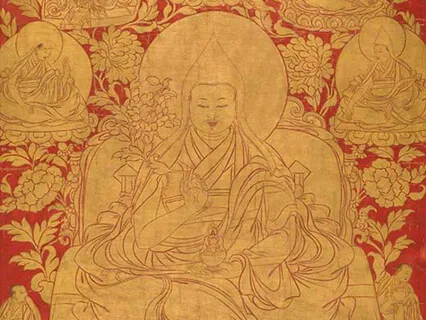
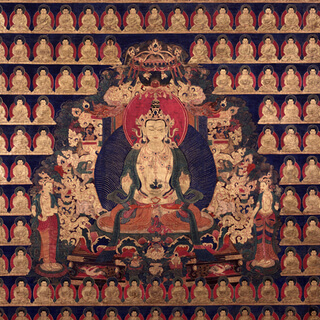
We are going to look at this historical figure who's behind me here.
And this is a teacher,
A Lama,
But not just any Lama.
This is the Dalai Lama.
This is the fifth Dalai Lama.
And this image that we are looking at here behind me has this deep red background.
It's a bit visually unusual,
Right?
It has this deep red background and then this monochromatic gold main figure with surrounding detail.
And this is from the 16th century.
This is a painting that we believe was made during the lifetime of the fifth Dalai Lama.
And there are a couple of visual clues that help us understand this hunch.
One is that the Dalai Lama is sitting not on a lotus throne,
As often figures are portrayed,
But on kind of a realistic looking throne here,
A table of offerings in front of him.
And then he is also amongst his billing robes holding a lotus blossom in his fingers.
The stem is in his fingers there and the blossom blooms over his shoulder.
But in his other hand,
His left hand,
He's cradling a vase.
And this vase symbolizes long life.
And it was often utilized in imagery and paintings in order to give this hope of long life to a person who was currently living.
So surrounding the Dalai Lama are a number of figures.
On the top left is a Tibetan king and the top right a prominent student.
In the center top is Avalokitesvara,
Avalokitesvara,
The Bodhisattva of compassion.
And it is believed that the Dalai Lama is a reincarnation of Avalokitesvara.
And then the four previous incarnations of the Dalai Lama are also pictured here on the side,
One,
Two,
Three,
And four.
And then bottom center is a wealth deity.
And on either side here are some monastic figures.
So this is his entourage,
As it were.
And it's interesting,
I think,
To note that he came to rule during this time in Tibetan history where there was this big power struggle between secular and monastic power.
And when he came into power himself,
His approach was to,
It was a holistic approach,
Which was unique and new.
And what he did was he integrated monastic and aristocratic officials under the single administration.
He had everyone live in the same area in Lhasa,
And even had the aristocratic members take on jobs,
If you can believe that.
So they were all kind of working together under one auspices.
So this was a new idea.
And what does this have to do with you and your meditation practice?
We'll unpack that a little bit today.
And it is,
I think,
An interesting metaphor,
This idea of power being something that,
This place of being able to see a holistic view and incorporate all of the elements together to move forward.
Tracy Cochran is here with us today.
Good to have you back,
Tracy.
And she's a writer and editorial director of the quarterly magazine Parabola,
Which is beautiful.
And we sell it in the shop upstairs.
You can also find it online and parabola.
Org.
And in addition to teaching here at the Rubin,
She teaches at New York Insight every Sunday at Hudson River Sangha in Tarrytown,
New York.
And her writings and teaching schedule can be found online at Parabola on Facebook,
Twitter,
And TracyCochran.
Org.
Please welcome her back,
Tracy Cochran.
Hi.
I picked this image because I was thrilled to think about an enlightened leader.
That was one reason.
And I thought it would just be such a lovely thing to think about.
I was also interested in a figure who wasn't just a great spiritual teacher,
But he had a job,
A really difficult,
Hard,
Messy job.
He had to reconcile all these conflicting factions.
So this was lovely to think about until I found myself lying in bed with this sleet wrapping on my window.
And my shoulder hurt.
And my voice was breathy.
And I came to the stark recognition that I absolutely don't know how to bridge the gap between a king in Tibet in the 16th century and myself.
It was quite embarrassing because I picked the image.
And there was a feeling of desolation that came with it,
A feeling of what do I know about power?
Especially because as I read about the fifth Dalai Lama,
He was not just a great king.
He was a great yogi.
He was an adept and a scholar.
And as I delved into it,
I began to think,
I wonder if he had supernatural powers.
Because we don't hear about them much in secular mindfulness.
But you do hear about them in Tibet and other Buddhist countries.
And the Buddha would talk about how if you make a certain kind of effort,
You could even gain the ability to fly,
To be invisible,
To be in many places at one time,
Which would be very useful if you were ahead of state.
He could just split himself.
And the list goes on.
And I felt even farther away until I discovered I remembered two great teachings,
The first of which you never know what's going to stay with you,
But it has to have the ring of truth.
And the first came from a New Yorker cartoon,
Which I remember with great frequency.
And in this particular cartoon,
King Arthur,
The boy who would be Arthur,
Who is an enlightened king in our Western tradition,
Is struggling to pull a sword out of the stone.
He's just a boy.
And this will be the test to see if he has the quality it takes.
And Merlin comes into the cartoon frame and says,
Use thy core.
Use thy core.
And as I thought about it,
Because it appeared some time ago,
And I haven't,
Since I mentioned I have a sore shoulder,
So I haven't actually been engaging my core lately,
It's come to be an acronym for me,
For the four qualities that lead to the development of powers in Buddhism.
And as I translate them,
The C in core is concentrate,
Which is the first in the Buddhist tradition too,
But it doesn't mean strain or think.
It means let yourself center.
Come down.
Come out of your head into your body.
Collect yourself,
Which is what you do when you come here.
And the Buddha wrote that when the mind is in the body,
And the body is in the mind when we're closer together,
It's sort of like an iron ball that's molten,
That's heated in a fire,
So it becomes soft and pliable.
And other times we might experience it as being like a feather,
Something light.
But this is what it means to concentrate,
To be collected,
To let heart and head and body touch.
And the O for me is to open,
To,
And you know,
One reason it's hard to relate to an awakened king isn't just because of our external circumstances,
But also our internal ones,
Because most of us are so worried,
Anxious,
Depressed.
It's a very stressful time,
And the tyrant you could be living under might be student debt,
Crushing debt,
Or depression and loneliness,
Or anxiety about the future,
About your health,
Or a loved one's health.
We're under tyranny.
So to come in here,
To manifest the desire to get here,
To sit down and be quiet with other people in itself is a tiny act of heroic resolve,
And when we sit down,
We open,
We collect,
And we open,
And we begin to recall who we are,
That we're living,
We're not just worries or aches and pains and concerns,
But a breathing,
Living body.
And I was touched at my fretfulness.
I found a video,
A little short video,
By a man named Terry Waite,
Terry Waite,
Who was held hostage in West Beirut for five years,
For five years.
For five years,
He didn't see the sky or the sun.
He didn't know what would come.
He was held in burnt-out buildings,
In chains.
And he said,
Long after his release,
That one day he recalled that this is my life.
I am alive.
He had breath.
He had this,
I had a heart,
A body.
He came back to life.
So the E in my acronym core is engage.
In this tradition,
They talk about effort,
But I prefer the word engagement,
That we sit down,
We collect ourselves,
We come back in touch,
And we begin to open and recall,
And then we let ourselves notice what we see.
Whatever it is,
We notice life coming into us as a gift.
So here is the strange thing,
Or the gift I wish to give you.
These qualities are the very same qualities that imbue the fifth Dalai Lama and other great,
Great teachers of Tibet with their power.
So I came to realize that,
No,
It's true,
I can't pretend to understand the life of such a being in such a culture.
But what I can do is receive the gift of the same teaching so that in my life,
With my aches and pains and breathy voice or slippery roads,
My life can come to life in a new way.
So let's sit.
So we take a comfortable seat and just let yourself notice how it feels to be in a body right now,
In this place.
And let yourself welcome and honor the body that got you here,
That has carried you for long.
And let everything happen just exactly the way it's happening,
With no judgment,
With acceptance and kindness.
And notice that attention begins to soften the body.
And as this happens,
Let the attention come to the breathing.
Without seeking to change,
Just notice breathing in breath,
Out breath.
And you see that you begin to open just a bit.
Recall that you have a body that senses,
That feels life.
And let yourself notice how it feels to be in this place.
Notice a light of attention that isn't thinking.
It's inside the body and the mind and also the heart.
And let yourself notice how it feels to be in this place.
Begin to notice that you are bigger than you think you are and open to the life around you and inside you.
And let yourself notice how it feels to be in this place.
You can come back anytime.
Anytime.
To the body and the breath and to life in this moment.
And find welcome.
No judgments.
Live your life God batches.
.
.
.
When you come home to the body,
You come home to the power of life.
.
You open to it.
You can feel it coming in and going.
You can feel it coming in and going.
You can feel it coming in and going.
You can feel it coming in and going.
You can feel it coming in and going.
You can feel it coming in and going.
.
.
.
Come home to the body and this moment and see that it's open and offering itself to you.
.
.
.
.
.
.
.
.
.
.
.
.
.
.
.
.
.
.
.
.
.
.
.
.
.
.
.
.
.
.
.
.
.
.
.
.
.
.
.
.
.
.
.
.
.
.
.
.
.
.
.
.
.
.
.
.
.
.
.
.
.
.
.
.
.
.
.
.
.
.
.
.
.
.
.
.
.
.
.
.
.
.
.
.
.
.
.
.
.
.
.
.
.
.
.
.
.
.
.
.
.
.
.
.
.
.
.
.
.
.
.
.
.
.
.
.
.
.
.
.
.
.
.
.
.
.
.
.
.
.
.
.
.
.
.
.
.
.
.