Welcome to the Mindfulness Meditation podcast.
I'm your host,
Dawn Eshelman.
Every Wednesday at the Rubin Museum of Art in Chelsea,
We present a meditation session led by a prominent meditation teacher from the New York area.
This podcast is a recording of our weekly practice.
If you would like to join us in person,
Please visit our website at rubinmuseum.
Org slash meditation.
We are proud to be partnering with Sharon Salzberg and teachers from the New York Insight Meditation Center.
In the description for each episode,
You will find information about the theme for that week's session,
Including an image of a related artwork chosen from the Rubin Museum's permanent collection.
And now,
Please enjoy your practice.
Good afternoon.
Polar vortex isn't going to keep you away.
Nice to see you.
And welcome to the Rubin Museum of Art and to our weekly mindfulness meditation practice.
I know we have some folks still joining us.
There's a little hiccup at the front desk.
So welcome,
Welcome,
Welcome.
We'll take our time here.
So this month,
We've been talking all about intention,
Intention in our practice,
Intention in our lives,
Intention at the beginning of the new year,
The Gregorian calendar new year.
And in fact,
The lunar new year is coming up too.
So if you want to celebrate Losar with us,
Tibetan New Year,
We have a couple of opportunities to do that.
And one is the sixth next Wednesday,
Himalayan Heritage will be celebrating Losar Wednesday evening here in the theater.
And then on the 17th Sunday,
There will be a big family celebration of Losar,
Which is free and throughout the museum and education center.
It's a really fun time.
So you get a chance to set an intention again,
If you would like.
Of course,
As meditators,
We know we can always begin again and intentions can be a part of our ongoing practice.
But it's nice to have these markers and kind of communal times of intention setting.
And that brings to mind our art object for today.
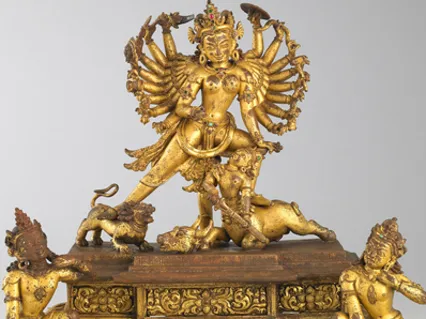
This is one of the most,
I will say,
Gasp inducing objects in the Rubens collection.
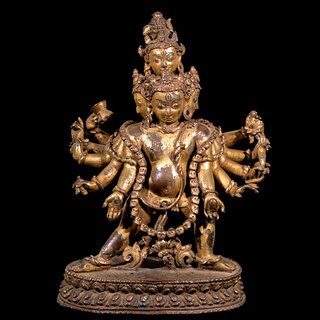
This is Durga,
The multi-limbed warrior goddess,
Durga.
This is from Nepal,
13th century bronze.
And as you can see,
Durga has a kind of a halo of limbs behind her here.
She in each of her arms,
In each of her hands is holding a different weapon given to her by a different god.
And the story of Durga and her mythic battle is,
Even her coming to be,
Is a really complicated and interesting one.
I'll tell you just a couple of aspects of it,
Which is that she was brought forth and called upon by the gods to defeat Mahisa,
I believe it is.
And in fact,
This is Mahisa under her kind of warrior pose,
Front bent leg there in the form of this half bull,
Half man.
So you can get a little glimpse of how it turned out for Mahisa there.
But this is an interesting object,
Lens through which to consider this idea of intentionality.
So in Tibetan Buddhist inspired artwork,
There is often this figure of the warrior,
The protector and the wrathful figure,
Who is considered to be just as important and useful,
If used correctly and intentionally,
As a peaceful figure as well.
So we can imagine the intentionality that emerged from Durga here as she went into battle in representation of all of these gods.
And I'll let you think about that as we meditate today.
Tracy Cochran is here with us.
Hooray.
Tracy is a writer and the editorial director of the quarterly magazine Parabola,
Which can be found upstairs at the shop and online at parabola.
Org and in the Rubin gift shop.
And in addition to teaching here at the Rubin,
She teaches at New York insight every Sunday at Hudson River,
Sonka and Tarrytown.
Her writings and teaching can be found online at Parabola on Facebook and Twitter and TracyCochran.
Org.
We love having her here.
Please welcome her back,
Tracy Cochran.
I love being here and especially under this fierce goddess and with all of you on this cold day.
And I wanted to share something that will be interesting to all of us,
Which is that I read online that visiting a museum is just as good for you as exercising.
And I looked into this story and first of all,
This is not an ordinary museum,
But a place of sacred art,
A place of objects like this statue of Durga.
And this is a place where we can get in touch with otherness.
The beloved poet Mary Oliver has left us and she talked about going in nature to touch otherness,
To remember that we're more than we think.
And this is another way to do it.
And even if you're not looking at that statue today,
The story of a goddess,
Of a force,
A force of creativity is something that can replenish and remind us all of our deeper intention.
And I've been listening to this story.
I watched some little videos of it aimed at children,
Which is my favorite way to learn things.
And also just reflecting on this figure.
And she might seem foreign to you if you grew up in the Western tradition,
But she is the mother goddess.
She is God the mother bear.
She is the fierce and loving force of creation.
I can't help but love the detail in this myth that when all the masculine gods are defeated,
They turn to Durga.
Where do you turn when you feel completely defeated,
Completely at your wit's end?
You touch the earth.
You give up and touch the earth.
And in a very real sense,
Durga represents the force of creation that holds the earth.
And she was called forth by beings in despair because a tyrant,
A buffalo demon,
But we know the type,
This egomaniacal tyrant who cared about nothing but himself and the exercise of his own power was ravaging the earth and sucking the power and the hope from the rest of creation.
And so she agreed to come forth,
To take form.
And she came literally from the coming together of different forces,
Affirming,
Destroying,
Reconciling or maintaining.
But and again,
This might seem something remote,
But do you know how it feels when you,
After you touch the earth,
You pull yourself together?
Something comes back to you.
You remember what really matters.
And very often,
It's not what you think.
It's something so primal and basic.
It's before words.
It's your wish to be here,
To be alive,
To keep participating in life,
To receive.
So Durga embodies that concentrated.
She has all these arms.
And one way to understand that is that she's embracing life.
The buffalo god,
The tyrant,
Like so many of our leaders,
Is full of himself and his agenda.
She is full of an embracing sense of life,
Of how good it can be to be here.
She's motivated not by self,
But by love.
Someone sitting next to me this morning looking at her said,
Is she good?
You know,
Because she looks kind of fierce.
And I said,
Yes,
She's good and fierce.
She's good and fierce,
Which is what we ideally want our mother to be in our defense,
In defense of our right to be here.
And she's got all these weapons,
But what interests me about her weapons is that they include things we don't usually associate with weapons,
Like a lotus,
Brandishing a lotus,
Which is a reminder that things go on.
They come up from the mud.
No failure is final.
I love that the ribbon once quoted me as saying that,
And I actually have to own that.
It came from Winston Churchill.
But it's true.
And no feeling is final.
That new life comes from the mud.
And another weapon was a shell.
Don't you love it?
Take that.
It's a reminder that there is a sound,
Ohm,
The sound of truth.
It's a reminder that we belong here in creation.
We're meant to be here.
And I think one thing that I certainly have found to be true is that this is a practice of remembering,
Recalling,
That even on your worst day,
You are more than you think.
And your life will hold more than you fear.
And that this intention isn't so much something that we have to strive to create,
But something we let ourselves remember.
That there's more than fear and mistrust and a cruel sense of our limitations.
That just like Durga,
We have amazing resources because we are alive.
And as we open to this truth,
We remember our inherent goodness.
We're meant to be here.
We're built for it,
To receive and to give.
So let's sit,
We take a seat with our feet firmly planted and our back straight.
And notice just that,
Just how it feels to land here in this room.
Noticing that the body got here through the cold and all the busyness,
It brought you here to this special place.
And notice that as you bring the attention to the body,
It begins to soften and open just a bit.
Like the half-open lotus of Durga,
It begins to open at the touch of your kind attention.
And we notice that there's thinking,
There's pictures in the head,
There are sensations,
And we let everything be exactly as we find it,
With no judging.
Notice how it feels to bring the attention home to the breathing and the body and the sensation of being present.
Cool,
Achi.
When you get taken by thinking,
You just notice this with no judging and gently bring the attention home back to the body,
Back to the breath,
Back to this moment noticing that it isn't closed,
It's opening and it isn't judging,
It's kind.
2 minutes.
.
.
.
.
.
.
.
.
.
.
.
.
.
.
.
.
.
.
.
.
When you drift away,
You gently come back to the life that's waiting to receive you.
The presence that sees without judging.
.
.
.
.
.
.
You begin to know how alive you are,
How responsive and open.
.
.
.
.
.