Welcome to the mindfulness meditation podcast.
I'm your host,
Dawn Eshelman.
Every Wednesday at the Rubin Museum of Art in Chelsea,
We present a meditation session led by a prominent meditation teacher from the New York area.
This podcast is a recording of our weekly practice.
If you would like to join us in person,
Please visit our website at rubinmuseum.
Org slash meditation.
We are proud to be partnering with Sharon Salzberg and teachers from the New York Insight Meditation Center.
The series is supported in part by the Hemera Foundation.
In the description for each episode,
You will find information about the theme for that week's session,
Including an image of a related artwork chosen from the Rubin Museum's permanent collection.
And now,
Please enjoy your practice.
My name is Gracie Mills and I've been an apprentice museum educator here at the Rubin Museum for the past year.
Now this month in meditation,
We've been looking at story,
The power that certain stories have,
And the ability of stories to unite a community.
And today we're going to be looking at how stories can actually allow people to identify and cultivate their own identities.
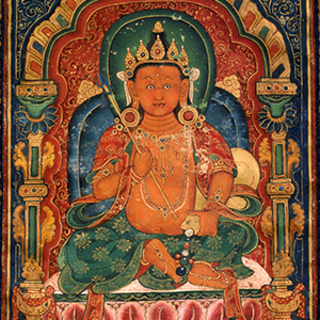
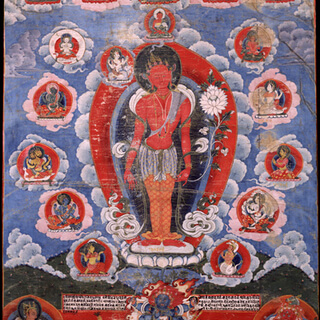
So today we're looking at this Tonka painting.
It is from eastern Tibet of the first half of the 19th century,
And it's made from distemper on cloth.
Distemper is a kind of glue paint,
Glue pigment,
And it is Padmasambhava's Pure Land,
Pure Land called the Copper Colored Mountain.
And legend has it that Padmasambhava still resides in this Pure Land to this day.
And according to a story prior to traveling to Tibet,
Padmasambhava gained the power of immortality.
And when he traveled to Tibet,
He subdued many local deities and spirits and converted them to Buddhism.
And we can actually see some of those spirits here in this image.
You can see various little scenes of little people here,
And they're actually in his Pure Land as converts to Buddhism,
And they are teaching the teachings that he himself taught.
And after the subjugation of these local deities,
Padmasambhava retired of sorts to this Copper Colored Mountain.
And so we can see that this legacy,
This story that is told kind of hints at the fact that Padmasambhava,
Since he still lives here,
Could come back to Tibet,
Could come back to the Himalayas,
And help the Tibetan people should they need his aid.
So we can see how this story demonstrates a strong connection that Tibetans feel to this figure in their culture and in their identity as someone who exists in past,
Present,
And in the future.
And if you want to take a closer look at these little scenes,
I highly suggest taking a tour with Jeremy after the program.
But today we welcome back Tracy Cochrane for part two of this month.
Tracy is a writer and the editorial director of the quarterly magazine Parabola,
Which can be found online at www.
Parabola.
Org and in the Rubin gift shop.
She's been a student of meditation and other spiritual practices for decades.
And in addition to the Rubin,
She currently teaches at New York Insight and every Sunday at Hudson River Sangha in Tarrytown,
New York.
Her writings and teaching schedule can be found online via Parabola and Facebook and Twitter and on TracyCochrane.
Org.
Please help me welcome her back,
Tracy Cochrane.
I'm so happy to be invited back and looking at this great palace behind me.
I don't know if you're like me,
But at least at one point during the week,
Maybe two or three points,
I thought I would love to retire to a place like that.
Because in the description that I was sent,
It's on an island in the middle of a forest full of goblins,
Goblins that are on his side.
And he has a private force of cannibals that he's converted.
So it might seem like a stretch,
You know,
To think of such a place,
Because most of us here didn't grow up with this particular mythology,
If I could call it that.
But in a way,
It's possible for us to understand what it's like.
The Buddha,
His dying words to Ananda were,
Be an island unto yourself.
And what does that mean?
It doesn't really mean separate yourself and cut yourself off from the world.
It means touch the earth of your life,
Your deeper life.
You know,
And I could get into converting the cannibals,
You know,
We get to stop devouring yourself and so on.
But I thought it's been a bit of a rough week in the United States.
So I thought I would keep it simple.
And I wanted to remind you that tomorrow is the solstice.
Tomorrow is the summer solstice.
It happens every year between the 20th and the 22nd.
And it's happened since time immemorial.
And the 24th in northern countries is called Midsummer Day or Midsummer Eve.
Maybe you've heard of it.
Shakespeare wrote a play about it.
And that celebrates the midpoint between planting and harvest.
And I bring this up because even if you're not in a position to join the hippies and pagans that will be gathering at Stonehenge tomorrow morning at dawn,
There's something inside you that can.
And that great stone monument was built so that the first light of dawn strikes the altar.
And it bears testament to our human capacity to observe,
To be patient and observe.
And the word itself,
Solstice,
Comes from a Latin word that means sun and stillness.
And its meaning was the day that the sun seems to stand still in the sky,
In the north.
It's the longest day.
And the day after the solstice,
The day after the light hits the altar,
The sun appears to go down a little bit more quickly.
Imagine having that kind of precision.
Of course,
If you were a farmer and every single one of our ancestors was a farmer,
At one point you would see,
You would notice.
So why do I bring this up?
Because there were special qualities that these early people noticed.
And these early people also included people in China,
In Egypt,
Where it was the New Year.
And they noticed,
And I quote Washington Irving,
Who is a neighbor,
Who was a neighbor of mine at Westchester.
It's a time that's a thin place,
Just like Halloween,
When spirits and unknown forces of all kinds are more easily available to us.
So maybe that seems far-fetched to you.
But when we come into a room like this and we sit down,
It's a day when we touch the earth of the body.
We're like the Buddha when he made that gesture of touching the earth.
And all hell can be breaking loose in your life,
Personally,
Nationally,
In every way.
And yet you can reach down and touch the earth.
You can make space for this body's right to be here,
To be sitting here breathing.
And at the same time,
On this eve of solstice,
We can make space for the sun,
The sun of our awareness.
And we don't even have to just relate to it that way.
You can have a moment today when you're outside of remembering,
Remembering that this practice literally means to remember.
Remember that you're under the sun.
You're on the earth under the sun.
And that this practice of sitting that we do is a way of becoming a thin place.
Not in the sense of weight loss,
In the sense of letting yourself be porous,
Letting influences reach you from the sun,
From the earth,
From the goodness and intelligence of nature.
We begin to discover when we sit down and breathe together.
Do you know the root of the word conspire means to breathe together?
This is a conspiracy right here in this room,
A conspiracy of awakening.
Together we're pooling our impressions of how it feels to be here and awake.
When you come into this room you don't just come for the speaker but because you remember something when you do.
You remember that you're larger than you think you are.
That you're not just one little tiny isolated being.
You're part of a greater being.
You're part of life.
Have you ever felt that when you sat?
It's just a breath that can bring you there.
And you begin to discover that you become strong when you let your borders be porous,
Open,
Receptive.
You remember what it's like to be here,
Touching the earth under the sun.
It means remembering what it's like to be alive.
So a story like this great teacher living still in the pure land becomes easier to approach and understand.
It's like the Buddha still teaching.
Not just in stories and not just in the great art in this museum but inside you.
These simple truths that he pointed out,
They're still available.
And in a way you can go to that island when you become an island in the spirit that the Buddha pointed towards.
He didn't mean cut yourself off.
He meant sit down in the rushing stream of life.
Sit down and remember to be here.
So the last thing I want to say before we take our seat is,
You know,
A lot of times lately the news has been kind of rough.
I heard a quote this week from another tradition from C.
S.
Lewis,
Holy places are dark places.
That means you sit down,
Usually you come to this practice not because things are going so well.
You come and sit down and take a breath because you might feel lost or overwhelmed or anxious and the same old thoughts aren't taking you anywhere.
So when we do this we find something new.
Not new in the sense of invented but new in the sense of rediscovered.
We begin to remember the resources we have in us.
We remember our deeper humanity and our connection to the whole of life.
These are the times we practice for and these are the times that turn us towards practice.
So let's practice.
How would that be?
So we take our seat and today paying special attention to how it feels to place your feet and straighten your back and grant yourself space.
Giving yourself welcome,
You're welcome here.
And just notice how it feels to be in your body without thinking about it and how it feels to be accepted.
And everything that happens to come up,
If tension is present,
Anxiety,
Thinking,
Let it be.
Understanding how the body begins to relax when you bring attention.
And as this begins to happen,
Bring the attention to the breathing without seeking to change it in any way.
Just bring attention.
Noticing in-breath and out-breath.
Noticing everything that's happening.
Attention,
Listening,
Thinking with no judgments.
And when you notice you're being taken away by thinking,
By a sensation of any kind,
You gently bring the attention back again to the breath.
Notice that when we grant ourselves acceptance,
We begin to relax.
Let me pause.
.
Sati means to remember.
Mindfulness means to remember the present.
Just as it is.
Just as it is.
Just as it is.
Just as it is.
.
Noticing that when you come home to the breath and the body,
You also open,
You soften and open.
Becoming more aware of being in life.
.
.
.
.
.
.
.
.
.
Noticing that when we come home,
We can experience ease just for a moment.
And opening to the world.
.
.
.
.
.
.
.
.
.
.
.
.
.
.
.
.
.
.
.
.
.
.
.
.
.
.
.
.
.
.
.
.
.
.
.
.
.
.
.
.
.
.
.
.
.
.
.
.
.
.
.
.
.
.
.
.
.
.
.
.
.
Noticing as we come towards the end that life is literally pouring through you.
That we're open.
And at the same time grounded.
Thank you.
Thank you.