Welcome to the Mindfulness Meditation podcast.
I'm your host,
Dawn Eshelman.
Every Wednesday at the Rubin Museum of Art in Chelsea,
We present a meditation session led by a prominent meditation teacher from the New York area.
This podcast is a recording of our weekly practice.
If you would like to join us in person,
Please visit our website at rubinmuseum.
Org slash meditation.
We are proud to be partnering with Sharon Salzberg and teachers from the New York Insight Meditation Center.
The series is supported in part by the Hemera Foundation.
In the description for each episode,
You will find information about the theme for that week's session,
Including an image of a related artwork chosen from the Rubin Museum's permanent collection.
And now,
Please enjoy your practice.
Great to have you all here.
We are talking this month about aspiration,
Aspiration.
And we're doing that kind of in concert with this annual thematic that we have that we're just launching here at the museum.
We're going to be talking about the future for the whole year.
And the future and time and the nature of time,
Our relationship to it,
How we feel about it.
You might have noticed up on the wall over there in the spiral lobby,
There's a whole bunch of hopes and anxieties that people have listed out about the future.
And it's been really interesting to see that over the last week or so,
How that's been amassing and evolving.
And it's interesting to notice as I look at it every day that there always seems to be just a few more hopes than anxieties listed there.
So aspiration.
And for a Buddhist practitioner,
The ultimate aspiration is that of enlightenment for the benefit of all beings.
And I think as meditators,
No matter how we're coming to this practice,
Whether it is through Buddhism or a secular approach or another way,
That we all hold aspirations differently in our practices.
And that something we've been talking about is the difference between an aspiration and a grasping.
And so aspiration,
Intention,
The relationship between those two,
And the other side of that coin,
That sort of willingness to let go,
The understanding of impermanence.
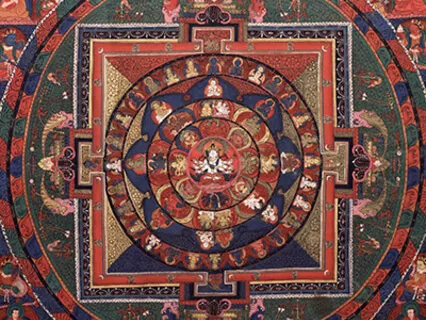
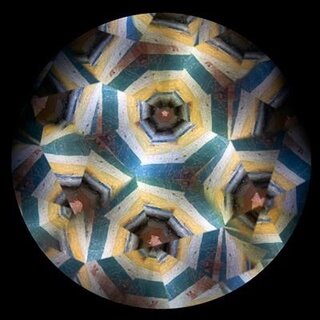
We're looking today at a beautiful mandala.
This is a mandala of Pancharaksha.
It's from central Tibet,
18th century,
Pigments on cloth.
And a mandala is a visual depiction of an aspiration,
If you will.
On the one hand,
It represents a palace.
It's actually a bird's eye view of a palace.
So you're looking at the floor plan here.
A palace that may or may not physically exist,
But that is very real for the Buddhist practitioner.
And at the center of this particular palace is the deity,
Pancharaksha.
And she is surrounded by her entourage.
And you can see that there is a kind of a central square here,
And you have four gates.
These are four entry points into the mandala.
They each face a different direction,
North,
South,
East,
West.
And then there are different layers of kind of a process that you go through to enter the very ultimately central,
Kind of most sacred part of the palace.
And indeed,
In many physical palaces throughout Tibet and other areas of the Himalayas,
There's this idea that at the very center is often the shrine.
It's the kind of the most protected and safe space.
And the metaphor here,
And for practitioners,
The reality is that you actually walk yourself through the different layers here until you reach the center.
And in fact,
The practitioner will visualize themselves becoming the central deity as a way of practicing the transformation into becoming enlightened.
So this is a roadmap of sorts.
We are delighted to have Tracy Cochran back with us today.
And she is a writer and the editorial director of the quarterly magazine Parabola,
Which can be found online at parabola.
Org and also upstairs in the shop.
She has been a student of meditation and other spiritual practices for decades.
And in addition to the Rubin,
She currently teaches at New York Insight.
She has a new class coming up.
It starts,
It's going to be eight Mondays in a row in the evenings,
Early evenings,
Happy hour,
Says Tracy.
This begins on March 19th,
Right?
And there's a brand new link up there if you want to check it out,
Visit New York Insight for more information.
She also teaches at Terrytown Insight in Terrytown,
New York,
And this is every Sunday.
And of course,
You can find her on Facebook,
Twitter,
And online at parabola and tracycochran.
Org.
Please welcome her back,
Tracy Cochran.
Looking at this gorgeous mandala,
I can't help remembering seeing it destroyed.
You would see these monks work patiently and meditatively with this beautiful aspiration to take on the mind of awakening.
And at the end of all their careful labors,
They destroy it.
And they take all that sand,
It's usually fine grains of sand,
And they cast most of it into water if they have access to that.
They give some of it away.
I got some of it once.
And I keep it on an altar.
And I think of it as a reminder of impermanence and aspiration.
So impermanence.
Just last week,
I was complaining about how cold it was.
And just today,
Walking down here,
I found myself complaining to myself about how hot it was.
And who knows what tomorrow's gonna bring.
But last week,
When we were together,
Some of us were together.
It was extraordinary because it was Valentine's Day,
It was Ash Wednesday.
It was Losar,
Or almost Losar.
And when I was walking home from being here with you,
I crossed Madison Park,
This busy little city park with people rushing this way,
That way.
And standing in the middle of the park was a Catholic priest in white and purple vestments with a sign that said,
Ashes and prayers.
Ashes and prayers.
And it was an extraordinary moment to see this person standing stock still in the midst of all this rushing.
And I was rushing along wondering what news I was gonna hear,
What fresh tweet storm,
What was I gonna have for dinner.
You know,
The usual thought stream,
And then this stop.
And even when I was here,
John,
And I were talking about how pagan the putting out of ashes looks.
And this turned out to be true.
After I saw that sign,
And I recalled that the traditional prayer is,
Remember that you are dust,
And to dust you will return.
So it turns out that this was a pagan Norse rite to invoking the protection of Odin.
And they spread it all over Europe,
And Constantine decided to incorporate it.
But it came from India,
From Vedic India.
The putting out of ashes was a way to signal and invoke Agni,
God of fire.
Purify me.
Forgive me.
Let me be open to something higher and finer.
And that word Agni became the Latin word for ignite,
Ignition.
And it became a day that was followed by the season of Lent,
Which turns out to be practiced in ancient Egypt.
Did you know that?
Forty days of purification,
Waiting for Osiris.
And it also was practiced by Indians in Mexico.
Forty days,
Preparing for the sun.
So why am I talking about this in the Ruben?
Because when we sit down together in the presence of this great sacred art,
It's not just any art.
It's a special kind.
We're invited to remember that inside each of us,
There's a capacity to know in a deeper way.
Not just know what we read in the news on our phones,
Or think in our minds.
But it's uncanny to realize that people all over the world,
In all different cultures,
Had this intuition that sometimes when we remember,
We're dust.
When we remember,
We're impermanent.
When we remember that someday we'll leave here.
At that moment,
It becomes more possible to open to another kind of energy,
Another kind of awareness and knowing.
And symbols like the mandala to take a seat in the center of your life,
Your experience.
Right in the middle of your busy day,
You're thinking about 10,
000 things.
You're worried and anxious,
Perhaps,
Or hopeful or striving.
All kinds of competing things like that crisscrossing in Madison Park.
And right in the middle of it,
To invite yourself to be still and open to your experience.
In a very real way,
That was exactly what people were doing in ancient Egypt,
In India,
In Mexico.
Opening to the truth that there is more.
That even in the midst of your worst day,
You might feel like all of your dreams and hopes have turned to ash,
Dust.
In that very moment,
Another kind of life can ignite.
You have a chance to remember what really matters.
To breathe,
To be here,
To be alive and part of life.
It turns out that aspire means to breathe.
To inspire means to breathe in,
To breathe in,
To take in inspiration,
The presence of all of us sitting together.
To aspire is something deep in you that wishes to be all you can be.
Not in the sense of climbing a mountain or getting a PhD,
Though you may decide to do those things.
But right in the moment,
We aspire to something unknown.
In the moment of seeing that priest standing in the middle of the city park,
I remembered that great Buddhist teachers say this path is a circle.
We aspire to what's not yet known.
And we also take our place with the ancient ones,
With all beings,
All beings from all times who've wanted to be fully alive,
To be warm-hearted and open and present and available to a greater light,
To the sun,
To a spark of something we share.
And it's quite extraordinary to have this ability right in the middle of the city to sit down and to do what these people have done for all times.
So why don't we join them?
And we do that by taking a comfortable seat,
Feet firmly planted on the floor.
And we let our eyes closed.
Some people aren't comfortable with closed eyes,
But if you can,
Do let your eyes closed.
Let your back be straight and feel yourself taking your seat in the center of life,
Picturing that mandala.
And you are in the center of it.
And the portals are open.
We can feel sensations on our skin.
We can hear sounds.
Thoughts bubble up,
Impressions from our day.
And we let everything happen to us with no judgment.
So we bring our attention back to our seat,
Allowing ourselves to feel how it is to be in this body right now.
And we begin to soften just a bit.
And as this relaxation begins to happen,
We allow the attention to come to the breathing without seeking to change it or alter it.
We just let the attention ride the breath,
The in-breath and the out-breath.
Sensing how it feels to be present in the body with no judgment,
No hurry,
With an attitude of welcome.
You're welcome here.
All right.
Sati,
The word for mindfulness,
In the early scriptures means to remember,
Remember to come home to this body,
In this breath,
In this moment.
Exciting.
Noticing that we can begin again at any moment and find welcome,
No judgment.
It's transformed into a sunlight of awareness that isn't thinking,
That doesn't judge.
It receives,
Sees.
It's transformed into a sunlight of awareness that isn't thinking,
That doesn't judge.
It receives,
Sees.
Noticing that there's a vibrancy inside us that we forgot.
A life that opens to receive life,
To respond.
It receives,
Sees.
It receives,
Sees.
It receives,
Sees.
Noticing as we continue to make this move.
It receives,
Sees.
It receives,
Sees.
It receives,
Sees.
It receives,
Sees.
It receives,
Sees.
It receives,
Sees.
Noticing how it feels to be welcome here with no judgments.
Noticing how it feels to be here with no judgments.
Noticing how it feels to be here with no judgments.
Noticing how it feels to be here with no judgments.
Noticing how it feels to be here with no judgments.
When we get taken by dreams or thoughts,
We notice this and gently come back to the breathing.
Breathing in and breathing out.
Remembering that we're part of life.
We're part of life.
We're part of life.
We're part of life.
Noticing as we practice this movement of return and allowing,
Letting ourselves be,
That there is an aspiration in us to be present,
To be here.
Noticing as we practice this movement of return and allowing,
Letting ourselves be,
That there is an aspiration in us to be present,
To be here.
Noticing as we practice this movement of return and allowing,
Letting ourselves be,
That there is an aspiration in us to be present,
To be here.
Noticing that this presence is an energy that we can feel,
Sense,
In the body and in this room.
Noticing that this presence is an energy that we can feel,
Sense,
In the body and in this room.
Noticing that this presence is an energy that we can feel,
Sense,
In the body and in this room.
Noticing that by making this simple movement of return to the breath and to the sensation of sitting here in this body,
We're not shutting down.
We're actually opening to something vast and unknown,
Becoming part of the whole of life.
Noticing that this presence is an energy that we can feel,
Sense,
In the body and in this room.
Noticing that this presence is an energy that we can feel,
Sense,
In the body and in this room.
As we come to close,
Remembering how it feels to bask in the sunlight of a greater awareness.
Thank you.
Thank you.
Thank you.