Welcome to the mindfulness meditation podcast.
I'm your host,
Dawn Eshelman.
Every Wednesday at the Rubin Museum of Art in Chelsea,
We present a meditation session led by a prominent meditation teacher from the New York area.
This podcast is a recording of our weekly practice.
If you would like to join us in person,
Please visit our website at rubinmuseum.
Org.
We are proud to be partnering with Sharon Salzberg and teachers from the Interdependence Project.
The series is supported in part by the Hemera Foundation.
In the description for each episode,
You will find information about the theme for that week's session,
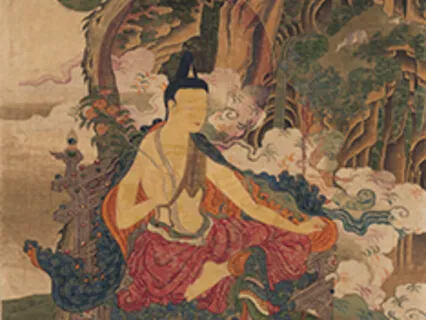
Including an image of a related artwork chosen from the Rubin Museum's permanent collection.
And now please enjoy your practice.
Good afternoon,
Everybody.
Welcome to the Rubin Museum and to our weekly mindfulness meditation practice.
Anybody here for the first time?
A few.
Great.
Welcome.
The diehards,
Every weekers.
Hello,
Front row.
And in between,
In between.
Great.
Great to have you all.
Happy Valentine's Day.
And it's Ash Wednesday also.
And it is the eve of the lunar new year.
So happy Losar.
There's a couple of ways to celebrate Losar with us this weekend,
If you would like to.
On Saturday,
My dear colleague Tashi Chodron will be leading a meditation practice in the Shrine Room area.
This is called Awakening Practice,
Saturday at 1130.
And then Sunday,
We have Family Day here at the Rubin.
And it will be all about Losar and the Year of the Dog.
So come have some fun with us.
That's,
I think,
12 to 4 on Sunday.
So we thought it was the doldrums of winter here,
But apparently things are stirring.
It's interesting to think about aspiration right now amongst this kind of quiet,
Darkest winter time with the promise of spring coming.
And we are talking about aspiration this month in a kind of concert with the theme that we're diving into here at the museum for the rest of the year.
We'll be talking all about the future.
So all of the exhibitions on all of our gallery floors and many of our programs will be having different ways in to this conversation about the future,
About our role in it,
And about what it means from a few different perspectives.
So aspiration.
Behind me,
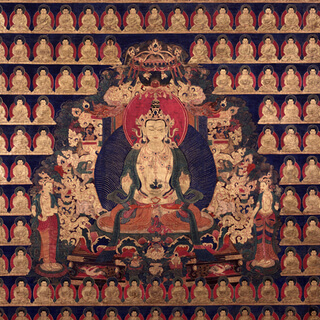
We have a kind of embodiment of aspiration.
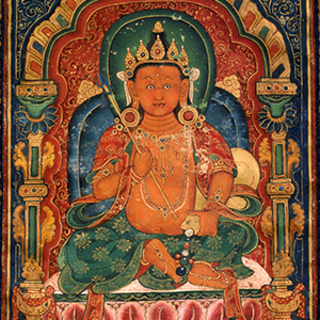
This is Maitreya.
This beautiful painting,
Mineral Pigments on Cloth,
Is from Tibet in the 19th century.
And I hope you got a chance to see some of the detail.
I know we tried to show you some detail slides during the entry portion.
But it's really,
Really quite gorgeous.
And if you can make the gallery tour with Jeremy today to take a closer look right after the program,
Please do.
It's really,
Really quite lovely.
And Maitreya is known as the future Buddha.
And Maitreya is thought to reside in Tushita,
Which is kind of a heaven realm.
And there,
Maitreya waits until Buddhism is forgotten about.
And at that point,
He will return.
And bring all of the teachings with him.
So he's kind of sitting and waiting for when he's needed.
Maitreya is also a Bodhisattva.
So he took this vow as an enlightened being that he would not just go on to enlightenment,
But really to stay and help people who needed help on their path towards enlightenment.
And I think we talked recently about the importance of taking a vow.
There's this difference,
A difference in terms of merit and karma.
When you do something that's valuable,
It's of course wonderful and meritorious.
But when you take a vow to do something that's wonderful,
And then you do it,
It's even better.
You get a lot more merit for that.
So it's something about making that commitment towards your aspiration,
And then moving in that direction that is incredibly valuable.
So that's what Maitreya is doing here.
We have our beloved teacher,
Tracy Cochran-Beth with us this week.
She'll be here this weekend next week.
Great to have you back,
Tracy.
Tracy Cochran is a writer and the editorial director of the quarterly magazine Parabola.
You can check it out in our shop.
This one is about wealth.
And she's is about wealth.
You can also find it online at parabola.
Org.
Tracy has been a student of meditation and other spiritual practices for decades.
And in addition to the Rubin,
She currently teaches at New York Insight.
And I know some of you were curious about any other upcoming writing and meditation workshops that Tracy's offering.
And she is going to do an ongoing class,
March and April,
At New York Insight.
So check out their website.
I think the specific dates are coming very soon.
And she also teaches every Sunday at Tarrytown Insight in Tarrytown,
New York.
And you can check her out on Parabola,
Facebook,
Twitter,
And tracycochran.
Org.
Please welcome her back,
Tracy Cochran.
Happy Valentine's Day.
I'm delighted to be back and I'm delighted to be here today,
In particular.
And I have a deep wish that we all feel surrounded by love right now.
And the ancient ones,
Including the people that made this exquisite ancient art,
Believe that love was an energy.
It's a kind of intelligence that we can access sometimes.
When in situations like this in particular,
We can soften up.
And I read this morning that Thomas Merton said the beginning of love is to allow someone to be exactly who they are,
Perfectly themselves.
Because to wish them to be otherwise is to be in love with your own projections.
And in a way,
That's what we do when we come here,
When we relax.
We let ourselves be exactly who we are.
That's giving ourselves love,
Opening to love.
And it's also Ash Wednesday,
Which is confusing for some people because eat the chocolate,
Don't eat the chocolate.
But it fits if you think of relinquishing or renouncing as letting go of a need for things and people to be different than they are.
Imagine renouncing self-judgment for Lent.
Just a thought.
So what does this have to do with Maitreya?
It does have a connection.
I'm not just wandering.
And I'm not.
I'm not.
Here it comes.
And so in the great legend,
The great myth of Maitreya,
He's the Buddha of the future.
He appears when the Dharma is lost,
When all truth,
Everything that you've been holding on to is vanished.
He appears.
So first of all,
I want to say it's been a long winter.
Have you noticed that about now,
About last week,
I remember my old father telling me when he got home from World War II,
He burned his army uniform.
And I had this overwhelming desire to burn my winter coat.
You know,
You have this feeling that you just can bear it.
And the scarves and the mittens and everything that looks so jolly in December suddenly has this grim look.
And taking Metro North down to the city,
It feels like a troop train.
You know,
People are like,
I'm going in.
It's grim.
But okay,
So this is a barren,
There's a barren time.
There can be a barren time.
The winter.
And it can also be an internal winter,
A feeling that you can barely drag yourself out.
That you have gone beyond hope.
There's nothing to hope for.
You're at the end of your rope.
This is when Maitreya appears.
Something fresh.
And as scholars have pointed out,
It's really interesting that this great myth of Maitreya,
The return of the Buddha,
Seems to resonate with other traditions in Judaism.
The idea of the coming of the Messiah.
Also in Islam.
Also in Christianity.
The idea of the return of the Christ.
The awakened one.
So what's interesting,
When you come to this museum,
You can think,
How can I relate personally to this ancient art and these far away traditions?
But I was reminded,
You know,
I'm the editor of Parabola,
And one of the founding editors of Parabola 42 years ago wrote Mary Poppins.
P.
L.
Travers.
And in the very first issue,
Called The Hero,
She wrote,
Everybody has to be the hero of one story,
Their own.
And when I first heard that,
I thought there was a battle between yes and I felt a little bit as if that magical nanny was scolding me for having a bad attitude.
You know,
What if I don't feel like being the hero?
What if I want to be an anti-hero?
Or just do my best?
But of course,
Slowly over the years,
I've come to realize,
As she wrote in that long ago essay,
That this mythic level,
The hero belongs to this level in us that's a mythic intelligence.
It's not the surface of the mind that is so interested in facts,
But something else.
The part of us,
When we sit down in this room together,
All of us,
There's a feeling of being on a journey.
And in the top of your mind that compares and contrasts,
You might think that's ridiculous,
Or you're too old for that,
Or you're too young for that,
Or I've heard that too much.
But still,
There's a feeling in the body.
Something in us longs for something unknown,
Something that we haven't already told ourselves or heard or read.
And something in us is just ready to set out for something more.
And the interesting thing is,
Wise aspiration in this tradition is sometimes in the early written tradition,
They describe it as having three parts.
Harmlessness,
Loving friendliness,
Love again,
And relinquishing,
Relinquishing again.
Three parts.
And this isn't a passivity.
It's a kind of giving up the known.
That part of you that comes here,
Or that has a moment late at night,
Or some other time in nature when you're alone,
When you're ready for something new.
Why is that?
Because you're not ready for something new.
Wise aspiration is the part of you that yearns for the future.
It yearns for Maitreya,
But not in the ordinary sense of yearning to go to Africa or get a PhD.
It's that part of you that yearns to be more fully alive,
More fully who you are.
And we all know those moments,
Don't we?
I mean,
On any given day,
On the way down here,
My phone was always grabbing at my attention.
My phone was always grabbing at my attention.
Have you noticed that?
It has like sticky little fingers.
And I knew there was nothing on my phone that I hadn't seen five minutes before.
Like the Nobel committee has contacted me,
But you know,
Like nothing was going to be new.
But at the same time,
There was something in me that knew that there was something else that was possible.
I came back to the sensation of the body and the aspiration to be here.
Coming here is a kind of vow.
It's a gentle vow for all of us,
Not just for me.
I'm going to show up.
And we show up to find something that's unknown,
But something we secretly suspect we will find.
So let's take our seat and we can talk a little bit more later if you want or not.
And we take our noble seat,
Knowing that even before we close our eyes that we can be heroic just for a moment.
It doesn't have to be a long,
Drawn out affair.
It doesn't have to be anything that anybody else sees.
It can mean taking our seat in the center of our lives right now.
And allowing the eyes to close and the feet to rest on the floor,
We do something that the Buddha brought as a new way to be a hero.
We let ourselves soften,
Let down our guard.
We let ourselves relax,
Noticing how it feels to land here in this new territory of the present moment.
Noticing that now is always fresh.
It's not known.
It's alive and offering itself to our attention.
We notice the body without thinking about it,
Just sensing it.
How does it feel to be here now?
And noticing the body soften just a little bit,
We bring the attention to the breathing.
Without seeking to change it in any way,
We just notice the in-breath and the out-breath.
And the sensation of being here right now.
We notice sensations,
Thoughts,
Tensions,
And allow everything to be exactly as it is.
No self-judgment.
And when we notice ourselves drifting into thinking,
Memories,
Taken by sounds,
We gently come home again to the breath and the sensation of being in this body.
Just let everything roll through us,
Let everything happen.
Coming home again,
Sati,
The ancient word for mindfulness,
Means to remember the present moment.
Meditation is a movement of return,
Of coming home,
And also a movement of opening,
Of allowing.
As we begin to relax and come home,
We notice that there's an attention inside that's not thinking.
It's like sunlight,
It's not separate from sensation,
There's a vibrancy in the body and the feelings that we forget.
When we come home,
We remember.
When we find ourselves sleeping or caught up in thoughts or having a difficult feeling,
We notice this with kind attention.
Nothing is rejected,
Nothing is judged.
And gently come back to the breath and to the experience of the vibrancy of the body,
The present.
You may notice as you begin to relax,
That there are finer feeling sensations,
Call them what you will,
In us.
Under the thinking and the worry,
There's a wish to be present,
To be here,
To be alive.
We wish to be part of it,
Part of life.
Noticing how it feels to come home and be welcomed,
Even if you've been sleeping this whole time,
To be completely acceptable,
No judgment.
Noticing that when we come back to the moment,
We're not shutting down,
We're opening,
Softening,
Enlarging our world.
We're not shutting down,
We're opening,
Softening,
Enlarging our world.
We're not shutting down,
We're opening,
Softening,
Enlarging our world.
We're not shutting down,
We're opening,
Softening,
Enlarging our world.
We're not shutting down,
We're opening,
Softening,
Enlarging our world.
We're not shutting down,
We're opening,
Softening,
Enlarging our world.
As you continue to come home,
You may begin to remember how large you are,
How vibrant and rich and part of life.
We're not shutting down,
We're opening,
Softening,
Enlarging our world.
We're not shutting down,
We're opening,
Softening,
Enlarging our world.
We're not shutting down,
We're opening,
Softening,
Enlarging our world.
We're not shutting down,
We're opening,
Softening,
Enlarging our world.
I just wanted to remind you that the great German poet Rilke says,
Let everything happen to you,
Joy and terror,
Just keep going,
No feeling is final.
And it can feel like the end of the space of a sitting,
A kind of track.
And slowly,
Drop by drop,
Moment by moment,
One moment at a time,
We begin to know that there is a new life always,
Beyond the end of what we think is possible.
And that's what I think the great myth of Metreia points towards.
And the P.
L.
Travers,
Who I delight in calling my colleague,
The author of Mary Povins,
My parabola colleague,
Talked about this layer of intelligence,
This mythic mind is like living water.
It's like striking water.
It's like we drag ourselves in here across the tundra of the winter.
And when we sit down together,
We penetrate to something deeper.
And all these great myths,
Including the lunar new year,
They're things that this body,
This heart,
This mind know.
So thank you for listening to me.
That concludes this week's practice.
If you'd like to attend in person,
Please check out our website,
Rubinmuseum.
Org slash meditation to learn more.
Sessions are free to Rubin Museum members,
Just one of the many benefits of membership.
Thank you for listening.
Have a mindful day.