Welcome to the Mindfulness Meditation Podcast.
I'm your host,
Dawn Eshelman.
Every Wednesday at the Rubin Museum of Art in Chelsea,
We present a meditation session led by a prominent meditation teacher from the New York area.
This podcast is a recording of our weekly practice.
If you would like to join us in person,
Please visit our website at rubinmuseum.
Org slash meditation.
We are proud to be partnering with Sharon Salzberg and teachers from the New York Insight Meditation Center.
The series is supported in part by the Hamera Foundation.
In the description for each episode,
You will find information about the theme for that week's session,
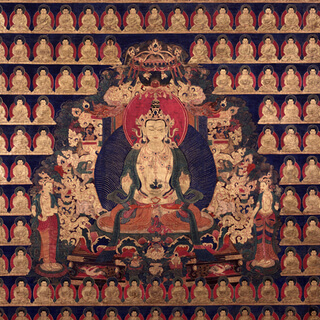
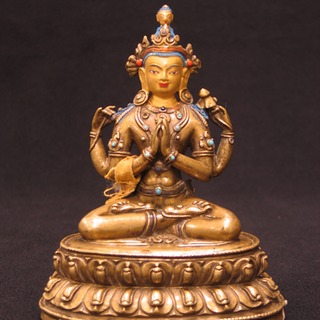
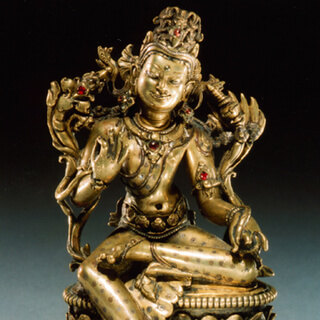
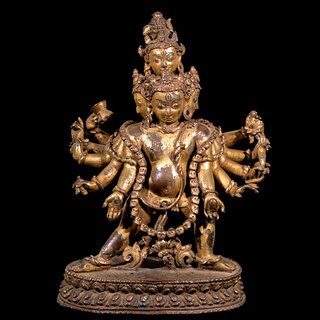
Including an image of a related artwork chosen from the Rubin Museum's permanent collection.
And now,
Please enjoy your practice.
Good afternoon,
Everyone.
Welcome.
Very warm welcome to our weekly mindfulness meditation here at the Rubin Museum.
My name is Tashi Chodron.
I host a monthly program called Himalayan Heritage.
It's every first Wednesday of each month.
How many of you have attended the Himalayan Heritage here at the Rubin Museum?
Okay,
Very handful.
The rest of you have been missing a lot.
So the first Wednesday,
That being said,
The next one is September 5th,
If I'm not wrong.
This heat is kind of making my mind a little bit.
And all of you are so brave.
And what better place to be right than here in the beautiful intention of having a peace,
Tranquility in the heart of this amazing city called New York,
Right?
So again,
This month's intention and theme is intentionality.
And I've mentioned in the past couple of weeks about how important intention is in the Tibetan Buddhist teaching.
There is one sentence that I read.
It says one simple practice that changes everything.
And that being said,
I think it's very important to have the right intention.
I remember,
I'll just share you one incident.
I remember when we were hosting the monks performing this really spectacular charm dance.
And I remember sharing it to my staff colleagues that we should have right intention in terms of,
You know,
Having these monks performing is to purify all the negativity or intention of,
You know,
There is such thing as liberation upon seeing.
In Tibetan word is called tong drou.
So just by seeing liberating oneself momentarily,
Even if that is right,
Though not in terms of like,
Oh,
This is like so grand or,
You know,
That is also part of it,
Right?
But having an intention of benefiting all the people who are observing watching the sacred dance to remove all our obstacle.
So that kind of intention.
And so right intention is very,
Very important.
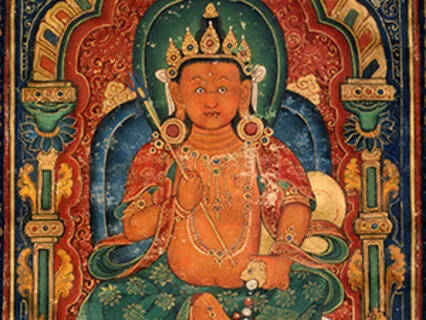
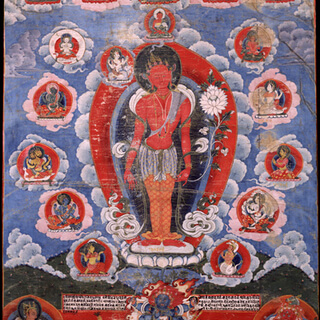
So this image that we have here is this amazing part of Medicine Buddha series of thangka,
I believe.
And this one that we're looking at is a really early 15th century thangka painting.
It's depicting the yaksha general.
It's a very beautiful Chinese aesthetic.
And the central figure here,
The general,
It's a protector and the Medicine Buddha series.
The intention of creating all this thangka is again to benefit beings,
To benefit all sentient beings.
And so you will hear more about this thangka,
My colleague Jeremy giving to her after this.
And so today,
I'm so honored to introduce Sharon Salzberg again.
And we are very,
Very fortunate.
And Sharon is the co founder of Insight Meditation Society,
Berry,
Massachusetts,
Studying and teaching for over 45 years.
Sharon's book Real Love,
You can also find at the ribbon gift shop upstairs as well.
You know,
Sharon doesn't need any introduction.
And we are very,
Very honored to have Sharon.
Please help me welcoming Sharon.
Thank you.
Hello.
Oh,
There are a lot of you coming in from the heat.
Thank you so much for coming.
Yes,
I didn't have that far to go.
But still,
It's quite a shock that moment of going out on the street.
So here we are.
So it's a very interesting topic.
This is the one time I'll be here in August and get to talk about this.
I'll be here twice in early September,
Get to talk about something else.
So the way that lately that these have been going is that the Rubin Museum itself suggests a topic for an entire month.
And so that's an interesting thing,
Because it may not be the hottest burning issue that you're thinking about.
But it's always provocative and useful to be given a topic because then you have to think more deeply about something.
And especially we'll see how I do next month when you have more than one on the same topic,
When you have to think of something different to say the second time.
But those of you who come can tell me how I did if you come twice.
But it was really interesting for me to get to think about intentionality.
And I found it an important kind of consideration because many times we think of meditation very much in the light of mindfulness.
It's being with things as they are.
It's not manipulating our experience in any way.
It's trying to look into the heart of what's happening.
But inevitably,
In any exercise of meditation,
There's some amount of letting go.
Right?
You're sitting and you're starting with feeling the breath.
And then your aim is to open up to body sensations and to experience them in the moment.
And before you know it,
You're thinking about whether it's worth trying to buy a little window air conditioning unit,
Even though your building has air conditioning.
Your friend just told you it's never going to be that cool.
It's always going to be.
Or maybe you should get,
Do they have air conditioner repair people?
Or maybe you have,
Right?
And you're going through the list of everyone who works in the building or where's the super.
And we had that argument about that other thing.
And I don't know if he's going to be that helpful and then maybe I need to move.
And it's like far from the breath and far from the body.
And then comes that moment,
Which demands commitment.
It demands letting go.
It demands a kind of renunciation.
We're going to let go of whatever has been distracting us and we have the intention of returning.
That's a moment that's very clearly intentional.
Otherwise,
We just go from the building to where should we move to,
Well,
If I move to that building,
Then those people are my neighbors.
And I don't know if I want them to be my neighbors.
And hey,
Did you hear about what they did?
I was just on Zoom this morning,
One of those webcast things with Sylvia Boorstein,
One of my colleagues and friends in California and a couple of other people.
And she was reading,
It's not Sapiens,
But it's the same author.
I forget the name of the book,
Which this author wrote,
Writes about human evolution and kind of how we've come to be blessed.
Where we are.
What's it?
Homo Deus,
Thank you.
And so she was saying,
I don't know from which book it was,
Because she'd read both,
That as he described the evolution of speech,
That really we started with gossip.
That was the first I'm saying that because he said about complaining.
That people,
That's how we started having conversations was because of gossip.
And we need to keep track of other people and the tribe and what they were doing,
If they were fulfilling their roles or they weren't fulfilling their roles or if they were,
You know.
And I thought,
Wouldn't you know it?
It's so satisfying in a way to gossip.
It's like so enjoyable in a way.
But when we really look,
You know,
It can be so petty or so divisive or so much removing ourselves from kind of the common human dilemma that we really feel more alone and we're cut off and lonelier,
Which is the big epidemic of loneliness,
You know.
And so maybe it's not that satisfying really.
It's an old pattern,
Oldest pattern maybe.
But maybe we want to experiment or temper or learn to play in a different way with these things.
And that's all intentionality.
Sometimes we confuse intentionality with like harsh self-judgment like I'm a horrible person,
I gossip endlessly and you know,
There's nothing to be done.
I'm just like a wasted human being.
Or you know,
I have to strain and strive and oh no,
I blew it.
You know,
Then it's all over and I'm just like the worst person that ever lived and I've got to try and try and try and we get tighter and tighter and we,
As in everything,
You know,
We have good days and bad days and we can't survive.
The resolve can't survive the bad days because once things go a little awry or we feel we failed a little bit or we've fallen a little bit,
We just kind of give up.
It's explosive,
Right.
And so,
Yeah,
We don't want to just live out the patterns of our lives without consideration and without experimentation and without some sense of possibility and creativity.
Like what might happen if I do this?
And that's kind of the flavor of intentionality within the context of meditation practice.
So I think I said here once before,
Like my friend Joseph Goldstein once took a resolve and these resolves tend to be kind of temporary,
Like we'll do this for a month,
You know,
Or I'll try this out for a couple of weeks,
Whatever,
And they're playful.
You know,
They're not meant to have us judge ourselves for when we completely blow it.
But Joseph took this resolve once,
I think it was when we were still living in India,
To not speak about a third person for a month.
That he said if he had something to say about someone,
Instead he'd say it to them.
And the way he puts it is something like 95% of his speech got eliminated.
You know,
It's that old gossip thing,
Yeah.
But that's kind of fun to see.
It doesn't mean that,
You know,
You're this pristine,
Pure,
Self-righteous person that's better than everybody else and you're never going to indulge again.
But it clarifies some things.
You know,
The things we're used to may not be the things that are really that productive of happiness.
We're just used to them.
And some of the things we've been taught will really make us a lot happier,
Actually,
Or not,
When we take a look and especially when we temporarily step away and just say,
Well,
How about if I do this for a week or a month or a moment,
Right?
How about when my attention wanders from the breath,
For example,
In a meditation.
I don't chastise myself for the next hour and a half.
And when I see that I'm beginning to,
I practice letting go and I have that kind of intentionality.
I'm just going to start again.
Practicing gratitude is the same thing.
And this really came out of your comment about how much fun it is to complain.
So I sit in the audience before I start these things.
You know,
It is fun to complain.
I enjoy it too.
It's probably as old in me as gossiping.
You know,
It's like very old tribal pattern.
You know,
So as I've said before,
You know,
When I began reading about gratitude practice,
Where we're urged at the end of every day to write down three things that we're grateful for,
And I realised that's going to take a lot of intentionality for me.
Because I am so much more likely to come to the end of the day and think about what I can complain about and what's not gone well.
And there's always an airline.
There's always a phone service.
And there's,
You know,
Internet speed.
And,
You know,
There's a lot to complain about.
The weather,
I don't like it,
You know.
Too bad.
You know,
So it takes intentionality for me to say,
What do I have to be grateful for today?
It's not denying that there are problems and it's not being conflict avoidant and it's not being diluted.
But how about let's give a little airtime to that,
Which we normally don't consider really at all.
Right?
So it's that opening to another perspective or another angle on things,
Another view.
It's the experiment.
It's the great experiment of the power of our minds to see what's it like when I look at things from this angle.
Not a phony angle,
You know,
And not something we're clinging to,
But it's just like,
What about when I wish myself well,
Rather than going through the list of my faults again?
You know,
What about when I look at what I have to be grateful for instead of just what I have to complain about,
Which also might be real,
But nonetheless is not the whole picture.
You know,
What about when I stop to consider there's no doubt causes and conditions for this person to be behaving in this way?
What about when,
You know,
So we have both kind of functions.
We have the letting go and renunciation function of intentionality where we can just gently let go of that which is other than our aim.
And we have that kind of opening function where we're willing to consider and look from different angles and so on.
It's really,
It's a great quality to be examining.
And let's sit together.
I don't know what those gongs are,
But must be time to sit.
So you can sit comfortably,
Close your eyes or not.
If you want,
You can use this as a time to settle your attention on the feeling of the breath,
Just the normal natural breath.
You don't have to try to make it deeper or different.
Find that place where your breath is strongest or clearest,
The nostrils,
The chest or the abdomen.
Bring your attention there and just rest.
If you like,
You can use a quiet mental notation of in out or rising falling,
But very quiet.
And when you find your attention has wandered,
That's the moment of intention and letting go and kindness to yourself as you just let go and bring your attention back to the feeling of the breath.
Thank you.
Thank you.
Thank you.
Thank you all so much.
Thank you.