Hello everyone,
Your friend Rafael here,
Welcome!
Thank you for joining me this time when I'll be talking about 5 steps that help me make meditation a habit.
These are some personal notes from my journal about this year-long journey that I have so far.
I started with very small steps and a lot of patience,
Celebrating every milestone week after week until I found my own rhythm,
My own time and a more structured practice.
What is meditation?
We should start with that.
And this is not going to be a moment for theory or for philosophy,
I'd rather leave that to the great yoga masters,
Meditation masters and my more experienced colleagues here.
But I want to bring to you the things that I love and that like open up my eyes about meditation.
And I want to start sharing with you some thoughts from Kyle Gray on his bestseller Raise Your Vibration,
It's my current reading.
Meditation is opportunity to become consciously aware of your mind and your thoughts that will never be able to silence our mind or our thoughts and it's about to be aware,
It's about being aware.
To connect with awareness and to be mindful during your practice,
You have to set up for success and in the beginning,
Focus on finding the time,
Sitting comfortably,
Setting a timer,
Breathe,
So you can connect with yourself and with your inner life.
If you are a beginner,
I recommend finding a guided meditation here on Inside Timer.
There are great teachers and you can join anytime.
I also am offering live guided meditations,
You can join or you can also join my yoga classes,
Just follow or friend me on my Inside Timer profile.
Alright,
Let's check out the steps.
Step number one,
Finding a time and a space.
Find a time of the day where you do an activity always at the same time.
For example,
After brushing your teeth and when you clean your face in the morning or before going to the kitchen,
Making your coffee or even at night once you have wrapped up your day and you are ready to go to bed.
This way,
You will start recognizing that it's meditation time.
Your mind will feel comfortable and invited to meditate also if you have a nice space for your practice so you can find or create the space for it.
No matter how big or small your place is,
Find a corner in your studio apartment or in the living room.
Right now,
You can start thinking about it so you can relax and connect with yourself there.
Set up a table around with some candles,
Decorations,
Some things that makes the place be yours.
Step number two,
Sit comfortably.
Something common among meditation courses and readings is that you should sit upright.
In the beginning,
It doesn't matter if you start sitting on a chair,
Trust me,
That's how I started,
Sitting on a chair.
And as long as you adopt a comfortable posture,
You will avoid body pain and physical distractions.
And remember,
You will remain aware if you have an upright sitting posture.
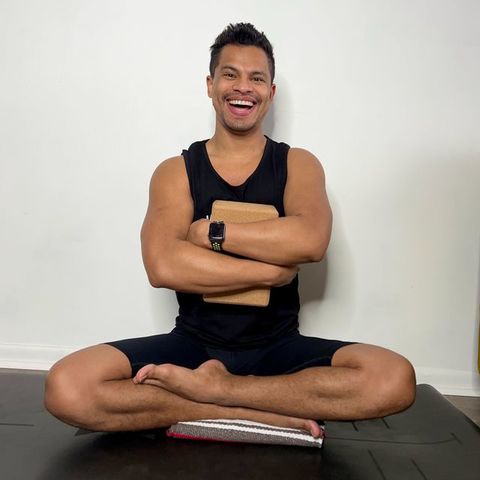
You might find comfortable also being sitting cross-legged on the floor.
You can always use pillows if you want to relax or avoid pain too under your knees or go by the wall and support your back right there.
Listen to your body,
That's the most important thing here,
And train it to where you want to get.
Swatmarama in the Hatha Yoga Pradipika recommends Padmasana,
The lotus pose,
This cross-legged sitting posture that if you are not related to yoga,
Maybe that's an image that you might get right now.
And if you do yoga,
Of course,
I'm sure that you know what lotus pose is.
So Swatmarama says this sitting pose in Padmasana is the recommended pose for meditation and breathing control.
You can read more on the Sloka 149 and I invite you to give it a try.
But remember,
Sitting comfortable is key.
Step number three,
Build your own time.
Yes,
Use an alarm on your phone or a timer so you stop wondering when you're going to be done or like,
Is it ready,
Is it done,
Am I done,
Like that happens and like that happens to a lot of us.
The most important thing here is that you need to be honest to yourself and set the time that you are actually going to dedicate to your practice.
I remember starting with a three-minute meditation.
I remember last summer,
Summer of 2020,
Three minutes,
That was my commitment.
And I stay a little longer after three minutes and then I started increasing it to five,
Seven,
12,
15 minutes every week when I felt that I could stay a little longer.
And the key here is that always stay in meditation or concentrated after the bell rings and then like just connect,
Just be one with it,
Just feel it.
And in time you will start increasing,
Increasing until you find the time that you really want to be there.
I remember I used to set up a timer for 20,
25 minutes and I thought that I was forcing myself to it.
So my meditation,
My average time right now is between 15 or 20 minutes,
Something in between,
Let's say 17 minutes.
And you know what?
I'm so happy and I'm so thankful that I got that time because those 17 minutes are filling my life with light.
The key here is to always stay a little longer,
Remember,
And then you can increase your time.
Step number four,
Breathing concentration.
I learned with my yoga teachers that the best and less complicated way to meditate is breathing consciously and to be mindful of your body and your surroundings so you start recognizing the connection by body spirit while you are concentrated.
Breathing is the object of meditation and you are the subject of meditation.
And meditation is going to be the union of the subject and the object.
You become one and I love this concept from my teacher Nenana Nafo.
Breathe until your inhalation reaches the duration of your exhalation and both are long and steady.
Every time your mind gets distracted by your thoughts,
Remember,
Go back and check on your breathing and not even by your mind,
Maybe a noise or sound that is distracting you.
Always check on your breathing.
Check what's going on in your body.
Be mindful,
Be present here and now.
There is no past,
Future,
Things to do during concentration.
Stay present.
And step number five,
Make it part of your spiritual life,
Of your spiritual practice.
Meditation can be both an exercise to release stress or calm down your thoughts or find a moment to connect with yourself and your inner life.
No matter your religion,
This is a moment to be grateful,
To feel grateful.
I end up with a prayer always thanking the universe for a new day.
This action makes you tune into Ishvara Pranidana,
One of Patanjali's Niyamas of the Yoga Sutras,
Total surrender to God or the divinity or the universe or call it how you want to call it.
So,
You remain connected with what's higher than us.
I also believe in the power of mantras.
Om Namah Shivaya makes me feel connected with the universe and I repeat this in my mind every time I feel or I get to be distracted.
This way you can incorporate to your sadhana a moment of meditation and gratitude.
I invite you one more time to my live meditations and yoga classes I'll be offering on this platform.
Let's practice together and be friends.
Please consider following me,
Sharing these spots and just join this beautiful community.
May all beings be happy,
Be loved and live in peace.
Namaste.