I'll start with a story.
When the Baal Shem Tov,
The founder of Hasidism,
Saw once that the Jewish people were threatened by a huge tragedy.
He would go to a particular tree in the forest where he would light a fire and he would recite a particular prayer and he would ask for a miracle to save the Jewish people from the threat.
And because of the fire and the place in the forest where the tree was and his faithfulness,
The miracle was accomplished and they averted the tragedy.
And the story is told that in the next generation,
The disciple of the Baal Shem Tov,
The Magid of Mezrich,
The people came to him with the same tragedy that was happening again to the Jewish people.
And the Magid of Mezrich said,
Well,
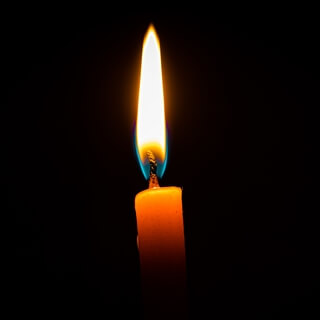
I know the tree in the forest where I have to go and I know the kind of candle that I have to light with the kind of fire,
But I don't know the prayer that I'm supposed to say.
So the Magid of Mezrich,
They say,
Went to that place,
That tree in the forest,
And he lit the candle and that was enough.
And that averted the tragedy.
And still later in the next generation,
Moshe Lev of Sosov,
In turn a disciple of the Magid of Mezrich,
They came to him with the same exact tragedy.
And he said,
I don't know how to light the fire.
I know the place in the forest to go.
I know the tree,
But I don't know the words and I don't know the fire.
And he went to the tree and he said,
I don't know the words and I don't know the fire.
I hope that's enough.
And it was enough.
And it averted the tragedy.
And they say that once again in the next generation,
Rabbi Israel of Rizhyn,
He was told that the same tragedy that was befalling the people.
And he sat on his chair in his study and he said,
I know that this tragedy happened.
It happened in the generation of Baal Shem Tov and in the generation of the Magid of Mezrich and in the generation of my teacher,
Moshe Lev of Sosov.
And I know that they did these things and they went to this place in the forest and they and they lit the candle and they and they went to the tree and they said these words,
But I don't know the tree.
I don't know where it is.
And I don't know the candle.
And I don't know the words.
But I know the story.
And he told the story.
And he said to God,
God,
I hope that's enough.
And it was enough.
And telling the story was enough to avert the tragedy.
So why do I tell this story about stories?
Because I'd like to make the point that a story is a frame.
And that the stories that we tell and the ways we frame things can make all of the difference in the world.
It can make the difference between averting a tragedy and not averting a tragedy.
It can make the difference between a horrible thing happening or something beautiful happening.
And we do it all the time.
We tell stories all of the time.
We create frames all of the time.
Sometimes we're not even conscious of the stories that we tell and the frames that we use.
And I just want to highlight one story,
One frame that we use in this modern world all of the time that many of us use and we're not even necessarily conscious of.
And that's the materialist scientific frame.
And this frame is a story,
But it's a frame,
But it's also sort of a story.
It's the idea that we live in a world of things.
We live in a world of things where there's nothing but things.
And we're all sort of soulless machines.
And that there's one world that we live in and that this world is the material world.
So this modern scientific frame from which that story derives has,
I want to emphasize,
It has many,
Many positives.
That scientific rationalist materialist frame,
There's the positive of the movement away from a pre-modern ethnocentric,
Hierarchical,
Supernaturalist system,
Way of looking at the world to one of rationalism and intellectual enlightenment and equality.
So I just want to make that point.
But it also has some drawbacks.
And I think one of the drawbacks that sometimes we overlook is that there is a danger of looking at the world as a place that's full of soulless automata.
There's a danger of looking at the world as a place that's full of things,
Of products to be used and thrown away.
This story has contributed,
In my opinion,
To the way that we treat nature and also to the way that we treat each other sometimes as objects.
Which leads back again to the very inequality and the very violence that this story was meant to move us away from.
That this frame,
This scientific intellectual materialist frame was meant to move us away from.
So what I'd like to offer tonight on this New Year of the Trees,
The eve of the New Year of the Trees,
Is an alternative frame.
It's another frame that's both ancient and modern.
And it comes from Jewish mysticism.
And it also actually is a frame that's present in many other indigenous cultures.
And in this story,
In this frame,
We don't just live in one world of things,
One material world,
But we live in other worlds as well.
We live in the worlds of emotion,
The worlds of the intellect,
And the worlds of the spirit.
In this frame,
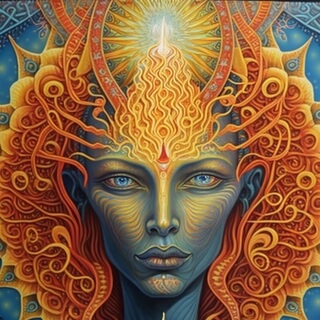
Every being is alive.
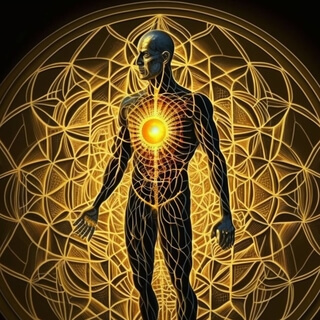
And every being has not only a body,
But also a heart and a mind and a soul.
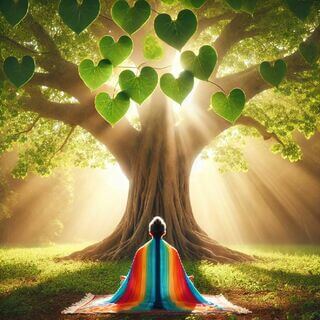
And this is the frame that we Jews call and the Kabbalists call the Tree of Life.
The story of this tree is the one that we have come to tell on Tu B'Shevat,
The 15th of Shevat,
The New Year of the Trees.
Originally,
Tu B'Shevat was a Mishneh,
A holiday from the Mishnah,
From the rabbis,
Which was very much about sort of when we taxed the fruits on people's trees.
But very quickly,
The Jewish mystics,
The Kabbalists,
Saw this beauty of looking at a New Year of the Trees that's deep in the heart of winter when the sap begins to rise again as a time to bring up this beautiful frame called the Tree of Life,
And this frame of living not just in one world,
But living in four worlds,
Living in the world of the emotions,
The body,
The intellect,
And the spirit.
And we are supposed to remember the same way that we remember on Passover,
We have a Seder.
We have a Tu B'Shevat Seder that is used to remind us of this frame,
Of this fourfold frame,
This story that we live in four dimensions or four worlds.
And again,
These four worlds,
I mean,
Once you use this frame to look at the world,
You'll see it everywhere.
So in Judaism,
We have a name of God,
Yod-Hei-Vav-Hei.
It's four letters.
On Tu B'Shevat and on Passover,
We drink four cups of wine.
There are four directions.
This is where the indigenous cultures come from,
Right?
There are four directions,
North,
South,
East,
And west.
There are four seasons,
Winter,
Spring,
Summer,
And fall.
In many indigenous cultures,
There are four elements,
Earth,
Wind,
Fire,
And water.
There are four stages in the life cycle of a tree,
Of anything that grows.
It goes from seed to sprout to tree to fruit.
And so we can see this frame,
This alternative frame everywhere we look.
And what I think the invitation is tonight,
And what I'd like to invite all of us to do tonight is to flip on this frame and to look at the world from this frame and to set our intentions for this new year,
Which is the secular new year,
But it's also the new year of the trees.
And it's also a new year for all of us sort of in the middle of this pandemic,
Which hopefully will end soon,
But it's a new world that we're living in.
The world has been transformed since the pandemic,
And we can't go back to business as usual.
What we can do,
What we can do is we can go back to what we're feeling called to do in this world.
We can come back to our highest ideals in the world of the body,
The physical world,
In the world of the emotion,
In the world of the intellect,
And in the world of the spirit.
And in my humble opinion,
This is the essence of what the Reverend Dr.
Martin Luther King stood for as well.
He challenged us to use a new frame to see the world.
He challenged us to buy into an idea,
The idea that we all have sparks of the divine within us.
We all have sparks of the divine that contain body,
Heart,
Mind,
And spirit,
And that we must treat everyone,
Every human being as a vow in Martin Buber's terminology,
As holy rather than as an it,
As a lifeless machine or an object.
So on this New Year of the Trees,
Which is also the day we celebrate the life and legacy of the Reverend Dr.
Martin Luther King,
As well as this week,
We're also reading the story of the liberation from slavery,
The story of the crossing of the sea of the Israelites,
And they sang their holy song,
Mee Chah Mocha.
On this New Year of the Trees,
On all of these occasions,
This trifecta,
Quadfecta day,
I would like to invite us to plant some seeds of awareness in all four of the worlds.
Let's plant a seed in the world of the physical to do something to help heal the planet this year.
Let's plant a seed in the world of the emotions to improve our relationships with others and have I-thou and not I-it relationships.
Let's plant a seed in the world of the mind to be open to new ways of thinking and to challenge unconscious and institutional racism and sexism and homophobia and transphobia.
Let's plant a seed in the world of the spirit to connect to the holiness that's present in the web of life,
To open to the idea that the world sparkles with the divine.
May all of these seeds that we plant on this New Year of the Trees grow into sprouts,
Trees,
And bear fruit,
Which will hopefully be the fruit of redemption.
Shabbat Shalom.