Guidelines for Love and Compassion Meditation.
The following are some guidelines for love and compassion meditation.
There are four major points.
Space,
Where to meditate.
Posture,
How to sit in meditation.
Instructions for loving-kindness and compassion meditations and how they differ from mindfulness.
And finally,
When and how much to meditate.
Point number one,
Space.
Where to practice formal meditation.
Choose a quiet space in your home or in a safe environment.
Create some privacy,
Close the door,
And ask others for some alone time.
Turn off any cell phones or electronic devices such as radios or TVs.
Clean and tidy the space as this will help put your mind at ease.
Make the space pleasing to the senses,
Meaningful or sacred by arranging flowers,
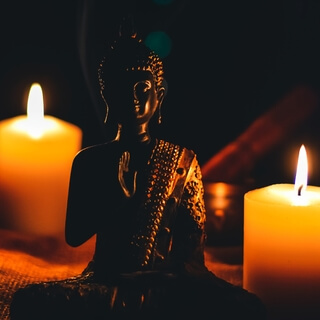
Lighting incense or candles,
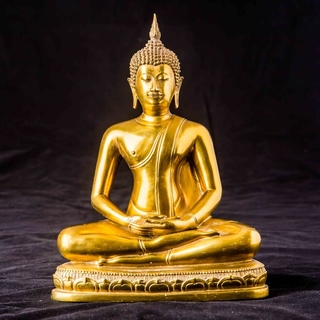
Setting up pictures or statues of inspiring people or places,
And making offerings or gestures of gratitude.
This helps to designate the workspace from ordinary space.
Point two,
Posture.
How to sit in meditation according to the Indo-Tibetan seven-point Viruchana posture.
In the beginning,
Comfort is more important than form.
If seated on the floor,
Place your legs in full or half lotus position or just cross them in front of you.
The right hand is placed in the left hand,
Palms facing upward with the tips of the thumbs gently touching.
If seated in a chair,
Place your feet flat on the ground and hands folded in your lap.
Eyes are half open gazing softly at the space in front of you.
This will help prevent you from falling asleep.
If restless,
Try closing the eyes completely to help the mind begin to relax.
Keep your spine erect like a stack of coins,
Upright but not rigid.
This will help you stay alert.
Position your meditation cushion beneath your rear to raise the spine and tilt forward the pelvis.
If in a chair,
Come forward slightly with your back away from the back of the chair and your rear at the front half of the seat.
Shoulders are even and relaxed.
Be mindful not to hunch or slouch.
Dip your chin down slightly.
Keep a relaxed space between your lips and teeth so that you don't clench the jaw.
Rest your tongue softly on the roof of your palate.
Point three,
Instructions for loving kindness and compassion meditations.
Assume a comfortable posture.
Begin by reflecting on your spiritual aspiration for your life in general and clarifying your intention to meditate in particular.
There are three types of aspiration.
The simple aspiration to achieve some measure of peace and happiness.
The medium aspiration to commit to complete freedom from suffering and the achievement of perfect happiness.
And the great aspiration to achieve complete freedom and happiness in order to benefit all living beings.
Begin with five to ten minutes of mindfulness of breath to create the optimal condition for contemplative learning.
You might like to cue the brief mindfulness of breath track from my first CD right before one of the love and compassion tracks in this CD.
This will create a continuous meditation.
Remember to focus your awareness exclusively at the nostrils and breathe diaphragmatically in order to trigger the relaxation response.
After a short period you can allow your breath to settle into a natural rhythm.
Once you realize you've been distracted from the meditation object,
Whether it's the breath during mindfulness or person receiving your love and compassion,
Return your awareness back to the focus with an attitude of discipline determination and non-judgmental care.
When you feel more relaxed,
Calm and centered,
Then shift into contemplative meditation mode,
Which I will now explain.
Contemplative meditations do not try to exclude restrict or reduce thoughts as one does in a mindfulness meditation.
Rather they harness and focus the power of positive thinking,
Active imagination,
Reasoning and intuitive intelligence towards transforming your mind.
Contemplative meditations use thinking to affect the heart.
The mechanisms of change in a contemplative meditation are insight and virtue.
Insight,
Also known as self knowledge,
Is the dispelling of inaccurate misperceptions about yourself,
Others and the world based on a more realistic perspective,
Understanding or moment of learning.
Virtue is the replacement of hurtful and harmful thoughts and feelings towards oneself and others with those of deep care,
Concern and sense of interconnectivity.
Insight and virtue develop both the mind and heart.
When in contemplative mode,
Focus your awareness on the chosen theme of love and compassion just as you have paid attention to the breath in mindfulness.
Compliment your disciplined focus with relaxed friendliness,
Allowing your inner intuition and guide to open your heart.
In other words,
Let the meditative thoughts and images move you emotionally.
Let them access your humanity.
For this you will need a sense of sincerity and genuineness in your practice.
Many of the contemplations on love and compassion use a series of phrases or stanzas.
Repeat these stanzas like a mantra,
A prayer or affirmation.
They are designed to counteract years of judgment,
Hatred and negative self-talk that may have become habits of your mind.
When you come to the end of your contemplation,
Seal your meditation with a dedication,
Recommitting your energies towards your initial aspiration.
Reflect that during the course of transforming your mind and heart,
You have just generated an enormous amount of positive energy.
Rather than allowing that energy just to disperse,
Imagine reinvesting it into your ongoing study,
Reflection and practice for your own benefit and for the benefit of all those around you.
Point four,
When and how much to meditate.
Formal mindfulness meditation involves set intervals of sitting,
Typically conducted in the morning or evening.
A contemplative meditation usually follows a period of stabilizing mindfulness.
Think of these as two separate techniques that you are combining into a single continuous meditation practice period.
In the beginning,
Try doing five or ten minutes of mindfulness until you feel calm and clear and stable.
Then add ten or fifteen minutes of contemplative meditation to arouse insight and warm-heartedness.
Contemplative meditations can and should occur outside the formal sitting meditation session.
Because contemplative techniques use mental faculties of introspection,
Reflection and self-talk,
They can be practiced at any moment.
For example,
When you see someone in pain,
By sending them loving thoughts and wishing that they be well,
You have in that moment performed a contemplative meditation.
I call this doing mental yoga because you're stretching your mind past rigid,
Egocentric habits and tendencies.
Although brief,
You have reversed your self- preoccupation and propensities towards hurtful thoughts with one single thought of love,
Care and altruism.
By generating one simple set of positive thoughts,
You have performed a powerful act that both protects and develops your mind.
Use the skills of mindfulness in everyday life to catch harmful or negative thoughts arising in your consciousness before you have time to act on them.
This will reduce your propensity to negativity and the future causes of suffering.
Use the skill of loving contemplation in daily life to generate virtuous thoughts that you can freely act upon.
This will increase positive mental tendencies and generate the causes of future happiness.
Remember the famous epitaph of the Buddha.
To eradicate negativity,
Cultivate virtue and train the mind,
This is the path of the awakened.