Thank you for joining me today.
We're going to be taking our joints through their full range of motion.
Moving our joints daily is a good way to lubricate the joints,
Increase blood flow and circulation.
Increase our range of motion,
And over time,
Decrease pain in those joints.
Let's begin.
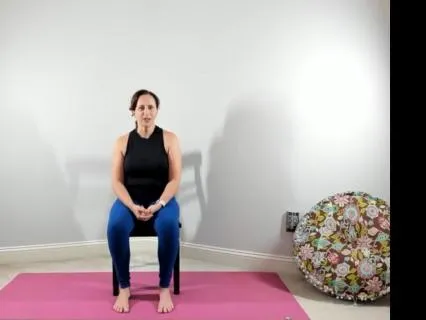
All you need is a place to sit.
This could be done also on your yoga mat,
But a little bit easier to do it in a chair or on the couch.
We're going to start at the head and work our way slowly down.
As you inhale,
Bring your chin up,
Feeling a stretch in the front of the throat.
As you exhale,
Bring your chin down,
Feeling a stretch in the back of the neck.
As you're moving up,
Make sure The breath is not changing,
You're not going so high that the breath is changing.
Is compromised.
And the same thing as you're breathing out and you're bringing your chin down towards your chest.
As we move,
We want to move in a pain-free range of motion.
Let's do two more.
Inhale,
Lift up.
Exhale,
Lower.
Inhale,
Lift up.
Exhale down.
Come back to the middle.
Ears over shoulders.
Now we're gonna turn side to side.
Pausing for a moment when you feel the stretch,
And then coming across the middle and switching.
Inhale across the center.
Exhale and turn.
Inhale as you look forward.
Exhale as you turn to the side.
When you're moving your joints,
Aim for about five to eight repetitions.
Of each exercise.
Two more here.
Slow and controlled,
No rushing.
One more.
Turning back forward.
Now we're going to tilt ear to shoulder.
Make sure it's the ear moving,
Not the shoulder moving.
Lift and switch.
So some ways the body might want to compensate to make your range of motion appear to be bigger than it really is.
Is bending a little at the waist.
Notice I'm nice and tall as I tilt.
And or elevating that shoulder towards the ear.
Keep the shoulders down and relax.
With the tilting motion,
You can go straight to the side.
Ear to shoulder.
Or you can tilt at a slight angle with your chin.
Down towards your collarbone or up towards the sky.
Changing that angle is going to change the stretch in the side of the neck.
Let's do one more in each direction.
We have one last motion we're going to do for the head and I'm going to turn to the side so you can get a better view.
This one is called head ramping.
Our head,
We hold it in a certain position throughout the day.
And as the day goes on,
Sometimes it goes further and further forward.
So depending on when you're doing this exercise,
You might notice a greater range of motion.
We're gonna back up a little bit.
Ears over shoulders and then release.
Think of sitting in your car.
Your head is not quite touching that headrest and I want you to push the middle of the skull back into that headrest.
Feel a stretch on the sides of the neck.
And then release back.
Push back.
And release.
We'll do a few more.
Another cue that might help you get the motion down is to imagine you're at lunch.
There's a very interesting conversation at the table behind you.
You're trying to listen to that conversation.
This is the motion you'd probably do without thinking about it.
Alright,
Let's move on.
We're going to go to the fingers now and work our way up to the shoulders.
So,
I'm going to turn my palms Up on my hands,
I'm wiggling my fingers in and out,
Trying to bend all the different joints.
You could also lift your hands and do a little air piano with the fingers.
Open and close.
And then I'm gonna keep my hands up in the air,
Point down.
Point up.
Down.
And.
.
.
We'll do a few more.
One more time.
When we circle from the wrist,
It can be a little tricky because you have two bones in the arm and they can roll over each other.
So I want you to do one at a time.
You're going to lightly hold your wrist with your hands about midway on your arm.
Keeping the two bones nice and flat,
You're going to make a slight fist and draw a circle in the air.
If I try to make it too big,
That outer bone is going to try to lift and come over the inner bone.
And then I'm really not moving my wrist.
Which is the point of the exercise.
Let's reverse it.
For Three.
Ciao.
Let's switch sides.
Start in one direction.
Take it slow.
You might notice a difference between right and left and how it feels or the range.
Let's reverse it.
All that is perfectly normal.
Bodies are not symmetrical.
Alright,
We're going to move on to the elbow joint.
This is a hinge joint,
So we're going to lift our hands.
Lower our hands.
This sequence is just one way to go through all the joints.
There are many different ways you can do this.
This could even be done lying down in bed,
Most of this,
If not all.
Okay there's a little side-to-side motion for the elbow.
So we're going to imagine we've got water here.
We're splashing it in our face.
Reverse the direction down,
Out,
In,
Up.
Release.
Moving up to our shoulders.
We're going to take our hands lightly to our shoulders.
Bring your elbows in as close as you can comfortably can.
Bring them up.
Out,
Back,
And down.
Now something like this,
If you have an injury on one side,
Instead of moving both arms together,
You could be alternating arms,
Pay a little bit more attention to one side,
Do five to eight reps,
And then switch and do the other side.
Let's reverse our circle.
We go up.
Forward,
In,
Down,
Back.
Notice your shoulder blades moving,
Sliding and gliding.
Last one.
Bring it down.
We're going to move on to the torso.
I'm going to show you the side view again.
We're going to move forward and back.
Extension of the spine,
Flexion of the spine.
This,
You want to be a little bit away from the back of whatever surface,
Your couch,
Your chair that you're against.
Using the hands for leverage,
You're going to pull forward,
Lift your tailbone up behind you,
Move your chest through your arms,
Lift your chin up a little bit,
And then round on the way back,
Push back.
Slide the tailbone under,
Spread the shoulder blades apart,
Lower the chin.
Inhale,
Come forward.
Tailbone up behind you,
Chin up in the front.
Exhale.
Rocking back.
Notice your pelvis.
Think of it like a bowl of water.
You're spilling the water behind you,
Spilling the water forward.
And then for a few repetitions,
I want you to notice the middle of the back,
Shoulder blade area,
Chest area,
Moving forward and back.
And then for your last few repositions,
Focus on your neck.
Chin going down,
Chin going up.
So we're getting all segments of the spine in here.
It up y'all!
Alright,
We're going to go side to side now with our ribs sliding.
Left,
Right,
This one can be challenging if you haven't done it before.
The brain likes novelty.
It's good for the brain to do something different.
It's also good for your ribs,
Good for your breathing,
Good for circulation and blood flow.
Think of a hand pushing one way,
Pushing the other way.
Let's put the first exercise,
The forward and back,
With the side to side together.
So we're going to bring the chest forward.
Ribs to the right,
Behind you,
Left.
Forward,
Side,
Back,
Side,
Stir around in a circle.
You've got a hula hoop.
It's not at your hips,
It's up here.
Try to keep that hula hoop in the air.
Let's reverse.
One more time around.
Back to the center.
We're going to move to the lower body.
I want to mention one thing before we continue.
If we get to a joint in the body where you're already experiencing pain,
You don't want that pain to increase.
We're moving in a pain-free range of motion.
If pain is already present,
We don't want it to go up.
So you're finding a range of motion that does not increase the pain.
Let's start on one foot.
Lift up your toes.
Keep your ankle nice and still.
You're going to curl your toes under towards the sole of the foot.
Pull your toes back towards your shin.
The toes are not as easy to move as the fingers.
We can't play the air piano here.
With the toes.
I wish we could.
Two more.
One more time.
Now I'm going to lift my foot up a little point.
Toes down.
Toes up.
This is a fairly simple motion,
But you should feel a lot of muscle engagement in the front and the back of the leg.
Now let's draw a slow circle.
Reverse it for five.
Four.
Three.
Two.
One,
We're gonna move on to the knee joint.
We're gonna pull under.
Just be careful if your chair has a bar across it.
Push out.
The knee works like the elbow joint.
Two more on this side.
Now as I bring it down,
I'm going to keep my foot just barely off the floor.
Imagine my leg is dangling in the lake.
I'm sitting on the dock.
And I'm stirring the water around with my foot.
Reverse Okay,
Let's place that side down.
We're gonna go to side two.
Lift up the toes,
Curl in.
Pull back.
Curl under,
Pull back.
She's waiting patiently to be pet.
And she ever so sweetly put her paw up on me.
Let's lift our foot off the floor,
Point.
In,
Out for three.
For two.
And one.
We're going to do five slow circles in one direction.
Last one here.
Reverse it for five.
For Three.
One,
Bend and straighten.
Last two times.
One more.
Keep the foot just off the floor.
Circle.
Reverse.
Okay,
We've gone through just about everything except for the hips.
We could do a little bit of the hip seated.
I'll show you that a little bit easier if we stand up.
So I will show you that version as well.
If you wanna sit in your chair and not stand,
This is the version for you,
Version one.
We bring it out,
Knee,
Foot away from hip,
We bring it back.
We bring it out.
We bring it back.
If your chair is a little slick and you start to slide back and you need to scoot forward,
Just adjust.
Two more.
One more time.
Switch sides.
Last two.
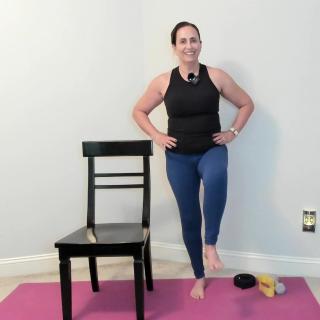
If you want to get a little bit more range of motion for the hips,
You can stand and use your chair as support.
You bring your hand to the side or the back of the chair.
You're going to bring your leg up.
Out!
Down a little bit like tree pose forward.
Out.
Down,
Forward.
I'm going to do two more in this direction.
Now start in that tree shape,
Lift to the side,
Bring it forward.
Down,
Open to tree.
Lift.
Forward,
Down.
Three to go.
2.
One more time.
Switching sides.
I'm going to move around to the other side of my chair just so I have space.
Out.
Down.
Forward.
Ball and socket joint.
You can start to smooth it out when you're more comfortable so it's not a separate motion.
One more in this direction.
Reverse For five.
Four.
Three.
Last two.
One.
Excellent job.
That is something that you can do daily,
Maybe start with every other day and work up to doing that daily.
Great way to stay limber,
To increase your range of motion.
In the body.
Thank you for joining me today.