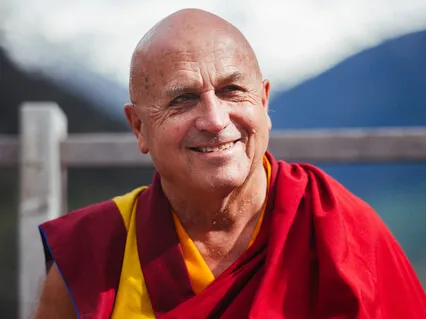
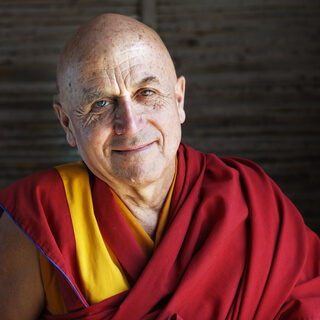
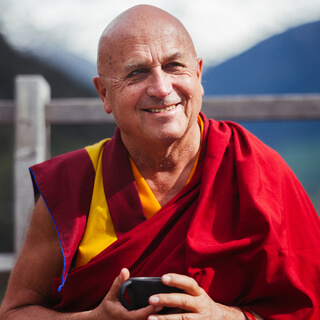
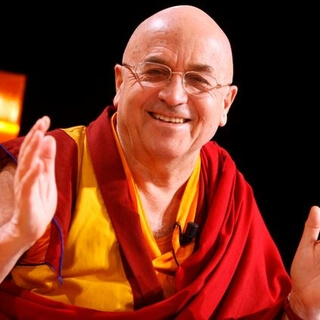
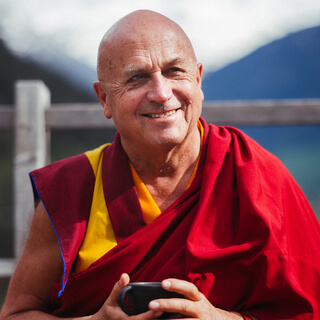
So I guess this is a result of globalization that you can find Coca-Cola tins on top of the Everest and Buddhist monk in Monterey.
And so I just came two days ago from the Himalayas to your kind invitation.
So I would like to invite you also for a while to the Himalayas themselves.
And to show the place where meditators like me who began with being a molecular biologist in Pasteur Institute and found their way to the mountains.
So these are a few images I was lucky to take and be there.
This is the Mount Kailash in Eastern Tibet.
Wonderful setting.
This is from Marlboro country.
This is Turquoise Lake.
A meditator.
This is the hottest day of the year somewhere in Eastern Tibet on August 1st.
The night before we camped and my Tibetan friends said we are going to sleep outside.
I said why?
We have enough space in the tent.
They said yes,
But it's summertime.
So now we are going to speak of happiness.
As a French man I must say that there are a lot of French intellectuals that think happiness is not at all interesting.
I just wrote an essay on happiness and there was a controversy and someone wrote an article saying don't impose on us the dirty work of happiness.
We don't care about being happy.
We need to live with passion.
We lack the up and downs of life.
We lack our suffering because it's so good when it sees for a while.
This is what I see from the balcony of my hermitage in the Himalayas.
It's about two meters by three and you are all welcome any time.
Now let's come to happiness or well-being.
And first of all,
Despite what the French intellectuals say,
It seems that no one wakes up in the morning thinking may I suffer the whole day.
Which means that somehow consciously or not,
Directly or indirectly,
And to shorten the long term,
Whatever we do,
Whatever we hope,
Whatever we dream,
Somehow is related to a deep profound desire for well-being or happiness.
As Pascal said,
Even the one who hangs himself somehow is looking for a cessation of suffering.
He finds no other way.
But then if you look in the literature,
East and West,
You can find incredible diversity of definition of happiness.
Some people say,
And only believed in remembering the past,
Imagining the future,
Never in the present.
Some people say happiness is right now,
Is the quality of the freshness of the present moment.
And that led to Henri Bergson,
The French philosopher,
To say all the great thinkers of humanity have left happiness in the vague so that they could define,
Each of them could define in their own terms.
Well,
That would be fine if it was just a secondary preoccupation in life.
But now if it is something that's going to determine the quality of every instant of our life,
Then we better know what it is,
Have some clearer idea.
And probably the fact that we don't know that is why so often,
Although we seek happiness,
It seems we turn our back to it.
Although we want to avoid suffering,
It seems we are running someone towards it.
And that also comes from some kind of confusions.
One of the most common ones is happiness and pleasure.
But if we look at the characteristic of those two,
Pleasure is contingent upon time,
Upon its object,
Upon the place.
It is something that changes of nature.
Beautiful chocolate cake,
First serving is delicious,
Second one not so much,
Then we feel disgust.
That's the nature of things.
We get tired.
I used to be a fan of Bach.
I used to play it on the guitar.
I can hear it two,
Three,
Five times.
If I had to hear it 24 hours nonstop,
It might be very tiring.
If you are feeling very cold,
You come near a fire,
It's so wonderful.
Then after some moments,
You just go a little back and then start burning.
It sort of uses itself as you experience it.
And also again,
It can also,
It's something that you,
It is not something that is radiating outside.
It's like you can feel intense pleasure and some others around you can be suffering a lot.
Now,
What there will be happiness,
And happiness of course is such a vague word.
So let's say well-being.
And so I think the best definition according to the Buddhist view is that well-being is not just a mere pleasurable sensation.
It is a deep sense of serenity and fulfillment.
A state that actually pervades and underlies all emotional states and all the joys of sorrows that can come one's way.
That might be surprising.
Can we have this kind of well-being while being sad?
In a way,
Why not?
Because we are speaking at a different level.
If look at the waves coming at the shore,
When you are at the bottom of the wave,
You hit the bottom.
You hit the solid rock.
When you are surfing on the top,
You are all elated.
So you go from elation to depression.
There's no depth.
Now if you look at the high sea,
There might be beautiful,
Calm ocean like a mirror.
It might be storms,
But the depth of the ocean is still there unchanged.
So now how is that?
It can only be a state of being,
Not just a fleeting emotion,
Sensation,
Even joy that can be the spring of happiness,
But there's also wicked joy.
You can rejoice in someone's suffering.
So now how do we proceed in our quest for happiness?
Very often we look outside.
We think that if we could gather this and that,
All the conditions,
Something that we say,
Everything to be happy,
To have everything to be happy,
That very sentence already bears the doom of destruction of happiness,
To have everything.
If we miss something,
It collapses.
And also when things go wrong,
We try to fix things outside so much.
But our control on the outer world is limited,
Temporary,
And often illusory.
So now look at the inner conditions.
Aren't they stronger?
Isn't it the mind that translates the outer condition into happiness and suffering?
And isn't that stronger?
We know by experience that we can be in what we call a little paradise and yet be completely unhappy within.
The dilemma was once in Portugal,
And there was a lot of construction going on everywhere.
So one evening he said,
Look,
You're doing all these things,
But isn't it nice also to build something within?
And he said,
Unless that,
Even you get a high tech flat on the 100th floor of a super modern and comfortable building,
If you are deeply unhappy within,
All you are going to look for is a window from which to jump.
So now at the opposite,
We know a lot of people who in very difficult circumstances manage to keep serenity,
Inner strength,
Inner freedom,
Confidence.
So now if the inner conditions are stronger,
Of course the outer conditions do influence.
And it's wonderful to live longer,
Healthier,
To have access to information,
Education,
To be able to travel,
To have freedom.
It's highly desirable.
However,
This is not enough.
Those are just auxiliary help conditions.
The experience that translates everything is within the mind.
So then when we ask oneself how to nurture the conditions for happiness,
The inner conditions,
And which are those which will undermine happiness?
So then it just needs to have some experience.
We have to know from ourselves there are certain state of mind that are conducive to this flourishing,
To this well-being,
What the Greek called oedimonia,
Flourishing.
There are some which are adverse to this well-being.
And so if we look from our own experience,
Anger,
Hatred,
Jealousy,
Arrogance,
Obsessive desire,
Strong grasping,
They don't leave us in such a good state after we have experienced it.
And also they are detrimental to others' happiness.
So we may consider that the more those are invading our mind,
Like a chain reaction,
The more we feel miserable,
We feel tormented.
At the opposite,
Everyone knows deep within that an act of selfish generosity,
If from the distance,
Without anyone knowing anything about it,
We could save a child's life,
Make someone happy.
We don't need a recognition.
We don't need any gratitude,
Just the mere fact of doing that.
Feel such a sense of adequation with our deep nature.
And we would like to be like that all the time.
So is that possible to change our way of being,
To transform one's mind?
Among those negative emotions or destructive emotions inherent to the nature of mind,
Is a change possible in our emotions,
In our traits,
In our moods?
So for that we have to ask,
What is the nature of mind?
And if we look from the experiencer point of view,
There is a primary quality of consciousness.
That is the mere fact to be cognitive,
To be aware.
This is like a mirror that allows all images to rise on it.
You can have ugly faces,
Beautiful faces in the mirror.
The mirror allows that,
But the mirror is not tainted,
Is not modified,
Is not altered by those images.
Likewise,
Behind every single thought,
There is the bare consciousness,
Pure awareness.
This is the nature.
It cannot be tainted intrinsically with hatred or jealousy,
Because then if it was always there,
Like a dye that would permeate the whole cloth,
Then it would be found all the time somewhere.
We know we're not always angry,
Always jealous,
Always generous.
So because the basic fabric of consciousness is this pure cognitive quality that differentiated from a stone,
There is a possibility for change,
Because all emotions are fleeting.
That is the ground for mind training.
Mind training is based on the idea that two opposite mental factors cannot happen at the same time.
You could go from love to hate,
But you cannot at the same time,
Toward the same object,
The same person,
One to harm and one to the good,
You cannot in the same gesture shake hand and give a blow.
So there are natural antidotes to emotions that are destructive to our inner well-being.
So that's a way to proceed,
Rejoicing compared to jealousy,
A kind of sense of inner freedom as opposite to intense grasping and obsession,
Benevolence,
Loving kindness against hatred.
But of course,
Each emotion then would need a particular antidote.
Another way is to try to find a general antidote to all emotions.
And that's by looking at the very nature.
Usually when we feel annoyed,
Hatred,
Or upset with someone,
Or obsessed with something,
The mind goes again and again to that object.
Each time it goes to the object,
It reinforces that obsession or that annoyance.
So then it's a self-perpetuating process.
So what we need to look now is instead of looking outward,
We look inward.
Look at anger itself.
It looks very menacing,
Like a billowing monsoon cloud,
Thunderstorm,
But we think we could sit on the cloud,
But if we go there,
It's just mist.
Likewise,
If you look at the thought of anger,
It will vanish like frost under the morning sun.
If you do this again and again,
The propensity,
The tendencies for anger to arise again will be less and less each time you dissolved it.
And at the end,
Although it may arise,
It will just cross the mind like a bird crossing the sky without leaving any track.
So this is the principle of mind training.
Now it takes time because we,
It took time for all those faults in our mind,
The tendencies to build up,
So it will take time to unfold them as well.
But that's the only way to go.
Mind transformation,
That is the very meaning of meditation.
It means familiarization with a new way of being,
New way of perceiving things,
Which is more in that equation with reality,
With interdependence,
With the stream and continuous transformation which our being and our consciousness is.
So the interface with cognitive science,
Since we need to come to that and what was the subject of,
We have to deal in such a short time,
With brain plasticity.
Brain was thought to be more or less fixed,
All the normal connections in numbers and quantities were thought to be,
Still the last 20 years,
Thought to be more or less fixed when we reached the adult age.
Now recently it has been found that it can change a lot.
A violinist,
As we heard,
We have done 10,
000 hours of violin practice.
Some area that controls the movement of fingers in the brain change a lot.
These are reinforcement of the synaptic connections.
So can we do that with human qualities,
With loving kindness,
With patience,
With openness?
So that was those great meditators have been doing.
Some of them who came to the labs like in Madison,
Wisconsin or in Berkeley did 20 to 40,
000 hours of meditation.
They do like three years retreat where they do meditate 12 hours a day and then the rest of their life they would do that three,
Four hours a day.
They are real Olympic champions of mind training.
This is the place where they meditate.
You can see it's kind of inspiring.
Now here with 256 electrodes.
So what did they find?
Of course,
Same thing,
Scientific embargo.
A paper has been submitted to Nature.
Hopefully it will be accepted.
It deals with the state of compassion,
Unconditional compassion.
We ask meditators who have been doing that for years and years and years to put their mind in a state where there's nothing but loving kindness,
Total availability to sentient being.
Of course,
During the training we do that with objects.
We think of people suffering,
Which are people we love.
And at some point it can be a state which is all pervading.
Here's the preliminary result,
Which I can show because it's already been shown.
The bell curve shows 150 controls.
And what is being looked at is the difference between the right and the left frontal lobe.
In very short,
People who have more activity on the right side of the prefrontal cortex are more depressed,
Withdrawn.
They don't describe a lot of positive effect.
It's the opposite on the left side.
More tenders to altruism,
To happiness,
To express and curiosity and so forth.
So there's a basic line for people and also it can be changed.
If you see a comic movie,
You go to the left side.
If you are happy about something,
You go more to the left side.
If you are a lot of depression,
You go to the right side.
Here the minus 0.
5 is a fourth standard deviation of a meditator who meditates on compassion.
It's something that is totally out of the bell curve.
So I don't have to go into all the different scientific results.
Hopefully they will come.
But they found that this is after three and a half hours in a FMRI.
It's like coming out of a spaceship.
So it has been shown in other labs,
For instance,
Paul Ekman's labs in Berkeley,
That some meditators are able also to control the emotional response more than it could be taught.
Like the start of experiments,
For instance.
If you sit a guy on a chair with all this kind of apparatus measuring your physiology and there's kind of a bomb that goes off.
It's a so instinctive response that in 20 years,
They never saw anyone who would not jump.
Some are some meditators without trying to stop it,
But simply by being completely open,
Thinking that that bang is just going to be just a small event like a shooting star.
They're able not to move at all.
So the whole point of that is not sort of to make like a circus thing of showing exceptional beings who can jump or whatever.
It's more to say that mind training matters.
That this is not just a luxury.
This is not a supplementary vitamin for the soul.
This is something that's going to determine the quality of every instance of our life.
We are ready to spend 50 years achieving education.
We love to do jogging,
Fitness.
We do all kinds of things to remain beautiful.
Yet we spend surprisingly little time taking care of what matters most,
The way our mind functions,
Which again is the ultimate thing that determines the quality of our experience.
Now compassion should also be put in action.
That's what we try to do in different places.
Just this one example is worth a lot of work.
This lady with bone TV left alone in a tent was going to die with her only daughter one year later how she is.
And schools and clinics we've been doing in Tibet.
And just I leave you with the beauty of those looks that tell more about happiness that I could ever say.
And jumping monks of Tibet.
Flying monks.
Thank you very much.