Hello there,
It's Mandy here.
Welcome back to Elizabeth and her German Garden by Elizabeth von Arnim.
When Count von Arnim died in 1910,
Elizabeth and her five children left Prussia.
She divided her time between various London addresses and her main base,
Which was in Switzerland.
Her friends included many literary and intellectual figures of the day,
Such as E.
M.
Forster and Hugh Walpole.
H.
G.
Wells was a lifelong friend,
Even though they didn't get on very well when they first met.
Anyway,
We've reached chapter five and before I go ahead,
Please feel free to make yourself really comfortable by settling down into your chair or your bed,
Relaxing your hands,
Loosening your shoulders,
And softening your jaw.
That's wonderful.
So if you're ready,
Then I shall begin.
September the 15th.
This is the month of quiet days,
Crimson creepers and blackberries,
Of mellow afternoons in the ripening garden,
Of tea under the acacias instead of the two shady beaches,
Of wood fires in the library in the chilly evenings.
The babies go out in the afternoon and blackberry in the hedges.
The three kittens,
Grown big and fat,
Sit cleaning themselves on the sunny veranda steps.
The man of wrath shoots partridges across the distant stubble and the summer seems as though it would dream on forever.
It is hard to believe that in three months we shall probably be snowed up and certainly be cold.
There is a feeling about this month that reminds me of March and the early days of April,
When spring is still hesitating on the threshold and the garden holds its breath in expectation.
There is that same mildness in the air and the sky and grass have the same look as then,
But the leaves tell a different tale and the reddening creeper on the house is rapidly approaching its last and loveliest glory.
My roses have behaved as well on the whole as was to be expected and the Viscountess Folkstone's and Laurette Messimer's have been most beautiful,
The latter being quite the loveliest things in the garden.
Each flower an exquisite loose cluster of coral pink petals paling at the base to a yellow white.
I have ordered a hundred standard teas for planting next month,
Half of which are Viscountess Folkstone's because the teas have such a way of hanging their little heads that one has to kneel down to be able to see them well in the dwarf forms,
Not but what I entirely approve of kneeling before such perfect beauty only it does dirty one's clothes.
So I am going to put standards down each side of the walk under the south windows and she'll have the flowers on a convenient level for worship.
My only fear is that they will stand the winter less well than the dwarf sorts being so difficult to pack up snugly.
The Persian yellows and bicolours have been as I predicted a mistake among the teas.
They only flower twice in the season and all the rest of the time look dull and moping and then the Persian yellows have such an odd smell and so many insects inside them eating them up.
I have ordered Saffrono tea roses to be put in their place as they all come out next month and are to be grouped in the grass and the semi-circle being immediately under the windows besides having the best position in the place must be reserved solely for my choiceless treasures.
I have had a great many disappointments but feel as though I were really beginning to learn.
Humility and the most patient's perseverance seem almost as necessary in gardening as rain and sunshine and every failure must be used as a stepping stone to something better.
I had a visitor last week who knows a great deal about gardening and has had much practical experience.
When I heard he was coming I felt I wanted to put my arms right around my garden and hide it from him but what was my surprise and delight when he said after having gone all over it well I think you have done wonders.
Dear me how pleased I was it was so entirely unexpected and such a complete novelty after the remarks I have been listening to all the summer.
I could have hugged that discerning and indulgent critic able to look beyond the result to the intention and appreciating the difficulties of every kind that have been in the way.
After that I opened my heart to him and listened reverently to all he had to say and treasured up his kind and encouraging advice and wished he could stay here a whole year and help me through the seasons but he went as people one likes always do go and he was the only guest I have had whose departure made me sorry.
The people I love are always somewhere else and not able to come to me.
While I can at any time fill the house with visitors about whom I know little and care less perhaps if I saw more of those absent ones I would not love them so well at least that's what I think on wet days when the wind is howling around the house and all nature is overcome with grief and it has actually happened once or twice when great friends have been staying with me that I have wished when they left that I might not see them again for at least 10 years.
I suppose the fact is that no friendship can stand the breakfast test and here in the country we invariably think it our duty to appear at breakfast.
Civilisation has done away with curl papers yet at that hour the soul of the house frow is as tightly screwed up in them as was ever her grandmother's hair and though my body comes down mechanically having been trained that way by punctual parents my soul never thinks of beginning to wake up for other people until lunchtime and never does so completely till it has been taken out of doors and aired in the sunshine.
Who can begin conventional amiability first thing in the morning it is the hour of savage instincts and natural tendencies it is the triumph of the disagreeable and the cross.
I am convinced that the muses and the graces never thought of having breakfast anywhere but in bed.
November the 10th.
Last night we had 10 degrees of frost Fahrenheit and I went out the first thing this morning to see what had become of the tea roses and behold they were wide awake and quite cheerful covered with rime it is true but anything but black and shriveled even those in boxes on each side of the veranda steps were perfectly alive and full of buds and one in particular a bouquet d'or is a mass of buds and would flower if it could get the least encouragement.
I am beginning to think that the tenderness of cheese is much exaggerated and I'm certainly very glad I had the courage to try them in this northern garden but I must not fly too boldly in the face of providence and have ordered those in the boxes to be taken into the greenhouse for the winter and hope the bouquet d'or in a sunny place near the glass may be induced to open some of those buds.
The greenhouse is only used as a refuge and kept at a temperature just above freezing and is reserved entirely for such plants as cannot stand the very coldest part of the winter out of doors.
I don't use it for growing anything because I don't love things that will only bear the garden for three or four months in the year and require coaxing and petting for the rest of it.
Give me a garden full of strong healthy creatures able to stand roughness and cold without dismally giving in and dying.
I never could see that delicacy of constitution is pretty either in plants or in women.
No doubt there are many lovely flowers to be had by heat and constant coaxing but then for each of these there are 50 others still lovelier that will gratefully grow in God's wholesome air and are blessed in return with a far greater intensity of scent and colour.
We have been very busy till now getting the permanent beds into order and planting the new tea roses and I am looking forward to next summer with more hope than ever in spite of my many failures.
I wish the years would pass quickly that will bring my garden to perfection.
The Persian yellows have gone into their new quarters and the place is occupied by the tea rose Sophrano.
All the rose beds are carpeted with pansies sown in July and transplanted in October,
Each bed having a separate colour.
The purple ones are the most charming and go well with every rose but I have white ones with Laurette Messimi and yellow ones with Sophrano and a new red sort in the big centre bed of red roses.
Round the semicircle on the south side of the little privet hedge two rows of annual larkspurs in all their delicate shades have been sown and just beyond the larkspurs on the grass is a semicircle of standard tea and pillar roses.
In front of the house the long borders have been stocked with larkspurs annual and perennial,
Columbines,
Giant poppies,
Pinks,
Madonna lilies,
Wallflowers,
Hollyhocks,
Perennial phloxes,
Peonies,
Lavender,
Starworts,
Cornflowers,
Lichness,
Chalcedonica and bulbs packed in wherever bulbs could go.
These are the borders that were so hardly used by the other gardener.
The spring boxes for the veranda steps have been filled with pink and white and yellow tulips.
I love tulips better than any other spring flower.
They are the embodiment of alert cheerfulness and tidy grace and next to a hyacinth look like a wholesome freshly tubbed young girl beside a stout lady whose every movement weighs down the air with patchouli.
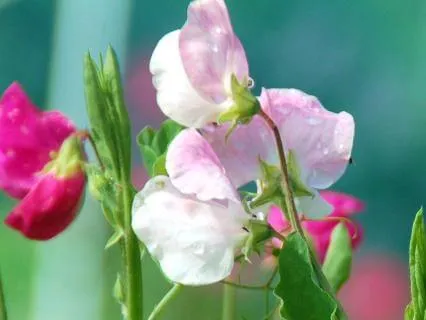
Their faint delicate scent is refinement itself and is there anything in the world more charming than the sprightly way they hold up their little faces to the sun.
I have heard them called bold and flaunting but to me they seem modest grace itself only always on the alert to enjoy life as much as they can and not afraid of looking the sun or anything else above them in the face.
On the grass there are two beds of them carpeted with forget-me-nots and in the grass in scattered groups are daffodils and narcissus.
Down the wilder shrubbery walks foxgloves and mullins will I hope shine majestic and one cool corner backed by a group of furs is graced by madonna lilies,
White foxgloves and columbines.
In a distant glade I've made a spring garden around an oak tree that stands alone in the sun.
Groups of crocuses,
Daffodils,
Narcissus,
Hyacinths and tulips among such flowering shrubs and trees as pyrus mullus,
Spectabilis,
Floribunda and coronaria,
Prunus juliana,
Mahaleb,
Serotina,
Triloba and pisadi,
Cydonias and wygelias in every colour and several kinds of crotageous and other may lovelinesses.
If the weather behaves itself nicely and we get gentle rains in due season I think this little corner will be beautiful but what a big if that is.
Drought is our great enemy and the two last summers each contained five weeks of blazing cloudless heat when all the ditches dried up and the soil was like hot pastry.
At such times the watering is naturally quite beyond the strength of two men but as a garden is a place to be happy in and not one where you want to meet a dozen curious eyes at every turn I should not like to have more than these two and rather one and a half.
The assistant having stalk-like proclivities and going home in the autumn to his native Russia returning in the spring with the first warm winds.
I want to keep him over the winter as there is much to be done even then and I sanded him on the point the other day.
He is the most abject looking of human beings lame and afflicted with a hideous eye disease but he is a good worker and plods along unwearyingly from sunrise to dusk.
Pray my good stalk said I or German words to that effect why don't you stay here altogether instead of going home and rioting away all you have earned.
I would stay he answered but I have my wife there in Russia.
Your wife I exclaimed stupidly surprised I didn't know you were married.
Yes and I have two little children and I don't know what they would do if I were not to come home but it is a very expensive journey to Russia and costs me every time seven marks.
Seven marks yes it is a great sum.
I wondered whether I should be able to get to Russia for seven marks supposing I were to be seized with an unnatural craving to go there.
All the labourers who work here from March to December are Russians and Poles or a mixture of both.
We send a man over who can speak their language to fetch as many as he can early in the year and they arrive with their bundles men and women and babies and as soon as they have got here and had their fares paid they disappear in the night if they get the chance sometimes 50 of them at a time to go and work singly or in couples for the peasants who pay them a fennig or two more a day than we do and let them eat with the family.
From us they get a mark and a half to two marks a day and as many potatoes as they can eat.
The overseer lives with them and has a loaded revolver in his pocket and a savage dog at his heels.
For the first week or two after their arrival the foresters and other permanent officials keep guard at night over the houses they are put into.
I suppose they find it sleepy work for certain it is that spring after spring the same thing happens 50 of them getting away in spite of all our precautions and we are left with our mouths open and much out of pocket.
This spring by some mistake they arrived without their bundles which had gone astray on the road and as they travel in their best clothes they refused utterly to work until their luggage came.
Nearly a week was lost waiting to the despair of all in authority nor will any persuasions induce them to do anything on saints days and there surely never was a church so full of them as the Russian church.
In the spring when every hour is of vital importance the work is constantly being interrupted by those days and the workers lie sleeping in the sun the whole day agreeably conscious that they are pleasing themselves and their church at one and the same time.
A state of perfection as rare as it is desirable.
Reason unaided by faith is of course exasperated at this waste of precious time and I confess that during the first mild days after the long winter frost when it's possible to begin to work the ground I have sympathized with the gloom of the man of wrath confronted in one week by two or three empty days on which no man will labour and have listened in silence to his remarks about distant Russian saints.
I suppose it was my own superfluous amount of civilization that made me pity these people when first I came to live among them.
I am sure they would not wear new clothes and I hear them coming home from their work at dusk singing and after all if you work all day in God's sunshine when evening comes you are pleasantly tired and ready for rest and not much inclined to find fault with your lot.
I have not yet persuaded myself however that the women are happy.
They have to work as hard as the men and get less for it.
They have to produce offspring quite regardless of times and seasons and the general fitness of things.
They have to do this as expeditiously as possible so they may not unduly interrupt the work in hand.
Nobody helps them,
Notices them or cares about them,
Least of all their husbands.
It is quite a usual thing to see them working in the fields in the morning and working again in the afternoon having in the interval produced a baby.
The baby is left to an old woman whose duty it is to look after babies collectively.
When I expressed my horror at the poor creatures working immediately afterwards as though nothing had happened,
The man of wrath informed me that they did not suffer because they had never worn corsets and nor had their mothers or grandmothers.
We were riding together at the time and had just passed a batch of workers and my husband was speaking to the overseer when a woman arrived alone and taking up a spade began to dig.
She grinned cheerfully at us as she made a curtsy and the overseer remarked that she had just been back to the house and had a baby.
Poor,
Poor woman I cried as we rode on,
Feeling for some occult reason very angry with the man of wrath and her wretched husband doesn't care a rap.
What nonsense it is to talk about the equality of the sexes when the women have to have the babies.
Quite so my dear replied the man of wrath smiling condescendingly.
You have got to the very root of the matter.
Nature while imposing this agreeable duty on the woman weakens her and disables her for any serious competition with man.
How can a person who is constantly losing a year of the best part of her life compete with a young man who never loses any time at all.
He has the brute force and his last word on any subject could always be his fist.
I thought I observed a tendency in the man of wrath to rather gloat over these castigations.
Pray my dear man I said pointing with my whip look at that baby moon peeping at us over the edge of the mist just behind that silver birch and don't talk so much about women and things you don't understand.
What is the use of your bothering about fists and whips and muscles and all the dreadful things invented for the confusion of obstreperous wives.
You know you are a civilized husband and a civilized husband is a creature who has ceased to be a man.
And a civilized wife he asked bringing his horse close up beside me and putting his arm around my waist has she ceased to be a woman.
I should think so indeed she is a goddess and can never be worshipped and adored enough.
It seems to me he said that the conversation is growing personal.
I started off at a canter across the short springy turf.
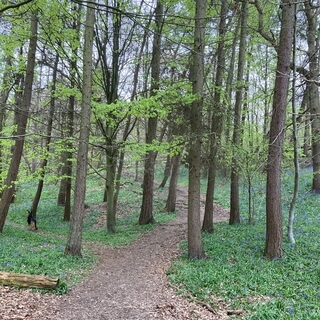
The Hirschwald is an enchanted place on such an evening when the mists lie low on the turf and overhead the delicate bare branches of the silver birches stand out clear against the soft sky while the little moon looks down kindly on the damp November world.
Where the trees thicken into a wood the fragrance of the wet earth and rotting leaves kicked up by the horse's hooves fills my soul with delight.
I particularly love that smell.
It brings before me the entire benevolence of nature forever working death and decay so piteous in themselves into the means of fresh life and glory and sending up sweet odours as she works.
To be continued.