Hi,
Everyone,
And welcome back to the podcast that exists to remind you that this world is full of mystery,
Magic,
And sometimes mayhem.
I source intrepid guests with stories of near-death experiences,
Ghosts and visions,
And paranormal encounters that can't be explained.
And this time is no exception.
I'm introducing you to Dr.
Raymond Roberts,
Who is a pastor with plus years of experience.
He's an author,
And he's also an incredible musician.
But who am I to describe Dr.
Raymond?
I'll let him introduce himself in his own words,
And just wait till you hear his miracle story.
It brought him to tears,
And frankly,
Me too.
It's a powerful reminder of connection,
Synchronicity,
And how this world works in incredibly mysterious ways.
All right,
Let's get to it.
Here's my conversation with the incredible Dr.
Raymond Roberts.
The clerk of session,
A woman said,
And then the clerk of session,
The session's the group that governs the church.
She said,
Are we ready to start?
I said,
I think we are.
And she walks out,
She says,
Boys,
Y'all come in.
And so they all stand around outside.
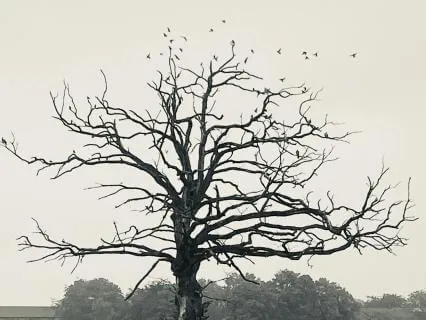
They start walking in and lightning struck the oak tree that they were under,
Blew out a window in the church.
And it was this remarkable like,
And the tree lived,
But it was,
Wow.
I'm Ray Roberts.
I identify as a Christian,
Presbyterian in that tradition.
So it's a particular tradition.
It's PCUSA,
Which is the liberal tradition within the Presbyterian family,
Reformed family.
I am an American.
I grew up here.
I'm Midwesterner.
I'm from Missouri.
And that's how I pronounce it.
Not like everybody else.
Everybody else is wrong.
But,
But I'm from Missouri.
I'm a St.
Louis Cardinals fan.
I'm a Boy Scout.
And that was very formative for who I am.
And so there's,
That's,
That's a neat little summary.
I've been 40 years a pastor,
And I do have a PhD in history and theology.
Cool.
I'm loving what you've just told me because I have questions here.
So years ago,
When I subscribed to Smithsonian Magazine,
They did this gorgeous article,
It was just so beautiful.
And it was about a really fabulous kind of summer,
I would say,
I don't know if it was a summer,
Well,
It was best during the summer,
I guess,
But it was following a road.
Along Missouri.
For music and all the festivals and musical jazz,
Blues,
And that Missouri was known for having all of these incredible events that really honored the history of the music,
The people of the music,
Along with a whole lot of amazing food.
And celebration and community gathering.
Is this,
Is this true or is it,
Am I making this up?
I can't tell.
You know,
I couldn't tell you.
Okay.
Um,
It couldn't tell you.
I know there's,
You know,
Like there's the,
In St.
Genevieve,
You've got this French influence that's there.
So that,
That's a part of the Missouri tradition.
And then there's also,
You know,
St.
Louis blues,
You know,
And the,
The Northern immigration out of the South by African-Americans,
Uh,
To Northern cities for,
To escape discrimination and,
Get jobs and stuff.
But yeah,
My,
My mother was a classically trained pianist and,
And was really quite a good pianist.
I didn't realize she was such a good pianist until I was much,
Much older.
She,
She,
I just thought everybody got tucked to bed and if their mother played piano,
They played like my mother did while we went to sleep.
You know,
Chopin,
Mendelssohn,
Concertos and different things.
I just thought that's,
That's life.
So my family was very focused on classical That was the only real music.
And they gave me violin lessons when I was a kid.
And those were fine until I got old enough to think that is the nerdiest thing.
My parents hate me.
They want to punish me.
So I taught myself guitar.
And of course,
Now I'm in a band called Reckless and Wild.
We're on Spotify.
I look back on that experience and think,
Yeah,
It's pretty good training.
Uh for you know,
Creating and writing music,
Which is the thing,
One of the things I love to do.
Amazing.
Can I ask you,
When you were growing up,
Did you have a favorite kind of music?
Oh,
That's a good question.
You know,
It depends on which age.
Until I got to high school,
I remember when the Beatles came out.
And they were on the Ed Sullivan Show,
So I'm that old.
They were on the Ed Sullivan Show,
And all my friends were talking about the Beatles.
And then,
You know,
My family was not a popular music family.
You know,
We were listening to,
You know,
Dvorak.
Brahms.
And we weren't listening to to that stuff.
And,
And so,
You know,
I was really interested in it.
My mother was said,
Oh,
That's really not music.
And then my father,
I remember at a party at our house,
We used to have these dinner parties and friends would come over,
My parents friends would come over.
And my father pontificating that the Beatles music was pretty good if you took out the rock element.
That's,
That's,
That was his,
That's how liberal he was.
So,
And,
You know,
Then I had a,
I have a cousin,
Tommy Johnson,
Who was in a band called the Doobie Brothers.
My aunt says that he wrote,
Listened to the music play at my grandmother's house down the street.
And,
But he was my,
I know my mother just was like,
You know,
She,
As I got to high school,
Music's a fine avocation,
But it's no way to make a living.
So she was trying to get me away from music because I was so interested in it.
Okay,
All of that is amazing.
Learning.
Instruments for me is a practical impossibility.
Do you think you have an affinity?
For.
I think I was exposed to it as a very young child.
And,
And I was,
You know,
The guy named Dan Peek was in the band America,
Right behind my grandmother's house.
Before we moved to England.
And I used to walk his sister home from school and carry her books,
Becky Peak.
And so,
You know,
There was music around.
And so that was always a big part of my life.
I tend to,
You know,
There may be some aptitude,
I'm sure there's some aptitude,
Right?
We come into this life with genetic predispositions that can be developed in certain ways.
So I'm certain there's something there for which I'm grateful.
Think,
You know,
They say everybody in China can carry a tune because Chinese language is so tuneful.
I actually,
Um,
Just,
Yeah,
Yeah,
No,
You're right.
That's all three different words.
Yeah,
I know.
I,
I actually read a really fascinating article that because of that,
90% of people over there have perfect pitch,
Which is incredibly rare in the rest of the world,
But it's because it's a tonal language.
And,
Um,
I thought that is so fascinating.
Well,
It goes to show that how much we're shaped by our environment.
There's the nature,
But then there's the nurture.
And I got lucky on the nurture side of things.
Yeah,
Yeah,
Yeah.
So there's hopefully.
.
.
Oh yeah.
Oh yeah.
I think,
You know,
I'm thinking about your grandmother's house and it sounds like this,
Like the house was in the perfect place and what a great environment.
You could walk your friend home with her books and come home and be surrounded by music.
And I,
You know,
I think it's a special kind of brain that is able to learn music,
But learn instruments.
You know,
My father rented a piano for me when I was younger and I just thought,
I cannot,
This is no way,
I mean,
I already know I'm not,
I'm being set up for failure accidentally,
But then I've met other people who just,
It is seamless for them.
It is easy.
They're able to do it without,
You know,
I love this question.
When you were a little boy,
What did you dream of becoming?
Oh,
Well,
In my family,
I dreamt of becoming a lawyer or a doctor.
Those were the two things.
And my father was an attorney.
He was a he was prosecuting attorney right out of law school.
And then he was the small town lawyer,
Which did everything from probate to criminal law.
And and then he got into labor arbitration and arbitrated all over the country.
He had a little private plane and would fly to Tumawa,
Iowa or,
You know,
The Kentucky coalfields or different places arbitrating between laborers and management.
And he would take me with him.
I was the eldest son.
And what I,
Looking back on it,
I didn't see it at the time.
I mean,
You know,
You're kind of clueless growing up,
Right?
But he was grooming me for the profession.
And when I had told him that I wanted to go into ministry,
He looked at me and said,
You're making a very bad financial mistake.
And he wasn't wrong.
It wasn't wrong.
But,
You know,
There's more to life than money.
And I think that's I would say that's the other thing my family taught me is that maybe that wasn't the lesson they wanted to teach me because we had we,
You know.
Anybody's flying around the world or flying to Mexico in February to go bass fishing,
And writing a letter to the school about how this is going to be some sort of cross cultural experience for their son.
I mean,
That that's,
That's the kind of thing that you know,
It's,
Yeah.
But we had a house in the Bahamas when I was a kid.
And we had a lot of things.
But what we didn't have is the spiritual life or I somehow along the way with all this Um.
.
.
Enriched life,
There was a spiritual emptiness in the middle of it.
And I,
You know,
What am I here for?
What's my purpose in life?
What about those who don't live like I do?
And,
You know,
Whose moms have to get up and work in the Trimfoot factory across town.
And they come home and they're tired.
And,
You know,
They tell the kids to go to sleep and,
You know,
They don't own a piano.
You know,
So there's,
That sense of what is this all about?
Those questions were really big in my mind.
Wow,
I kind of.
Just thank you for sharing your childhood because that does sound very enriching,
Frankly.
And your father just sounds really driven,
Motivated,
You know,
Passionate about what he did,
But also what a gift.
I mean,
I know that he was kind of like saying,
Hey,
You know,
Maybe this is what you could do later,
But what a gift to be exposed to all these different places around the States at that time and all the different people,
Because,
You know,
Plenty of fathers wouldn't have taken any of their children.
They would have just.
.
.
And we would talk about the cases.
Wow.
And and on the way on the way there and on the way back.
And my father had a sense of justice that was pretty strong.
And that,
You know,
He.
I think that's what made him such a successful labor arbitrator,
Is that sense of justice,
But also recognition of the rule of law.
I mean,
You know,
I would say,
Well,
I think it should be this.
He said,
Well,
The contract says this.
So what do you say now?
And,
You know,
And that,
You know,
He was,
I just,
You know,
That was So I have a sense of that.
Yeah.
That brought into how I look at the world.
Yeah.
Wow.
You know,
You've segued really nicely into the second question,
Which was,
And you've kind of already alluded to part of the answer,
But,
You know,
Did you grow up in a religious household?
What did that look like?
It sounds like not.
And then You know,
How did your connection evolve over time with the divine so that now,
You know,
Then you chose ministry.
That's pretty fascinating.
My,
You know,
In some ways my family.
Was religious in that they sent me to a Lutheran grade school.
And that was partly because my mom had been a French teacher at the local high school,
And the principal said,
Ain't,
And didn't use good grammar,
And she was not impressed.
And so she was being the wellesley grad here in Little Farmington,
Missouri.
She didn't like that.
So sent me to Missouri Senate Lutheran grade school,
And she once told me that I didn't believe in God,
When I graduated from college,
But then when you were born,
When I was carrying you,
I thought to myself,
Well,
I wouldn't believe in me if I were the baby growing.
And so she said that gave me a sense of maybe there's the possibility of something bigger than us that we're a part of.
So I've never really had much trouble believing that there is a God.
And at the Lutheran grade school,
I remember Mrs.
Schramm,
One saying,
Well,
Go to the zoo and look at the monkeys and you can wait there all your life and that not a single one of them will turn into a human being.
And,
You know,
She was speaking against evolution.
So I went home and talked to my mom about this.
She goes,
We believe in evolution.
You don't have to make a big deal about it with students at the school,
But we believe in evolution.
So I've never understood,
Never understood why people have trouble with the idea that God can use secondary sources.
St.
Augustine called it the seed principle.
But we weren't active in going to church except for the time when I was in the Lutheran grade school.
In fact,
When my father died,
I learned that he'd been an elder in the Presbyterian Church.
I didn't know that.
I knew his fond of the Presbyterian minister who had,
I think he might have baptized me.
I was baptized in the Presbyterian church.
I went through confirmation in the church.
We weren't active.
We didn't go.
You know,
Our family could have done so much for that church.
Once you become a pastor,
You kind of realize,
You know,
That church could have really benefited from,
You know,
The resources in the presence if we kind of looked beyond ourselves.
What we did is most weeks is we'd sit at home,
Cook eggs and bacon,
Spend time together reading the newspaper,
Drink coffee,
And maybe work in the yard.
Or if we weren't doing that,
We would go floating on the rivers of that part of Missouri,
Which is known for all of its,
You know,
The Current River,
The Black River,
The Merrimack,
Mineral Fork,
Loving Point,
All these different rivers.
I'm sorry,
But it sounds like you're describing heaven.
It was pretty great.
And,
Uh,
But we weren't ever in,
We didn't even go on Christmas and Easter.
My grandmother was quite devout.
She was very involved in the Methodist Church,
And it was a Boy Scout leader.
My Scoutmaster once asked me,
Would you be the troop chaplain?
And that was a providential question.
And I'd never considered it.
But I didn't know how to say no.
And so I agreed to lead a kind of worship service on our Boy Scout camping trips.
And I thought,
You know,
I don't know anything about this,
Except for what I learned in the Lutheran school for three years from kindergarten to second grade.
I should go back to church.
So I started going to church,
Going to Sunday school,
Met my friends,
And the kids in MYF became my friends,
And I would go to MYF.
And when I was in high school,
I'd go to church by myself.
Off.
My grandmother would sit down,
I'd sit in the balcony with the kids and she'd be down on the floor.
And if some of my friends weren't there,
I'd sometimes sit with her.
That's.
.
.
It was kind of around the church.
My father was pretty skeptical.
Of organized religion,
I would say.
And he was,
You know,
Kind of with a Mark Twain kind of sense of,
Yeah,
Which that stuck with me,
Too.
You see people who are religious do a lot of foolish things in the name of religion,
Inspired by the faith,
You know,
That especially in our time,
I think we see stuff that I think is going to be hard for the church in the future.
You know,
It's not a good witness.
I think it's really interesting for the Anglican Communion.
When I was in seminary,
I had a class that was dedicated just to the history.
Of the Anglican communion and,
You know,
From,
You know,
Their origination to the present and,
And it was really interesting understanding that As with all things,
You know.
Things evolve,
They change,
They shift,
They orient themselves in new ways to what's going on in the world.
And how do the human beings within those organizations,
I don't know,
I guess live their truth or,
Or respond in a way that feels authentic to them and with integrity.
And I just,
You know,
I'm a panentheist.
So I,
Have no skin in what's going on.
But certainly all of my,
I went to a Methodist seminary,
Very liberal Methodist seminary.
And so certainly the rest of my cohort was,
You know,
Kind of starting to engage with these issues.
It'll be interesting to see what happens over time.
There's no sinless traditions.
That's something my dissertation advisor,
Doug Otati,
Taught me.
I don't know if you know Doug Otati.
He just retired from teaching at Davidson,
But he was my doctoral dissertation advisor.
But he would say,
There are no sinless traditions,
And that includes the Christian traditions.
Yeah.
And that includes national traditions.
You know,
I mean,
There's,
I think,
In our time,
A desire to expunge from the record the idea of America's founding faults.
And,
You know,
That's and it's problematic because faults shape the way we're living today.
If we didn't make mistakes,
How would we ever learn?
Yeah,
On the other hand,
But from my understanding,
Since more than just mistakes,
That's true.
That's true.
It's it's not Oh,
I blew it.
It's it's more like someone's really getting hammered because of this,
The way this and I've either done or we've organized to do.
Yeah.
Yeah.
Yeah.
Thank you.
Thank you.
I,
I am intrigued by the answer to this question.
You know,
Your father sounds like he really,
Well,
Your whole family,
It sounds like a life of the mind,
Very intelligent,
Very,
Um,
Compassionate,
Um,
But also oriented outwards to the world.
You know,
It wasn't an insular household facing inward.
Um,
Your father absolutely,
You know,
Flying all over the country,
Um,
For his job and his work negotiating,
Helping,
Being of service.
You know,
I can't even imagine what that example kind of showed you or how it led you?
Do you feel like.
.
.
His work and witnessing his work has led you to some of the work that you've done today.
I mean,
You are a,
I want to ask you about this.
You're a professor of health ethics and or you were a professor of health ethics.
I don't even know what that is.
I'd love to hear what that means.
But it does seem like a little bit of a,
I don't know,
I don't want to say social justice,
But helping people understand how to be in the world around health in a way that has integrity and authenticity,
But also wholeness and a healthy way to engage with ethics around health.
Yeah,
I'm not teaching this semester,
But when I've taught it,
I talk about the ethics of being a professional.
Because as a professional,
You're educated.
You're tested against a body of knowledge.
That's hence the professing part of professional.
It's the emphasis upon that.
The classic professions,
Of course,
Law,
Medicine,
Ministry,
Education.
And it's not just professional dry cleaning,
Right?
And it's it's oriented around the university.
And so in the stuff I've read about that,
You know,
Being a professional gives you a sense of responsibility,
Right?
If you're an engineer,
And you've passed the engineering,
Your job is to kind of help people deal with the natural world,
You know,
The forces of nature.
And,
Or if you're a,
You know,
Of course,
Medicine's about health,
Law's about legal,
And ministry is about our relationship with the divine.
So that's,
So I would start the class there.
And then I really wanted to give them a method of moral analysis.
And give them tools for thinking through what are the dynamics that are going on that we need to pay attention to.
And so I taught a form of not only ethics,
What is ethics,
Deontological ethics,
Teleological ethics,
Virtue ethics,
But also a way of analyzing situations.
Almost every ethical argument is couched in a couple of terms.
One is there's some understanding of the situation.
Their moral norms,
And then their loyalties that are being served.
So like in health,
You know,
Someone may choose a course of action to protect that I'm going to practice defensive medicine so I don't get sued.
They may want to do a scientific experiment in advanced science.
They may want to keep the patient alive for the family.
They may want to serve the patient first.
I mean,
There are a number of loyalties that can compete.
And then finally,
And I think the hardest for the students to grasp is that Moral arguments are always shaped by anthropological assumptions.
Who are people?
What do they need to flourish?
How can we expect them to react?
And so anyway,
I tried to get them up.
That's a brief parameter.
That's the whole class could have just done it.
In five minutes.
Thank you.
Thank you for that explanation because I saw that I was like health ethics,
Interesting.
You know,
I I,
I've interviewed multiple people whose parents were really involved in making life better in whatever way they could for others.
You know,
I do see some of that in your work.
And I,
Correct me if I'm wrong,
But as a you know,
It says that you're a historian pastor,
But you're also,
You know,
You are,
I would say a historian,
You know,
As well.
And we always need people who can step outside of history and observe it objectively.
However,
I just read another article that said nothing in this world can be objective because we're all observing it through our lens.
So literally everything's subjective.
It doesn't matter what you're looking at.
But as best we can observing,
You know,
History.
Kind of stepping out of it.
And seeing what's going on today in the world,
It's a little overwhelming what's going on in the United States.
I also am kind of colored by the fact that I grew up in an Islamic country for four years,
So I actually have deep intimacy with people overseas.
Which country?
Oh,
Pakistan.
Pakistan.
Yeah.
And so I,
I understand,
You know,
That we have way more in common than anything else,
But it is interesting to,
Well,
It's not interesting for me.
It's dismaying to see whole cultures,
Um,
Kind of demonized,
Vilified,
Um,
Painted with a very,
Very broad brush.
Um,
There's no nuance.
There's no,
You know,
Often these comments or disparagements are made,
Um,
In complete ignorance.
The people haven't even met anyone who is a practitioner of Islam or Hinduism or whatever the case may be.
You know,
Call me simplistic.
That's fine.
I will accept that.
But I really like it when everybody gets together and gets to learn from each other.
Um,
I think that's how our culture,
Our world,
Our society becomes richer and more beautiful.
But here you are with,
You know,
Kind of,
And correct me if I'm wrong,
But you're observing what's going on.
You know,
History,
You were aware of the nuances,
The ebbs and flows of different ideas.
Um,
How do you feel about what's going on now?
And this is such a big question and I'm sorry to kind of like foisted on you,
But you know,
If you have.
You know,
Kind of a little contribution about,
You know,
What you think is going on in the U.
S.
,
I'd love to hear it.
There's a really good book,
Although I don't disagree with the last chapter.
It's called Fall of Republics,
And he makes the case that it looks at republics in history,
And it talks about Sparta,
Carthage,
Rome,
Venice.
Then it looks at what the lessons were that people learned from these republics for the political development that happened in England during the English Civil War.
And also in the American Revolution.
And.
One of the things he says is that the other republics,
Contrary to Benjamin Franklin's statement,
It's a republic if you can keep it,
Which makes it kind of sound like a fragile teacup,
Actually are pretty resilient.
They're more resilient than dictatorships.
Which can only last as long as the dictator.
But what he says,
The only republic that fell in history is Rome,
And it fell once it had no external enemies.
And so the fear of the external enemy was turned,
And he says,
In any large political body,
You're going to get parties.
Usually two parties,
Because you can't get power unless you've got two parties and become the majority.
And so it's usually two parties.
And this fear that had been directed outward,
And we all know there's all kinds of terrible things that happen with fear directed outward,
But becomes directed inward.
And that's what created the dysfunction that led to the fall of the Roman Republic.
And I think we see that going on.
I mean,
I think we're deeply polarized and it's not just,
It's effective polarization is what they call it.
You know,
It's not,
It's our problems,
Not the principles because apparently people are willing to sacrifice principles pretty easily.
It's not even the policies because people seem pretty flexible about the policies,
Frankly.
You know,
Some constitutional conservatives are suddenly,
You know,
Well,
It broke the law,
It doesn't matter.
Or,
You know,
Or they excuse it with what about Or they,
You know,
Our problem becomes with the other party.
And the other people.
And the fear is that if they take power,
Things will get really bad.
But it doesn't mean they won't get bad because,
You know,
There's some people espousing some pretty scary stuff.
But it doesn't mean everybody does.
And what happens is the metal hollows out.
Of a republic and I think that's what we're seeing right now.
And people pick the worst examples of the party to say everybody thinks that way.
And healthy parties police themselves.
And right now,
It appears to me that one of the parties is unable to police itself.
And,
You know,
Todd Blanche,
The latest example,
Where you've got a clearly unfit person who should not,
Who will weaponize,
Has weaponized and will weaponize the government in ways dangerous person.
And yet the person on the committee says,
There's nothing we can do.
Well,
You've got to vote.
The Constitution gave Article One,
First,
It's Article One for a reason,
And it has to do with Congress and the role of Congress.
Article Two has to do with the executive.
And I was at a conference a couple of weeks ago,
And there are all kinds of reforms they talked about on the presidency that we need to make,
Reforming emergency powers,
Pardon powers,
And other things.
But then there was a person who used to be Mark Rubio's legal advisor,
Who's head of,
What is it called?
It doesn't matter.
He's the head of a group.
He said,
You know,
We've talked a lot about the problems in the presidency,
But there are real problems in Congress.
Is Congress has a role and it's not playing the role that the founders envisioned.
And the real problem with that is cultural.
It's cultural.
That is,
We've,
Our culture is not able to hold our represent,
And there's variety,
You know,
Gerrymandering and other things,
But there's,
There's a variety of reasons that the Congress is not fulfilling its role.
And,
You know,
He,
One of the,
This is Greg Nunzi,
I believe his name,
Society for the Rule of Law.
He said,
The founders,
Saw lots of different parties,
But I'm not sure they really saw two parties.
And.
And so,
You know,
How do you,
How do you speak what there are ways to speak more objectively about this.
But anytime you speak,
You become part of the Continuum.
And so you're immediately pegged as,
Oh,
Well,
You're for this side,
Not the other side.
And when party identities is so central to people's identity,
You may have noticed when I introduced myself,
I didn't say.
I'm a.
Because in many ways,
Yeah,
I probably vote one way or another.
You probably guess what it is.
But that's it's it doesn't really I'm much more interested in principles and the person in the policy,
You know,
The candidate in the policies than I am with I'm going to vote my party.
That never crosses my mind.
Um affected.
Uh,
It just doesn't.
Thank you so much for that answer.
It's really helpful for me because sometimes I get overwhelmed by everything that's going on.
And I just wonder,
How does a person take it all in and kind of understand it or even begin to understand it?
Or when there's so much happening all the time,
It's just really hard to keep up.
Thank you,
That is very helpful and I'm so grateful to hear your point of view.
The Apostle Paul said our struggle is not with flesh and blood.
But with principalities and powers.
And I need to write this up,
But this would be maybe the next book.
But I do think it is so easy to think people are the problem.
And sometimes they are problematic.
I just mentioned Todd Blanch,
He's a problem.
But our bigger problem is what's driving the behavior of people in ways,
The amount of money in politics,
The way our media system is set up.
The way we get our information.
I mean,
There's other things that are.
.
.
And I would also say the decline of the mainline church,
I think,
Is a part of this.
We no longer share language that.
That helps us too.
The mainline church at its best,
Not always at its best,
But at its best.
Gave a language that was not exclusionary.
It didn't exclude other voices,
But gave you a reason to include them.
So,
You know,
If you look at somebody like John Witherspoon,
Who's the only clergyman to sign the Declaration of Independence,
He leads the Presbyterian Church to demand,
First thing they pass when they organize the National Church is,
God alone is Lord of the conscience.
You know,
And changes the Westminster Confession of Faith,
You know,
From the magistrate's supposed to uphold true religion to the magistrate's supposed to treat everybody the same.
You know,
They did a number of things at the very beginning.
Those are the first things he did about freedom of religion.
And of course,
His most famous student is James Madison,
Who helps with the Virginia Statute of Religious Freedom,
Memorial and Remonstrance Against Taxation to Pay for Clergy Salaries,
And writes the First Amendment.
I mean,
That's his most famous student.
And he's echoing these ideas of freedom.
And those are good reasons.
I would argue Christians have very good reasons to uphold the freedom of Muslims to live as Muslims in American society and not be afraid of them taking office and winning office.
The idea of natural law,
For example.
Paul says in Romans chapter 2,
God has given everyone a conscience.
Well,
Everyone has a moral sensibility.
We.
That that means there are no religious tests for office.
Yeah.
And it leads directly to that.
Yeah,
I actually years ago.
Read an incredible book on a Pope who lived around the year 1000 and he was very tolerant,
Very open,
Didn't last very long.
But was very tolerant and very open.
And because of that,
There was a great flowering.
In Spain.
It became a,
You know what I'm talking about?
It's like,
You know,
The sciences,
Math,
Art,
Writing,
Everything because the Catholics,
The Moors,
Everyone was coming together and sharing knowledge and language and art.
And it was almost like this cultural explosion of intelligence and sharing.
And so I think to myself,
Oh my gosh,
That's what could happen.
Well,
And in fact,
I would argue we have had that in the 20th century.
What I worry about is that we may lose that.
There's the fear of the other,
The fear of the immigrant,
The fear of people who are different.
Will shut down.
I mean,
We're losing research scientists right now.
I know.
And then,
You know,
The artists and others.
And for no good reason.
Yeah.
Obviously,
You know,
If there's somebody who's actively destroying society,
Yeah,
You got to whoever they are.
They need to be restrained.
Itchy.
That's how you get flourishing cultures that are diverse,
And where one idea sparks another idea.
I think of in the 11th century,
You know,
The natural law theologians,
They discovered Aristotle,
And there's this wonderful,
And they also,
In the process,
Discovered this whole natural law idea that everyone has a moral sense.
Well,
It's not,
It's a small step,
One historian says,
From the idea that you can discover They're all laws of the universe.
The moral order to discovering the natural laws of the universe,
The natural order.
And then you get the enlightenment,
You get,
I mean,
Those are significant achievements.
When you allow that human reasoning,
Not always perfect,
Always simple,
Always broken.
Yeah,
I was particular,
No sinless traditions,
All that.
But when you when you have enough trust in it,
That you can Welcome insights that are not your own and think about it and then respond creatively.
I think that's,
I think there's an ideal of culture there.
That's the kind of place I want to live,
That's vibrant.
Expressive.
You know,
Challenged.
I'm not sure everybody likes to be challenged,
But I enjoy it.
It may be that I speak from a very privileged place where I can enjoy it.
That's also the case.
Well,
You are,
I'm so glad.
I'm so glad to have you on this podcast because I welcome those people.
So thank you for sharing that.
I just love hearing all your stories.
They're kind of incredible.
I'd love to ask the main question of the podcast.
And then we'll start talking about what you do in life now and what you've shared of yourself and your work.
But I would appreciate if you'd share one story or two stories,
However many you feel called to,
Of something that you've either witnessed or experienced that you thought was magical,
Miraculous,
Or mysterious.
So I remember as a young pastor,
I got asked to speak at Presbyterian revivals,
Which are like revivals,
But everything's in decency and order.
And,
You know,
A series of sermons over a couple of nights.
And I was invited to speak at Providence Presbyterian Church.
And a friend of mine who was the editor of the paper,
Local paper,
Drove me down.
He was from that area down in the south side of Virginia.
And he,
So he drove me down and we had dinner with everybody,
The whole congregation gathered,
They all had dinner.
And I had spoken at a youth retreat the year before for the presbytery,
Which is the local body of churches,
And that's how they got my name.
And so,
We had dinner.
The clerk of session,
A woman said,
And then the clerk of session is the group that governs the church.
She said,
Are we ready to start?
I said,
I think we are.
And she walks out,
She says,
Boys,
Y'all come in.
And so they all stand around outside.
They start walking in and lightning struck the oak tree that they were under,
Blew out a window in the church.
And it was this remarkable like,
Lived.
But,
But it was,
It was,
Wow.
That was,
It was kind of a clear day.
It wasn't,
You know,
It was just a bizarre event.
So everybody came in and we had,
We had the service.
It was fine.
And then after the service,
My friend said,
I'm going to go see my brother.
I've arranged for you to,
If you don't mind,
To ride with this family who,
And he said,
This church hasn't had a pastor.
And their son just died.
And maybe you could offer some pastoral care and I'll come by and pick you up later.
So I get in the car and I'm talking with them and I said,
I heard you've had some really,
Really tough year and they talked about their son,
Calvin.
Who had died,
Had been hit by a car on his birthday.
They gave him a bicycle and he got hit by a car.
And it's just.
So.
So we get to their house.
We go inside.
There is this picture.
He was in my small group the year before.
And he had talked with me about his spiritual life,
And he had a girlfriend,
And he was thinking of ministry.
So we'll set you met.
And I'm.
These things just lining up like crazy.
Anyway,
We're driving home.
Logan's driving me back,
My friend,
And says,
So how was it?
And I started trying to tell him the story.
And.
Yeah,
Of Providence.
Presbyterian Church.
So there's a moment where it's like,
Frederick Buechner says,
You know,
God needs to show up in your life if you believe in God.
I don't know that I believe that everything,
Little thing that happens,
I don't believe God killed Calvin.
I think things happen in this life,
But I do think God is a redeeming presence.
And,
And.
I saw it.
And was able to participate.
And what's equipped.
Via Comfort.
At a time of Pixar.
Thank you for sharing that.
Can't even imagine what a tragedy and and I was thinking while you were telling the story.
What a comfort you must have been for that family.
During that gathering because.
.
.
I felt like I was.
I mean,
Obviously they have to tell you themselves about what they felt,
But I felt like.
.
.
You know,
We were able to talk about it and about things that.
Nobody else.
He had been in my small group like just a couple of weeks before.
And I had a sense of what they'd lost.
Yeah,
Yes it,
You know,
I worked for an elderly couple for about 14 years in Portland and of course over the years became really quite close to them and You know,
Her husband had passed away.
The year before,
And I think they'd been married for 60 years.
And,
You know,
When Sam passed away,
I think June.
Kind of felt an incredible sense of loss,
Of course.
You know,
She had.
An ailment that she decided not to get treated.
And very quickly was in a coma in the hospital.
And one day.
.
.
Um I went to visit her and spend time with her and her daughter and her granddaughter came in and we just sat for a couple of hours,
You know,
In the same room.
Sharing stories about Sam and June.
And the daughter said to me,
Oh my gosh,
You know,
So many,
So much more about my parents than I did.
I haven't heard some of these stories.
And I said,
Well,
I spent,
You know,
I spent a lot of time with them and you know,
I'd lunch with Sam two or three times a week.
And of course we would talk.
And,
And so I realized later after I'd left,
Um,
Because both the daughter and the granddaughter were kind of just floored by everything that I had told them that that was part of my work with Sam and June was being present to her daughter and her granddaughter at that time and telling them all of these stories and sharing.
Things that they had not heard and that I saw the comfort that it brought them.
And I realized,
Oh my goodness,
This was always meant to be part of the service that I provided to the family,
Sharing these kind of incredible recollections that they hadn't heard.
And so I'm thinking about you and showing up to these,
The house,
Calvin's family's house,
And how,
You know,
Of course your relationship with him was very different.
And so you could provide a different lens Calvin and who he was and how he was in the world and what an incredible gift.
Yeah,
It was.
It was kind of overwhelming at the time once,
You know,
When it really hit me.
In the drive home and I was like,
Wow,
I just.
Where I'm supposed to be.
At least tonight,
So.
Friends,
That's a wrap on my conversation with Dr.
Raymond.
I want to thank Dr.
Raymond for coming on the show and sharing his incredible stories,
As well as the work that he's doing in the world.
There's no doubt he's making this world a better place and encouraging more understanding and compassion for everyone in our worlds.
Thanks,
Everyone,
For listening.
And if you could do so,
Please subscribe to the podcast and leave a rating or a review on whichever They help people find this little labor of love of mine,
So I'd appreciate it,
And thanks a bunch.
Thank you for listening,
And here's my one request.
Be like Dr.
Raymond.
Sink into the flow or the mystery that's life.
Understand when you're needed.
Step up to the plate when you can share a story about someone that might heal someone else's heart.
We're all here with certain gifts,
Everyone and you never know when that opportunity is going to show up where you can bring beauty or a blessing to someone else.
So be like Dr.
Raymond and keep your eyes open and show up in ways that might heal other people's hearts.