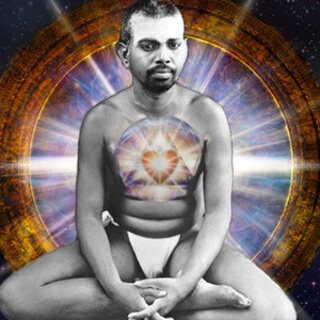
The teaching of Ramana is really the middle path,
The middle way between what's considered Neo Advaita or instant enlightenment or instant awakening,
Which literally throws out all practice.
It really is based on turning your attention inward to the source instantly,
Here and now.
This is the primary focus of the teaching of Papaji who was a student of Ramana Maharshi.
But if your focus is liberation,
This approach will only work for a very short period of time.
It does not lead to liberation from the karmic wheel.
And the focus of Ramana's teaching is liberation from the karmic wheel of suffering.
That is the endless cycle of birth and death.
So awakening can happen in a fraction of a second.
You can experience a shift in consciousness right now in less than a finger stop.
You can be awake,
Awakened to your true nature,
Which is pure conscious awareness.
That's instantaneous.
But this sudden awakening does nothing to address the karma,
The parabda karma,
The genetics of mind or the genetic mind,
The vasanas,
Which are latent unconscious tendencies.
These are not addressed with the Neo Advaita approach.
What this means is you can awaken to the pure awareness,
Which is a massive shift in consciousness.
But this sudden awakening leaves the ego very much intact and in charge.
And it can actually be camouflaged with truth and direct experience,
Which turns into a trance of enlightenment or the delusion that you are suddenly enlightened.
It doesn't work that way for liberation.
So on the other end of the spectrum,
There's Advaita Vedanta,
Which is an ancient spiritual philosophy and practice that had very strict guidelines.
There was a certain number of repetitions of the mantra that must be performed on a daily basis.
There are strict meditation or vipassana practice to learn to hone the mind,
To focus the mind on the source.
But there are very strict application of practice or tapas,
Severe austerities.
So this is the other end of the spectrum from Neo Advaita.
Ramana is the middle way between these two extremes.
He realized that for the average person,
Practices were essential,
But his teaching is not A plus B equals C or the strict application of practices in the context of Advaita Vedanta.
It is unstructured practice,
Meaning that you have to develop your own structure based on his guidelines.
So in other words,
If self-inquiry or the question,
Who am I,
Is too challenging for you,
Then you begin with a simple meditation practice,
Which is not concentration,
It is meditation,
Which is looking within to discover the source of the feeling me in your body.
This is the meditation that Ramana recommended.
It is an inquiry.
But he said,
Eventually you must come around to self-inquiry,
Which is questioning the me.
Who is this me?
Who is the meditator?
Who is this me?
Who is the meditator?
Who is the questioner?
Who is the doer?
This is a direct confrontation of egoic identity.
So eventually Ramana said,
You must get around to questioning the me,
The doubter,
The believer,
Right?
This me that you think you are.
And then the mantra was an aspect of his teaching that is rarely discussed,
But when you really spend some time to review self-inquiry,
Which is one of the core documents of his teaching,
You will discover that the mantra was very much a part of his teaching.
But again,
It's unstructured,
Meaning it's not a method or a formula to get.
And in the West,
We're used to a method or a formula to get whatever it is that we perceive that we want.
If you do this,
Then you get that.
It's not that simple because of the complexity of mind,
Ego,
Karma,
Genetics,
Conditioning,
The unconscious vasanas that are deeply ingrained in your physical form,
And also the way your brain is actually wired.
So it's very immature to think that you can become liberated from the karmic wheel in a finger snap,
Which is really the Papaji perspective.
It simply is not going to liberate you.
Instant enlightenment or instant liberation is the fallacy of neo-advaita,
Or what's been called neo-advaita,
Which is the primary focus of Papaji.
He literally took one small aspect of Ramana's teaching,
Which is the Toria state,
The stateless state of pure conscious awareness alive in your heart.
And he basically turned that into the entire teaching of Ramana Maharshi.
This is not Ramana's teaching.
Yes,
Ramana takes you directly to the source through meditation,
Through self-inquiry,
And the mantra.
But Ramana also is very aware that for the average person,
All of these other issues must be worked through,
Or you will not develop the skill to stay in the mind.
You will not develop the skill to stay focused on the source.
So this skill of focusing on the source is literally a purification of mind that comes through applying the practices that Ramana recommended.
Meditation,
Self-inquiry,
And the mantra as a yogic practice.
Ramana's teaching is based on bhakti,
Which is love and devotion.
This is just pure love of God,
Love of love,
Right?
Love of the omniscient love alive in your heart.
And jnana yoga,
Which is divine wisdom.
So this podcast is revealing the divine wisdom,
Which is practice,
Is essential to address the conditioning,
The physical wiring of your brain based on your parabda karma,
Which is your predetermined destiny,
The genetics,
The genetic mind,
And everything that you have learned and experienced from the moment you were born.
If this is not addressed,
The ego remains very much in charge because the ego itself has not been addressed when you focus on the source or the teria state,
Which is Papaji's famous teaching of no student,
No teacher,
No teaching.
This is the teaching.
But that's the teaching of Papaji.
It is not the teaching of Ramana Maharshi.
So the application of his core teaching is what leads to real progress,
Noticeable progress.
And by progress,
What is meant is that you will no longer react to situations in your life in the same way.
You will not be easily triggered by events outside of yourself or by things that people do or say.
The reason for that is the more you practice,
The more you learn to focus on the living truth of the heart and you develop the skill to stay there by purifying the mind and seeing through the reflective nature of ego,
Which is pure reflective consciousness.
And you've heard me speak of reflective consciousness.
The ego is reflecting everything you perceive through your five senses,
Which reinforces the feeling me inside of you.
It's a very strong feeling that you exist and you are your body.
Right?
So Ramana's teaching is helping you to see through this great illusion of ego,
Which is reflecting your senses on one side and on the other side is reflecting your eternal nature.
This is why the me,
If you play close attention,
Feels eternal because it is a reflection of your eternal nature.
But it is an illusion and just knowing that it is an illusion doesn't really serve to cut through this illusion,
To develop the skill to stay in the Turiya state,
Which is pure reflective consciousness,
Which is pure still,
Constant conscious awareness.
And when you give your attention to your heart,
To the pure awareness of your heart in this moment,
You can experience peace,
Love,
Natural compassion,
Silence.
In a moment you can experience that,
But to reside as that or abide as that requires the application of the teaching,
Not in a specified formula,
But in a continuous practice.
So Ramana's middle way is continuous practice,
Meaning that meditation is continuous,
Self-inquiry is continuous,
And the power and the sound of the mantra is continuous.
And the mind can hear that and immediately reject the idea of continuous practice because that seems impossible to the mind.
The mind is always distracted by outer circumstances,
By people,
Places,
And things,
And desires,
And attachments.
So as you move through life,
You are constantly distracted.
So you might experience a moment of bliss by giving your attention to the heart,
But then old patterns of suffering always return.
And the reason for that is there is so much going on in the physical form,
The wiring of your brain,
The conditioning,
The karma,
Or you can look at that as just the pure genetics of your destiny.
All of this is the complexity of suffering that must be burned through entirely in order for you to be liberated from the karmic wheel.
So it's no small undertaking.
It's very easy to start on the mountain path,
To be attracted to Ramana Maharshi,
And the pure power and transmission of his realization,
Which is a living presence,
The power of pure presence,
Is still alive.
So it's very easy to be attracted to that and enter onto the mountain path,
But very challenging to stay on the mountain path because there has to be this deep desire for liberation.
Liberation,
The desire for liberation,
Is what keeps you on the mountain path.
If you're only looking to feel a little bit happy or just to improve your life a little bit,
The mountain path really isn't the path for you.
You can experience moments of bliss,
And yes,
Your life can improve somewhat,
But really the mountain path is the path of liberation from the karmic wheel of suffering,
Which means there has to be this deep,
Deep call,
This deep longing for liberation,
For the end of suffering,
Lifetimes upon lifetimes of suffering.
And Ramana is giving you the road map.
He's saying here,
Look within your own heart and practice.
Look within your own heart and practice.
Apply the teaching.
This means it is a way of life.
Continuous practice is a way of life.
It has to be important to you.
It was just something of a curiosity or something you do once in a while.
Then it's unrealistic to expect that you're going to make progress.
Progress only occurs in direct correlation to your commitment and surrender to the infinite omniscience.
So it is impossible to address vasanas,
Which are unconscious tendencies,
Without the assistance of omniscience.
Omniscience,
Which is love or bhakti,
Love of God,
Surrender to that love,
That infinitude,
Must happen for any progress to really occur.
How are you going to address a vasana that you know nothing about,
That is unconscious to you?
So if you surrender with the intention,
So intention is part of this unstructured practice of Ramana Maharshi.
And he was clear about the intention.
The intention must be,
I want to be liberated from the karmic wheel.
I am tired of lifetimes upon lifetimes of suffering.
I want to get off the karmic wheel of suffering.
This is the intention of the unstructured practice or the middle way of Ramana Maharshi.
So surrender or the intention of liberation is surrendering that to the infinite wisdom that is unseen.
So Ramana's teaching really is purifying your mind,
Burning through the karma,
But it's based on trust of the unseen presence of God.
Trusting the unseen presence of God is essential for real practice,
Is essential for real progress.
Without the omniscience,
You simply can't do it.
It's like trying to make a rope out of sand if you're using the ego to overcome the ego.
Do you see how it just creates a little bit of a loop?
Even if it's a loop that includes bliss.
You have moments of bliss but it's replaced by suffering.
It's replaced by suffering because you are still the doer who is trying to overcome the suffering.
Do you see?
And if it's something you're not even aware of,
It's one thing to address patterns of suffering that you're aware of.
But how are you going to address the things that you are not aware of without the help of the omniscience which is aware of everything,
Which knows how,
Which has the inherent power to address vasanas,
These unconscious tendencies.
It literally rewires your brain.
It changes the physical structure of your brain when you apply those three core practices,
Meditation,
Self-inquiry,
And the mantra,
With the intention of liberation but the surrender to the omniscience.
It's literally inviting the omniscience,
Which is the intelligence of the entire universe,
To come in to support your own direct realization.
Because until you have your own direct realization then it's nothing but a spiritual concept.
Even the Toria state is a spiritual concept until you've had the direct experience.
And that's what you're going to do.
You're going to be able to use that spiritual concept until you've had the direct experience.
But to really address every aspect of you as a human being,
You must surrender to the omniscience.
You must learn to trust the unseen.
You must have that experience.
And apply again and again in everyday life.
So if you're triggered by something,
You inquire who is triggered.
Don't get into the story.
The story just leads to more suffering.
Adam lives in the application of the teaching.
Who suffers?
Who is this who,
Right?
Resting your mind in the source,
Meditation,
Is essential to be still,
To be quiet,
So you can even really notice what's going on inside of you.
So Ramana's middle way is powerful.
It's infused with the omniscient presence alive in your own heart.
It is the roadmap of liberation.
Om shanti,
Shanti,
Shanti.
Om shanti,
Shanti,
Shanti.