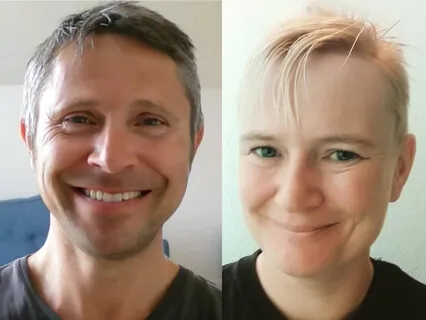
Today,
I'd like to welcome my good friend,
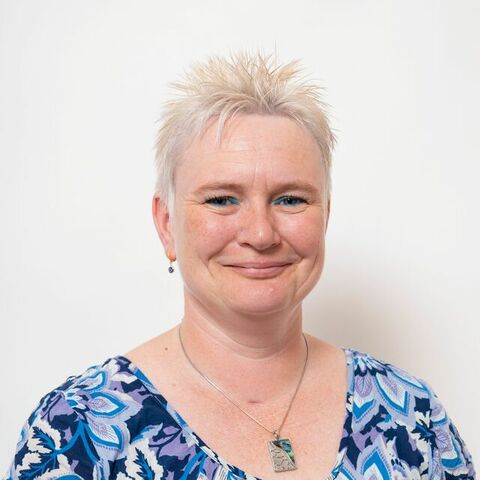
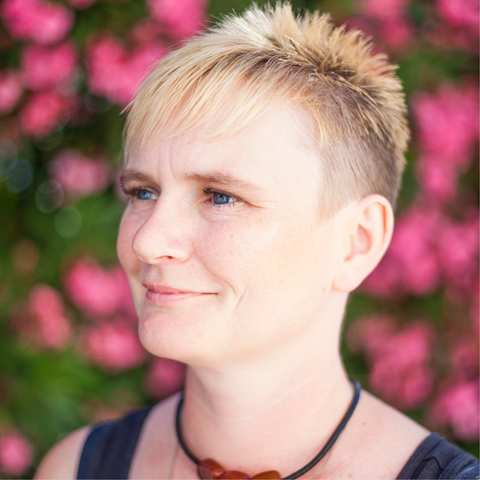
Kazaia Gibbons,
Onto the podcast.
Kazaia is a meditation teacher on Insight Timer,
Where she has over 175,
000 plates.
Also,
A Reiki Master,
NLP trainer,
Tarot professional,
And delivers psychologically informed environment training in organizations working with vulnerable people.
Kazaia's specialisms are in mindfulness,
Energy medicine,
And the unconscious mind.
So there's an interesting combination of skills and experience,
Kazaia.
Yes,
Yeah,
It's quite varied.
So that's part of what I love about my work,
Really.
Yeah,
Yeah.
Well,
Welcome to the podcast.
I really appreciate you taking the time to come on and share.
Well,
It's going to be a lot about NLP,
Isn't it?
NLP and mindfulness today.
But before we get into that,
How are you feeling?
How are you doing in general?
I'm good,
Yes.
I'm situated in the Algarve,
Which feels like a little haven of peace with everything going on with the world.
And thank you,
Darren,
For inviting me onto the podcast.
It is a pleasure to be here and I appreciate the invitation.
So thank you.
Oh,
You're welcome.
Yeah,
I really enjoy the Algarve.
I've been there on family holidays,
And it's a beautiful place.
Whereabouts are you in the lockdown cycle at the moment?
We're starting to come out,
And we've actually been very fortunate in Portugal,
And especially in the Algarve.
We have touched wood,
Had no cases in my district or the next district at all.
So we're sort of tentatively coming out,
Although I personally do a lot of my work online.
So I'm fortunate not to have to go and have so much contact at the moment.
Sure,
Yeah.
Yeah,
I think we're all in different places with it because here in the UK,
Or today actually,
We're just starting to relax the lockdown a little,
But there's still a lot of restrictions in place.
But I think it's going to be nice for people to be able to get out and enjoy more leisure activities and the things that people used to do a lot for pleasure when they used to go out.
And things like water sports and travelling to different areas and stuff like that.
That's what's being relaxed in England.
And I've been indoors a lot,
You know,
Myself over the last few weeks.
And it's been challenging on the one hand,
But I've also found it really quite beneficial how I've been able to go inwards and also faced quite a few of my demons.
So I've been,
I don't know how you found it,
But I've been able to work through quite a lot of stuff.
Yeah,
That's a wonderful thing to come out to that,
Isn't it?
Is that the opportunity to go inside and work with that stuff.
And of course,
It's nice to be able to get out outside again now,
Because nature is fantastic,
Isn't it,
For mental health.
I have always been able to get outside.
We live fairly rurally.
So fortunately,
I've had that opportunity to sort of go for a walk or even a cycle locally.
But in terms of time,
I parent as well as work.
So I've had less of the sort of going inside time and more of the opportunity to spend time in presence with the people that matter.
I've got my daughter here,
And my dad lives in a studio flat just below us.
So it's been nice to be reminded that,
You know,
These are the people that matter and I can spend time with them.
Yeah,
So we were just talking just now about inside and outside and that links us nicely into NLP or neuro linguistic programming.
Because I know that that's a lot about doing work inside,
In particular inside the mind,
And then influencing what happens outside.
So it'll be really good if you could just share with the listeners your definition or maybe just a brief introduction to what NLP is.
Yeah,
Sure.
And it will be a brief introduction and possibly quite wordy as well,
Because there's a lot in NLP.
So NLP stands for neuro linguistic programming.
And so the neuro is about your neuro circuitry.
It's what goes on in your brain.
And of course,
What goes on in your brain influences your mind,
Your body.
The linguistic is about the language that we use.
And language is interesting because we say that we have an internal deep structure and then a surface structure.
And the language that we use on the surface is the language that we use on the brain.
And the language that we use on the surface will reflect or express what is happening in the deep structure.
So what's happening in terms of,
Say,
Beliefs and values.
And then if we change our language,
We also have the opportunity to change that deep structure,
Which is where a lot of that NLP comes in.
So that's the neuro linguistic.
And then the programming is really about that choosing which patterns to run.
Choosing which patterns that you're going to allow your brain,
Mind,
Body to run.
And this is why it's so powerful,
Because we as humans work a lot on patterns,
Unconscious patterns that all serve or have served a purpose in the past.
And sometimes we get stuck in those patterns.
So with NLP,
We can program or reprogram those patterns for more choice.
And NLP is also about how do we do what we do.
So we say that it's an epistemology or a methodology for discovering how do we do what we do,
And specifically how do we do what we do excellently.
So if I wanted to discover in NLP terms what how how someone performs a particular task excellently,
Then I would go and I would create a model of them using all the different principles and practices of NLP.
So that's a very brief description of it.
Oh,
Okay.
Yeah,
There were so many things popped into my head there as you were speaking.
One of them was around these unconscious patterns and straight away there I made the link to attachments.
You know,
In the Buddhist teachings,
It talks about how we create these attachments in our mind and we grasp onto things.
And that means that our thoughts and patterns go in a certain direction based on those attachments.
And the Buddha teaches that the attachment and the craving is the root cause of all suffering.
And there's a straight away for me an interesting link there between acknowledging these attachments and reprogramming them to gain more freedom and to gain more choice.
So you could use NLP to work on your psychological attachments.
Is that correct?
Yeah,
Absolutely.
And it is one of the most powerful parts of NLP.
We say that every behavior has a positive intention,
An unconscious positive intention,
And by behavior,
Thoughts,
Thought patterns,
Attachments are all behaviors.
So if you were struggling with a particular attachment or even if you weren't struggling but you were working with it or through it,
Then you might work out psychologically what is the purpose of this,
What is the need that's being fulfilled.
And it usually comes down to a handful of different basic needs that we all as humans do need.
So security,
Safety,
Love,
These kinds of very high value,
Values we call them.
And so once you know what that need is,
Then you can start to work with what are three or four or five or a hundred different more healthy ways of fulfilling that need.
And so you can let go of the attachment without letting go of fulfilling your psychological needs as a human being.
We have all these patterns and some of them are on the surface and conscious.
And then you also mentioned the unconscious because I know that NLP is a lot about that.
And I would think that these attachments,
Yeah,
They work at different levels.
So with NLP,
You can even take a very deep attachment,
A deep subconscious or unconscious attachment or pattern that's wearing away in the background.
And NLP gives you the tools to be able to influence that as well,
Right?
In addition to the stuff that's going on at the front of the mind.
Yeah,
Absolutely.
And for me,
The most powerful work in NLP is the unconscious work because the unconscious directs,
Defines and filters so much of our experience.
And once you know that,
There's so much freedom to be had from creating a relationship with your own unconscious mind because your unconscious mind is a part of you and it always has your best interests at heart.
So when you can create a relationship where you can actually communicate with your unconscious mind and say,
You know,
This is how I want my best interest to be fulfilled,
Then it gives you absolute freedom on that psychological level.
And that starts to,
It can be very dramatic,
The kinds of changes,
The kinds of positive impact that can come from that.
Sure.
Yeah.
And I love this idea of excellence.
And you talked about modelling as being part of NLP.
So the modelling is about finding someone who is achieving what you'd like to achieve,
Maybe at the standard or level of quality that you'd like to achieve it at.
And then I take an inventory of,
You know,
The things that they do,
The way that they're thinking,
Because it's all a process,
And then taking that and then basically doing that yourself and achieving the same result.
So I guess sports people would do this quite naturally,
Wouldn't they?
Especially the guys that are,
You know,
The top end of the game where they're looking around at why is someone else able to serve a tennis player?
Why is someone else able to serve in that way?
How do they do it?
Let's look at it.
Let's look at it.
Let's look at it.
Let's look at it.
Let's model it.
And let's see if we can emulate it and do the same ourselves to get the same result.
And then I was thinking also about the earlier part of our discussion,
And even some of the more personal,
Softer elements like how you're able to balance family and work and it sounds like that's all working really well for you.
And you know,
You've got your success with the training that you do and insight time and all these other things.
So even with a situation like that,
You could take a part of that and say,
Okay,
Well,
Kasaya is able to do that.
So what is Kasaya doing?
And what is she thinking to get that result?
And then seeing if you can apply it yourself within your own context.
And I'm guessing that you would apply some of it,
But some of the bits you might have to change.
So because we have different situations,
Don't we?
So people might not be able to emulate someone else completely.
They might have to take components of it and then,
Yeah,
Change bits that then work for them,
Or maybe even change some of it so they get an even better result than the person that they're modelling.
Yeah,
That's really interesting that you say that because it's one of the important things about NLP is that it's about structure and not content.
So I'll give you the example actually of when I did my Master Practitioner in NLP,
I created a model of my stepfather,
Graham Dexter,
Who's also an NLP trainer.
He was really good at pain management.
He was excellent.
And this is one of the things about modelling is that you don't choose someone who's just good at what they do.
You choose someone who's excellent.
So he is a pigeon fancier and he has spent 50 years looking up at the sky watching pigeons.
And he had actually worn down two of the vertebrae in his neck.
So we're talking about genuine and serious pain here.
And he had managed to firstly come off the painkillers that he was initially given and then live with this pain and transform the pain into simply a sensation that he experienced.
So I thought that model would be a really good one to have,
A really useful one to have.
And so I,
In the modelling process,
You go into sort of three positions.
So I sort of experienced being around him while he was managing his pain.
I shadowed him and sort of copied his physiology and what he was doing,
Even with his eyes,
Which can show how we're representing our thoughts.
And I interviewed him as well.
And I watched him teaching the pain management model to one of his clients.
And from the information that I gathered,
I discovered a strategy which he had.
And the strategy was he had a kinesthetic experience,
Which was the pain,
Which we're calling,
We're not calling pain,
We're calling it aversive sensations.
And then he,
That would be accompanied by an internal visual.
So he would see the area the sensation was coming from in a certain colour.
And then he had a little mantra that he repeated to himself.
And that was lotion is motion,
That sorry,
Motion is lotion.
So that to move would would actually resolve the pain.
And then he would,
While he said that,
He would visualise the colour changing,
And then he would move,
He would take a step.
So that was fantastic to have that.
But that wouldn't be applicable in all circumstances.
So what I did is I took the content out of it.
So what he was visualising,
What his specific words were,
And I kept the structure.
And when I when I tested this,
I tested it by going and having my first tattoo done.
So I'd heard all sorts of things about,
You know,
Tattoos hurt,
They don't hurt.
In my experience,
They don't.
And I use this model.
And so when that tattoo gun was going into my arm,
I would have this sensation which could be interpreted as pain.
And I would get the visual and the visual was actually me seeing this drawing coming into being on my arm.
And so I,
It's a crow,
This tattoo.
So my mantra I changed,
I used the mantra just as Graham did,
But I changed the mantra to welcome crow.
And then I changed my visual to imagining that what I was feeling was crows feet as it alighted on my arm as if there was a real crow sitting there on my arm.
And then I sort of go back into the normal,
The situation I was in being present in the situation that I was in,
Which for Graham was a step forward for me was sort of chatting with the guy who was who was doing the tattoo.
So the the content can be applied very,
Very differently.
But we keep the structure.
And it's one of the most powerful things about NLP,
Not only in modeling,
But also in client work,
Because I can work with a client who doesn't want to tell me the content of their thoughts,
Behaviors,
Whatever it is.
And I can still empower them to have more choice without having to know all their private life.
Sure,
Sure.
Yeah.
So you can model the excellence and then in a way take that as a template,
Which you can then bespoke based on a context.
Yeah.
Yeah,
Yeah,
Very much so.
So we keep the structure and the content really doesn't matter.
Yeah,
Yeah.
Or it does matter.
It can be tailored.
But the structure is what is important.
Yeah,
Maybe like taking a template for a Word document or a template for a website,
And then modifying it to suit your own situation.
Exactly.
Yeah.
Yeah.
Hmm.
A lot of people listening to this podcast are listening because they're interested in mindfulness.
How would you say that mindfulness links in with NLP?
Or what's the difference between mindfulness and NLP?
Or a third question,
You can answer any of these.
How can they complement each other?
Maybe that's the best question.
Yeah,
Well they absolutely do complement each other.
I know certainly in the practice of NLP that mindfulness is really useful.
Mindfulness is something I tend to typically describe when I'm teaching it as both a state and a practice.
So it's a state that you go into and you can go into in formal meditation and that helps you to have that state in non-formal situations as well.
And as you know,
It's a practice.
It's something that you do whether in the context of a formal practice,
Meditation,
Or whether in the context of remembering to be present in any life situation.
So it's a state and a practice.
And NLP is a set of practices which can help you to access states.
So they very much relate in terms of the technical aspects.
For example,
One of the techniques for mindfulness,
As you'll know,
And I know that you sort of teach this as well,
Is that we can anchor the breath to that mindful state or we can anchor anything to that mindful state.
So one of the most popular NLP techniques is called anchoring and the anchor is something.
So it could be something like the breath or something physiological,
A gesture,
Even something like squeezing your hand or something.
Or it could be something visual,
A picture that you bring up.
Some of my students use tarot cards for this or a sound or even a scent.
Something which brings you into a certain state.
And in NLP,
We set anchors deliberately to create a desired state.
So that anchoring is something really that technically both mindfulness and NLP have in common.
And then in terms of what they do for you or how they work,
I would say that broadly mindfulness allows you to access conscious resources and to make conscious choices about how to respond.
And NLP allows you to access unconscious resources and to program those choices into your unconscious mind.
So they really do complement each other very,
Very well.
Yeah,
I believe that there's a link as well between mindfulness and NLP and the mindful awareness needs to be there for you to use NLP.
You can't use or practice NLP without awareness.
It would be impossible.
Yeah,
I agree with you there.
And,
Well,
There's an argument that you can't do anything fully without mindful awareness,
But that is an extension of it.
Yeah,
Yeah,
There's another extension with mindfulness and this is something that I teach personally in my classes and programs,
But it's not a popular thing,
Which is that mindful awareness can go much deeper than the surface level of the mind.
So the traditional way of thinking the traditional secular mindfulness teaching that you get is being aware of thoughts.
So these are typically thoughts that are there on the surface level.
However,
In my experience,
The longer that you practice mindfulness and the deeper your practice,
And in particular meditation practice helps with this,
You go deeper into the mind.
So mindfulness can not only be used at a conscious level,
But you can start to be able to observe some of those thoughts that are wearing away in the back of the mind that feel like they're quite some distance from where you are now,
Or they could just be really quiet and you can start to see more of the subconscious mind through becoming more mindful.
Because I see it as being a,
It's a continuum where you've got the front of the mind and then it just goes back deeper and deeper and deeper.
So mindfulness for me has a vertical dimension to it as well.
Yes,
Definitely.
With an in-depth and long-term consistent mindfulness practice,
You will start to get those as you know and as you teach.
And so yeah,
It's just another way in which they complement each other very,
Very well.
One of the aspects of how the conscious and the unconscious minds relate to each other that we teach in NLP is that the unconscious is what receives all the information.
Yeah,
So I think it's something like,
And I have to check the number,
But something like 200,
000 pieces of information that we experience in any second.
So that's information from our environment,
Information from knowledge that we already have that is stored.
And what the unconscious mind does is filters out anything that it doesn't decide is relevant for that moment.
Because if we were to consciously experience all of those 200,
000 pieces of information per second,
That would be overwhelming and we wouldn't be able to function.
And with mindfulness,
One of the things that you might start to discover in your practice is what shape those filters are,
Which are filtering your brain.
What shape those filters are,
Which are filtering your experience.
What are the the presupposed truths which shape those filters?
What are the beliefs which shape those filters?
What are the experiences which have created those filters?
And then with NLP you can choose to maintain and or replace those filters.
And you can choose to do that deliberately with an outcome in mind.
Sure,
Yeah,
And this is one of the key differences between mindfulness and NLP,
Or mindfulness practice and NLP practice,
Is that mindfulness is about awareness really and it's about acceptance as well.
It's not necessarily about controlling and influencing,
Although it does give you that ability,
But that's not part of the practice.
Whereas NLP is more about controlling and influencing.
So we put the two of those things together and we have quite a powerful set of tools there.
Yeah,
Very much,
And that is an important distinction about the acceptance with mindfulness and the ability to control with NLP,
Certainly.
And yeah,
They do go very nicely together.
It reminds me of that quote,
That Victor Frankl quote,
In the moment between stimulus and response there is a space and it is in that space that we have our choices.
And I have used that quote in teaching both mindfulness and NLP because it works for both.
And I think within this space that would be a good place to start to draw the interview to a close.
I had so many questions to ask you,
I think I got through about half of them.
Yeah,
Maybe we should have a chat another time to talk about some of the more spiritual aspects of how we could use NLP and mindfulness together.
And also there's a whole area about using NLP for communication within ourselves and others.
And that's a very useful and practical area.
I'm sure people would be interested in that too.
But for now,
Would you be able to let the listeners know how they could get started with NLP if they're just a beginner or if they've got an NLP practice,
What they could do to cultivate that?
Yeah,
So certainly the best way to learn about or to develop your NLP practice is to do it.
I co-train with Dr Jan Russell,
Practitioner right through to master practitioner.
And we have the opportunity for collaborating also on trainer trainer,
So NLP courses.
And at the moment we have the practitioner which is the first level.
Our next one begins on the 4th of June.
But we run those fairly regularly and of course with the well-being online at the moment we're running that online.
If you didn't want to go on a course but you just wanted to learn and discover more,
There are so many resources out there.
I would recommend the classic texts are the structure of magic,
One and two.
They're quite heavy.
In terms of using NLP in communication and business,
There's a book called NLP in 21 Days which is really useful.
Anything by Robert Dilts who is a very spiritually inclined NLP trainer and who some of his models are what we teach in our courses.
But yeah,
If someone is interested in coming in and learning,
Then the practitioner is the place to start.
And it's something that there is a government health warning attached.
People can find that they're making big changes in their lives by the end of this course.
And so although those changes tend to be positive for the best,
Sometimes they can be a bit of a shake-up.
So I'll put that health warning in there because it's what I've found to be true and was also the case for me as well when I started my NLP.
So yeah,
People can get in touch on my website which is keziahgibbons.
Com or on any of the social media to find out about the courses that we are running.
And I'm always happy to chat with someone who would be interested to know how they can apply NLP in their own lives.
Awesome.
Okay.
Well,
Thanks so much for sharing your knowledge and experience and inspiring us and reminding us that with our mind,
We've got both the responsibility to stay aware,
But also to influence and control the way that we think to make us better,
More effective,
Excellent people.
Brilliant.
Thank you very much,
Darren.
Okay,
I'll speak to you soon.
Take care.
Okay,
Take good care.
Thank you.