We are reading.
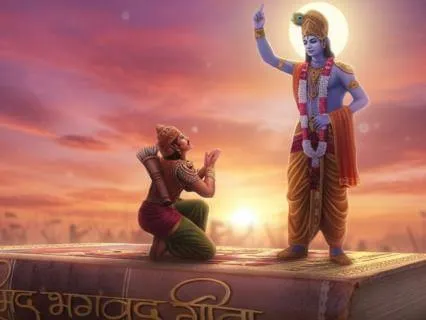
Bhagavad Gita.
This version,
This is the Stephen Mitchell version,
But you can read any version that you love.
There's thousands of versions of it,
And they're all wonderful.
It just depends on what you like.
Kind of the perspective of the translator and the author or the editor.
The Bhagavad Gita lives within the Mahabharata.
Great great Indian epic story of this family or these two families or it's really just one family but and the inner battle between them.
And so.
At this point in the story,
Today we're looking at chapter 2,
Verse 58.
And if you want to go back.
I have a whole playlist called the Bhagavad Gita and you can listen right from the beginning going forward,
Especially the very first talk is really interesting because it gives the foundation for the great battle.
And one of the most important things to understand about the battle is it takes place on a battlefield called Kurukshetra,
Which basically is,
It's like the pilgrimage to your true heart.
So if you were to imagine.
Inside of you.
On the one side,
You have your true self.
You have your true soul,
Your soul's path,
Everything that you are actually the reason you're actually here on earth the reason you've taken form the reason you have the desires and the inspiration and even the challenges that you have All of this is for your true soul's desire.
But then you have this other,
Let's call it another side of you.
That holds all your family traditions.
The way society sees things.
Everything you learned in school.
Everything you've adapted to over time.
Maybe you've had a lot of trauma in your life and you have adapted by creating walls and protection mechanisms.
Well,
All those things have kept you safe here and maybe even provided a foundation for living here on Earth today.
But they may not actually be about your soul's path.
And when we get to a point in life we may actually start to realize that those things are hindering our path.
They're actually causing us all kinds of sadness,
Depression,
Limitation.
So it's somewhere around this point that we start to have a realization.
That maybe we need to look within.
We can't keep just acting unconsciously based on everything that we know or everything we're afraid of.
And we need to find a different guiding light.
And this is normally the beginning of a spiritual path.
Oftentimes we've had an experience,
Something happened.
Maybe it was just a moment watching a sunset,
That a little spark of the eternal rose inside of us.
And it changed us.
And it's not even like,
We seldom even have words to describe it.
All we know is.
.
.
We got a taste of something.
That was beyond the pain and the pleasure and everything we experience in life.
And that is normally the seed.
Of why we study the Gita.
Why we join Insight Timer.
Because it's like,
Whatever that is,
I want more of it.
And even if you try to explain it,
It's really hard.
So this is the point that we find the hero of the Gita,
Arjuna.
He's at a standstill.
He's locked between I want to honor the teachers and the experiences and my family and all of the people that I've known and trusted.
I can't do that anymore.
I actually have to find a new way to navigate.
How do I do that?
I remember years ago,
Lots of you guys know this story,
But when I was 29,
I was sick.
I had breast lumps,
My mom had just died of breast cancer,
Her mom died of cancer,
You know,
So I was kind of one of those families.
Teacher came into my life,
Jim,
This was the my very first book I ever wrote was all about this story.
I realized that there were a lot of things that about my mom's experience.
That I had adopted because I wanted to be like her.
My mom was very loved and very loving.
And I wanted to be like her.
But there were also aspects of her that were harming me.
That weren't actually part of my soul's path.
And that was a huge part of my dark night of the soul.
It might've been a dark night of the soul all into itself.
How do I honor her memory?
How do I honor who she was?
But separate the parts of her.
That are actually really not okay for me now.
You know,
For example.
I teach tantra and yoga and all these different things.
You know,
Here in this community,
This might seem like a really great idea.
But out in the world.
.
.
You know,
It's so funny how many people in this little town I live in.
Literally have said to me.
Well,
I hear you live an alternative lifestyle.
I'd like to hear more about that.
Because I teach Tantra.
And they think I'm having like orgies on the weekend and 400 lovers or something you know and it's like No,
Actually,
My great joys are doing jigsaw puzzles with my kids and going bike riding with my friends and hanging out with my grandson.
That's not really what Tantra is.
But the teachings that my mom would have given me was.
Don't put yourself up for criticism in the world.
Try to lay low.
Keep all those things to yourself.
Don't talk about those things.
Do the responsible thing,
You know,
Make people happy,
Make them uncomfortable or make them comfortable.
And again,
It's just one example.
But these kinds of teachings are hard and that's where Arjuna finds himself on this battlefield between all that he truly wants to live on one side and all his great teachers and family and friends on the other.
How does he fight?
How does he engage in this battle?
So Krishna is his charioteer.
Family friend,
But also well,
In the language of the Gita,
It is Lord.
Krishna is Lord,
Highest advisor,
But so Krishna for us is the wisdom of our highest self,
The wisdom of our soul.
And at this point Krishna is sharing ideas with Arjuna about how to live according to your soul.
How to live according to your highest wisdom.
And Arjun is wide open to it now.
They've had a bit of arguments in the last few verses and stuff.
But right now,
Arjun is open to listening.
And we all get to that point,
Even when we begin a spiritual journey.
The first portion of it is arguing with the teachers.
Well,
How could you say that?
What are you talking about?
Don't you understand I have to pay rent?
Yeah,
But what if they really say this awful thing to me?
Do I still have to act in nonviolence?
We have all this argument.
And then at some point,
We kind of just stop arguing and we say,
I'd like to learn.
I'm ready.
And that's where Arjuna is right now.
So.
Back up a couple of stanzas here so i'm starting we're in chapter two And I'm going to start reading on verse 53.
It doesn't matter,
But some people like to follow along.
Arjuna said,
How would you describe the man whose wisdom is steadfast?
How does this wise man speak?
How does he sit,
Stand,
And walk?
Krishna said.
When a man gives up all desires that emerge from the mind,
And rests contented in the self.
By this cell.
He is called a man of firm wisdom.
Now in this instance,
Self is capitalized.
So just so you know.
He goes on.
He whose mind is untroubled by any misfortune.
Whose craving for pleasures has disappeared.
Who is free from greed,
Fear,
Anger.
Who is unattached to all things.
Who neither grieves nor rejoices.
If good or bad things happen.
That man is a man of firm wisdom.
Now,
If you would like to go back and find out more about those.
The recordings are here on Insight.
All right,
So this is the verse we're gonna look at today.
Having drawn back all his senses,
From objects of sense.
As a tortoise draws back into his shell.
That man is a man of firm wisdom.
I'm going to read the Maharishi Mahesh Yogi's version of this one.
And when such a man withdraws his senses from their objects.
As a tortoise draws in its limbs from all sides.
His intellect.
Is established.
I'm going to read one more version.
When the Yogi like a tortoise withdrawing its limbs.
Can fully retire his senses.
From the objects of perception.
His wisdom manifests steadiness.
I would love to know your guys' thoughts about that.
What does that sound like?
What does it feel like?
Sort of about developing the witness mind.
It would be so nice to draw my limbs into a shell and retire my senses.
Cozy.
Beginner's mind.
I'm sitting with this one right now.
We are not of the body.
Reminds me of Yoga Nidra.
Going within the self,
Non-grasping to anything external to the self.
Is this what the tortoise asana pose is bringing us towards?
Mm.
I don't know,
But it sure seems like it,
Eh?
But it was because I was so terrified when people would talk to me.
I wanted to pull myself in and become like a rock.
My body relaxed hearing this.
Observing mind and witnessing all of it from a higher perspective.
I always teach this with the intention of turning in.
But not in a retreating way exactly,
But going inwards to see more clearly.
Yes,
We will talk about that.
It has been said,
But keep getting the phrase,
Of the peacefulness of going within.
In my version,
It reads as if wisdom inside the shell.
So if I take a pause and just think for a moment before I act,
I could actually become wiser.
Mm-hmm.
Yes.
I snuck in a bit late,
And even that can be without a value assigned.
The mind can be a symbol for one of the tortoise's limbs that also needs to turn in.
Sense the body,
Yes.
The Maharishi phrase's turtle reference is more clear to me.
Mitchell sounds like the turtle is avoiding.
The phrasing makes the difference for me.
Tortoise,
One can choose to be retracted and open to the world.
Exactly.
The illustration used in this verse is that of the turtle.
Whenever it encounters danger,
The turtle protects itself by drawing its limbs and head inside its shell.
After the danger passes,
The turtle again extracts its limbs and head and continues on its way.
The enlightened soul possesses similar control over the mind and senses and can retract and extract them according to the needs of the situation.
Exactly.
And this is a very important distinction,
That this is not withdrawing out of fear and staying there.
It's okay to withdraw when there's true danger.
But when we simply become agoraphobic,
Like we're afraid to go outside,
We're afraid to talk to people,
We're afraid to actually experience the world.
That's different.
So let's back up a little bit.
And we're gonna look at when they talk about withdrawing the sensory organs,
That's essentially what they're talking about.
The tortoise shell is like the sanctuary of the calm mind.
But a lot of us live with our sensory organs,
Our limbs out all the time.
We are literally living in this constant barragement of,
Or bombardment of touch,
Smell,
Taste,
Hearing,
Touch.
See you.
Thanks Geneva.
And so you imagine this,
Like even today,
Like,
And you think of how much sensory stimulation we have,
And this includes looking on our computer,
Watching videos,
Watching movies,
Scrolling on social media.
It includes eating,
How much sensory stimulation we have through eating,
Listening to music,
Listening to people talking,
Listening to podcasts,
Listening constantly.
So for a lot of us,
For a lot of our lives,
We highly identify with the outside world.
A huge portion of our thoughts.
Are actually based on stimulus from the outside world.
I like social media.
I find it can be very lovely.
But what I find is I have to limit it.
Because.
When I say scroll Facebook.
An idea goes into my head.
I can spend the next hour thinking about this random idea.
And oftentimes it's not positive.
It's not a good thing that I'm thinking about.
I can just read a book and hear something really cool.
And now I'm pondering how this fits in my life.
It's normally something I'm now angry about.
Or now I'm arguing with people I don't even know.
That is crazy making.
That is a waste of our energy.
It's a waste of our pranic energy.
It's a waste of our thought.
It's a waste of everything.
And it does absolutely no good.
Like we're just dumping our energy onto the sidewalk.
And when you really think of how much of our thoughts are actually coming from the outside world.
From something someone said.
From something we experienced,
From maybe even a big heavy meal,
Something we ate,
And for the next couple of hours,
We're kind of sluggish because of this thing we ate.
The very idea.
Of withdrawing our senses?
Is kind of terrifying for a lot of us.
It's like this is where if I was to say,
Okay,
Let's everybody right now,
We're just going to sit comfortably,
Close our eyes.
And we're just going to meditate in silence for an hour.
Most people would be like.
What?
What do you mean?
Can we at least listen to music?
Can we at least be doing something?
Like,
There's no way.
Why?
Why can't we sit in,
And this is not a judgment and it's not a reprimand,
Okay,
This is just an awareness of our absolute Total.
Dependency on external stimulation for our sanity.
Okay,
If the idea of sitting in absolute silence with zero stimulation feels hard,
Then this verse is for us.
Because This is the challenge that everything that we are thinking about all day long is actually coming from outside of us.
Well,
If everything is coming from outside of us.
Who are you?
Who are you when you're not being stimulated?
So I'm going to back up again.
In Tantra and Yogic philosophy.
They look at the different aspects of the mind.
And there are three main parts.
Some add the ego in there,
But let's just stick with three for a minute.
The first one is called manas.
And manas is the part of the brain that receives all sensory stimulation.
So this is when I touch my skin and that sensory input goes down through my nerves into my brain and says,
Aha.
Soft.
Squishy.
Or I see out the window and my brain recognizes,
Aha,
Sunlight,
Trees,
Fast moving car,
Dogs.
Or I taste something and Manas receives that information and says sweet,
Sour,
Bitter.
This is Manas.
Then you have citta,
And there's many,
Many interpretations of what citta is,
But one interpretation is that citta is almost like our bank of memory.
So I eat something sweet.
And so mana says sweet,
Chitta says,
Ooh,
Like chocolate.
So this is what Chit is doing,
It's sort of having this conversation with Manas.
And then we have buddhi.
So if you take the word buddha and insert I for the A,
Buddhi,
Booty is intellect.
Intellect says,
I like chocolate.
Or if you're like one of my friends,
I hate chocolate.
So your brain is now this pinball machine between these three minds.
Ooh,
I see this.
Ah,
I recognize it as sunshine.
Yay,
Sun.
Ooh,
I recognize sunshine.
I see this.
Ooh,
We need rain.
No more sun.
We're in the middle of a drought.
And our brain is constantly doing this like pinball machine inside.
You read something on Facebook.
I hate that.
I can't believe that.
I remember this other thing.
I really don't.
And whether we agree or disagree,
This is this constant thing inside of us.
Then,
If you add in the ego.
Ahamkara.
Now all of a sudden we start identifying.
With all of these thoughts.
I'm someone who loves chocolate.
I'm someone who is against that thing over there.
I am someone who is for that thing over there.
I am someone who loves sunshine.
I am someone who.
.
.
I am someone who.
.
.
All of these identifications are based on all of these thoughts,
These vikalpas,
They call them.
Bang,
Bang,
Bang,
Bang,
Bang.
And we can spend our entire life.
Thinking that we are those thoughts.
So the practice of pratyahara.
Lots of you guys are into yoga,
So I'm going to use the Sanskrit,
But it doesn't matter.
Pratyahara simply is the act of withdrawing the senses.
That's all it means.
If you do something that allows you to withdraw the senses.
So what happens?
Let's say you're going to sit comfortably.
You're going to close your eyes.
You don't have to do this right now.
But let's say you're sitting there,
You close your eyes.
You're not tasting anything.
There's no sounds.
There's no music.
Your eyes are closed.
And you're just going to sit quietly.
What happens?
Is all the energy.
That is normally going out and receiving energy from the world.
Goes inward.
And now you start listening inside.
And you start noticing thoughts.
And you start noticing emotions.
And you start noticing feelings.
And you start noticing something within.
And what's interesting is when we withdraw the senses,
Manas becomes quiet.
Citta has nothing to think about,
Has nothing to compare anything to.
And Budi becomes quiet.
What's wild is booty.
Wisdom.
Intellect.
It lives within you.
All the time.
Whether or not you're responding to the outside world or not.
You hold wisdom right now.
Your intellect is the light,
The clarity of your soul.
Right now.
Unless we spend time.
Having withdrawn the senses,
We may never connect.
With that pure wisdom inside.
The pure booty.
Because the reality is.
Chocolate has nothing to do with my soul.
My opinion on something going on in the world.
Has nothing to do with my eternal soul.
My thought about you or my thought about this or my thought about my past or whatever.
Has nothing to do with my eternal self.
There is so much joy.
True happiness.
When we get to connect.
Our soul.
And that's what this is saying.
This is saying.
That in order to connect with that.
Deep,
Deep soul.
We have to at least be able.
To pull them in.
We don't have to become a monk.
We don't have to become a recluse.
But we have to start exercising.
The ability.
To pull them in.
I started turning off all lights a half hour before bedtime and being in silence while I stretched my yoga mat.
It's a lovely way to unwind with no stimulation.
That is so beautiful.
How do we turtle when it feels impossible?
So much noise.
This is where having some kind of spiritual practice is so important.
Even if it's just 10 minutes every day.
To do something that helps you connect.
With that inner self.
And it often is something challenging.
It's often something that.
Like,
Say,
Meditating.
For 10 minutes.
To just close your eyes,
Even if it's hard.
Close your eyes and focus on the breath.
Maybe do a pranayama.
That plays with the breathing,
That helps quiet the mind.
And just something that allows you to connect to the thing within you that you can't describe.
It's so important.
Because it's only when we connect with that something inside of us.
That we start to get balance with the outside world.
It's not just about saying,
Well,
I'm just going to withdraw everything,
And I'm going to delete my Facebook,
And I'm going to turn off my phone,
And I'm going to just stop talking to people,
And I'm not going out in public.
None of that works.
And we're actually going to talk about that next week.
The desire doesn't go away.
And this is where some kind of yoga practice,
Tantric practice,
Spiritual practice that really helps you connect with you.
Is so,
So helpful.
It also helps us determine or distinguish between.
Happiness,
And sensual pleasure.
So for example.
When you connect with that inner self.
And it could be anything,
It could be.
Again,
There's these times when you experience pure joy that are so important.
It might be horseback riding.
And you are galloping through a field.
And you are actually experiencing pure bliss.
Is it really the horseback riding that's causing the bliss?
Or is it?
The sheer feeling of bliss,
Like the horseback riding kind of brought you to a place and you're feeling true bliss.
Every time you experience bliss,
That's real happiness.
But when we think that happiness comes from sensual pleasures,
We're in trouble.
If we think happiness comes from chocolate.
We're in trouble.
Because our soul.
Is always seeking the real happiness,
Soul happiness.
The happiness that comes when we close our eyes We take a deep breath.
And we realize.
Wow,
I got to be alive again.
I got to wake up this morning.
I got to go out in the world.
And smell the fresh air.
And read a book.
And do all kinds of things like that.
There's a great gratitude.
In that.
I love Chuck that I'm in trouble.
Me too.
That's what I mean.
Again,
And none of this is about not loving chocolate,
Not loving laughter,
Not loving sunshine.
It's not about that or trying to avoid pain.
What this is saying is that when we're on this spiritual path,
And we're really trying.
I hesitate to say that.
Because a lot of us have a lot going on that we're struggling with.
The problem is,
Is that when we make our spiritual practice too easy,
We don't change.
So for example,
I teach Kundalini Yoga.
I've taught it for 20 years.
It's not meant to be an easy yoga.
And I don't mean physically easy.
I mean,
It's not meant to be easy mentally.
You know,
You could choose a Kriya to do.
You know,
It might not look like much.
But you may have to close your eyes and breathe and focus within.
Maybe that's hard.
Or maybe there is something physically challenging.
But the problem is not actually that you can't do it,
It's that your mind talks you out of it before you do it.
So sometimes we choose a practice that we like.
We say,
Oh,
I just love this one guided meditation.
And again,
I'm not saying we shouldn't use guided meditations or do practice we like.
I belly dance because I love belly dancing.
We should always do things we love.
But if we truly want to heal.
If we truly want to release our Addiction.
To the sensory inputs of life.
That we actually have to do a practice that's challenging.
And that means,
It might just simply mean,
I'm going to sit down.
Every day for five minutes.
With my eyes closed,
And I'm just going to breathe.
And when my mind wanders,
I'm going to come back to the breath.
And when my mind wanders,
I'm going to come back to the breath.
And when my mind wanders,
I'm going to come back to the breath.
And I'm going to do this every single day.
For five minutes.
And then maybe five minutes is easy,
And you're going to expand it to six minutes.
Or you can expand it to 10 minutes.
Like it doesn't have to be complicated.
It doesn't have to be some full-blown Kriya.
It doesn't mean you don't have to go to India for it.
The truth is,
If you think you have to go to India for it,
It's not going to work.
Because that's not it.
The practice really matters.
And the wild thing is,
Is like we can't even describe what happens.
Because the crazy thing is,
You're doing it.
And you don't actually even understand what's changing.
But you change on a deep level.
Deep level.
And it's subtle.
And then slowly.
You start to not need it.
The chocolate.
And we'll just use chocolate as an example,
Because I personally love chocolate.
Suddenly the chocolate becomes a choice.
But it's not about if I say I'm never allowed to have chocolate ever again.
That's not what this verse is about.
This verse is about noticing that when your spiritual practice is working,
The chocolate becomes a choice.
You can pull in all your limbs.
And you don't need the sensory stimulation.
If an opportunity comes.
Because of course,
This whole thing is about what does a person.
.
.
Who has a calm mind look like.
That's what Arjuna has asked.
How would you describe a person whose wisdom is steadfast?
Whose wisdom is steadfast.
How does that person speak?
How do they sit,
Stand,
And walk?
What do they look like?
Well,
For them?
They don't need any of the sensory pleasures.
And they don't fear any of the sensory pain either.
It happens,
It doesn't happen.
Oh,
That looks delicious.
I'll have some of that.
You know,
It's funny.
Recently,
I've changed my diet.
And normally this isn't something I can do.
Normally my food is sort of my,
If there's any addiction I have,
It's to the sensory pleasure of taste.
And I mean,
People have told me for years,
Oh,
You should get off dairy,
Oh,
You should stop having sugar,
Oh,
Gluten's hard on you,
Blah,
Blah,
Blah.
And I've always been like,
Yeah,
And I've tried,
I've gotten off of them.
And then come back on them with a vengeance.
With a vengeance.
And recently,
And I don't know why.
Maybe it's because I did a 40-day sadhana,
A meditation.
Maybe it's the yoga.
Maybe it's something I read.
Maybe it's all the things.
But for some reason,
About a month and a half ago,
I'd gone to this psychic woman,
Very interesting healer.
And she had said,
In order to heal this thing,
You need to get off of dairy and gluten for 10 days.
And you know when all your ducks just line up and you say,
Okay.
And honestly,
It was like I had a lobotomy.
Whoever that person was before,
Who was so addicted to these foods.
She's just gone.
Like,
Just go on.
And so slowly,
Then sugar went by as well.
And for like the last month.
I've had almost none of these foods,
Which were once 80% of my diet,
Without a doubt.
Question.
And it was funny because my body was totally shifting and changing and everything,
You know.
But I had told myself this wasn't like a zero.
It was like maybe like a 90,
10,
Like 90% of the time I wasn't going to have these foods.
And the wild thing is of course,
When you give up something like that.
You know,
Your whole world opens up into a million other foods.
Suddenly I'm having stir fries with rice and salads and delicious things.
Like it's not that.
It feels like a limitation.
But it's actually.
You know,
Really wonderful.
And the crazy thing is,
About on Saturday,
William and I,
You know,
We'd done a pile of things and I thought,
Oh,
Let's go to the cafe.
We went to the cafe.
Had a latte and a Danish and he had a muffin.
It was all the things,
All the food,
All the gluten and sugar and milk and all the things.
It was delicious.
It was so much fun.
It was very,
As the Dutch would say,
Very gezellig,
Right?
It was lovely.
And the funny thing is,
Today.
.
.
Three days later or two days later.
My body's different.
It feels different,
It feels heavy,
A little restricted,
A little tight in the joints.
And again,
So now suddenly my wisdom body knows something.
It's not a criticism.
It's not that I'll never do it again,
But now I know something.
It's like,
Oh,
That's interesting.
It just simply fortified.
My ability?
To pull my legs in.
And let them out.
Like there's no loading.
So it's just,
It's a very,
Very interesting thing.
To realize that,
Wow,
My happiness has nothing to do dairy,
Gluten,
Or sugar,
Which I would have told you two months ago.
That those were my greatest,
Not my greatest choice,
But those were definitely part of my.
Actually part of my identity.
And today,
If someone said,
Katrina,
You can never have them again,
I'd say.
Maybe it,
Like it wouldn't even be a blade.
And of course,
This is one of the challenges that we have.
When our addictions,
When we do have addictions that come through the senses.
We're never happy.
It never satisfies us.
We never become happy.
I'm going to read the Maharishi's one more time.
And then I'd love your final thoughts on it.
And when such a man withdraws his senses from their objects.
As a tortoise draws in his limbs from all sides.
His intellect.
Is established.
What is your takeaway from that?
One thing that really strikes me reading it now is that The person withdraws his senses from their objects.
That's up to me.
It's up to me to withdraw.
You know,
The chocolate doesn't own me.
Reaching the state of nothingness leads to reaching infinity.
Epic boundaries.
The more you can withdraw from external stimulus,
The less you need.
Your happiness is not dependent.
The wise can draw in their senses at will.
The attention and divine energy flow goes in exactly.
Go within,
All we need to know is within us.
I think of the Four of Swords in Tarot,
Deep Rest.
I always say when we go within,
We are never without.
Being in the body doesn't require one to be a slave to external senses.
Exactly!
It's a choice to go within.
Like it's an empowerment.
For all of us,
This wise person is all of us.
We all can do it.
And it begins simply with awareness.
Like for example,
Let's say you love smoking.
So the smoking is this,
And I say that because I actually love smoking.
I don't smoke anymore,
But I actually love the feeling of smoking.
What's interesting is to begin simply observing.
How much sensory input the smoking is giving you.
Just notice it.
You have to stop smoking.
Just notice it.
And then notice.
The eye.
That is noticing.
There's the body that is getting the sensory input.
There's something inside.
Watching.
The smoking.
And just to always be aware of the witness mind watching.
Just watch.
That's all.
And just slowly connect with that one inside.
That's enjoying the cigarette.
And like,
So for example,
Reagan,
I'm trying to turtle away from nicotine altogether.
But just to watch.
And you might even ask yourself.
Do I want this whole cigarette?
Just ask.
There's no right or wrong answers.
Just ask.
And then what's wild and the point of all of these teachings that we've been looking at the last four or five verses.
Is that as we strengthen the watcher,
The craving for the sensory stimulus just goes away.
It's not about forcing it away.
It's about strengthening the one inside.
I love the example of the 10 day you gave.
It is then when the body knows what it feels like.
Then the wisdom comes when we do add it and how it feels.
No judgment,
Just aware of how it feels now.
We get to choose,
We have the power to choose.
I catch glimpses of her.
The watching slows everything down.
Great feeling of gratitude.
Just watch.
I loved the freedom and empowerment I felt when I finally gave up smoking.
What about a career for an addiction?
You know what?
There's a great Kriya for addiction in Krinalini Yoga.
You place the thumbs at the temple,
On the temples here.
Fingers are rolled onto the palm.
Your eyes are closed,
Focused here at your third eye.
And you hold your jaw together.
And you chant satanama mentally.
And with every.
Sound,
You clench the jaw lightly,
Like you kind of Sa-ta-na-ma,
Clench,
Clench,
Clench,
Clench.
And you do this for like five to 11 minutes.
And it works like crazy.
Kind of reprogramming the mind it's an amazing thing and you can just look it up you can google kundalini yoga kriya for addiction it's very very popular it's very good meditation.
Thank you guys so much for being here.
I'll see you next week.