So we are reading.
From the Bhagavad Gita.
This is a beautiful story.
And theoretically,
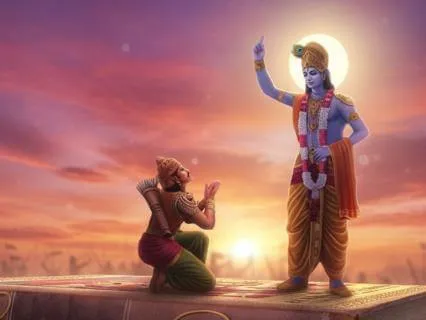
It's a story of a dialogue between Arjuna,
The warrior.
And Krishna.
The Lord,
However you understand it.
But it's also a discussion between all of us.
And our highest self.
Arjuna is us.
Arjuna is the human being.
Trying to figure out how to have a wonderful experience here on Earth.
But like Arjuna.
We easily get caught up in.
All of our experiences here,
All of our trainings,
All of our attachments.
Attachments to ideas,
Circumstances,
Goals,
Hopes,
Dreams.
Even the beliefs of family members,
The beliefs of society,
The beliefs of our religion,
We get attached to them.
Even though they're really just ideas.
So Arjuna is all of us.
Arjuna is living in the world.
He's been trained to be a warrior.
He's been trained in the caste system in India,
Not that we're not promoting the caste system.
But he was raised to be he was raised in the warrior caste so the warrior caste has very specific beliefs,
Things you can and can't do.
And we all have that.
You know,
We were all raised maybe in a particular.
.
.
Socio-economic group.
We were raised in a particular religious group.
We were raised by parents maybe that wanted us to extend beyond what they we're allowed to have.
Or maybe we immigrated to a new country and we want to have a new opportunity for ourselves and our children and all of these places we find ourselves in society.
Have particular,
Quote,
Rules.
They have ideas that.
.
.
You know,
Even for me,
I was the eldest born of two teachers.
I did well in school.
I have a deep,
Deep program of perfectionism that says,
Unless I do something perfect,
Unless I sound intelligent,
Unless I know everything about everything,
There's something wrong with me.
And I've spent a lot of time unpacking that.
And learning my.
My three favorite words or maybe it's three and a half or kind of but the the words are I don't know.
Because if I actually don't know the answer,
I have to stop acting.
Like the child of my parents and that straight-A student and whatever.
Essentially,
I just stopped being a know-it-all.
But we all have some version of that.
Whatever it is,
Whether I was an average student,
Or I hated school,
Or I was a good student,
Or I was raised in a family of wealth,
Or raised in a family of poverty,
Or abuse,
Or what all the things.
So it's a very interesting thing to kind of look at.
The assumptions that are what our life will be like.
And this was Arjuna.
He was supposed to be a warrior.
He was supposed to be always brave.
He was supposed to honor his family and friends.
And all of a sudden he found himself on the battlefield.
Surrounded on both sides by family and friends.
Surrounded by things he was attached to on both sides of the war.
And he didn't know what to do.
And this is like us.
There comes a time often in our lives where no matter What?
We've told ourselves that we believe what we've told ourselves that we actually believe is true about life.
All of a sudden we may come to a point where Our experiences don't line up with our belief systems.
And where we found ourself is a dead end.
We actually can't take any more steps forward.
Because there's no happiness there.
For me,
This was a huge turning point when I was 29.
And I had done everything what I thought was right.
And of course,
I ended up having breast lumps.
Lots of you guys know that story from my book.
And a teacher appeared.
And I slowly had to start backing that truck up.
And start to realize.
There were a lot of beliefs inside of me.
That had everything to do with my family,
Everything to do with society,
Everything to do with religion,
Everything to do with every book I'd ever written or ever wrote,
Every guru I'd ever respected.
But none of it was about me.
None of it was about my soul's journey.
It was all intellectual.
And it was almost like my intellectual ideals had created a prison for my soul.
And kind of tried to whip her into shape.
You've got to act like this.
And then it just reaches a point where.
Everything comes crashing down around you and this is a dark night of the soul.
So this is where Arjuna finds himself.
He's on the battlefield.
He knows what's righteous and true.
He's supposed to fight.
And he looks around.
And he can't.
He can't take one step forward.
He slinks down into the chariots.
And gives up.
And Krishna says,
You must fight.
And again,
This isn't about fighting.
It's about engaging in your life.
Fighting was important to him because he was a warrior caste.
But it's not about that.
It's about every single one of us.
So at this point in the discussion,
Today we're looking at chapter 2,
Verses 66 and all the way to 68.
And at this point,
I'm going to read a little bit before.
So if we look back to chapter 2,
Verse 54,
And you don't have to follow along if you want to.
I'm just telling you what the verse is in case you have a book with you.
So Arjuna,
Up until this point,
Has been kind of fighting Krishna.
Like,
What are you talking about?
He's basically defending Krishna.
His belief systems.
We all do that.
Whenever we hit a dark night,
First we fight back.
Or if someone says to you,
You know,
You could look at this differently.
You don't understand.
This is the way it is.
I know this is right and we fight.
Until we're so tired of fighting.
And eventually we give up and we say,
I'm listening.
I'm willing to learn.
It's almost like a part of me has opened up.
I have room for something new.
So at this point,
Arjuna stopped fighting and he says,
Well,
How would you describe the man whose wisdom is steadfast,
Krishna?
How does the wise man speak?
How does he sit,
Stand,
Walk?
So I remember,
Again,
Back when I was 29 and my teacher,
Jim,
Was helping me.
Jim was like from another planet.
You know,
He wasn't,
But he was someone special.
And he saw the world so incredibly differently.
And I was at the end of my rope.
I had small children.
I thought everything was perfect in my life,
Or as perfect as I could make it.
And deep down,
I was extremely depressed,
Despairing even.
And so here Jim is presenting me with a whole different way of living,
Like an entirely different perspective on life.
But it's wild,
It's wild for someone to propose a different paradigm.
It's one thing to teach me something different inside.
The paradigm I believe.
A paradigm is just a set of belief systems that we all kind of assume are true.
And so,
You know,
I easily might have found myself saying to Jim,
Okay,
That's all great.
And it resonated as truth.
But how do you actually live?
Like how do you actually make money?
How do you actually interact with my husband?
How do you actually raise kids like that?
That's not normal.
And that's essentially what Arjun is saying.
He's like,
Okay,
This some epic man of wisdom you're talking about,
Like.
What does he talk like?
Like,
Does he have friends?
You know,
It's basically what you think.
And Krishna says.
When a man gives up all desires that emerge from the mind,
And rests contented in the self by the self.
He is called a man of firm wisdom.
He whose mind is untroubled by any misfortune,
Whose craving for pleasures have disappeared,
Who is free from greed,
Fear,
Anger,
Who is unattached to all things,
Who neither grieves nor rejoices if good or bad things happen.
That man is a man of firm wisdom.
Having drawn back all of his senses from the objects of sense.
As a tortoise draws back into his shell.
That man is a man of firm wisdom.
He continues on talking like this.
Last week we did,
We talked about this one.
If a man keeps dwelling on sense objects,
Sensory objects is anything we see,
Touch,
Hear,
Smell,
Taste,
Which of course includes Things we desire like pleasure.
And things we try to run from,
Like pain.
If a man keeps dwelling on sense objects,
Attachment to them arises.
From attachment,
Desire flares up.
From desire,
Anger is born.
From anger,
Confusion follows.
From confusion,
Weakness of memory of who you are.
Weak memory leads to weak understanding.
And weak understanding leads to ruin.
But the man who is self-controlled.
Who meets the objects of the senses with neither craving nor aversion.
Will attain serenity at last.
In serenity,
All his sorrows disappear at once,
Forever.
When his heart has become serene.
His understanding is steadfast.
So all of those we've talked about in previous talks that you can listen to if you would like in our playlist.
Today.
These are our verses.
The undisciplined have no wisdom.
No one-pointed concentration.
With no concentration,
No peace.
With no peace,
Where can joy be?
When the mind constantly runs after the wandering senses.
It drives away wisdom like the wind blowing a ship off course.
And so,
Arjuna.
When someone is able to withdraw his senses from every object of sensation.
That man.
Is a man.
Of firm wisdom.
I'm going to read you one other version of those three verses.
And then I would love to hear from you kind of what pops up for you when you hear them.
This one is.
The Maharishi Mahesh Yogi's version.
He who is not established has no intellect.
Nor has he any steady thought.
The man without steady thought has no peace.
For one without peace,
How can there be happiness?
When a man's mind is governed by any of the wandering senses.
His intellect is carried away.
By it as a ship by the wind on water.
Therefore.
He whose senses are all withdrawn from their objects.
His intellect is established.
What do you guys get from all that?
How does it feel?
Peaceful?
Does it feel hard?
Does it feel judgmental?
Does it bring an emotion?
It feels real.
Follow the attachments and that thief steals your better judgment.
This is so timely for me.
Lately I have felt my attention span scattering.
And I have been trying to ground myself and regain my ability.
To focus on one thing at a time.
Can I read it again?
For sure.
I'm going to go back to Stephen Mitchell's version.
The undisciplined have no wisdom.
No one-pointed concentration.
With no concentration,
No peace.
With no peace,
Where can joy be?
When the mind constantly runs after the wandering senses.
It drives away wisdom.
Like wind blowing a ship off course.
And so Arjuna,
When someone is able to withdraw his senses from every object of sensation,
That man is a man of firm wisdom.
There's a few things I want to talk about.
The importance of a personal practice,
Yes.
That is exactly the point.
The importance of practicing Pratyahara.
Yes.
How to choose wisely.
I find this time of the year particularly distracting.
Interesting.
Withdrawing the senses.
So let's talk about that just for a minute,
Withdrawing the senses,
Because this is very,
Very important.
Pratyahara is also the withdrawing of the senses in Sanskrit.
In no way are they saying not to enjoy chocolate.
Are not to enjoy a hug from a loved one.
Or not to enjoy a beautiful sunset.
It's more like.
.
.
Imagine that within us,
We have two different worlds.
One world.
Is within.
If you close your eyes.
Sit in a quiet room and breathe.
There is a whole world inside of you.
Your soul.
It's quiet.
It's your divinity.
It's your prana.
And there's an entire world inside.
As soon as we open our eyes.
And we start walking through our day.
Through our senses,
We are interacting with this physical world.
And this is a real part of our world.
And we eat food and we have friends and we drive cars and we go on insight timer and we do all the things we sleep and we make love and we go for long walks.
This is us in the world.
And there's nothing wrong with that.
There's nothing wrong with being in the world.
That's why we're here.
That's why we incarnated here on earth in physical bodies.
The problem comes.
When we don't understand that we are also We also have an infinite inner world.
And we have an inner world that is very wise.
And when we connect with our soul,
We remember why we're here.
So if you imagine When you think of the chakras,
Most of us have all studied the chakras,
These energy centers within us.
The third chakra is often considered our ego,
Our sense of self.
But what it's accessing isn't kind of our intellectual secondary ego that,
You know,
Wants a million dollars and a three car garage and a beautiful wife and whatever.
Third chakra.
Is who you are.
This is your soul's manifestation here on planet earth.
This is why I love teaching the Bhagavad Gita here at Insight Timer.
Because it is in alignment with my soul.
I have gifts and desires and interests all stored maybe or expressed in my third chakra.
And when I do things that are in alignment with my third chakra,
Everything works right.
Because it's in alignment with my soul.
But if I chose to do something else,
Earlier I was talking about how I took care of my grandson this weekend.
And my grandson's five months old.
And I am so grateful that I got to take care of him this weekend.
But this is not my gifting.
I have friends that are gifted with babies.
They are thrilled with taking care of children.
For me to open up a childcare.
Could I do it?
Sure.
But it's not in alignment with why my soul came to planet Earth.
I would eventually get sick.
So,
Point of having the ability.
To withdraw the senses.
Means that you have the ability to go within and talk to your soul.
But many of us do not have this ability.
We have the ability,
Kind of like someone who's addicted to smoking who says,
I could quit anytime I wanted,
I just don't want to.
Well,
If you've ever tried to quit an addiction and told yourself that,
We all know it's not true.
It's much more complicated than that.
So through practice,
Through spiritual practice,
Through meditation,
Through pranayama,
Through kriya,
Through exercise like that,
We actually cultivate,
We quiet,
So this is,
I teach kundalini yoga.
And the reason I teach kundalini yoga is because it is designed to quiet the mind.
You have movement and breath and mantra and all the things that the mind actually quiets enough.
For us to connect with our soul.
And I have a super active mind.
So I really need,
You know,
The big guns.
When it comes to spiritual practice.
But it takes time because we grow up,
You imagine as a baby.
A baby is all sensory.
At least as we experience them.
They're touching,
They're feeding,
They're pooping,
They're sleeping,
They're.
.
.
Right?
This is how we're actually integrated into the earth,
Into being a human being.
So we live that very heavily attached to the outside world sensory experience for quite some time.
Till all of a sudden we have this moment where we're like.
.
.
There's more.
I'm sick of living like I'm in a pinball machine.
You know,
Being thrown off that way,
And then someone says that,
And now I'm angry,
And then something happens,
And now I'm happy,
But now I'm afraid that I'm gonna lose that happiness,
And so I withdraw,
And then something else happens,
And I'm like a slave to my emotions.
And I'm a slave to everyone else's emotions.
I'm a slave to my circumstances.
You know,
One minute I'm happy because I have enough money for rent,
And then the next minute I'm not happy because I don't have enough money for rent.
And one minute I'm happy because I had a really great date,
And the next minute I'm not happy because it turned out not to work out.
And eventually it's like you kind of get tired of the roller coaster of the sensory world.
So what is the answer?
What is the predominant teaching of the Gita?
There is a quiet space inside.
Where your soul resides.
That can become the center of all the experiences.
So the first thing I really want to talk about Stephen Mitchell talks about The undisciplined have no wisdom.
No one-pointed concentration.
I really like this.
It's like.
.
.
When we can actually cultivate one-pointed concentration.
It's like in order to do that,
Every single aspect of who we are must actually be focused in this single point.
And this is no small thing,
But this is a journey.
This is the spiritual path.
Is being able to take all of our thoughts,
All of our beliefs,
All of our experiences,
And synthesize them into a single point.
Because when we can't do that,
It's very hard to speak from a place of wisdom.
Have you ever talked to somebody?
And Let's say you've done something and they've judged you for it.
They're like,
Well,
That's wrong.
You shouldn't have done that.
You should have known better.
Blah,
Blah,
Blah,
Blah,
Blah,
Blah,
Blah.
But you've actually maybe even witnessed this person do much worse things.
Or maybe you've even witnessed them do the exact same thing.
I know one person who.
.
.
She's a hoarder,
Like that's one of the things she struggles with and there's a million reasons why.
And she is so hypercritical.
When other people live in messy spaces.
And I always look at her and I think,
It's so weird.
Like it's so weird that you're so judgmental of other people.
You do the exact same thing.
And again,
I don't care whether people are messy or they keep a million things.
It doesn't make any difference to me.
But the contrast between her judgments.
And her reality.
Is interesting.
Because she's not one-pointed.
She's got all these other like flailing thoughts and experiences out here,
But none of them are integrated.
Into each other.
So she sort of compartmentalizes.
And she just chooses this one thing and says,
I judge this about you.
But she's got guns pointing in every direction.
So it's almost like there's a lack of integrity.
Like if you think of,
And I don't mean this as like a weird judgment,
I mean,
Integrity that I am a whole person.
And we all know there's something about slowing down in life.
And realizing that,
You know,
I have this judgment.
But I've also had this experience where people are really happy.
Like let's say something like cleanliness.
I had never considered whether someone was clean or messy.
I couldn't have cared less growing up.
Even as a young adult,
It never dawned on me.
If I came to your house,
If it was messy,
If it was clean,
I wouldn't have even noticed.
And then,
When I got married,
My in-laws were constantly talking about.
.
.
Other people's houses.
Like,
They were good,
I was like,
Wow.
Not much of a housekeeper there,
I'll tell you that.
I've never even heard anyone say stuff like this.
But then all of a sudden,
I started thinking it.
It's not even like I cared,
But I started to notice because I kept hearing it over and over and over again.
And then,
Of course,
I started feeling very self-conscious about my own body.
Housekeeping.
I started feeling very self-conscious if they were coming over that suddenly I had to clean.
And it created this whole monster.
And then one day,
You kind of realize that.
Oh,
Whether someone has a clean house or a dirty house.
Has nothing to do with their happiness.
Whether they're a nice person.
Whether they're a good parent.
Whether they have a happy relationship.
Whether they're successful in life.
You know,
I think it was something like seeing a picture of Einstein's office and how all of his books were all disheveled and everything was messy and everything in a part of me went,
Maybe this isn't such a great idea.
So this experience,
All of this finally came together.
In a new cohesive reality.
You know,
So now I have a philosophy,
Say,
About whether a house is tidy or not or whatever.
But it actually has now integrated everything I've ever known about it.
So there's something really interesting about practicing single-pointed focus.
And this is why we meditate.
This is why When we meditate,
They say focus on your third eye point.
Focus on the candle.
Focus on the mantra.
Focus on the breath.
ONLY.
Focus on nothing else.
And I'm not talking about guided meditations,
There are a whole other remedial,
Wonderful thing.
But what's interesting is,
Let's say,
Right now,
I said,
OK,
Everybody,
Let's sit,
Close your eyes,
And focus on your third eye point.
Just focus on that and nothing else.
The second you feel your eyes flick away from it,
We notice.
What pulled our focus?
Because whatever it is,
Is one of those extraneous flagell like i can't think what the word i want it's like it's like an octopus and we've got all these mind tentacles flowing but they're all unintegrated Whatever it is that's pulling our focus is exactly what we need to integrate.
It's exactly what we need to look at.
Maybe you're doing a yoga practice and your mind just keeps wandering.
Excellent!
Where your mind is wandering.
Is exactly what you need to look at.
That's the point of yoga.
Yoga is this yoga practice.
It's a practice of gathering all the cats in our mind.
And saying,
Let's all come together.
Why is it hard?
Why is it hard to gather those?
Why is it hard to integrate them?
My guess is because they are in conflict.
With a belief that we hold.
Maybe we have an idea about what relationships should be like,
How our partners should act,
Things like that.
And now their actions are something else.
So I don't know how to bring these two things together.
So they are now disparate.
And so in the point of this,
In this moment,
On that topic,
I have no wisdom.
Because I actually.
.
.
Have disparate thoughts and experiences about this thing.
Until I can bring everything into a single pointed focus.
I haven't actually integrated.
All the different ideas I have about this.
So it's interesting,
As he says,
The undisciplined have no wisdom.
No one-pointed concentration.
I want to read to you.
Something interesting that Paramahansa Yogananda said about this.
And this is about the idea of being undisciplined.
Oh Arjuna!
A person whose consistent wisdom is the charioteer of the stallions of the senses.
Prevents them from racing wildly over the precarious terrain of sense objects.
He guides them instead.
With a sure and steady rain.
Over the straight pathway to blessed liberation.
The goal is to be the charioteer of the stallions of the senses.
To prevent them from racing wildly over the precarious terrain of sense objects.
I love that.
The idea that the senses are stallions,
They're powerful,
They're unbridled.
I guess those aren't unbridled,
But they're wild.
There are wild,
Wonderful,
Sensory,
Sensual nature.
There's nothing wrong with them.
But we have an inner charioteer.
Who gets to decide what we want to experience here on Earth.
And it takes time to slowly bring them into alignment so that we can still experience the joy and pleasure and power of them.
But we're not flying up cliffs and over things and embankments and getting hurt along the way.
So the undisciplined,
You can imagine,
Right?
If those horses are just riding all over the place,
And how often do we feel like that?
Honestly,
How often do we feel like life is just pulling us from pillar to post and we're just in the middle going,
Enough.
Oh my God,
I can't believe it.
You just feel like you have no control at all over your life.
This is a huge challenge.
The undisciplined have no wisdom,
No one-pointed concentration.
With no concentration,
No peace.
With no peace,
Where can joy be?
And that's interesting,
Right?
Because there's almost like.
.
.
It's almost like our world has trained us.
To love drama.
It's like all the Hollywood movies and the soap operas.
Like we literally watched soap operas.
It's exhausting,
100%.
But it doesn't have to be.
That's the whole point.
But the first thing is we actually have to imagine A world without drama.
Like,
Just for a moment.
Let's imagine.
A world without drama.
Now,
This is not a world without difficulty.
It's not a world without challenges.
It's not a world without joy.
The drama is secondary.
If you have a car accident,
You have a car accident.
Maybe you break your leg.
Maybe something happens.
We fix it.
You heal it,
You have to take time off work.
Can't do the things you normally do.
Doesn't have to have drama in it,
You could.
You could go there.
I can't believe this happened to me.
What am I going to do?
How am I going to pay the rent?
How come you know that jerk off?
Why wasn't he paying attention?
All of that is choice.
All of that.
Is 100% in our control.
And that's really interesting to say.
Imagine not.
Letting those horses run wild.
Because the only person that suffers is us.
It does no good.
It doesn't change the circumstances,
And all it does is create suffering.
And it takes away our peace.
Now imagine this person.
They're in a car accident.
Their leg is broken.
They can't work,
They can't do whatever they need to do.
And they sit with single-pointed focus and say,
Okay.
What's the next step?
I'm gonna need some help with the children.
Who's out there?
I'm going to have to figure something out with my rent.
Okay,
Let's look at the options.
You can even hear.
Peace in that.
Single pointed focus.
Concentration.
Peace.
Even though Got a broken leg.
Life has changed.
Fly in the ointment.
But that isn't easy.
Like,
It's easy for me to say that,
But we were raised in a world of chaos.
Not chaos.
Chaos is a good thing.
Raised in a world of drama.
Where the important thing is to be righteous and angry and frustrated and sad.
And so what's interesting is that's why the yogis are always like.
.
.
Meditate.
Go within.
Connect with your soul.
Because one of the very important qualities of our soul.
Is peace.
Eternal joy.
Inside every one of us.
Our soul.
Is Peace.
So when we close our eyes and we breathe into that,
We can connect with that inner peace.
We can connect with that anytime we want.
But that is where we have to actually have practice.
Because if we are accustomed 100% of the time,
I'm being thrown pillar to post.
You know,
My happiness is dependent on my partner,
On my parents,
On my job,
On this,
On that,
Right?
It's everything else my happiness is dependent on.
And then you decide,
You know what?
I'm just going to do a five minute meditation practice.
I'm going to sit comfortably.
I'm going to close my eyes.
And I'm going to focus on my breath.
Count to four as I inhale,
And then exhale counting to four,
Or something.
Or do inhale for four,
Hold for four,
Exhale for four,
Hold for four,
Whatever.
You're going to do some kind of breathing practice.
And at the end of that practice,
Your eyes are closed and everything is quiet inside.
And the key.
Is to allow that visceral experience to soak up,
Like to be soaked up by your.
Cells.
So now.
Your experience as a human.
Might be 1% peace.
99% controlled by the rest of the world.
All of a sudden you're at work or something happens and someone upsets you.
And 99% of the time,
You're probably going to just react like you always did.
There's this little 1% of the time where you kind of look at it.
And you think,
Well,
This has nothing to do with me.
And you let it go.
You don't even think about it.
It's like,
Oh.
They're having a bad day.
I don't know why they're yelling at me.
You know,
So then you think,
Wow,
This is like magic.
So I'm going to go and I'm going to practice again.
And I'm gonna do this every day.
I'm going to breathe.
I'm going to do my meditation.
And then all of a sudden that 1% becomes 5%.
8%,
12%.
20%.
50%.
This is over time.
The challenge is we can't intellectually get there.
We actually have to build the visceral memory in our bodies.
Through practice to get there.
So what's interesting is.
.
.
We all seek happiness in life.
Like,
We all want to be happy.
If we seek happiness in the outside world,
This is where we can get into trouble.
And again,
I'm not saying,
I mean,
I got to snuggle with my grandson this weekend.
I,
You know,
William,
He makes,
My partner,
Makes homemade chocolate with coconut milk and delicious syrup and wonderful things.
I get all kinds of pleasure and happiness out of that.
But when I only depend on things going my way for happiness,
I'm in big trouble.
Because that's not how life is designed.
Everything isn't going to go my way.
We don't live in that world.
I'm not even sure we'd want to,
To be honest.
But we have a treasure trove of peace and joy right inside of us,
Right in our soul,
Right in our heart center.
And this is where we need to practice that.
And the nice thing about it is that.
.
.
It's actually true joy in there.
It's like you're accessing the.
.
.
The source of joy.
The source of life.
You know,
And so it's interesting,
Just like whatever our practice is.
To kind of sit there and breathe into it,
Especially when we're This is the difference between a pranayama and a meditation.
Pranayama,
There are specific exercises that help us.
Heal the mind,
Heal the nervous system,
And they're so powerful and they're so wonderful.
And as we do them,
We are actually withdrawing the dependency on the outside world for our happiness.
That's what we're doing.
And then the beautiful thing is.
Once we've released the dependency on the outside world of making us happy or sad or whatever.
Then we have all the choice in the world.
We can still experience everything in the world,
Happy or sad.
But it doesn't take away the inner joy of being alive.
You know,
It doesn't tank us,
It doesn't destroy us.
Because we have this huge.
Vast space inside.
And what's interesting is it's like.
.
.
You almost have a chance then to dive deeper into the world.
Like once we actually cultivate this deep,
Deep,
Love and peace and joy and quiet inside?
When we're out in the world,
And we lose someone or something,
And we feel grief.
We're not afraid to feel all of it.
Because it can't overtake us.
Because we're so aware.
Of our eternal self.
And so we can cry and mourn and grieve and be with others.
Because we know we'll come out of it the other side.
Whereas a lot of times when we don't have that deep well,
When we don't have that connection to our soul,
All of a sudden,
Something happens out there.
And we're so afraid of the feeling.
We're so afraid of the sadness.
We're so afraid of it.
We actually just threw up a wall.
And we don't feel it and we just become numb.
And we tell people,
Oh,
No,
I'm totally cool.
Nothing really bothers me,
Really.
I don't really get angry.
I don't really get sad.
I don't really,
You know,
I'm fine.
We're not fine,
We're just walled off.
We're numb because we're terrified of feeling anything.
We're terrified of things going well because,
Well,
Then you know what's around the corner.
What goes up must come down.
We're afraid of pain because we're sure it's going to destroy us.
So one fun exercise to do to actually play with this.
Is actually practicing.
Five minutes.
Sensory.
Fasts.
Every day.
You don't even have to do a conscious meditation or anything.
Maybe you finish a task.
And you just go and you sit down,
Close your eyes.
And you just breathe.
No phone,
No scrolling.
No music,
No podcasts.
You actually just sit for five minutes with no sensory inputs.
No intention.
No goal.
Just five minutes.
To let the swirling thoughts,
I used to do this all the time on the farm before I knew anything about yoga and meditation or before I was into it.
And I remember one day.
My kids got on the bus,
My youngest got on the bus and headed off to school.
And I remember sitting down on the couch when that bus pulled away.
And I closed my eyes.
And the little voice in my head said,
Stay here.
Don't move until the world stops spinning.
This became my favorite meditation.
Is just to sit down,
Close your eyes,
Let the world spin around you,
Let your thoughts spin,
Just breathe.
And eventually it stops spinning.
And then I could just stand up.
And go about my day.
So just something fun to do.
I'll reread the whole thing one more time as we complete.
The undisciplined have no wisdom,
No one-pointed concentration.
With no concentration,
No peace.
With no peace,
Where can joy be?
When the mind constantly runs after the wandering senses.
It drives away wisdom.
Like the wind blowing a ship off course.
And so are Juna.
When someone is able to withdraw his senses from every object of sensation.
Batman.
Is a man of firm wisdom.
I would love to know what your.
.
.
Takeaway is from today or what are you thinking about or what You know,
If you had to write something on a sticky note on your fridge from today's talk,
What would it be?
I like the sensory fast.
Yeah!
It doesn't have to be complicated.
Tapas tapas tapas.
Pause.
Yes.
Have fun with short meditation.
Go sit down until the world stops spinning.
Stay here,
Don't move until the world stops spinning.
That the answers to our inner turmoils are found going inward,
Not out in the world or friends.
One pointed focus is the gateway to eternal joy.
Maintain your anchor.
Hang out with your soul for a few minutes through the day.
You can't think your way to a meditative connection.
Instead of stallions,
I will have unicorns.
It's awesome.
To be unaffected by the senses or good or bad stories.
That is why we practice.
I am one with me.
Keep focus on my practice and inner self.
Change is coming.
Yes.
Attachment is a thief.
Thank you,
Everyone.
Thank you for being here.
I hope you have a wonderful week.
We'll see you next Monday.