Hi everyone,
It's Judy Cohen and this is Wake Up Call 378.
Happy 2023.
Today,
Let's circle back to the paramitas or perfections of mind.
When we left off,
It was about the fifth paramita or perfection of meditation and there's much more to explore about that one but maybe I'll come back to it.
Today,
I want to poke around in the perfection of wisdom or understanding prajnaparamita.
In classical mindfulness,
In the earliest understanding of mindfulness before Zen invites us into a bigger,
More expansive view as I understand it,
Prajnaparamita is about understanding what are called the three characteristics.
So,
I'll start there and then over the next few weeks,
Maybe move outwards into a more expansive imaginal realm as Norman Fisher invites us to do in his book about the paramitas the world could be otherwise.
So,
I'll do that over the next few weeks.
So,
The three characteristics are just that.
They're the three immutable characteristics of being a human being,
Being alive in the world right now,
Or being alive really at any time in the history of humanity,
At least as we know it.
In the Pali language,
The names are dukkha,
Anicca,
And anatta.
In English,
They translate as suffering or stress,
Impermanence,
And not-self or emptiness.
Dukkha,
The first one,
Suffering,
Stress.
It's this understanding that stress is part of the fundamental characteristic of life and doesn't go away.
And that doesn't make it sound very fun because why would we try to have that kind of focus?
Why focus on suffering and stress?
Isn't the whole point of mindfulness to avoid them or get rid of them?
And the answer to that,
I think,
Is yes and no.
So,
Dukkha,
You might recall,
It's also the first noble truth.
And that is the truth that there is suffering in life or there is stress in life.
And sometimes the texts say to think of it as a wheel that's out of true.
So,
We go along in our lives and there are times when everything seems to be running smoothly,
But then something happens and it's kind of like bumpity-bump,
Bumpity-bump.
We're hobbling along on this misshapen wheel.
And sometimes that happens and we don't want to have it happen.
Sometimes something small,
Like we're late and the train isn't coming or the car won't start or something big,
Like we break a bone or somebody we love gets sick or dies.
So,
It's just the nature of life.
And to understand this,
One way to look at it is,
As the poet Kabir says,
Look at it in the tiniest moment of time.
So,
To see suffering in the text that we miss when our phone's on silent or the tongue that we burn on our tea,
Just to watch and see how life is full of these moments and then to make peace with them.
So,
Ruth King,
One of our great Western meditation teachers,
Suggests that we think of dukkha as nothing is perfect,
Which to me is perfect because it's the truth,
Nothing is perfect.
And we can make peace with that.
And that's the great news of this first characteristic is we can make peace with the imperfection of life.
We can stop stressing over life's imperfections,
Our experience of imperfection.
We can stop stressing over the stress.
We can just learn to be with it in a deeply self-compassionate way.
Joseph Goldstein,
One of our most senior American teachers,
Suggests we think of dukkha as that we are not alone.
And that's the other good news of dukkha is we aren't alone.
It's the same for everybody.
Some people may not see it.
Some people may not want to see it.
But in truth,
We all have these moments when we don't get what we want or we get something we don't want or we lose something or we lose someone.
We're all in this together.
That's the first characteristic.
And we can practice with it just by bringing our nonjudgmental attention to each moment and a lot of self-compassion.
And when we do that,
Dukkha will be right there to practice with.
Second characteristic is anicca or impermanence.
Everything is always changing.
We want to hold on to things when they're good,
But we can't.
Everything just slips through our fingers.
We're all just falling through the air,
Nothing to hold on to,
As Chögyam Krampor Rinpoche said.
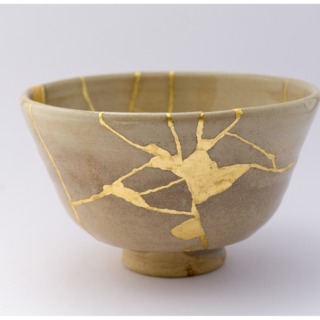
Someone broke a big,
Gorgeous,
Gold-painted bowl that I inherited from my grandmother,
And it's irreplaceable.
And I sell the loss in my body as such deep sadness because I've used that bowl as a fruit bowl since 1997.
It was really one of my prized possessions.
But the truth is the bowl was already broken or was bound to be broken.
A hundred years from now,
A thousand years from now,
That bowl would have been nothing but dust no matter what.
And so I'm sad.
I feel a sadness.
But the truth is everything is impermanent.
Nothing lasts,
As Joseph said.
It's great news to be able to see that and to practice with it.
It helped me to continue to love the person who broke the bowl right in the moment,
To have compassion for them more than to worry about the bowl.
The bowl is broken and all is well.
So we've all lost things,
We've lost people,
And we grieved,
And all is still well.
Someday we'll be the one who's lost,
And the world will keep turning,
This beautiful,
Impacted,
Spectacular world will still keep turning.
The third characteristic is anatta,
Or not-self,
Or emptiness.
I love this characteristic.
It's really helpful for me.
And whenever I get into a situation where I think I know myself,
Or I see some quality of heart or mind that I like,
And I think I can hang my hat on it,
Or see something that I don't like and feel ashamed of,
Anatta is right there to remind me that there is no such thing as a fixed self.
This person I know as Judy,
And you hear yacking away here on the wake-up call on Thursdays,
It's nothing more than a constellation of changing qualities of heart and mind,
Informed by every experience I've ever had,
Or bumped into over the last 63 years and four months.
And the same is true for you.
You're different now than a moment ago,
You'll be different in again in another moment.
There's no fixed you,
Fixed any of us.
I've heard Indigenous people talk about humans as hollow reeds,
Experiences flowing through us,
And I love that image.
Ruth King simplifies it and just says nothing is personal.
And she doesn't mean we shouldn't take responsibility to be the most generous and ethical and patient people we can be.
She just means,
I think,
That we're all just doing our best,
And to the extent there's something inside of us,
Some conditioning,
Some formation,
Some remnant,
We can't take that personally.
We just have to be kind to ourselves and everyone all the time,
Let the rest go,
And go back to our cushion,
And cultivate more kindness and compassion for ourselves and for everyone else.
Joseph says that anatta really means everything is connected.
Oh,
It's beautiful,
Isn't it?
So not only am I not this fixed separate self,
Not only are none of us a fixed separate self,
But we're all in this mishmash together.
We're all bumping up against one another.
We're all impacting one another.
We need to watch out for that.
And we can see this in our law practices and in our classrooms really well,
Maybe better than anyplace else.
And then what is there to say?
What else is there to say?
We're empty.
We're connected.
So is everyone.
So is everything.
And none of it is personal.
How perfect is that?
So let's sit.
So finding a comfortable posture that is relaxed and also dignified,
Back straight,
Top of the head parallel with the ceiling or the sky,
Chin tucked just a little bit,
Eyes closed or downward cast,
Feeling the body sitting or standing or lying down or walking,
The sense of the body connected to the earth,
Sense of being connected to yourself,
Sense of being connected to everyone here on the wake-up call,
Everyone in your immediate environment,
Everyone in your world,
Everyone on this beautiful blue planet.
Maybe checking in with that connection.
Is the connection with the earth warm and loving?
Could it be a little bit more warm and loving?
Bring as much love and compassion to the planet in this moment as you can.
Maybe calling to mind some favorite place you have on this earth,
Sending some special loving kindness to that place.
Could be a tree in your park or a lake or the ocean or the mountain.
Maybe sending a little gratitude.
A special place where I am,
I can see the pine trees and the redwoods and the fir trees dusted with ice and snow and still standing there so majestic,
Uncomplaining,
Giving off oxygen.
Easy to send a little gratitude to the earth,
Seeing that.
And for ourselves,
What's our connection to ourselves?
Can we send just a little bit more love,
A little bit more compassion to ourselves,
Warm up our connection to ourselves?
Call to mind something very kind that you did in the last day or week or month and be grateful for the kindness and love in your heart.
And for everyone,
Can we just in these last moments of our sit,
Warm up our connection to all humans and all beings,
Seeing all the good that is out there and resonating with that,
Connecting with that,
Taking that with us into 2023.
Thank you so much everyone for being on the wake up call today.
Take good care,
Be well,
And I will see you next Thursday.