Good morning.
Wherever you are,
Settle for a moment.
Feet on the floor if you have them there,
Hands resting.
Notice the weight of your body where it meets the chair,
Or the bed,
Or the ground.
This is a short practice of Stoic morning affirmations.
And before we start,
I want to be honest.
Most affirmations ask you to declare a future that you wish for,
Like,
I am abundant,
Or I am unstoppable,
Or I attract good things.
The Stoics kinda did the opposite.
They began the day by recollecting what was already true.
So there's no manifestation here,
No raising of vibrations.
Just eight old lines,
Mostly from Marcus Aurelius and Epictetus,
And a little silence between each.
You can repeat them aloud,
You can repeat them in your own mind,
Or you can simply listen.
Whatever feels best today.
Let's begin with the body.
Three slow breaths.
In through the nose,
Out through the mouth.
There is no perfect breath here,
Just one that's a little slower than the one before.
Breathe in for four.
And out for sex.
Again,
In for four.
.
.
Out for sex.
One more.
Breathe in.
And out.
Notice that you have already done the most important thing today.
You have woken up.
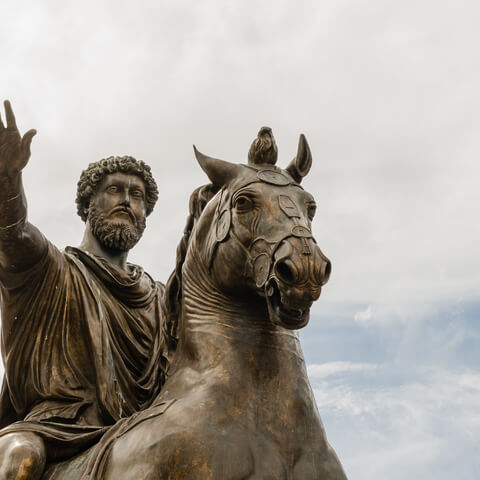
Marcus Aurelius was a Roman emperor.
At the start of his private notebook,
He wrote himself a reminder for the morning.
When you arise,
He told himself,
The people you deal with today will be ungrateful,
Arrogant,
Dishonest,
Jealous.
They are like this because they cannot tell good from evil.
But I have seen the beauty of good.
And so none of them can harm me.
Epictetus,
Who had been a slave before he became a teacher,
Told his students to keep certain sentences ready to hand,
Like a small knife on the belt.
There is a useful modern parallel here.
Repeating I am a lovable person has been shown.
In at least one well-known study to make people with low self-esteem feel worse.
What the research more clearly supports is making one specific plan,
What psychologists call an implementation intention,
And the evidence for that is strong.
Which is,
Conveniently,
What the Stoics were already doing 2,
000 years ago.
So that's what we'll do now.
Eight lines,
Then one rehearsal,
Then one quiet plan.
Okay,
Number one.
Some things are up to me,
And some things are not.
What I think.
What I choose,
What I do.
These are up to me,
Most else is not.
It is not things that disturb me,
But my judgments about them.
The event arrives.
The judgment is mine.
The people I meet today may be ungrateful,
Arrogant,
Dishonest,
Jealous.
But we were born to work together.
I am rising to do the work of a human being.
Not the work of an employee.
Not the work of someone trying to be impressive.
The work of a human being.
5.
The impediment to action advances action.
But stands in the way,
Becomes the way.
Sex.
Epictetus put it this way.
Never say of anything,
I have lost it.
Say,
I have returned it.
7.
If anyone can show me I am mistaken,
I will gladly change.
8.
And from Seneca He who has lived today has lived enough.
And this is the part the research is clearest on.
Picture one difficulty you actually expect today.
Not the worst case,
Just the one most likely.
It might be a conversation you've been avoiding,
The moment you reach for your phone instead of doing the thing,
A meeting where someone usually frustrates you.
Picture it briefly.
And then make one quiet plan.
If that happens,
Then I will.
.
.
One sentence,
You don't need more.
Keep it.
It's yours.
That's the practice.
Eight old,
Ancient lines.
One rehearsal.
One plan.
None of it will make the day easier.
Would make you steadier inside the day.
Which,
The Stoics thought,
Was the only thing that was ever actually up to you.
Take a slow breath in.
And out.
Notice the weight of your hands,
The sounds in the room.
Go gently.
I'll see you back here tomorrow.
And if this practice helped,
Even a little,
Please leave a rating.
Ratings help other listeners find the track.
Thank you for practicing with me.