Welcome to the FlowState Performance Podcast.
Created for those committed to mastery and success.
Coming to you from Manly,
Australia,
We break down the science and philosophy of optimal performance.
So you can unleash your potential.
Welcome to the FlowState Performance Podcast.
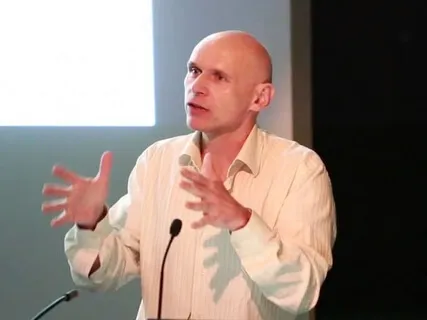
I'm Jero Taylor and today I'm talking to Arne Dietrich who's a professor of cognitive neuroscience and the author of How Creativity Happens in the Brain.
Welcome Arne.
Hi,
Welcome.
How are you today?
I'm alright.
Excellent.
Cool.
So I've been reading through your website today and I love the way you describe what you do.
So you called yourself a tour guide into the bizarre world of brain cells and human behavior.
Yeah,
I suppose it is a bizarre world because it brings two things together,
At least in my case,
That people usually do not associate with one another.
And these are sort of ephemeral mental events like creativity,
Altered states of consciousness.
And the other thing is a really hardcore,
No thrills,
Mechanistic view of how that happens in the brain.
And very few people bring these two things together.
And it is a bizarre world for many people to see these experiences people have and put into a language that sounds so scientific and is scientific.
Absolutely.
Absolutely.
So talk to me,
Set the scene for me.
How did you end up becoming a neuroscientist?
That was early on in life.
I was a teenager and I noticed a knack that I had for watching people,
Understanding people and looking at them really in a way that would understand underlining themes,
Mechanisms,
Causes of behavior.
So I studied psychology naturally and I also have a very scientific mind.
So I gravitated naturally to what you could call the most mechanistically scientific branch of psychology,
And that is neuroscience or the intersection where psychology and neuroscience come together.
And I then entered,
Got my PhD in a neuroscience program,
In a very traditional neuroscience program,
And went from there.
That's how I became a neuroscientist.
Right.
Fantastic.
So and within the world of neuroscience,
Where would you say that you specialize?
Well,
I started out in a very traditional program.
I worked on learning and memory on the hippocampus,
On doing brain surgery on animals and testing them for all kinds of things with all the techniques available about 30 years ago when I got my PhD.
But I've gravitated away from this to what would be,
I guess,
Called a niche within neuroscience.
And these are these experiences that are very difficult to bring into the lab and therefore tightly control in terms of the conditions for a scientist.
It's much easier to do work on memory.
So many people scare away from investigating these sort of events because there's very little funding for it.
And it's also quite difficult.
It's new territory.
But for me,
This was much more interesting than doing a traditional work on attention,
On memory,
Or on some sort of disease like Alzheimer's,
Parkinson's,
Or attention deficit disorder.
So I gravitated towards what very few people do.
And therefore,
There's not much work in that area as opposed to other areas of neuroscience.
Would you say that what you spend a lot of time studying is the science of consciousness?
Yes,
That's exactly what I do.
I would say that fits it straight on.
And things like the heart effect or eureka moments,
Inside events,
Creativity,
Flow,
These are all,
I would think,
Subheadings under the overall banner of studying consciousness or conscious events or alterations to consciousness.
Absolutely.
OK,
Fantastic.
Well,
I believe that you're probably one of the most learned people on the planet when it comes to the question,
What is consciousness?
And it sure is a slippery question,
Isn't it?
Yeah,
I think there is very good work on consciousness.
People who take the visual system and visual experiences.
But very few people do what we in science find rather normal,
And that is studying an event by altering it.
And so very few people,
Although there are people that study consciousness and some very famous people from Antonio D'Amazio to people like Francis Crick,
The late Francis Crick,
But they never study that by deliberately changing it through,
For instance,
Let's say,
A flow state.
And I thought my approach to consciousness or understanding the topic was by studying its alterations.
And so in that,
I have very few colleagues.
But actually,
The study of consciousness,
There are quite a number of people in it.
Absolutely.
It must have changed a lot since you've been in the profession.
I guess the last 20 years,
There's been a,
Or the last 10 years perhaps,
There's been a renewed interest.
I think probably Csikszentmihalyi kicked off a whole load of interest.
And then more recently,
There seems to be more of a convergence of sort of spiritual themes and scientists who are sort of exploring consciousness with a different perspective.
Would you say that's true?
Yes and no.
I think the heydays are already,
We've sort of crossed over an inflection point already.
And for the last 10 years,
Actually,
We've been a bit stuck.
I think the 10 years before that were really where the first sort of getting together of perspectives and views happened and a lot of flurry activity occurred.
But in the last six,
Seven,
Eight years,
I've not seen the same kind of progress.
I guess it slowed down a bit because once we add the first sort of ways in which we can explore this,
There was not continued interest.
So it's not an increasing,
Accelerating thing.
To me,
In the last few years,
We have kind of evolved around the same themes.
And some of them are,
I think,
Are not very healthy and in fact are theoretically toxic.
And that is also part of the problem that people entering the field that are not trained in neuroscience and then dabble around somewhere with neural networks and the prefrontal cortex without fully understanding how difficult it is to get true,
Honest,
Sound,
Mechanistic explanations going.
And so I've also become a little bit of a critique,
A critic of the field with critiques that I think are necessary in order to move the field forward.
Really?
Can you give an example of such a toxic theory?
Yeah.
I mean,
For instance,
I think the most famous one is certainly the right brain theory of creativity.
That,
In my opinion,
Is an idea that should be treated like nuclear waste and buried for a million years.
It's just dumb.
It's just a stunted idea.
And the main problem of that idea is actually the underlining mistake in thinking that creativity can be localized in such a manner.
The right brain is really only one instance of a way of thinking that I think is profoundly mistaken.
And that is to find locations for creativity or location for flow rather than mechanism.
And now in the current days of functional MRI and of PET scans and these wonderfully colored neural scans that appear on all media outlets these days,
You get the idea that creativity has got to be somewhere.
Flow has got to be somewhere.
But this is probably a mistaken view.
It is probably a distributed entity.
And looking for the centers of creative thinking is pretty much like looking for the center of thinking.
It's in the brain,
Stupid.
Okay,
So basically.
.
.
And that is one of the things I think that's a toxic idea.
Understood.
Yeah,
I think that more and more people are tuning into the idea that the whole left brain,
Right brain thing doesn't have much validity.
But what about the whole.
.
.
Another one which I'm sure you can straighten me out on,
But this whole idea of we use 10% of our brain.
What's the truth there?
Actually,
There is a bit of an interesting thing in neuroscience because I remember many,
Many years ago I was part of a sort of a network who tried to get to the source of this rumor,
Of this myth,
Of this mistake,
Because it is another stunted idea.
And we couldn't.
We didn't know where it ever came from.
I have heard it,
I think,
On all five continents and I've heard it expressed to me as a fact,
As this is something that everybody knows obviously to be true.
But we know it's not.
And so I find that not only the source but also how widespread it is a very fascinating thing.
There are two very easy theoretical arguments against this that should make clear that this is not something that can possibly be the case.
But the main one,
To reduce it to the main one,
Is an evolutionary argument.
The brain is an extremely expensive machine.
It weighs only 2% of your body but costs about 20-25% of all of your resources.
To build this thing for evolution has costs.
To produce something like this,
A machine like this,
And then only use 10% of it,
Pretty much violates the principles of evolution,
Of an adaptive approach.
When you evolve something,
It has to have functionality.
There can be,
Of course,
Epiphenomena.
And you can,
Of course,
Evolve something that doesn't have a direct function,
Sort of as an epiphenomena.
But it is very unlikely that a machine as expensive as the brain,
I mean metabolism-wise,
Would be an add-on that actually is not needed.
As far as we can tell in neuroscience,
You need all the brain you have,
Otherwise you wouldn't have it.
This idea of 10% violates basic principles of biology and neuroscience and evolution.
Alright,
Thank you for putting us straight there.
Understood.
Okay,
So you've written a book which is actually entitled An Introduction to Consciousness,
Which I just ordered.
I know it's not your most recent book.
But can you explain to me,
I know that this would fill a whole book so it might be difficult,
But could you explain to me in a nutshell your definition of consciousness?
Consciousness,
A bit like creativity,
Is something that is insufficiently defined.
And it's a bit like what William James said 120 years ago,
That you know it when you see it.
We all know what we're talking about when we're talking about consciousness.
But putting the finger on it and circumscribing it with precise language has been very,
Very difficult.
And the reason why that is the case is because there are fundamental philosophical differences in conceptualizing the concept of consciousness.
The main one is subjectivity,
That some people,
Let's say team A,
Would think that this is a fundamental component of consciousness.
Team B,
The sort of the hardcore materialist scientists,
Do not think so.
And we cannot even agree on the fundamental components of conscious experience,
Which is why we dodge the bullet a bit.
We all do it in the field of letting it,
Of defining it a bit loose,
A bit like a fuzzy set.
Okay.
And like I watched the TED Talks video that you gave,
And basically I noticed how you put across an idea that altered states of consciousness are not higher states of consciousness.
Could you just run us through that idea?
Yeah,
Of course.
It comes from my own experience as well,
But also from my knowledge as a neuroscientist about how the brain works.
And in my personal life,
I also hunt flow states almost religiously,
If that's the right phrase to use here.
And thinking about my own experiences,
Introspecting about them as well,
And theorizing what we know about the brain,
Comes back,
For instance,
This 10% idea.
And of course,
If you understand the brain operating at full capacity in full consciousness,
Your conscious state right now,
My conscious state right now,
Meaning attending to external stimuli like you and I do right now,
Then this would require pretty much the full capacity of the brain.
Any alterations to this are naturally subtractions to conscious experience.
And most of my alterations to consciousness that I experience,
For instance,
In long endurance exercise,
Which is one of the flow states I get into constantly,
Whether it's skiing or hiking or doing triathlons,
I notice that most of the mental capacities that I have are downregulated.
Things like attentional processes,
Working memory,
Sort of my sense of self,
A very complicated computation that you can compute the difference between self and other that requires a lot of neural resources.
And,
You know,
When you're in a flow state and you merge with your surroundings,
You no longer compute this.
For me,
All of these sort of things were subtractions to experience.
And I also understood that most of these complicated mental events,
Like attentional processes,
Like a sense of self,
Like a theory of mind,
Self-reflective consciousness,
The fact that I can think about the fact that I'm thinking,
All of these things are gone in the flow state.
And all of these are also computed in the frontal cortex.
And so the idea initially that I had about 12,
14 years ago now was that what happens in an altered state is that the frontal cortex must be downregulated.
Modules within the frontal cortex,
Not the whole frontal cortex,
But modules within it are downregulated.
And I called this hypofrontality and explored theoretically of whether that could be an underlining mechanism for altered states of consciousness.
I pitched this idea then several years later after working out the details of how this would work in neural networks in the frontal cortex.
So the idea is very simple.
Altered states of consciousness,
Therefore,
Would be a downregulation.
They are not higher states of consciousness in terms of brain activity.
They might be higher in terms of experiences,
In terms of what you understand about the world.
But they're certainly not higher in terms of neural mechanisms,
In terms of neural resources,
In terms of your brain activity.
Okay,
Okay.
I understand a lot clearer now because after watching that video,
I don't know if you've read the comments below it,
But there's a lot of people who are saying things like,
How is he defining higher and lower?
He's obviously not experienced this sort of altered state of consciousness and all this sort of thing.
And I knew what these people were saying because in my life experience,
Sometimes these higher states of consciousness kind of get in the way of my life.
Sometimes self-consciousness is not convenient.
It stops me from expressing myself,
For example,
In like,
Say I was at a festival or something like that.
And sometimes you want self-consciousness just to go away.
So sometimes I seek out these lower states of consciousness,
I guess you would call it.
That's really interesting.
I do the same thing.
I mean,
I've never known anybody who's very happy,
Who thinks a lot about his own thinking.
Very critical and self-critical people.
It not necessarily are things that make you understand more about yourself.
Sometimes less is more,
But not in terms of neural activity.
So to me,
An altered state of consciousness almost by definition in terms of neural activity is a lower state of activity.
That doesn't necessarily mean that this is not something healthy or unhealthy.
There's no value judgment to this.
It's a purely mechanistic approach to understanding altered states mechanistically in the brain.
Right.
So you're basically looking at the amount of neural activity that's going on.
Yeah,
Because I seek these out just the same.
When I seek out a flow state,
I seek out really dimensions of consciousness that are to me more pleasing or more happier,
To be honest,
Understanding different things about the world.
I read about this tribe that exists in Malaysia.
They call this Singhoi people.
I don't know if they're still around anymore,
But this anthropologist studied them in the 1960s and 70s.
Basically,
He realized that this tribe completely isolated from other civilizations.
They almost communicated telepathically.
They seemed to sense whenever he was coming,
And they would be there waiting for him with no communication devices.
Their dream world was merged into their reality.
If they dreamed about a mango tree,
Then they'd go and find this mango tree sort of thing.
In your course of studying,
You must have come across some interesting things.
Have you studied people involved in shamanistic ritual or on psychedelic substances,
For example?
No,
Because I'm not an anthropologist.
Consciousness is interdisciplinary,
And the different disciplines,
They need to work together,
Each coming with their own area of expertise.
This is not something ethnography that I can do.
I'm not trained in it.
But I've had quite a number of experience studying induction methods.
I can tell you one,
For instance,
That is quite common in my neck of the world.
These are Sufis who spin,
And they also come to an altered state.
I wouldn't call it necessarily a flow state,
But it's certainly an altered state.
You can see the altered state in their face.
They're not there.
They're not with us.
They're somewhere else in their minds.
Humans have discovered a variety of ways,
Drugs of course,
The most obvious ones,
To induce altered states.
I have studied them some,
But not directly with those involved doing these induction methods.
I've read about the weirdest things of induction methods involving pain,
Sleep deprivation,
Food deprivation,
Dances.
I mean,
Voodoo dancing to certain rhythmic beats and music are similar induction methods.
There's a great variety of those.
I'm amazed about them.
I've never heard of that tribe you talk about,
But I would not be surprised if we find more and more people who have been more and more inventive about how to alter their mental state.
Indeed.
Yeah.
It's a very interesting area.
In the modern day,
You've got these guys who are throwing themselves off cliffs or hurtling down a mountain at 50 km an hour to alter their state of consciousness.
It's just such an interesting parallel to think,
To join them up with Sufis or shamans or Tibetan monks 1500 years ago.
Yeah.
I also join them up with people,
Engineers in Silicon Valley who make the next iPhone.
Because it's not necessarily that one is better than the other or creativity can be associated with one state or the other.
It's a different kind.
And so,
You can also solve problems and be very creative.
And that is oftentimes forgotten in a very highly concentrated default state of consciousness where there's no alteration whatsoever.
So,
That also has to be included in the whole spectrum when it comes to flow and creativity.
That also is a way to pursue your life.
This tribe or any other tribe doesn't come up with the technological marvels we do.
That can only be done in a different state of consciousness,
What I would call,
I guess,
For lack of a better word,
Default consciousness.
Interesting.
Yeah,
I'm keen to talk about creativity in just a minute.
But just a bit more on consciousness.
So,
Do you feel like it's possible to fully understand and define consciousness without really understanding quantum mechanics and the sort of unknowns that that field is throwing up?
Yes,
I do.
I so far quantum weirdness and the weirdness of quantum mechanics and the sort of parallels that are being drawn to the weird events of conscious experience are very entertaining,
Very interesting.
But I guess that's also where it ends on the entertaining part.
Because so far we have not been able to and there's no serious work that I know of to tie this in in a way that would be scientifically suitable or scientifically sound.
These are just metaphors of how you can be in two places at the same time or things like this or quantum gravity.
So what,
For instance,
Roger Penrose has pursued,
I think,
Is misguided to a large extent and is fascinating because I think it tells an interesting story.
But for neuroscience,
I think we are going to discover that the events that we are after,
Of course,
We are made out of the same matter.
So we're made of quarks,
Bosons,
Mesons and gluons.
But,
Of course,
Above the subatomic level,
They cancel,
These effects cancel each other out,
Even at the level of a molecule,
Much less of a neuron,
Much less of a neural network.
And so for that really to work or have any sort of scientific validity,
We would need to find quantum effects at the size of neural networks.
And we are talking about several levels,
Layers of explanations that we would have to cross.
And without crossing those,
And I don't think we will cross them,
Because,
As I said,
As soon as we go out of the subatomic realm,
These effects cancel each other out,
That we will have explanations of consciousness sooner or later,
It's hard to predict,
That do not have to make at all any recourse to quantum mechanics.
Okay.
In your professional opinion,
Does a tree have consciousness?
No,
You need a network to compute it.
That means you need a computational machine.
You need a brain.
And certainly,
I would go for the idea that you have a continuum.
That means I would not make a categorical separation from us to the next chimp.
Although it's a big jump,
It's not a categorical difference.
So the less brain you have,
That means the less neurons you have,
The less networks you have,
The less of sophisticated complexity in your neural network,
The less consciousness you have.
Once you get to a plant,
You no longer have a neuron.
You no longer have a computational machine.
And there I would find talking about consciousness in a living organism that doesn't compute information in the same bytes and bits than we do,
I find not very useful.
Okay.
Without ruling this out with 100%,
I'd go for 99.
999.
I'm glad you said that.
I'm glad you left that point at 0.
0001%.
So do you think that,
As a human,
Do you feel we are connected to each other in some way?
I mean,
Does that question actually mean anything to you?
In what way?
Of course we're connected,
But in what way do you mean that?
Connected by some form of collective consciousness?
That is non-communicative in ways that I can either see it or hear it,
That I cannot pick up with my normal sense systems?
No,
I don't think so.
Until we have evidence otherwise,
I think it is safe to stick to explanations that we can support and build an edifice of explanations that could get us somewhere in terms of understandings.
This sort of flight into mysterious forces and events,
I find only useful if it can be supported scientifically.
But what if science just… Again,
Without ruling it out,
But the possibility,
Of course,
That's why we in science talk about falsification.
I will not rule this out,
But also unless there is evidence,
I will also not listen to it.
I don't have the time.
I only have 85 years on this planet and I want to get somewhere.
By the time I die,
I want to understand something that I didn't understand when I was born.
And spending too much time out on a loop in La La Land is not my way of approaching consciousness.
As I told you,
I have a very high sort of mechanistic,
Scientific,
Hardcore view on the matter.
And that is my approach.
It does not mean necessarily that it has to be everybody's approach.
But for me personally,
Somebody who makes statements along these lines has a very large burden of proof.
If you have an extraordinary claim,
You should bring extraordinary evidence before I spend my time listening to you.
Yeah,
Fair enough.
My personal feeling with things like this is that if I experience something,
Then it's true in my experience.
Oh yeah,
That's certainly the case.
That's certainly the case.
How do you explain synchronicity,
That idea of meaningful coincidences,
Or déjà vu I guess is similar,
Or yeah,
That whole idea of,
I don't want to talk about the law of attraction,
But synchronicity.
Well,
Again,
As a scientist,
I would require,
What I require of all scientists,
Or with anybody who is making a claim,
That this be demonstrated with proper control conditions.
And this is where it usually is a problem.
Once you put this under proper controls,
You have to also count the false alarms,
The times that you thought there was synchronicity,
And there isn't,
Where you thought somebody is on the same page,
And she wasn't.
Once you properly do that,
Then you're going to have an assessment of whether that experience is something that is generalizable,
Or whether that is something that you fool yourself,
Because we are very good at fooling ourselves.
And this sort of thing you have to,
In my science,
As a confound,
You have to eliminate before you can make a claim.
Yeah,
Okay,
Interesting.
But it's true for psychology as well as for neuroscience.
Otherwise,
You cannot falsify.
That means otherwise you cannot eliminate something,
Because we have a range of experience that includes almost everything.
So if the experience in and of itself is being counted as evidence,
Which we don't do in science,
We don't count subjective experiences as objective evidence.
You have to produce the evidence itself,
And then we can go from there.
Do you think in your life you'd be interested in dropping the mantle of being a scientist,
And for example,
Come along to the Peruvian jungle with somebody,
And go and spend some time with some shamans,
And take some ayahuasca,
And have that sort of experience as an exploration of consciousness?
You're assuming that I haven't done that yet?
Yeah,
Yes.
There's no assumptions here.
Well,
I lived in Peru for a while.
I lived there for one year.
Oh,
Did you really?
Yeah,
So anyway,
Without going into that.
Of course,
I understand.
Yes,
But I would understand these experiences as my experience,
And not as something generalizable,
As something that holds for other populations,
Because the same sort of rituals might be experienced completely different by others.
And as a scientist,
I would understand that.
And I think a critical attitude,
A scientifically critical attitude towards this experience is just healthy.
As I always say to my students,
You should open your mind,
And you should keep it as open as you can,
But you should not open your mind so far that your brain falls out.
And at that point,
You have to be critical.
And so,
Yes,
I'm open to this.
I have been open.
I was open to this.
And experiences like this,
I would take as just that,
Experiences of mine,
But not experience that I can generalize scientifically as a phenomena of consciousness that applies to others as well.
Interesting.
Okay,
Just moving on,
Arne,
What do you think about this gut as a second brain theory?
So this idea that we have,
You know,
Lots and lots and lots of neurons in our gut,
Or maybe spread throughout our body,
Down our spinal cord,
And therefore that being evidence that we kind of have inverted commas,
Two brains.
Not much.
For the same reason.
I think the short answer would be computational complexity.
Yeah.
First of all,
You don't have neurons in your gut.
You need,
And even the neurons in the spinal cord are primarily in order to distribute your motor commands and collect sensory information.
There is a degree of autonomy,
And they do computations,
Obviously,
But look at the complexity,
And look what a system like this could possibly do in computing the kind of things that you or I would call consciousness or conscious experiences.
So I would certainly again think that this sounds far-fetched,
And as long as there's evidence that there's sort of a second system inside of you somewhere in some shape or form that equals that between your ears,
You have a long way to go if you want to make that claim.
Again,
For the same reason.
I mean,
If you look at animals and you go down the list of what they can do,
What their mental capacities they have,
Given the brains that they have,
That I think staying on the right side of having a sanity check here is very important.
In order really to make progress.
I mean,
You can entertain any idea you want to,
But a skeptical attitude,
I think,
Is very important if you're dealing with phenomena that are so easily fooling you.
Well,
What does intuition mean to you,
Arne?
The same thing.
Intuition,
We define,
For intuition we have a good definition,
I think.
Intuition,
We define typically as knowledge that you have without intentionally thinking.
It is just sort of knowledge that pops up,
And of course that means it's computed in your head,
But not by conscious parts of your head,
Of your brain.
You have very complex systems,
Your implicit system,
Very complex systems in the brain that,
Where the computations actually do not reach your conscious reflective part of networks,
And they can be very complex.
And so they can compute knowledge,
They can compute events,
They can compute understanding of something that then in its full form is catapulted into consciousness.
And all of a sudden you have an idea going,
Oops,
Oops,
And you have sort of an intuitive knowledge,
But you've obviously computed it,
Just not consciously and intentionally.
But locating this in the gut,
I think,
Is the wrong place to go.
Where does it come from?
Where do these morals,
Instincts,
Intuition,
Is it like hardwired into our DNA?
Where is it coming from?
No,
Our DNA,
We can dispense of that.
In terms of hardwired,
We can also be very critical of that as well.
Your genes,
The 25,
000 or 26,
000 that you have in the Human Genome Project counted,
They are by far not even by orders of magnitude enough to specify your brain connections.
So you cannot look at your brain and think that this is predetermined by your genetic makeup.
This is just combinatorially not possible.
So you have always an effect of brain wiring that is of course guided by your genetic program,
But it's also influenced vastly by your environment.
That already starts prenatally,
And of course it continues and grows by then your upbringing and then your culture and then your experiences,
And your brain wires itself up in ways that has also a lot of randomness in it.
And you have very large scale systems that are very,
Very complicated.
And as I said,
They don't necessarily reach with their computation consciousness.
And they are the ones that we ought to be looking at.
As a matter of fact,
Within the study of consciousness,
In my neck of the woods,
That means neuroscience,
I would think that this is now the hot area of neuroscience,
To do exactly that kind of work of how the brain accomplishes this sort of knowledge,
Understanding,
Behaviors that are run intuitively.
And they can be very complex.
As you said,
For instance,
Even moral understanding of a certain situation,
We have an intuitive,
Instinctive sort of sense.
And it's very unlikely that that is hardwired in a sense that this is predetermined.
It depends a lot of your experiences.
But once it is,
Just because it isn't hardwired doesn't mean it isn't computed in the brain.
But it's not in a network that is not pliable.
It's not in a network that is not plastic.
It can change because of new experiences that you have.
So the word hardwired here is sort of a red flag that I think we neuroscientists are always put into this position that if we are talking about these events coming from the brain,
That we are always put into the position of,
Oh,
Then it must be hardwired.
That is not necessarily the case.
We understand brain plasticity very well.
And the word hardwired,
I think,
Doesn't apply to these kinds of complex behaviors at all,
In fact.
Fair enough.
Fair enough.
There's a lot of talk about,
Or certainly in my circles,
About looking at the brain.
Does consciousness exist just within the brain?
Does the brain generate consciousness?
Or is the brain sort of modeled as,
I don't know,
Like a radio transceiver of consciousness?
Is this something that you've heard before?
Yeah,
I've heard this before.
Is this one of the things that you would like to stamp out as a harmful,
Toxic myth?
No,
Because I think this is different than demonstrating that something is wrong.
This is a possibility,
But it's so far-fetched I don't have any time for it,
Unless you,
Of course,
Bring evidence.
So it's very different whether something is falsifiable and false,
Or whether something is a nutty idea,
Where there's really actually no evidence for it,
But also no evidence against it.
That's very different.
And so when you have an idea like this,
Again,
The burden of proof is on you.
And so far,
I'm not aware of any single datum,
Of any sort of evidentiary basis at all.
Not a single piece of information,
Not a single bit,
That we have evidence for the existence of consciousness outside brains.
That means outside neural networks.
And again,
The complexity argument arises here.
The more complex it is,
The more complex can your consciousness be.
So if you want to claim that consciousness exists somewhere else,
Let's say,
I don't know,
In a hologram or in a black hole,
Or in a salamander,
Or in the university as a whole,
Or whatever your argument is,
Really,
Or some other aliens,
Then of course you have to support this somehow before I spend time thinking about it.
Yeah,
Okay.
Fair enough.
Let's get on to flow.
Just firstly,
It's a question that I'm often asked,
And I think about it a lot,
But what the connection is between meditation or meditative states and flow states.
Is this something that you've looked into?
Yeah,
I have.
And I'm one of those who has defined this a little bit,
I think,
More precisely of where the difference is between flow as an altered state.
And there are several markers,
But to make a somewhat longer story short,
The main thing is movement.
A flow state,
As defined by Csikszentmihalyi,
And as it is generally accepted as a flow state,
Is a smooth integration of sensory input and motor output.
That is true for a surfer and a musician,
For an actor and somebody who plays tennis.
That there is an output.
In meditation there is no output.
Or there doesn't have to be,
I guess you can produce an output,
But it's not necessary.
In meditation you sit,
And that's it.
You don't have a motor movement that is smoothly integrated with sensory input.
And that's the main difference.
Now phenomenologically speaking,
I've been in both states,
Although I'm not a very good meditator,
I've meditated,
I have for many years,
But I have never achieved deep states,
I guess because I didn't have dedicated enough time for it.
But from my understanding of this,
These are two different states I can distinguish.
A meditative state and a flow state.
Do you think that one helps the other?
Do you think training for meditation makes you more prone to flow states and vice versa?
I have no evidence for this,
And I'm suspecting yes.
Okay,
Interesting.
I cannot support it myself.
There is a statement that I would go with a hunch that yes,
That one facilitates the entrance to the other.
I would say from personal experience that it's one way.
From personal experience I would say that training for meditation facilitates flow states.
I would agree with you on that.
I would go with your idea.
I have the same experience,
Or let's say I have the same hunch,
But I don't have a mechanism for it.
I don't have an explanation for it,
And I don't know how that would work,
But I would go with that.
But the main difference here,
I think,
Between meditation and flow is the movement.
Okay,
Interesting.
So you've got creativity.
It seems to be a little bit of a black hole or an area of much confusion.
It just baffles me where we are in the world.
We can put a man on the moon,
But we don't seem to be hell of a lot closer to understanding creativity.
And I just want to read a quote that you wrote in an article,
But just because I think it's a great sentence.
Like no other field of psychology,
The study of creativity is beset with nebulous concepts,
Combustible propositions,
And myopic theorizing to say nothing of all the vacuous fluff out there.
So tell me about where we are now,
Especially with you having written the book,
Relative to this world of vacuous fluff when it comes to creativity.
Yeah,
And that sentence is,
I think the amazing part of that sentence is that it got managed to actually appear in a scientific academic article.
I got it somehow through the review process.
But I think that's also because there's an understanding that there are a lot of,
I think you have noticed the last half an hour or a few minutes,
How hardcore of a thinker I am when it comes to admitting evidence and where you can stand in order to build something that is not built in quicksand.
And when you look at the ideas out there about creativity and where it comes from and what enhances it and how can you foster it,
You have some really crazy ideas that either don't work or have no theoretical foundation,
Are conceptually mistaken,
Are incoherent,
And everybody dabbles in it.
Everybody thinks that they understand it somehow and everybody understands this differently.
When you listen to one person,
He tells you something,
He's convinced because that's how he experienced it,
And then you talk to another person and she tells you another story,
Completely different,
That is incongruent with the first story you heard.
When you want to make sense out of all of this,
You will see that the process of falsification,
That means the process of falsifying things,
That means of throwing out ideas that we know don't work,
Has not taken place here.
And everything floats in the air and everybody picks up whatever they want to pick up.
And this has unfortunately also penetrated the scientific study of creativity,
Which is heavily fragmented,
With everybody having sort of their same idea,
Sorry,
Different idea,
And doing whatever they want to do,
Claiming whatever they want to claim,
And that's where that sentence comes from.
So you have even neuroscientists who tell you what I think is fluff.
Is there any non-random marker yet found?
Is there any sort of theme or theory that is put out there?
Like,
Would you be able to,
If I said to you,
Arne,
I want to be more creative,
Are you able to scientifically back any sort of method to become more creative?
That's a very difficult question.
We know that certain things work better than others,
And we know this empirically,
Because more people have tested this out.
Ideas,
For instance,
Like,
For instance,
Generating as many ideas as you can possibly can without judging them first.
I think are things that have produced variations that then other people can pick up on.
But we also know that this can produce a lot of dead ends and waste a lot of time.
But in general,
I think it is very difficult at this point because of the way creativity research has not progressed in the last 30 years.
There is very little that we can make sound connections between the level of psychological events or even neuroscientific events and enhancing creativity.
We are working on this,
And I think this will come.
But currently we have to be very,
Very cautious in order to make these sort of connections because what we know is very tentative.
Understood.
Thank you for that explanation.
Can you tell us about the book?
I guess the book is called How Creativity Happens in the Brain.
Just tell our listeners a little bit about it.
I think I start out in the first chapter or two demolishing pretty much most of the currently circulating ideas.
That not only includes the right brain,
But also ideas that my colleagues in neuroscience are floating.
That includes,
For instance,
Now the new front runner of where creativity happens,
The so-called default mode network,
Maybe a third of it.
Ideas that it has to do with white matter density or is located in a specific area like the superior temporal gyrus or the frontal cortex.
These are all the same kinds of mistakes that are essentially phrenology.
When I'm done with this,
I make very cautious steps of how a neural network,
I forego localization of function.
I don't think creativity is localized.
I take the position that it is widely distributed.
So looking for it with a function of my eyes is a misguided idea.
And I can theoretically back this up over many,
Many pages of why that is the case.
Of course,
You have to support such a claim.
And then I go take very,
Very cautious steps.
The first one is that you have to understand the underlining mechanism of generating new stuff.
And it's always an evolutionary generate and test algorithm.
You do this consciously,
You do this unconsciously.
But what you effectively do is generate ideas and test them for fitness.
And I think this is a fairly safe way to start.
That means also that you start looking for types of or parts of creativity.
And the safest one to go is variation selection.
And once you look for variation and selection in the brain,
You no longer really look for creativity as a whole in the brain.
And I think you have a better approach.
Then I also outline how that algorithm works differently in the brain than it works on DNA.
Because,
Of course,
You recognize this as the basic algorithm of nature,
The variation selection process with inheritance proposed by Darwin and currently the reigning theory of biology in the modern synthesis.
But our brains do that differently.
And I have spent several chapters explaining exactly what is the difference between how the algorithm works in nature and how it works in our brains.
And then spending several chapters seeing whether we can tie these differences to brain mechanisms.
That is effectively the book in a sort of without getting into any detail of making cautious steps towards how possibly a neuroscience of creativity should look like.
Because it should not look like the way it looks right now,
Which to me is fluff.
Okay.
Just something came to my mind.
I know that your friend Steve Kotler,
Who wrote the Superman book,
I can't remember whether it was in reference to your research,
But I remember a chapter talking about creativity and flow and theta and gamma being paired.
And when we're in a theta brainwave state,
Then you might see this gamma brainwave going off,
Signaling some sort of neural activity linked to creativity.
Is that correct or not?
The last two words are not.
The rest is linked to creativity.
What you should say in order to make the sentence correct is to say linked to a type of creativity.
And then you are on your way.
As soon as you link it to creativity as a whole,
I can easily theoretically and empirically demonstrate that not having these data waves can also produce a creative state.
So you enter something.
What you just said is a false category formation by associating a particular mechanism with the whole of creativity.
And that's where the mistake comes in.
As soon as you say that you can link this with a type of creativity,
Then you're on your way to something that can be supported,
Because there's also a different type of creativity where that is not required.
You see?
But I'm only 99.
999 percent sure of my theory.
So I'm OK.
I'm just saying.
So tell me what I just did.
I did a false category classification.
Yes.
And by associating this with a whole of creativity,
If you were to associate it with a type of creativity,
Let's say flow or certain parts of flow or certain parts of certain parts of flow,
Then I think you'd be more sound because I can easily tell you gazoodles of exceptions to this that are also creative.
And then you have something called a false category formation.
You associate creativity with one thing when we know that the opposite is also associated with creativity.
Right.
We could talk about this for days on.
But I know that you're a busy man.
So there's a couple of I'm really it's a really fascinating chat.
We've covered a lot of ground from consciousness to creativity to a lot of the myths that are out there.
There's just a couple of questions that I like to ask all guests and they're not necessarily anything to do with neuroscience or consciousness.
But I'm just interested.
It's a classic question.
But if you could have a meal,
A last meal with any any three people,
Any humans from any era of history,
Who would you want to hang out with?
Just a meal.
You can just hang out with them.
You can go kite surfing with them if you want.
Well,
If it's just a meal,
I would rule out Angelina Jolie.
That's why I'm asking.
Okay.
Yeah,
It's just a meal.
Okay.
It's just a meal.
Difficult.
Anyone come to mind?
I guess I'm no.
And I'm thinking on two lines.
One,
I'm thinking what the person did.
And that means what he or she is famous for and how interesting it would be to talk to this person.
But then I immediately also think about what I know about that person's personality,
What that person would even talk to me about.
For instance,
Newton is a good example.
He's such a head case.
I think having dinner with him would not do anything and increase my understanding.
And so I would think of him and then I immediately would discard him because of his personality.
I think he would be a very interesting dinner conversation partner.
He would have the brain,
But you wouldn't be able to tap it.
We're just looking for interesting conversation here.
Yeah.
And you wouldn't have it with Newton.
I don't think so.
From what I've read about his personality.
I dodged that bullet.
Can I?
No problem.
No problem.
And if you had the power to change anything in the world,
Just with the click of your fingers,
What's one thing that you would change,
You would take away,
You would add?
I would change the population explosion.
Okay.
Because it's the underlining driving force of all other problems,
Whether it's climate change,
Whether it's hunger,
Whether it's poverty.
Well,
Actually not hunger and poverty,
But certainly all that thing that might look like could actually bring us down.
As in extinct us sooner or later.
We have to go back to a billion people on this planet somehow and we are still accelerating the population.
So that's the first thing that comes immediately to mind because everything else would not be a problem,
At least not in the order of magnitude that it is if there were only one billion people on this planet.
Yep.
Yep.
I think there's a lot of wisdom in that.
Awesome,
Arn.
I'm really grateful for your time.
We'll wrap it up there and thank you very much for your time and get on with your day.
You're very welcome.
All the best,
Arn.
Take care.
I enjoyed it a lot.
Thanks,
Boy.
Well,
That was Arn Dietrich,
Professor of Cognitive Neuroscience,
And I hope you enjoyed that conversation.
We'd love to hear from you,
So please send back any feedback in Twitter.
You can contact us.
FlowState1 is our Twitter handle or on Facebook,
The FlowState Collective.
You'll find us there.
Don't forget we put up really detailed awesome show notes for each episode,
For each interview that we do on www.
Flowstatecollective.
Com and we put links to everything that we just spoke about in that interview.
I hope you enjoyed the show.
You can really help us out.
We're at the early stages.
If you could go onto iTunes and basically go onto the iTunes app and subscribe and then rate and then obviously leave a five-star rating and obviously write something awesome,
We'd be super grateful.
And more importantly,
If you love it,
Just share it with someone.
Share it with a friend.
Tell a friend that they should listen to this podcast if you think it's something interesting for them.
We really appreciate it.
Thank you,
Guys.
See you next time.
Bye.
Bye.