Yoga Nidra is a state of deep relaxation or psychological sleep.
We do not physiologically sleep during the practice.
We remain awake but draw our awareness inwards,
Causing our physical bodies and conscious mind to rest deeply.
This allows us to access our subconscious.
Yoga Nidra is not performed during any other activity.
The eyes remain closed and the body still.
While the practice may be performed before bedtime to prepare for better quality sleep,
Yoga Nidra is not sleep and can be performed whenever complete sensory withdrawal is appropriate and possible.
This practice of Yoga Nidra lasts for approximately twenty minutes.
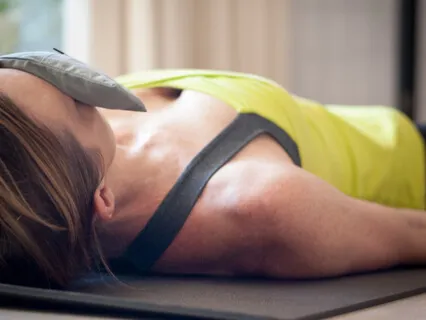
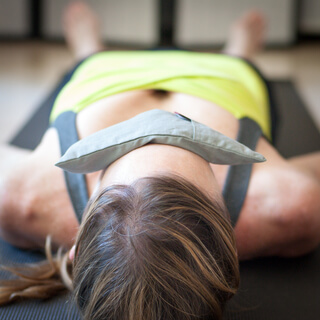
Remove all disruptions and prepare the body by lying comfortably with the head supported and the limbs slightly away from the body.
If this is not possible,
Yoga Nidra may be performed sitting but only with the back,
Head and all limbs supported.
Eyes close now and once the body is comfortable,
All physical movement should cease.
At this point in our practice we set an intention called a sankalpa.
If you do not already have a sankalpa,
It is not necessary to make one today.
You can discover one for yourself over time.
It should be direct and practical,
Expressed in short simple terms.
You may wish to manifest something in your own life,
Improve a relationship,
Heal an injury,
Advance a spiritual goal or dedicate your practice to something or someone that you love.
During the practice of Yoga Nidra the mind becomes receptive to this intention.
The intellectual mind and emotions are quietened,
Allowing the subconscious to absorb the resolution.
Once you have set your intention,
Practice with it until it manifests.
With this technique you can realize lasting change in your life by practicing regularly,
Sincerely with intention.
If you have a sankalpa,
Repeat it silently three times now.
We begin our Yoga Nidra by turning our attention to the breath.
Place your right hand on your navel and your left hand on your chest.
Now become aware of the breath in the abdomen,
Remaining light,
Gentle,
Focused.
Inhale with the belly rising into the hand on the navel and exhale allowing the belly to fall away from the hand.
Breathe quietly without tension for at least three cycles of breath in your own time.
The stomach pushes into the hand on the inhale and passively falls away on the exhale.
Inhale the belly rises.
Exhale the belly falls.
By breathing like this using our abdomen we begin diaphragmatic breathing.
This type of breathing invokes our parasympathetic nervous system and our relaxation response.
Lower the arms back down by the sides now and slightly away from the body.
To prepare ourself for Yoga Nidra we will practice two rounds of a breathing exercise known as Viloma 1.
I will first describe the practice before we begin.
During this practice we hold the breath out at the bottom of an exhale.
Take care not to hold the breath too long and if you have high blood pressure or any other medical condition that would prevent you avoid holding the breath completely and just breathe naturally without retention during this part of the practice.
When we begin we will slowly breathe in for a count of three.
We'll inhale any remaining breath and then gently exhale for a count of three.
After exhaling any remaining breath in the lungs we will pause,
Holding the breath out for another count of three.
We will practice this for two rounds and then return to natural breathing.
My voice will be your guide but don't worry if the count feels too slow or too fast for your body or your level of experience.
Just follow without tension returning to your natural breath if there's any discomfort at any time.
Wherever you are in your normal breath cycle exhale completely now and we'll begin.
Inhale slowly,
One,
Two,
Three,
Inhale any remaining breath and gently exhale,
Three,
Two,
One.
Exhale any remaining breath and now pause,
Two,
Three.
Repeat,
Gently inhale,
One,
Two,
Three,
Inhale any remaining breath and slowly exhale,
Three,
Two,
One.
Exhale any remaining breath and pause,
Two,
Three.
Return now to gentle natural breath,
Release any further control over your breathing.
Yoga Nidra begins now.
We begin with a body scan starting at the right side thumb.
First finger,
Middle finger,
Fourth finger and little finger.
Palm of the right hand,
Back of the right hand swirling around the right wrist.
If there is any part of the body with any discomfort or injury pass over this area twice.
Move up the forearm now to the right elbow,
Right upper arm,
Right shoulder and armpit.
Continue down the right side body to the waist and then swirl awareness around the right hip,
Thigh and hamstring.
Move to the right knee and kneecap.
Continue to the shin,
Calf and swirl around the right ankle.
Move to the top of the right foot,
Sole of the foot,
Big toe,
Second toe,
Middle toe,
Fourth toe and little toe.
Become aware of the whole right side,
The whole right side.
Move your awareness now to the left side thumb,
Fourth finger,
Middle finger,
Ring finger and little finger.
Palm of the left hand,
Back of the left hand swirling around the left wrist.
Move up the forearm now to the left elbow,
Left upper arm,
Left shoulder and armpit.
Continue down the left side body to the waist.
Swirl awareness around the left hip,
Thigh,
The left hamstring.
Move to the left knee,
Kneecap,
Shin,
Calf and swirl around the left ankle.
Move to the top of the left foot,
Sole of the foot,
Big toe,
Second toe,
Middle toe,
Fourth toe and little toe.
Become aware of the whole left side,
The whole left side.
Turn your awareness now to the back of the body,
Observing any contact between the body and the bed or the floor.
Come to the heels,
Back of the calves,
Backs of the thighs and buttocks,
Middle back,
Upper back,
Back of the head.
Become aware of the whole back body,
The whole back body.
Release the entire scalp now and move down the front of the body,
The forehead,
Left eyebrow,
Right eyebrow,
Inner eye,
Outer eye and cheekbones.
Swirl awareness around the jaw,
Peel the tongue away from the roof of the mouth.
Release the throat,
The collarbones,
The chest and the rib cage.
Move through the diaphragm,
Abdomen,
Hips and pelvic floor.
Backs,
Thighs,
Knees,
Shins and tops of the feet.
Become aware of the whole front body,
The whole front body.
Now take your attention to the major parts of the body.
Right arm,
Left arm,
Both arms together.
Right leg,
Left leg,
Both legs together.
The whole back,
The whole back.
The whole front,
The whole front.
The whole head,
The whole head.
Now be aware of the whole body,
The whole body.
Bring your attention now to the spine and visualise chakras or energy centres along the spine.
Begin near the base of the spine.
This chakra is called Mulandara and is located near the tailbone at the perineum,
The pelvic floor or the base of the cervix.
It represents earthly connection,
Survival and is linked to our sense of smell.
Here we visualise a lotus flower with four petals and the sound LAM.
Next we move directly to the tailbone and sacrum.
This chakra is called Svadhisthana.
It represents water,
Intimacy and is connected with our sense of taste.
An orange lotus with six petals and the sound VAM represent this chakra.
We continue up the spine to a point just below the navel and the solar plexus.
This is Manipura chakra,
Our seat of fire,
Will power and our sense of sight.
Here we visualise a yellow lotus flower with ten petals and the sound RAM.
Move up the spine again now to a point just behind the heart.
This is Anahata chakra,
Our seat of love,
Our sense of touch and corresponding to the element of air.
A green lotus with twelve petals and the sound YAM represent this chakra.
Continuing up the spine we reach the throat.
This chakra is Vishuddhi.
This chakra represents our sense of hearing,
Our expression and clarity in the ether.
Here we visualise a blue lotus with sixteen petals and the sound HAM.
Moving now to a point between the eyebrows.
This is the chakra ANYA.
An indigo coloured lotus with two petals represents this chakra.
It has the purpose of creativity,
The element of mind and is connected to the universal sound OM.
Moving from the top of the spine to the back of the head,
This is now the Bindu or moon chakra.
Represented by a crescent moon,
It is regarded as the source of psychic sound for those ready to hear.
At the crown of the head we move to the highest chakra,
Said to contain all the other chakras,
Sahasra.
This is the spiritual element and the seat of our highest wisdom.
A white or violet lotus with one thousand petals and the universal sound OM represented.
Return down the chakras now.
Sahasra,
Bindu,
ANYA,
Vishuddhi,
Anahata,
Manipura,
Swadhisthana,
Mulandara,
Mulandara,
Swadhisthana,
Manipura,
Anahata,
Vishuddhi,
Anya,
Bindu,
Sahasra,
Sahasra,
Bindu,
Anya,
Vishuddhi,
Anahata,
Manipura,
Swadhisthana,
Mulandara.
Now release the focus on the chakras and see the whole body as if in a mirror,
The whole body.
Now repeat your sankalpa,
The same sankalpa,
Your resolve,
Your intention,
Silently,
Three times.
Relax all efforts now.
Relax all efforts now.
And without moving,
Bring your awareness back to the abdomen.
Without controlling the breath,
Merely observe the rise and the fall of the breath in the abdomen.
Belly rises on the inhale and gently releases on the exhale.
Gentle inhale,
Passive exhale and again.
Introduce small movement now into fingers,
Perhaps toes.
When you're ready,
Roll slowly to your right side and pause here in the fetal position for several cycles of breath before sitting up.
This concludes the practice of yoga nidra.