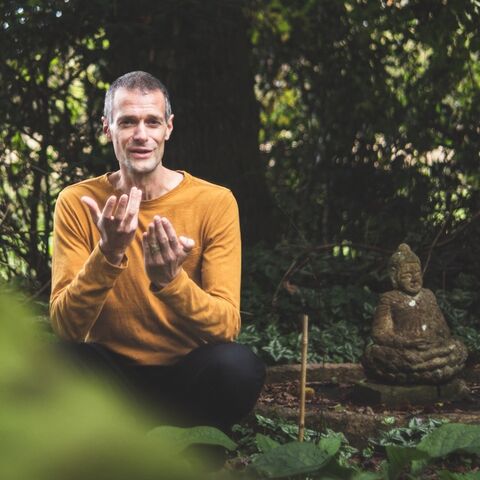
And today I have Wendy Nash with me again for our third installment of the meditation Q&A.
Wendy,
How are you?
I'm good.
I'm good.
I'm good.
Thank you very much.
Well,
Welcome to all those on a wisdom app and insight timer,
Which you're not going to get to see Wendy's lovely face.
You'll have to just bear with mine.
I'm noticing that this is so superficial,
But I guess because I broke my nose,
One of the nostrils is larger and I have this block.
So maybe the one of the nostrils got bigger so I can breathe better out of that.
I don't know.
It's this things when you're on camera.
Right.
And then we're also on,
We're doing restream.
Io,
Which is so should be on YouTube.
So you're welcome to chime in on any of those platforms with questions.
And since we didn't get any questions again,
Wendy,
I'm I'll jump right in here.
I don't waste no time to what Wendy wrote me previously.
So if we're doing a Thanksgiving edition of this,
I guess when Wendy says that we'll aim to chat about quote,
How to practice with ambiguity,
Uncomfortable truths,
People we love,
But don't like their ways or words,
Navigating guilt,
Shame,
Humiliation,
Privilege,
Dot,
Dot,
Dot,
The problem of wanting to be good,
Right,
Ethical when,
When these are all one side of the coin,
How to include the crappy stuff without avoiding it or being overwhelmed,
How to rise to the challenge rather than rise above it to avoid the challenge.
And Ooh,
This is so good.
This is so juicy.
There's just so much stuff packed in there that we can,
We can unpack and unfold.
And I replied real briefly,
The only thing amongst what you've mentioned,
I see and feel has been mostly hijacked for political purposes on both sides is quote unquote privilege.
So while I can obviously address this,
It comes at a low preference.
All the others are all engines go with preferences weighted towards meditative context.
So a lot of wordiness there for me.
Right.
But the main thing is let's just jump into this.
And so do they even celebrate Australia and celebrate Thanksgiving in Australia?
I wouldn't think so.
Right.
No.
So I just,
Before I start,
I forgot to do it last time,
But I always like to acknowledge that I'm so I'm in Queensland in Australia just for our listener and what,
You know,
Viewer and I just I'm on a country in Australia and 800 Aboriginal countries in this huge country called the new world,
Like the US.
And it turns out that people have been living here for 70,
000 years.
So that's a lot of observation,
Learning integration that I really like to include,
Because one of the things that from original sort of ways of looking at the world is that it's all about how do you relate to yourself and the people you're with and the environment around you?
How do you include stuff from the past?
What do you want to bring with you?
What do you want to leave behind?
You know,
I'm thinking long down the future.
So I think it's really important to include that people have been caring for this country and really take on board some of the good stuff that has come out of that,
The ways of being and living and thinking about how to be harmonious in an environment.
Now that doesn't mean to say that it has always been good.
There's lots of stuff about payback,
Which is revenge.
There's lots of stuff,
You know,
It certainly wasn't all peace and love by any stretch.
But I think it's really nice to think about how do we relate to people?
And how do we relate to ourselves?
How do we relate to our environment?
And that we don't,
We didn't just kind of arrive here in this nanosecond you and me Josh,
Apart from everything is the third time we've met.
But also just,
We come with stuff,
You know,
We come from families,
We come from communities,
And it's just not always easy to hear our own voice,
Understand where we are.
So that's,
I really like to include that.
And yeah,
Just to say thanks to the people who have been caring for this country.
Now you asked Josh at the beginning,
Do we giving?
No,
We don't.
That's an American thing.
I believe in Canada,
They have that,
But it's a different date.
That's all I know about Thanksgiving.
It's got something to do with turkeys and kind of,
You know,
A lot of colonial conflict about was it given was it taken,
All sorts of things like that.
But I don't,
I don't know so much about it.
Complex,
Complex.
You know,
It is something else and to leave a lot of the political issues aside,
Which I'll gladly do,
You know,
That this is,
These are important points.
And I forgot,
I've got my Native American art that I met the artists who drew it.
And I was going to show that on camera,
I was really tempted to run away and show it real quick.
And there was all the different peoples in the area that they're in.
And this came to mind earlier when I know when he likes to mention this,
There is no sovereign land for the Native Americans or the certain tribes.
Some like the word tribes still that I've talked to,
But there's none in Missouri,
The state that I'm in,
Which is really interesting.
I won't go into speculation and I don't even know the history of why that is.
I know there's the Trail of Tears that was here for.
There's a state park where that started.
No need to go much into that.
But yeah,
Let's jump into this.
Just I guess,
Point by point here,
How to practice with ambiguity.
Now for those not in the States,
Thanksgiving,
I spent it with my family.
And what is the old Ram Dass saying that if you think you've had any kind of spiritual progress or time with your family,
Right?
I forget how long it is,
But practice with ambiguity.
Now this for me during Thanksgiving anyway,
Is pretty much non-existent.
People in my family are pretty much straightforward,
Almost to the point of sometimes I wish there was ambiguity.
Now that straightforward is a really good quality to have,
But it depends how you do it.
And sometimes ambiguity can be fascinating for some of the subtleties that it brings in life,
Right?
And a lot of times I love engaging in subtleties,
But over this,
There's sometimes when there are just not any subtleties,
It's just kind of blunt,
Which is okay too.
It's a different type of interacting.
So when I am in conversations that are kind of ambiguous,
It keeps me in my toes because maybe I'm constantly reading into things that aren't there,
Or maybe I might be missing certain cues about what's there.
Trying to find out,
Well,
Is someone being vague and ambiguous for a certain reason,
Or they just don't see the importance of the details here?
And sometimes I get too lost in details and I don't see the overall picture too.
So Wendy,
How do you deal with ambiguity?
And then also we're going to try to tie this into a meditative context too,
Which is going to be kind of fascinating,
I feel.
Yeah,
Let's go with the meditation approach because that's what we're here for.
So I think it arose because I've been really thinking about people in my family who I love,
But,
And there,
I don't know if you've had this experience where talking with people and one person in my family says,
I'm a good communicator,
But then she churns through relationships because she also knows that she says a lot of crappy things and I'm going,
Well,
And then she says sometimes quite hurtful things to me.
So if I say,
Well,
Actually that was hurtful,
Then I get this eye roll,
But yet,
You know,
This is somebody I love and is often lovely and then is often really unpleasant actually.
So I think from a meditation perspective,
That's kind of like how to be with people who we have these unclear relationships with and,
You know,
And so that is,
And it's as much as,
As much I want to come forward and be myself and that is what is desired,
You know,
That that particular person wants me to be very loving and warm,
But I feel like I have to hold back.
And so there's a,
Because I'm so nervous about kind of what is likely to come out of her mouth,
You know,
And it can flip at any moment.
So it's very complicated.
So how to deal with somebody who is unpredictable,
Lovely,
That they,
They see themselves in,
In one way and then I have to respond with,
And then they behave in a different way.
And then I,
How do I respond to that?
And I think really keeping,
Keeping family occasions like drop in,
Was it,
I think it was Pema Chodron or it was Chogyam Trungpa said,
You know,
Just go for half an hour,
Like create it so that it's just half an hour.
And that can,
And so that when it's longer,
It's a little bit more appreciated.
You just,
I'm going to,
You cop flat for that,
But it is,
How do we deal with all this stuff where it's actually,
Families are great to work with,
But it's not easy.
You know,
I don't know if you,
You sounded like you had a bit of a time where people said things that was actually,
So I used to be very brutal and honest and it still happens,
You know,
And,
And that's,
That's,
But kindness,
You know,
There isn't always kindness in families.
There's a lot of assumed,
What I'm always really amazed at is people say,
Oh,
I never speak to other people in the way that I speak to myself and the way that they speak to their children and I'm like,
Actually you do speak to other people the way that you speak to yourself.
It's pretty unkind there.
And I don't really understand why people speak unkindly to their children actually.
And I see it in,
In my family members.
I don't have children personally,
So maybe I'm super naive about it,
But I certainly am aware of,
Yeah,
That.
Oh,
We've got a question away.
Tea Lady Nat came back by the way,
So that was that.
And we have Lawrence,
What are her views as possibly seeing playing as a saxophone as a form of meditation?
So should we go with that one?
So I've kind of opened it up.
I put Wendy's comment in the chat and I'm going to add it too.
And I know Lawrence is a buddy of mine,
So he's,
He's,
He's,
Lawrence is,
I won't say anything about Lawrence.
He's an acquaintance,
So we can,
Actually let's do that and I can,
Well,
Hang on,
Let me just throw some stuff out there to,
To address what you said.
So and then we'll get right to Lawrence's comment.
So this thing,
It's about perception and then I'll drop what Wendy said in the chat.
There's a lot of perception involved in this,
Right?
And I would say in my case,
It's more about actually I was doing the harsh things too,
Unfortunately.
You know,
I,
You know,
It's,
I don't know how much I want to go into this,
But it was,
It was fairly brief.
But the question I want to ask Wendy with around this is,
Did she,
Did she say,
Or did you say,
What was your comment?
Did you bring her into it?
You said,
That made me feel like this.
Is that what you said?
Or how did you,
How did you express your feelings?
Because what I've found that it's challenging to do is instead of having,
Saying the other person made me feel this way,
Or when you,
When you say that it makes me feel this way.
So instead of using them as a cause for it happening,
It may or may not be true.
Instead of phrasing it in the fact that,
Oh,
When you,
When this was said,
Then I felt,
Or how can I put this?
I feel like this now.
So how can we say it and convey it that it,
You know,
It might,
They might contribute to the cause of it,
But they might not.
It may,
It may have just triggered something in me from the past,
Right.
That came up like this.
The other huge point here that I found from one of my teachers,
It's explained so much in life in a way,
But it doesn't answer it,
Is why do people say one thing,
So many people say one thing,
Mean another thing,
And yet act in an entirely different way altogether?
You know,
It just boggles the mind how often that is.
Okay.
So I think that's enough to chew on there for a second.
Yeah.
And there is a way of phrasing it,
But there,
But I think it's also important to recognize that one of the things that can happen in a,
In the Dharma world is to keep kind of going back and going back and going back and thinking if I'm just kinder and I'm just,
If I do more,
If I'm more loving,
If I'm more this,
If I'm more generous,
If I'm more da da da,
That it'll,
It'll fix.
Cause there are so many stories like that,
But I,
I don't know.
I think sometimes you,
You can lack boundaries in that actually.
And so,
And,
And not say actually I need to withdraw from the relationship for a while or I need to,
And it's not always easy.
I was speaking with a client this week and she has a,
I guess a lady in her community and she's in a tight knit community.
So it's almost like a relative or something.
It's not,
But it's almost like that.
And she's got to navigate that relationship,
That woman who is very judgemental,
Who's a bit of a gossip,
Who's a bit of a bully.
And it's not straightforward.
You can't always leave,
But I think you can,
And this is perhaps more important for women.
You can think about how much you want to disclose to them.
Yeah.
And keep it brief,
Keep it minimal.
And,
But people do get like offended that you hold back.
You know,
You're seen as cold.
And it's also the opposite where people are offended from oversharing.
Cause I actually have the opposite tendency where people are like,
Hey Josh,
Maybe you need to be quiet for a little bit now.
Maybe you've said enough.
Maybe you're saying more than you should.
So it's like,
And then we,
You know,
The cliche saying we can't be friends to everybody,
Right?
We can't make everybody happy.
That's just the,
Just the fact of life,
Right?
It's impossible.
Also the advice of limited to a half an hour,
This is really good.
Even more so there's folks that we don't want to kind of blow off,
But we just don't want to engage on them with any extended period of time.
So we can give them,
You know,
10 minutes of our time that we just have to now how this is done in practicality with some people is a different thing.
You know,
Some people we have to be more blunt with.
Some people can pick up more on subtle cues,
But this is the thing we have.
If we're not in a space where we're bringing out something that's beneficial for the other person or ourselves or both or everybody,
Well then I think it's time to reassess like what's the best way to go about this to kind of get the most bang for the buck here.
Yeah.
And so you want to address that and then we can.
.
.
Yeah.
And yeah,
I will.
And then we'll go back to Lawrence.
And I think there is something about,
Oh there was something you said and I thought,
Ah,
I know kind of how I want to answer that.
And now I've forgotten what you said.
I know,
In the same way with your stuff,
Wendy,
So much good juicy stuff there.
It's just like choosing which morsel to take.
So it's about the time limit that it's not practical to have everybody like us all the time.
Oh,
I know.
Yeah.
So when I was a kid,
I was really bullied a lot.
And at one point I thought,
I'm going to try and be who they want me to be,
Who I thought they wanted me to be.
So I tried to be that.
And then they still didn't like me.
And I thought,
Okay,
Well,
I'm just going to be me.
Like there are people on the planet and I cannot know everybody,
Not everyone is going to like me.
I don't like everybody.
And I can be passive in who I keep in contact with,
Or I can take a proactive position and go,
That person I want to have in my life because I like them,
Because they are warm,
They are kind,
They are thoughtful.
That person,
I'm not keen on having them in my life because they are not hurt.
They are not kind,
They are not thoughtful,
They are not caring.
I mean,
There are people are going to be difficult.
There are times when you have to just work through stuff,
But I think it's really important to I think in all of this,
What's really important is to acknowledge the actual pain,
The actual pain.
Lawrence has put here and he said,
Using the two truth method has helped.
And I think by just to check in with Lawrence,
Just double check me here.
But I think with the two truth method,
By that,
Do you mean the absolute truth and the relative truth?
Is that what you mean?
Well,
Let me pick up real quick on what Wendy said.
And if it can also be the opposite,
Like there's people that I like them pushing me and challenging me at the same time,
It can be too much.
So knowing when I'm being in my comfort zone too much and when I need to get out and then sometimes I seek out certain people that will help push me to my edge and test me on how I'm going to respond.
But sometimes I fail at that.
And sometimes I have to limit the time with them and then pull back as well.
So that's another thing that goes with this too.
And now I forgot the other point too.
But yeah,
Let's jump into,
I know Lawrence and I have had Dharma talk,
I guess Dharma discussions too.
And I'm grateful for Lawrence for asking the tough questions to me sometimes.
So go ahead,
Wendy.
So he has confirmed that it's about the relative and the absolute.
And so for other people who are listening,
Just to explain what the relative and the absolute is,
This is my understanding.
So the relative position is that we,
How do I say this?
Well,
We relate.
So one is larger,
One is smaller,
That one is,
You know,
There are bigger and smaller,
There are louder,
There are taller,
There are,
It's a comparative position.
And it's also saying that we kind of connect at certain points.
So there is a truth to the fact that Josh and I are on this call together and Lawrence and other people are here listening to Tlady Nat.
And there's a natural position of kind of engaging with the language,
How we understand sound and being part of things.
And we exist in the sense that we respond.
So there's all this like interactions and responsive.
So that's what the relative world is,
The relative truth is working on.
The absolute is more to do with this more deep understanding about how things are connected.
So I guess I would say the relative is to do with the fact that we are interconnected and that we kind of bump up against each other and we are conditional in the way that we navigate our relationships.
And the absolute is that at a deep level,
We're sort of all atomic and there is no self,
There is no fixed,
Permanent,
Stable condition.
We are always in this state of flux and to not take it,
Being so personally because there is no person.
I think it can be very easy just on a side there to do a bit of spiritual bypassing by moving into that space of thinking,
Well,
It's not real pain because it's all relative,
You know,
At a deep level,
It's absolute so it's not really there.
And I think that that can lead to a false,
Well somebody said to me yesterday,
It's like emotional resistance rather than emotional resilience.
And I thought that was a really good way of looking at it.
So emotional resistance would be bypassing,
I don't feel upset because I know in reality that there is no self and self and dah,
Dah,
Dah and that's kind of really,
You can hear that over the top but the resilient is saying,
Oh,
That really hurt and that was extremely painful and how can I navigate that so that I don't feel,
They should have done this and they did that and dah,
Dah,
Dah and carrying it forward.
It says,
He is happy.
Can you hear me?
Because it says one of the streams is not connecting.
Can you hear me?
I can.
Yes,
I was putting more stuff in the chat there because I didn't realize that YouTube will truncate the comments.
So I had to copy and paste and pay attention to how to do that.
It's a pain.
Anyway,
So yes,
So this is,
So the one thing that stuck out at me that I would want to say more on is the not self.
So this is a really complex thing,
Especially for people that don't have a deeper meditation practice I would say,
Not all people,
But it's this teaching of not self and it's more like a strategy and it's very complex.
It's not that,
Because when the Buddha asked point blank,
Is there a self?
Is there not a self?
He didn't answer the question because yes,
There's a type of thing we call a self.
That's how we navigate in the world.
But on deeper levels,
It's like this construct.
Sometimes it can be a very helpful construct to navigate the world in,
But it is that it's a construct.
If you start deconstructing,
Really looking into it,
Which can be kind of dangerous for some people,
I would say,
Because it can be really destabilizing as well.
So it all depends on who we want to try to talk to about this strategy,
But I think everything you said was put very well.
The two truths,
Let's see,
Thena Sorobiku wrote a little bit on this that Lawrence and I have talked about a little bit.
And yeah,
I don't know where I want to go with this.
I guess it would have to be more in a relationship or in a meditative context.
So I guess more specific questions would have to be asked with this for me to dole out knowledge on it.
I think Wendy's overview and explanation of it was very well.
So what about the saxophone,
Wendy?
And then I guess we can jump back into your original topic if there's no other question.
People ask me what is meditation.
I learned a really good thing the other day,
Which I had not heard from.
Basically with the Dharma,
You have three layers of the Dharma.
And the first is ethics.
The second layer is mind training or meditation.
And the third is interdependence.
I'm going to call it that.
The two truths,
The recognition of two truths.
Some say it's wisdom,
Right?
And wisdom is Shrinita.
It's often translated,
But I don't really like that translation because it gives the impression that you have to be kind of wise or clever or something like that,
As opposed to seeing that the world is inherently unstable and dynamic and living with that reality and not getting overwhelmed or whatever.
So that's why I kind of went interconnected more at that point.
I like that.
I would say that that is why you're wise if you see and know that right and not try to get too caught up in other ideas about wisdom,
But actually can live and know that.
So yes,
Jump right into it though.
The interconnectedness.
I love that.
I want to hear more about that.
Yeah.
So I thought that was really interesting to kind of go,
Okay,
So the foundation is ethics.
And I really like that.
And the second one,
And I think with ethics,
It's not only whether we are kind and how do we speak to others and how do we behave and what is the impact on our bodies and whether that invokes shame and paranoia and things,
But also I think it means that the better we know our mind,
The bigger we are because we are more able to look ahead and think what is the long-term effect of that.
So that's a really nice foundation to have it in.
And meditation is the mind training.
And what I really like about thinking about,
Well,
What is meditation?
And what they're describing is relaxation.
You know,
I like to come up with a good book and kind of let things go.
And somebody else is like,
I like to walk along the beach and go for a bit of a stroll and let my mind settle.
And so that to me is not meditation because it's not,
To me,
You hear a starting point and thinking,
Well,
What qualities and attributes in my mind do I want to take with me going ahead?
So that to me is training because it's like the more,
If there's something about really engaging with what is here in order to understand what is here in order to think,
Where do I want to go with that?
So strolling along by the beach or whatever or sitting there calming down,
That sort of stuff.
To me,
That's not meditation.
And somebody asked me,
Oh,
I think this is similar to what Lawrence is saying.
I'm in a foul mood.
I sit at the piano for a couple of hours and I just let it all kind of,
I come out and I'm like in a better space.
And I would say that is flow.
So I don't know,
Lawrence,
If that's what you're describing.
You go in there and you're in a foul mood or you're in a particular state of mind.
And then at the end of that,
You're calmer.
But I think the problem with that is that there isn't the training to be,
How do I be in the world?
What is my ethical position going forward in this?
How is this going to interact with other people?
How is this time understanding,
This time what I'm doing,
Changing the way that I understand myself to be more able to be with others?
Now it depends on kind of,
So if Lawrence has said flow was the answer I was looking for,
Was seeking as a difference.
So that is the flow.
So yeah.
And I would add,
Yes,
Just what Wendy was getting at even more succinctly is how is playing the saxophone helping train your mind?
And for what purposes would such a training be undertaken for that mind training?
So yeah.
Yeah.
And I think that it can be,
But it just depends on is it that you want to do this as an act of love?
Are you learning the sax in order to,
I want people to have a beautiful experience of life,
Of music,
To dance,
To feel embodied,
To feel joyous in life.
Then I'm like,
Okay,
This is an act of love,
An act of joy.
This is about compassion.
And then I go,
We're in the Brahma Vahara,
The four immeasurables,
The divine abodes.
And that to me is if that is your intention,
If that is your heart space that you are working with,
Then I say yes.
And this is a really good point in distinction.
So when I say mind training,
I guess maybe the word is probably Chitta.
So it's sometimes trained as the heart mind.
So yes,
It can't neglect the heart either.
And the Brahma Vaharas are a really good training because it's not just,
Well,
I love this,
I love that because I can love ice cream,
Right?
These are actual really beautiful practical qualities that can be cultivated for our own betterment and progression,
Expansion,
And towards less stress in life and for others too.
Because when we have trained the heart in this way to meet just about any instance in life with these four heart qualities of loving kindness or unstoppable friendliness,
Compassion,
Basically meaning what we talked about earlier of acknowledging pain.
That's where it starts.
And caring about it,
Wanting it to release and be free from it.
And then rejoicing,
Being happy for other people's happiness.
And then equanimity,
Kind of the grand apparently even keel care.
And at the same time,
Knowing that I can't live other people's lives for them,
They have to make their own decisions.
These ways of meeting the world and ourselves is a training in such a beautiful yet practical,
I feel,
Quality that we can engage in and cultivate.
And yeah,
There's so many ways to go about doing this.
There's more formal versions of it too.
And then there's just things that have kind of like a valence maybe or a trace or a flavor of these sublime abidings.
They're called sometimes.
And yes,
And so really briefly here on Insight Timer,
I think they asked for people to,
If they like this,
They're welcome to donate since it's a donation based platform.
And yeah,
So I guess if Wendy has anything else to add,
We can go for that.
This next thing here,
And we've just got to ambiguity,
Right?
So the next one's uncomfortable truths.
Oh yeah.
This was one I got big time practice with over Thanksgiving,
But I'll just,
They're right there for me.
So the thing,
Just to add on the thing about Brahman Maharsa,
I like the word in my head Buddhist term for the divine abodes and like immeasurables.
I feel it's more,
What are we doing here?
It gives a bit more guidance on that.
And the reason I like the immeasurables is because it's like,
It's immeasurable in how many times and how many ways you can practice with whom you can practice and the knock on effect is immeasurable.
So if I'm kind to you in this moment,
Well,
You've got other ways and other places and we've got,
You know,
How many people we've got listening here now,
32 meditators we've got.
So thank you to everybody who's just listening to this.
So we don't know how of those 32 people who are with us,
What the impact will be of being kind in our conversation with each other and what the knock on effect will be to them.
And I,
That's why I like the term immeasurable.
So what was your question?
They're boundless,
Yes.
There is no limit.
You know,
You know,
They go on.
So I don't like infinite as much,
But boundless,
Like they,
They go beyond all boundaries.
So even if we've constructed boundaries for ourselves,
These are things that just penetrate all that because they're not only harmless,
But they're just,
It's,
It's really hard to pick a bone with a lot of these,
I think,
As long as we get the definitions right now,
There are some you know,
Once we really dial into what these mean and their effects I feel is really,
It's really key to these as well too.
So there's a little bit of details involved,
But yeah,
They're such beautiful,
Immeasurable boundless states.
So the next one is how to practice with uncomfortable truths.
So this is something where usually I invite these and I love these,
But not everybody loves truth or uncomfortable truths.
I'm learning this the hard way,
Right?
Some people like to stay in their comfort zones because a truth can really destroy someone's reality.
You know,
It can decimate it.
And so I find myself more times than not well,
Maybe a little bit better recently,
But until now,
It really bites me in the rear end that I'm infringing on some people's realities when I'm speaking certain truths to them that they're not either ready to hear or they're not equipped to know how to handle.
Okay.
So this is why the Buddhist guidelines for wise speech also included besides speaking truth is it has to be spoken at the right time.
It has to be done with kindness.
And neither of those,
I feel sometimes are that I'm violating when I do this and not considering those.
Are they bringing concord?
Of course,
It's not bringing concord if I'm decimating someone's reality with the truth,
Right?
And then the other one,
What am I missing here?
But I think that's enough to get started on this.
Now I look just because I love truth and being called out of my own stinky BS doesn't mean everybody does,
Right?
So this is,
It has to be considered that way.
Now yeah,
So I think that's enough for Wendy to address.
It depends on whether we're in it or that you're coming from a position of,
So you and I are having this conversation in a Dharma capacity,
You know,
And we're going,
Yeah.
And I can go,
Geez,
You're a bit off there or whatever,
But we're both kind of equals in this place.
We're in this place together.
Then I say,
I think I'm above you.
And I go,
You know,
Josh,
You've got to have something like,
Whatever attitude going there.
And there's a sense of separation between us.
Then I think that to me is the difference.
And what I often do with people,
Maybe if they come to a problem,
You know,
They come to me with a problem they've got,
And my first question is not to answer them.
There's a few different ways that I do this,
But if they've got a problem or a thought,
Maybe they're thinking I'm a bad person or whatever it is.
I start off and I use the metta bhavana,
So the loving kindness meditation framework,
Where you go.
So I go,
Okay,
Well,
What's the,
You know,
Just feel that that sentence or that thought in your mind and just feel it how it lands in the body and where it is and what kind of the fullness of the experience and what is good about that thought.
So maybe if this morning I was meditating and I thought,
Wow,
I really hate myself.
You know,
It was just,
That was true.
Like that I just,
I was like,
Wow,
This is the truth.
I actually feel that I really hate myself.
I really,
That is the uncomfortable truth of what I felt this morning.
So I had to just sit there and go,
Well,
What is good about that?
And it's like that actually at some level I see that I have that in common with so many other people actually that so many people dislike themselves and I know what it's like to not like yourself.
So it's a way of connecting with other people.
And also it makes me think I don't want to be like that actually.
I want to be different and I don't want anybody else to think that about themselves.
So it helps me engage with that as a perspective that is unhelpful,
But there is something quite motivating just in acknowledging it.
So the first one is to go,
Well,
What is good about that thought?
And the next one I go is what is bad about that thought?
And it's like,
Well,
I feel like it undermines my sense of confidence.
I feel like I'm worthless and no good on the planet.
And how could my partner love me?
And I could,
If I was not watchful about that and attentive,
I could maybe do something in the relationship which would sabotage the goodness within us,
Within our relationship.
If I actually believed it,
If I actually acted on it,
Then it would be a harmful thing in our relationship.
And then my favorite question with uncomfortable truths is,
Well,
What am I not seeing about this?
And it's like,
As I say that about that thought,
I really hate myself.
I think I'm just awful,
Horrible person.
It's like that is such a temporary state actually.
Other times I know it's not true.
Sometimes I think I'm a really cool person.
I really like who I am.
I like that I do lots of really fun different things and I'm thoughtful and I'm not retrospective or whatever.
And then I just do,
Which is that bad,
The unknown,
What am I not seeing about this and the whole thing.
And that helps me create a whole large thing to bring it down to a small and to provide text and to really understand its place within me and attention to all that.
So that's how I deal with uncomfortable truths.
Well that's beautiful,
Wendy.
And I think I mentioned this in a follow-up email from one of our shows.
And if I'm getting this right,
This is kind of Tara Brock's approach to this is it feels,
While it feels real,
It's not true.
So it feels really like that,
But it's not true that you're a crappy person.
That's not true.
It feels like that and you can't argue with how it feels because that's the way it feels.
There's no right or wrong feelings.
They're all valid,
But it's not true.
And I challenge you on that.
The traditional Dharma language is,
What you pointed out so beautifully is what is the benefit of this,
What's the allure of this experience,
What's the danger of it,
And then what's the escape?
You know?
I didn't know that.
I can't,
Yeah,
Right.
The thing too about this is,
This is so wild because this is more on inferior ego point.
And I went through this for years,
Sadness,
Depression,
That kind of thing.
And I don't talk about that much because it's not all that relevant anymore unless I get asked specific questions around certain people like this.
Now flipping it though,
The superior ego state.
So this is almost the polar opposite to this where the uncomfortable truth is,
What if someone's perceiving me again and again that I'm the superior guy and it's this habit that I am the victimizer and maybe I was at one time,
You know?
But now it's this pattern that's been.
.
.
And so what happens when I just start to use that against these accusations to meet that energy with the same energy?
And then it's just like two heads butt or two fires come together.
And so this is another interesting approach.
And I don't think it's really a wiser,
Helpful approach,
But that's what happened.
It's happened before here recently.
And what happened was it ended in just kind of.
.
.
It severed the communication for a little while.
I'm sure it'll come back together,
But it really stopped things.
It wasn't pleasant.
It probably wasn't skillful on my part,
But that's what happened.
I kind of met the same energy with the same energy.
And at least it had the effect of me causing less harm going forward because that communication stopped even temporarily.
So while there were still a lot of lingering kind of challenging feelings,
I guess,
Or whatnot,
That at least my words couldn't harm anymore for that time period that we were together,
I guess.
So yeah,
So that's the other end of this.
So it's just life is just so rich.
And so I look at it not as a failure on my part so much as like a challenge.
This shows me what I still have to work with,
Right?
That this is only one way to approach things like this.
All these different techniques and we're learning as we go along,
Right?
We're not fully enlightened Buddhas yet,
If you haven't noticed.
What about,
Hey,
Josh,
What about this in that interaction?
So I had something similar where my partner and I,
We've just moved into this new house and I said to him,
Should we put this plant around the back of the house?
And he kind of was,
He grabbed it and he's like,
And I was like,
Wow,
What happened there?
You know?
And I came back to him five,
10 minutes later,
Whatever it was,
I mean,
Probably maybe more like 15 just because I was like,
Wow,
I maybe did I,
I'm just wondering if I silenced you actually because he had said,
Look,
I'm not really up to this and I'm like,
Oh,
Should we,
Should we just move it now?
And I said,
Oh,
Did I silence you?
And and he said,
No,
You,
You,
It was actually,
There was something superior and demanding in your voice.
And so I was like,
Oh yeah,
Yeah,
I know it's really,
It's true.
Like I know that that is part of my patterning that I come with that history,
You know,
That I have that,
A demanding history.
So I know it's true.
I kind of just agreed with him.
So what I'm wondering is why you wouldn't just agree with him going,
Yeah,
Actually I,
I hadn't seen that side of myself before and I'll think about it.
Like what made you want to react?
So the question here is,
So what is the question in this though?
So to me,
It's like,
You know,
If somebody comes to you and goes,
Hey,
Josh,
You're a bit superior there.
And it's like,
Where you go,
Oh,
I think you're probably right there.
I know I can be.
I know I have been.
It's probably true this,
You know,
Well,
If I,
You know,
I don't know,
You,
You see things,
I have a voice inside my head and I don't hear my tone in the same way inside of me that,
That as what it lands in other people and so how it lands in other people.
But if he says,
You know,
I was superior to Manding then,
Well,
I reckon he's probably right.
So the question is for me is what made you kind of defend against it?
To me,
That is the question.
Oh yeah.
Why wouldn't you just agree?
So this,
This wasn't really defending.
This was just me getting more,
A little bit belligerent with the same type of energy that was coming at me.
Now,
In the instance you're telling me about,
That is so rich and complex and diverse for,
For there's so many different layers and just a few of them that I picked out.
Well,
You know,
There's the traditional gender roles and I know that's a huge topic and it's been politicized so much now for good and bad and otherwise.
So that,
That comes into play in that instance that wouldn't necessarily come in because this is,
This was the same sex family member in a way.
So the other thing is,
Yes,
This is really important.
So I learned this fairly early on,
Thanks goodness.
Thank goodness.
Well,
Actually it wasn't.
But when I learned that a lot of people,
Especially those who identify with emotions,
They don't really pay as much attention to what's being said.
It's how it's being said.
And so me living in my head so much and having these kind of identifying with the world more thoughts,
How you say things is oftentimes just as important and a lot of times way more important than the content of what's being said.
I mean,
It could be the most rational,
Even helpful thing,
But if it triggers something in someone emotionally,
Just by the tone of voice and how it's being conveyed,
It overrides anything else.
So that is like at the forefront and what people,
So the people I feel that identify more with emotions,
They don't know where the people that are coming from a lot of times without training that are coming more from cognition and thoughts and vice versa,
Right?
The people that are coming from cognition and thoughts,
They want to lay everything out there really logical and get,
You know,
It just makes so much sense and you can't see it.
No,
You're missing the emotional context and the feelings of this and yeah,
How it's being conveyed.
So that's of utmost important in this too.
And so,
But then intimate relationship type things,
There's a whole another rich dynamic that's going on there now and it just amazes me how what we might think of as something very kind of minute and of insignificant things in so many other areas of life when it comes to intimate relationships,
Those things,
Especially if there's habits and patterns around them,
Can just amplify off the charts sometimes,
Right?
So but so,
Right.
So in my instance of this,
I guess you said the question was,
Why didn't I just know,
But it still applies.
So it is.
So you know,
Yeah,
Why didn't I back down?
Why didn't they say,
Well,
Yeah,
You're right.
You know,
Why am I acting like this?
Why?
Why am I responding like this?
I mean,
You obviously perceive me in that way.
So you know,
Something's going on here.
And I was trying to prove a point and,
You know,
Kind of defend myself and explain,
You know,
What what I was doing wasn't actually the way it's being perceived,
But that was kind of beside the point,
You know,
Because of the,
The emotions that got involved on both sides.
Right.
So there are a couple of things.
First up,
T Lady Nat has said,
Yes,
Delivery and tone and also body language.
Thank you,
T Lady Nat.
And I think that's really true.
And the other one,
You know,
You've said that you have so I'm going to pull you up actually on this.
All right.
So hey,
Here we go,
Folks.
The other thing is we finish up in five minutes,
I think too.
So just a heads up on on our time.
You've said that you have a cognitive approach.
And but you reacted completely emotionally,
You are reacting to their energy,
Which is the emotion actually.
And there's something here in the cognitive approach is a superior position.
And and so that and but,
You know,
It's really easy to think that the the intellect is superior.
And you know,
Because there is a there is a that is a stance of superiority,
In fact,
And even if me describing this,
I feel like me even pointing it out to you,
Kind of is also part of it,
What I would,
What I do,
Which is really helpful is to just ask,
Well,
What am I not saying about this?
That's my go to whenever I feel like I'm doing stuff that pisses people off is I'm like,
Well,
What am I not saying about this?
What I'm,
I've clearly got some energy in here,
You know.
I had my therapist,
And she's like,
Bussy boots.
She called me that and took me ages to realize that she was kind of saying,
You're actually really buzzy.
It's a barrier and demanding.
So I was like,
Oh,
You were actually saying that.
This is totally spot on,
Wendy,
It really is.
And I think there is some contention where there's some competition here that,
You know,
That they want to be considered more superior intellectually or something or that,
You know,
Attack and stuff.
But it's like,
You know,
Let's peel all that away and get to the heart,
You know,
Get to the heart of this,
Get to,
You know,
This inter-relational interaction,
And this involves emotions and things.
And so what I was trying to do,
The thing that I completely went out the window is I was just matching the energy that was coming at me,
Right?
I didn't stand firm in my light,
In my wisdom,
In my power,
And hold steady and then pause and respond with the level of energy that I really wanted to bring to this.
No,
I got entangled with the energy that was coming at me.
And so I responded with the same type of energy.
Okay.
But is it energy or is it just emotion?
Well,
As we know,
Emotion is a huge amplifier,
Right?
So it will amplify.
And one of the purposes of emotion is to kind of push someone away as a protection,
Right?
One of the things or the opposite to really kind of draw in.
So it's an amplifier.
I feel that,
You know,
While some of the emotions are rich and beautiful,
Like in music and whatnot,
A lot of times,
Most of them with training can be cleared.
And that's not to be where you should just go into all intellectual approach.
That's not what I mean.
I mean,
Kind of mastering our emotions.
So where we have a choice of what emotion that we want to bring to the situation for the best of all involved,
Right,
The highest good of all involved,
And then everybody,
Ideally.
So this is where we train our emotions too,
Right?
And a lot of it has to do with clearing the emotions.
But before even all that comes is being aware of this,
The emotions,
Especially of myself.
So not everybody can tune in all the time to all the rich diversity of emotions and other people.
So we haven't even got to,
We've got two things down here.
The next one was people we love,
But don't like their ways or words.
We kind of got into that a little bit.
Navigating guilt,
Shame and humiliation.
We got into that,
I guess,
In previous episodes,
But I think we're going to have to start wrapping it up here,
Right?
Yeah,
I think,
But I think it's really interesting because there's also some ways there that it's like,
There's something there which I sort of thought,
Are there,
It feels a bit like we're using words in ways,
I don't know,
I'm not so sophisticated with the understanding the difference between energy and emotion.
Because to me,
What I hear is that somebody was hurt,
Didn't defend it against their hurt,
Because they felt like you were speaking down to them,
I'm guessing.
And then you went back and then you just were equally kind of reactive and you were caught in the emotional reactivity,
Which then as you can see,
It just ricochets and it's just,
You know,
Let's make a big drama and catastrophe of everything.
You know,
Because clearly between you and this other person,
It created actually quite a lot of hurt,
You know?
And this is what we did and it was something that was one,
It took that response,
It was probably like three seconds long.
And yet the imp,
The tale of that,
Comet tale of that,
It was just,
How long ago was that?
You know,
Somebody said something to you when you were like 10 in primary school and the tale of that is how many decades?
It's so amazing.
Anyway,
We're at time.
And I accused him of just doing the same thing he was doing to me.
So but that's a vicious cycle.
I have to choose to stop that because I can't,
You know,
I have to take responsibility for my actions in my words.
I can't rely on somebody else to break cycles.
So that's,
It's on me,
My responsibility.
What,
You know,
How I view it and how I respond is totally my responsibility.
It really doesn't matter other than,
You know,
Yeah.
So that's that case.
So now abuse,
When it gets into abuse,
That's a different thing.
But all right.
Well,
All you all,
Thanks for joining us.
And I guess we'll catch you next month.
Wendy,
Did you have the date and time of that?
Oh,
I should try.
But before I do,
I will look it up in two seconds.
I just wanted to say,
Jay says,
Thank you,
Wendy,
Joshua,
And all really good Q&A,
Peace and love.
So and Lawrence says,
Cheers.
And it's just so nice to,
To have people be interested in this.
It's just,
You know,
You know,
Go round and round and round in circles,
Half the time.
So just before Christmas,
I'm just quickly looking it up here.
Now my time zone,
I'm in Australia.
So it's worth bearing in mind that my time zones are really different.
But I've got it down for 1130.
Let me just look it up because it's 11.
So okay,
So the 21st of December your time,
And you're in Chicago time,
Central time,
And then at 730,
730pm.
I'm in Australia and Brisbane,
And I'm 30am on Thursday,
The 22nd.
So we're doing a pre-Christmas how to survive.
It's a really good time of year to engage in that.
So it'll be,
I guess,
Geared towards that unless other people have questions on that.
So it's again,
That's the 21st at 730 central time,
And I'm not even going to try to remember the Australian time.
So it's okay.
1130am on the following day.
And just a quick just heads up,
Tlady Nutt has said,
Always a pleasure,
Wendy,
You are beautiful soul and love to Joshua and all.
So thank you Tlady Nutt for those beautiful comments.
It really is beautiful.
It is heartwarming too.
So yeah,
And very helpful and true.
So yeah,
Okay,
Y'all.
Thanks for joining and may you be blessed with all the optimal and ideal interactions around holidays and beyond.
Yeah,
Just keep saying,
That's all I say.
Don't make it worse.